




Aging Well: News & Insights for Seniors and Caregivers
- From dandy horse and velocipede to the Penny-Farthing and Rover safety bicycle; John Boyd Dunlop invented the pneumatic tyre.
- The first Irish club, the Dungarvan Ramblers Cycling Club, founded in 1869, marked organized cycling's early roots.
- Cycling offered women freedom and independence, sparking debate but becoming a force for emancipation praised by Susan Anthony.
- R. J. Mecredy published Ireland's first cycling guide in 1890, invented bicycle polo, and won championships using Dunlop tyres.
With the introduction of electric-powered bicycles, there seems to have been a boom in bike sales in Ireland, and the considerable efforts of some local authorities to provide safer bike lanes along our urban roads, apart from causing some controversary, are encouraging many who have not done much cycling before, to take it up seriously
Cycling has come a long way since its popularity began in Ireland nearly 170 years ago. This mode of travel began in the early nineteenth century as what was termed a ‘dandy horse’, a two-wheeled wooden machine with a seat on which the rider sat as he (it was almost exclusively a male activity then) used his feet to propel the machine along. Later, the forerunner of the modern bike, a machine called a velocipede, driven by foot-peddles, became popular and the first ‘bicycle’ to be mass-produced. What we know as the penny-farthing came next, with one large wheel. These machines were not for the timid: a toss from one could easily be fatal, and the young men who rode them scoffed at the idea of having brakes.
The first cycling club in Ireland, the Dungarvan Ramblers Cycling Club, was established as early as 1869. In the early years, cycling remained an exclusively male-dominated, upper and middle-class activity. The original ‘bone-shakers’, cumbersome machines propelled by pedals attached to the front axle were superseded in the early 1870s by the ‘Ordinary’, popularly known as the Penny-Farthing. The first recognisable ‘modern’ bike design, however, the Rover ‘safety bicycle’, came out of Coventry in 1885. After John Boyd Dunlop, a Scots veterinarian and inventor who spent most of his career in Ireland, invented the pneumatic tyre in 1888, the bicycle as a popular form of transport took off.
 What had hitherto been an exclusively male activity swiftly became popular with women. It is clear that while cycling was becoming a vibrant part of cultural and social life, it was particularly embraced by women because of the freedom and independence it provided. The American magazine Munsey’s pointed out in 1895 that what was ‘merely a new toy’ for men was for women ‘a steed upon which they rode into a new world.’ A publication with the title The Wheelwoman and Lady Cyclist ‘The Only Ladies Cycling Paper’, came out in 1896 with articles about notable society lady cyclists and suitable clothing for the activity.
There were those, however, (mainly men) who believed that cycling might ‘intoxicate women to immoral acts’. Some trumpeted that riding bicycles would destroy a woman’s femininity by giving her muscular arms and legs and tempt her to wear masculine clothes: cycling for women would lead inevitably to immodesty, promiscuity and infertility. Women’s bicycle saddles were even causing consternation in medical journals: some medical men considered saddles to be potential stimulators of sexual desire for women and it was thought that the action of pedalling created rhythmic movement of the clitoris, thereby arousing sexual feelings. Some companies were quick to cash in on the controversy by producing special saddles for women, ‘relieving the sensitive parts of the body from pressure of any kind’, and labelled these saddles ‘Anatomical’ or ‘Hygienic’.

John Boyd Dunlop, inventor of the pneumatic tyre, which revolutionised the development of cycling
All of these concerns were soon swept aside. The American social reformer and women’s rights activist, Susan Anthony, wrote in 1896 that cycling had done more to emancipate women than anything else in the world. ‘It gives women a feeling of freedom and self-reliance. I stand and rejoice every time I see a woman ride by… the picture of free untrammelled womanhood.’ The year before, a young Boston woman and mother of three, Annie Londonderry, set out to cycle around the world, with little more than a forty-two-pound bicycle, a revolver, and a change of underwear. Astonishingly, she completed the journey in fifteen months.
The usually conservative Dr Seneca Egbert, of the University of Pennsylvania Medical School, wrote in 1890 with regard to women cycling, ‘it gets them out of doors, gives them a form of exercise adapted to their needs, that they may enjoy in company or alone, and one that goes to the root of their nervous troubles’. Amalie Rother, a cycling devotee who clearly had no ‘nervous troubles’, said in 1897 ‘an experienced female cyclist can only be amused by the question, ‘skirt or trousers?’ A woman has exactly the same number of legs as a man…and should clothe them sensibly, giving each leg its own covering rather than placing both into one. Has it ever occurred to anyone to put both arms into one sleeve?’
Regarding developments in Ireland, the Weekly Irish Times commented, on 13 July 1895:
“The girls in town here are having the bicycle fever pretty badly – they are teasing their fathers and mothers and husbands and brothers to buy them a pneumatic steed, and those who have learned to ride, and some who haven’t, may be seen whizzing in all directions about town.”
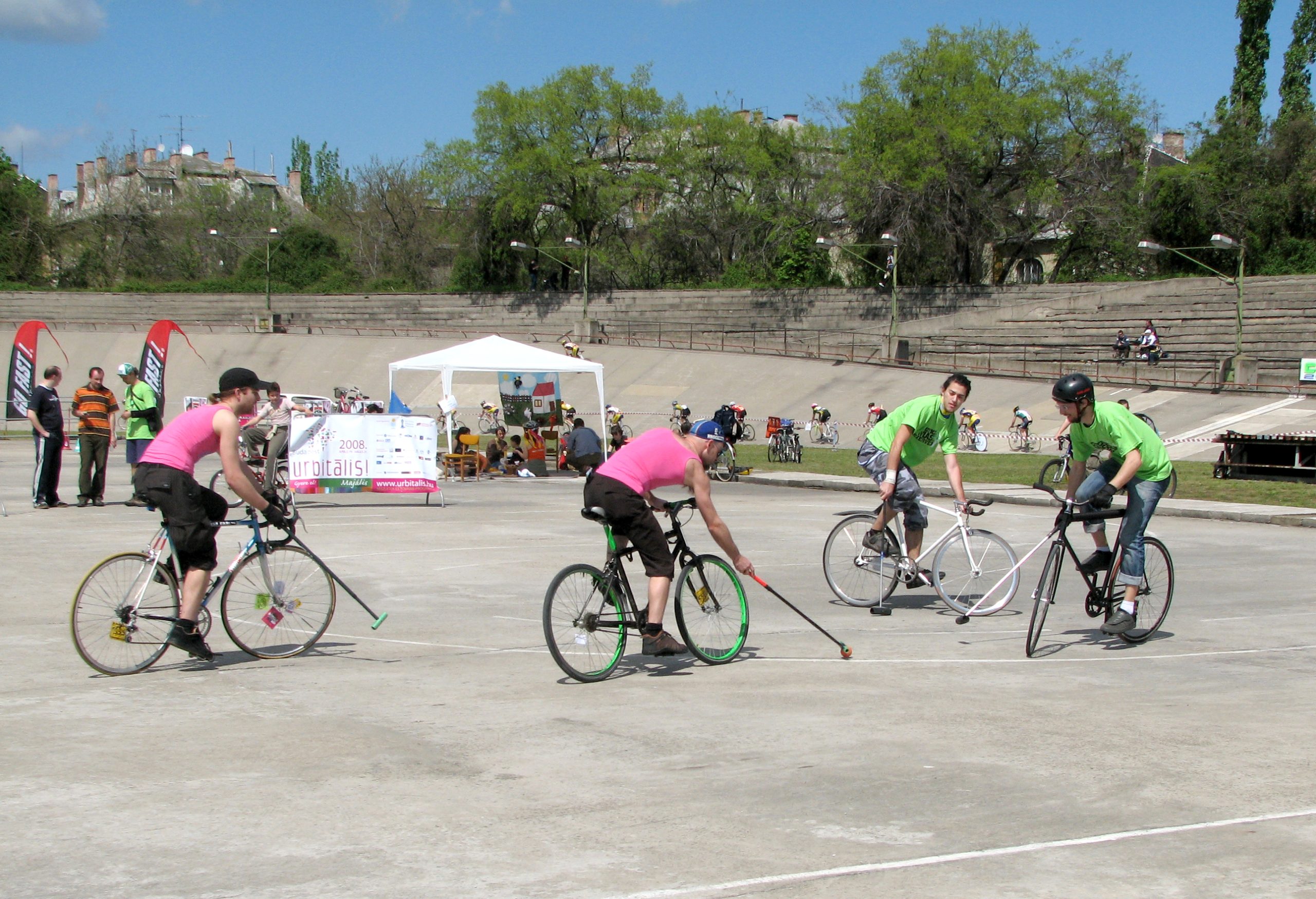
The first Irish guide book for cyclists, Cyclist & Pedestrian Guide to the Neighbourhood of Dublin, by R. J. Mecredy, the editor of Irish Cyclist and Athlete paper, was published in 1890. A cycling enthusiast, he won the 40km English tricycle championship in 1886, and in 1890, on a Humber machine with Dunlop tyres, he won all four English championships. His wife, Catherine, was one of the first Irish women to wear ‘rational dress’, that is, cycling bloomers, when riding bicycles. In 1891 Mecredy invented Bicycle Polo, a sport that before the end of the century had spread to Britain, France and the United States. The first international match was played between England and Ireland at Crystal Palace in London in 1901, with Ireland winning, 10-5. The game was a demonstration sport at the 1908 London Olympics, when Ireland won, beating Germany. It is still played today all over the world, and is officially recognised by the Union Cycliste Internationale.
Read the full article on the original source

