




Global Black Voices: News from around the World
- New state law YIGBY streamlines approvals for religious institutions to build affordable housing, but local governments set locations and affordability requirements.
- Churches, often land rich and cash poor, can lease or sell property for affordable housing, generating revenue and serving community needs.
- Successful partnerships in Arlington, West Palm Beach, Atlanta and Miami show church-led mixed-use developments can provide long-term affordable units.
As Sarasota County policymakers and advocates sit down this fall to hash out bold approaches to the region’s ongoing housing crisis, they’ll have a major new tool on the table – one that could help open hundreds of parcels of land owned by religious institutions.
The tool stems from new legislation signed by Gov. Ron DeSantis that took effect July 1.
Dubbed YIGBY – for “Yes in God’s Back Yard” – it allows churches, synagogues and other religious institutions to develop affordable housing on their properties regardless of zoning, if at least 10% of the units are affordable. To be eligible, parcels must hold houses of public worship on the site or be adjacent to those that do.
The acronym is a play on another, NIMBY, which stands for Not In My Back Yard, a longstanding reference to residents’ opposition to neighborhood development proposals.
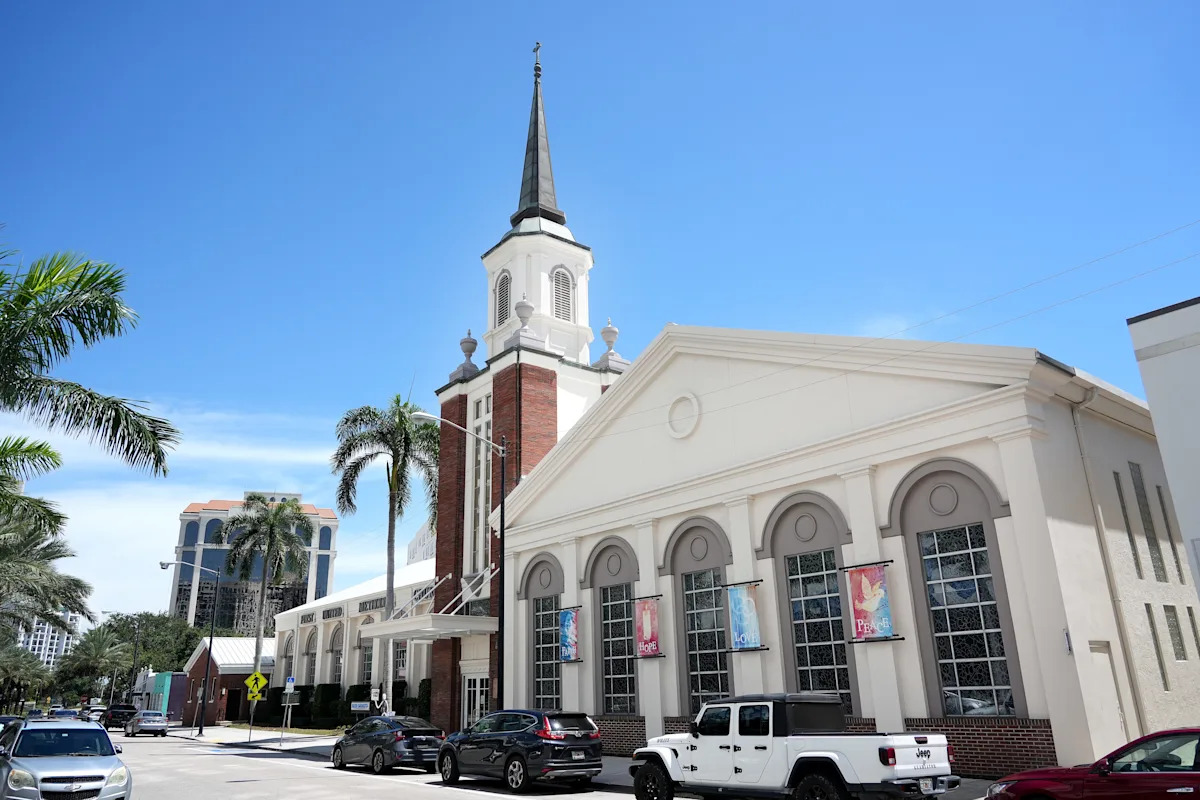
First United Methodist Church of Sarasota, located at 104 S. Pineapple Ave.
An analysis by the Florida Housing Coalition found that roughly 30,000 parcels statewide could qualify under the new law to be opened for affordable housing development. In Sarasota County, it would be more than an estimated 300 parcels, encompassing about 1,500 acres. In Manatee County, the numbers are about 450 parcels spanning 1,300 acres.
Kody Glazer, the Coalition’s chief legal and policy officer, noted that local governments and churches across the state and nation already have been working in partnership on affordable housing.
However, the new law significantly speeds up the process by eliminating the need for officials to go through time-consuming land-use changes before approving church-led projects.
“This just fast-tracks it,” Glazer said.
However, he stressed that local governments are still in the driver’s seat.
“It’s up to the local government to allow it,” he said. Counties and municipalities will determine where to let this happen. What’s more, they can increase the percentage of units required to be affordable.
“Local governments have all the say,” he said.

First United Methodist Church of Sarasota, located at 104 S. Pineapple Ave.
Land rich, cash poor
The impact could be enormous.
In one of its reports, the Florida Housing Coalition used Duval County as an example. Focusing on parcels concentrated around downtown Jacksonville – where high density residential would be appropriate – it estimated that thousands of homes could be constructed on property owned by religious institutions under the new law.
While many of Sarasota County’s religious institution-owned parcels are in rural areas with smaller densities, the potential is also great here.
All sides stand to gain, advocates say.
For instance, while communities nationwide struggle with a deep shortage in workforce and affordable housing, churches and other religious organizations are facing a drop-off in congregation sizes even as they contend with costly maintenance for lands and aging worship centers, halls and other buildings.
Given that churches tend to be “land rich and cash poor,” those that are selling or leasing properties for affordable housing use are discovering a much needed source of revenue.
“I think it’s another win-win,” Glazer said.
A place at the table
Examples of successful partnerships exist from Virginia to Texas, Atlanta, West Palm Beach and Miami.
One Arlington, Virginia, congregation sold property and used the proceeds to build a new church while working with a local nonprofit developer to construct affordable housing, the Coalition noted in its Sarasota study.
Another in West Palm Beach carved out excess land and leased it to developers for affordable housing, keeping rents below 80% Area Median Income for 90 years.
And in a plan involving what members called a “God-size vision,” a church in Atlanta is repurposing its downtown property not only to build 320 units of housing – most of which will be affordable – but also new classrooms for its preschool, a new fellowship hall, gymnasium, administrative offices, parking and retail space.

Rev. Brett DeHart, pastor at First United Methodist Church of Sarasota, located at 104 S. Pineapple Ave.
For the Rev. Brett DeHart, pastor at First United Methodist Church of Sarasota located on Pineapple Avenue, it is an exciting time for churches to join the search for solutions to Sarasota’s dire housing crisis
“The larger picture for us − we want to be part of the conversation and an advocate for solving the challenges that the community faces,” DeHart said. “We feel like our church and hopefully the greater faith community needs to have a place at the table for those conversations and to advocate for the betterment of the community in whatever that might be.”
Already First United Methodist Church has a long history of supporting the community, as a founding church of local organizations such as Meals on Wheels Sarasota, and Resurrection House, a day resource for homeless men and women.
For the past year, DeHart has been attending affordable housing summits and luncheons sponsored by the Greater Sarasota Chamber of Commerce to listen and learn from area business leaders, nonprofits and residents – all impacted by the housing crisis.
His church is, too. Anytime it hires programming staff, new employees who move here encounter severe difficulties finding housing.

The First United Methodist Church of Sarasota, located at 104 S. Pineapple Ave.
The church is committed to remaining in its downtown location, he added. At the same time, it is increasing its internal conversations about how to best use its resources to be most helpful for its own members as well the community at large.
“How can we be the best church for Sarasota? How can we bless Sarasota in the decades to come from this location and be part of this vibrant downtown area?” he said.
For Matt Sauer, collaboration and impact officer at the Charles & Margery Barancik Foundation, partnerships with religious institutions on housing make sense both on a capital investment level as well as a mission level − in service to residents.
“There are a lot of people in need, and churches have traditionally been a place they could get help,” Sauer said. “To me it’s a virtuous circle.”
This article originally appeared on Sarasota Herald-Tribune: ‘Yes in God’s Back Yard’ law: Churches could address housing crunch
Read the full story from the original publication
