


Close Menu
Savannah HeraldSavannah Herald
    • Home
    • News
      • Local
      • State
      • National
      • World
      • HBCUs
    • Events
    • Directories
    • Weather
    • Traffic
    • Jobs
    • Sports
    • Politics
    • Lifestyle
      • Faith
      • Senior Living
      • Health
      • Travel
      • Beauty
      • Fashion
      • Food
      • Art & Literature
    • Business
      • Real Estate
      • Entertainment
      • Investing
      • Education
    • Guides
      • Back to School Savannah
      • Summer Camp Guide
      • Juneteenth Guide
      • Black History Savannah
      • MLK Guide Savannah
    We're Social
    • Twitter
    • Facebook
    • YouTube

    Subscribe to Updates

    Get the latest creative news from FooBar about art, design and business.

    Trending
    • SCAD Donation Provides Creative Resources for SCCPSS Art Classrooms
    • Savannah Steel beat Greensboro Groove for third-straight win
    • How Faith, Community and a Few Bad Games Led These Players to the Savannah Bananas
    • Mary Rivera, ‘Spider-Man: No Way Home’ Grandma, Dead at 82
    • North Carolina A&T homecoming tickets sell out in minutes online
    • Spotlight on Fauci Said to Boost Book Sales for Kennedy and His Publisher
    • DJI launches Mic Mini 2S, but not in the U.S.
    • Will Smith Reveals Parenting Regret
    Facebook X (Twitter) Instagram YouTube
    Login
    Savannah HeraldSavannah Herald
    Savannah HeraldSavannah Herald
    Home » Adults Have Struggled to Set Rules for AI In School. These Teens Figured It Out
    Education

    Adults Have Struggled to Set Rules for AI In School. These Teens Figured It Out

    Savannah HeraldBy Savannah HeraldAugust 2, 20269 Mins Read
    Facebook Twitter Pinterest LinkedIn WhatsApp Reddit Tumblr Email
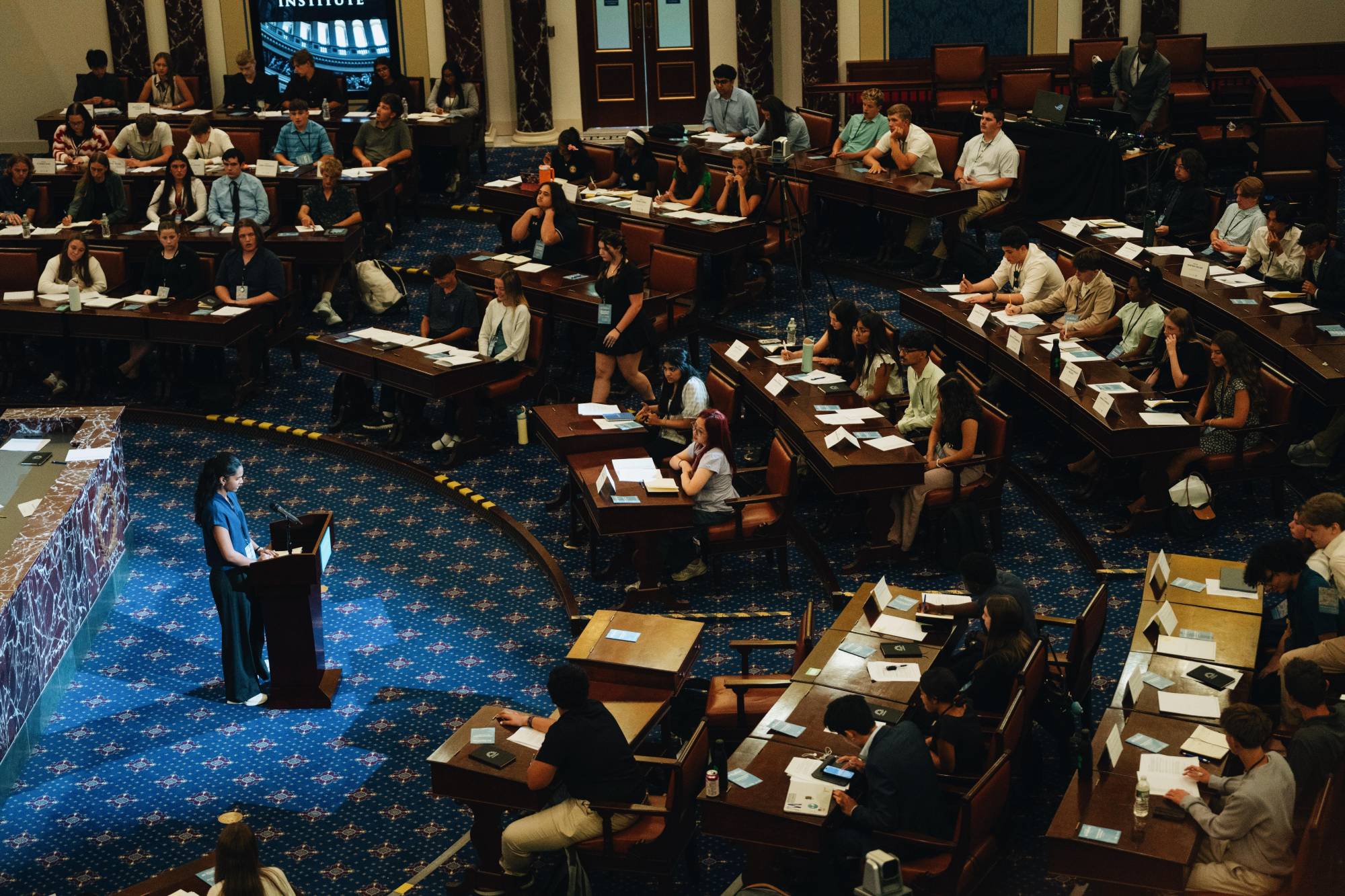
    Student addresses peers in a replica of the U.S. Senate chamber.
    Share
    Facebook Twitter LinkedIn Pinterest Email

    From Campus to Classroom: Stories That Shape Education

    Key takeaways
    • Student-designed Students First Act passed overwhelmingly, centering youth voices and sending policy recommendations to thousands of school leaders.
    • Schools must teach AI literacy as soon as devices arrive, covering misinformation, plagiarism, bias, privacy and environmental impact; students sought federal funding.
    • Student rules limit AI on graded tests, allow editing after eighth grade, and require citation plus oral defenses or handwritten checks to prove mastery.
    • Teachers may use AI for planning and feedback but must post clear policies; flagged work needs teacher investigation and chatbots must alert staff in crises.

    “We missed the mark with social media and phones,” said Hunter Wurzel, a high school senior representing Ohio. “That’s been a huge talking point already [this weekend], is how we failed to implement those things into education and teach the youth how to use them.“

    Wurzel and his 97 colleagues were handpicked by their school leaders and hosted by a handful of education- and tech-focused groups, including the Edward M. Kennedy Institute, AASA (The School Superintendents Association), and Day of AI, a nonprofit launched out of MIT’s RAISE AI literacy initiative.

    At times during the weekend, where NPR was able to watch the events unfold, the bill seemed doomed, only to be revived by a flurry of student-led negotiation, old-fashioned compromises and some spirited speeches.

    “[This bill] is about who gets a seat at the table. Today, students have that seat,” Bena Mejia Romero of Connecticut told her fellow senators before the final vote.

    Ultimately, their Students First Act passed overwhelmingly, 82-16.

    Among the bill’s requirements: States should provide AI literacy as soon as students get access to classroom devices; AI use should be banned on all graded tests; and teachers can require an oral defense of any project from a student suspected of using AI inappropriately. (You can read the full bill at the end of this article.)

    “The adults themselves haven’t been able to come to consensus on this, right? And so now it falls to the kids. Let them lead the way,” said Jeffrey Riley, the executive director of Day of AI and former education commissioner of Massachusetts.

    While the Students First Act isn’t actually law, any more than the teens are actually senators, AASA plans to send the text to its members: 10,000 school leaders across the country, many of whom are right now crafting their own AI rules in the absence of regulation.

    Rules for students

    When students arrived at the start of the weekend, they were presented with a stew of policies that they had suggested in the run-up to the event. Then they were divided into subcommittees — focused on students, educators, administrators and families — to debate the dozens of proposals and create a coherent bill they could all support.

    The student-focused section of the final bill includes 15 provisions, several focused on a concern many of the senators shared: that teens are using AI to do their thinking for them.

    Without guidance and guardrails, “[AI use] is just gonna go unhinged,” said Campbell McHenry, a high school junior from Mississippi. “Everyone’s gonna stop learning and start relying on AI. Instead of using it as a tool, they’re gonna use it as a brain.”

    Student senators representing (from left to right) Colorado, Arkansas, North Carolina, New Mexico and Connecticut meet in their assigned subcommittee to debate the AI bill’s student-focused provisions. (Kieran Kesner for NPR)

    Among the bill’s student-focused proposals:

    • Approved uses: Students should not be allowed to use AI for writing, “though editing, brainstorming and studying” with AI should be allowed after eighth grade.
    • Prove mastery: Students permitted to use AI should have to cite how they used it and demonstrate their grasp of a subject through discussions, handwritten tests or oral defenses.
    • Plagiarism review: Any student suspected of using AI inappropriately should have their work reviewed not just by AI checker software, which can be unreliable, but also two school officials.

    One of the most contentious issues was deciding when students should first be exposed to AI in the classroom: High school? Middle school? Earlier?

    Lucia Herrera, a Missouri high schooler, took issue with an early draft of the bill.

    “There’s nothing that says students need to be proficient before using it,” Herrera told her subcommittee colleagues. “It’s basically saying they can use it whenever. Which I think is a misuse of it.“

    Her subcommittee’s proposed solution: require schools to teach AI literacy as soon as devices are introduced in the classroom, including misinformation, plagiarism, bias in AI design, student privacy, appropriate academic use and AI’s environmental impact.
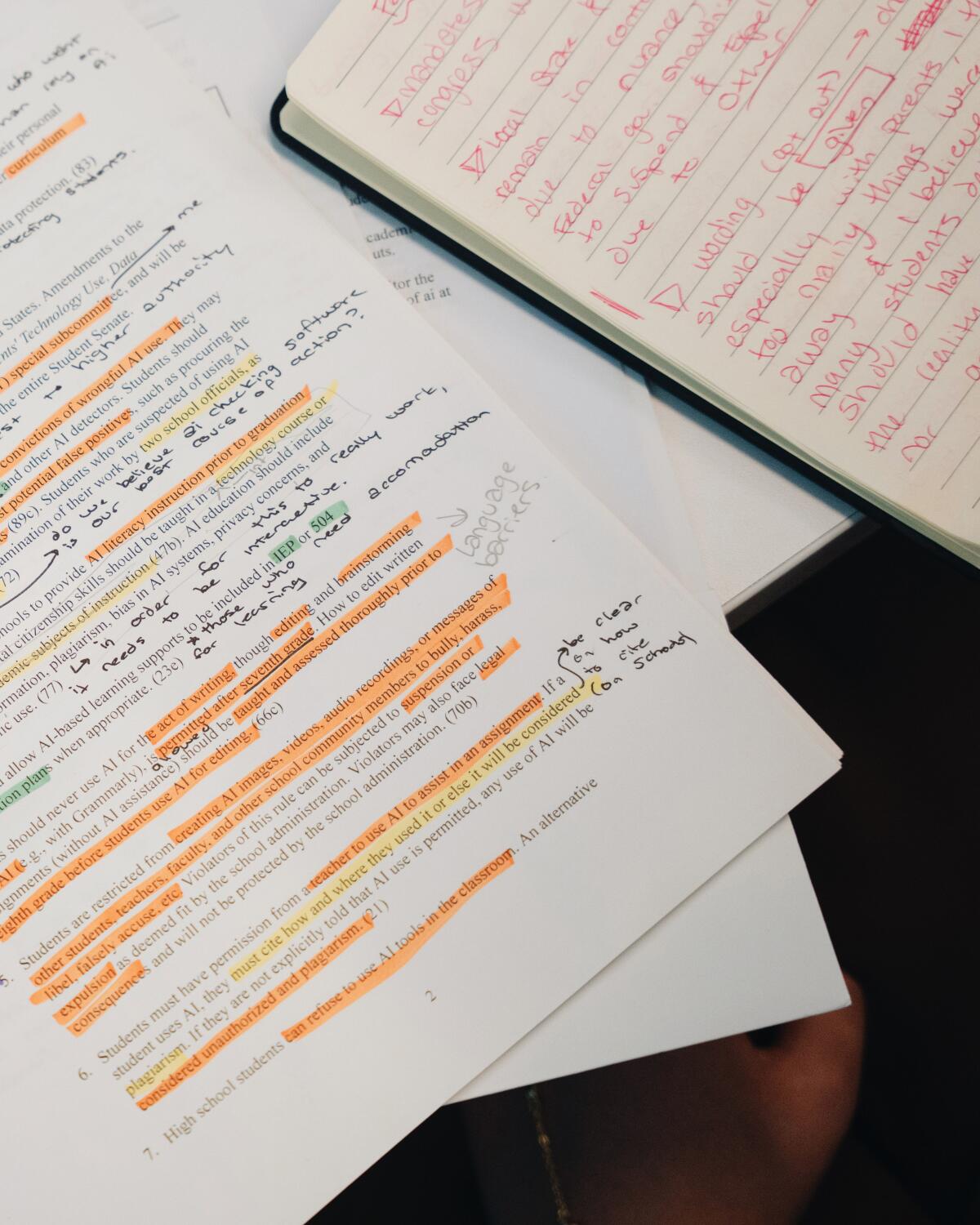
    Sophia Fenn of Washington state took the work seriously, going line by line through the proposals and making detailed notes about what she would like to amend or strike altogether.
    Sophia Fenn of Washington state took the work seriously, going line by line through the proposals and making detailed notes about what she would like to amend or strike altogether. (Kieran Kesner for NPR)

    When the provision came up later that day, before the full Senate, Connecticut’s Bena Mejia Romero told her fellow student lawmakers they should support the new requirement. “If we’re going to be using devices, we should know the dangers and the benefits that they have.”

    But one of the senators from California, Om Lala, argued that requiring schools to begin teaching AI literacy would be a heavy lift. “Teachers already are pretty under-resourced.”

    Tristan Tjetjep of Tennessee added that he worried how “underprivileged schools” would pay for this new instruction.

    Suddenly, the students had run headlong into U.S. schools’ funding inequities — a problem they attempted to resolve with a requirement that the federal government chip in funding.

    Rules for educators, parents and caregivers

    The Students First Act not only covers students’ use of AI but also insists on rules for educators:

    • Approved teacher use of AI: Allowed for tasks including lesson planning, making practice materials, providing feedback and improving instruction.
    • Must have a clear AI policy: Each semester, teachers need to post “a clear, written AI usage policy,” explaining when AI is allowed and when it’s not.

    What’s more, if an AI detector flags potential inappropriate AI use in a student paper, the bill says “teachers must personally investigate the issue before reporting the student to admin.”

    The student senators struggled with the 10 provisions in the bill’s parents/guardians section because, as Isabella Stringer of New Hampshire said on the Senate floor, “We cannot legislate parenthood. Schools cannot tell parents what or how to teach your children.“

    As such, some of the provisions here suggest rather than tell. For instance, one says simply that parents should encourage balanced technology habits and emphasize the importance of ethical academic behavior at home.

    The Edward M. Kennedy Institute for the United States Senate sits on the University of Massachusetts, Boston campus and is home to the world's only full-scale replica of the U.S. Senate chamber.
    The Edward M. Kennedy Institute for the United States Senate sits on the University of Massachusetts, Boston campus and is home to the world’s only full-scale replica of the U.S. Senate chamber. (Kieran Kesner for NPR)

    The early version of the bill also gave parents a full veto over their students’ AI access, but many of the senators argued that AI is here to stay and students must be taught how to use it.

    “Giving [parents] the complete say, especially in middle to high school, in what their child can and can’t do with AI is gonna limit [students] because a lot of [adults] don’t even know what AI is themselves,” said junior Tatiyana Reaves of North Carolina.

    In one of the weekend’s more passionate exchanges, senators debated what should happen if a student attempts to use a school-based AI tool, like a chatbot, “for emotional support.”

    Several teens worried that if a student confided sensitive information about, say, their sexuality or a mental health crisis, they should be able to trust that it would be kept private.

    But Dylan Dornack of Iowa argued on the Senate floor that, for students in crisis or experiencing suicidal thoughts, the technology must alert a human.

    “This could be lifesaving,” Dornack told his colleagues, “whether or not that student is fearful that they might get outed. This is just one of those things that has to be taken to trusted adults.”
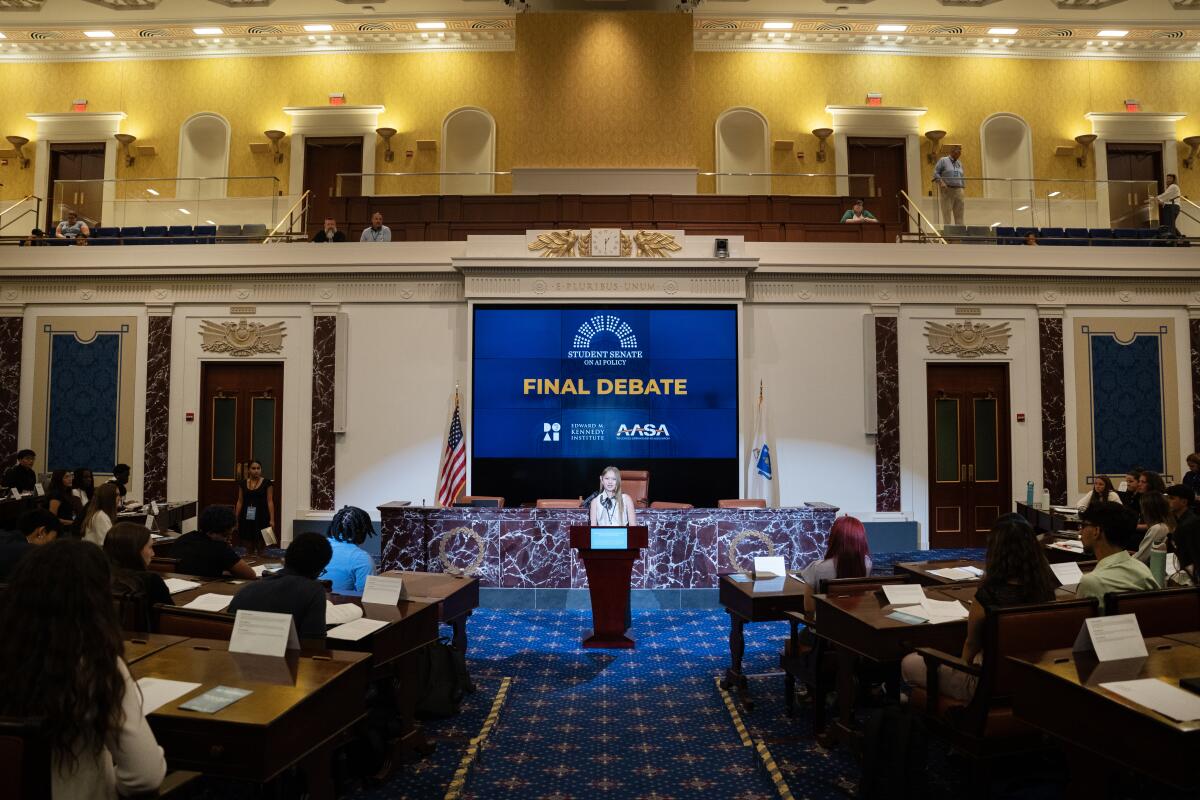
    Wehiwaalani Gapero of Hawaii was one of dozens of students who chose to address their colleagues for a minute each before the final votes of the weekend were cast.
    Wehiwaalani Gapero of Hawaii was one of dozens of students who chose to address their colleagues for a minute each before the final votes of the weekend were cast. (Kieran Kesner for NPR)

    Ultimately, the students agreed: When a school chatbot detects a student in need of emotional support, it should not fulfill the student’s request but instead alert school officials.

    The rush to passage

    At the end of the whirlwind weekend, the student senators gathered in the replica chamber and more than half volunteered to address their colleagues for one minute each.

    Dornack was the first to speak and called the bill an important, if imperfect, foundation for schools’ AI policies. “You have to lay the blocks before you can have the building. So here I say, let’s lay the blocks and let’s pass this.”

    In the final minutes before a key vote, student senators from (left to right) Minnesota and Washington state confer with their colleague.
    In the final minutes before a key vote, student senators from (left to right) Minnesota and Washington state confer with their colleague. (Kieran Kesner for NPR)

    But Jadelynn Petitjean of Alabama called the bill an “unstable foundation” and opposed it.

    Earlier in the day, West Virginia’s Ethan Liu had also opposed it, highlighting several contradictions in the bill, including amendments that both restricted students’ AI access while appearing to give teachers wide discretion over when and how AI is used.

    “I thought it reflected really badly on us. I had a whole different speech planned out against this bill, actually. It was really good,” Liu told the Senate chamber before the final vote.

    But at the last minute, the event’s organizers allowed the students to iron out a few of the bill’s inconsistencies, and, as a result, Liu changed his vote, saying “this bill is in much better shape.”

    Student after student walked to the microphone at the front of the chamber, and most endorsed the bill, including Kendall Terao-Toma of Hawaii:

    “This is for our future — not just for education but for the workforce we will join, the economy that we will build and the communities we will lead.”

    Edited by: Nirvi Shah and Nicole Cohen; audio story produced by: Lauren Migaki
    Visual design and development by: LA Johnson

    Read the full text of the Students First Act:

    Read the full article on the original site


    Related Posts

    • Federal Reserve Plans to Reduce 10% of Its Employees
    • NCS students earn Regional Honors and State Recognition at Georgia Student Technology Competition
    • The Best 2025 Amazon Prime Day Beauty Deals for Every Budget
    • Chad Powers reunites HBCU athletes-turned-actors
    • Screens are Leaving Schools Fast, Though Some Students with Disabilities Rely on Them
    • Ken Griffey Jr.’s signature sneaker gets HBCU makeover
    • Valio innovation VP talks protein, GLP-1 and AI
    • Zacchaeus: A Lesson on Urgent Salvation from Jesus
    Academic Achievement Black Colleges Black Educators Black Excellence in Education College Readiness Education Equity Education Headlines Education in the South Education Policy Georgia Education Georgia Public Schools Georgia School News HBCU Education HBCU graduates HBCU News Higher Education News Historically Black Colleges K-12 Education News Local School News Student Success Stories
    Share. Facebook Twitter Pinterest LinkedIn WhatsApp Reddit Tumblr Email
    Savannah Herald
    • Website

    Related Posts

    Education August 4, 2026

    Will Smith Reveals Parenting Regret

    Education August 1, 2026

    Economic Development Around the State

    Education July 30, 2026

    Georgia Trend Daily – July 30, 2026

    HBCUs July 30, 2026

    HBCU News – Horizons Atlanta at Clark Atlanta University: Transforming Summer Learning, One Scholar at a Time

    Local July 30, 2026

    Schedule Now for Free Mammograms at Chatham County Health Department August 24

    Education July 29, 2026

    HBCU News – Collaboration and Partnerships Become Crucial to HBCUs

    Comments are closed.

    Don't Miss
    Real Estate June 30, 2026By Savannah Herald04 Mins Read

    The Median Age of Homeowners Surges as Younger Americans Are Sidelined

    June 30, 2026

    Real Estate News & Market Insights: While the U.S. homeownership rate has hardly budged in…

    Andela CEO talks about the need for ‘borderless talent’ amid work visa limitations – Computerworld

    June 30, 2026

    City of Savannah, Partners to Hold Full-Scale Emergency Exercise

    August 28, 2025

    I don’t know what God is. But the search keeps me grounded and feeling alive | Karen Rinaldi

    March 29, 2026

    Will Republicans in the House of Representatives be All-White After the Midterms?

    June 6, 2026
    Archives
    • August 2026
    • July 2026
    • June 2026
    • May 2026
    • April 2026
    • March 2026
    • February 2026
    • January 2026
    • December 2025
    • November 2025
    • October 2025
    • September 2025
    • August 2025
    • July 2025
    • June 2025
    • May 2025
    • April 2025
    • March 2025
    • February 2025
    Categories
    • Art & Literature
    • Beauty
    • Black History
    • Business
    • Climate
    • Culture
    • Education
    • Employment
    • Entertainment
    • Faith
    • Fashion
    • Food
    • Gaming
    • Georgia Politics
    • HBCUs
    • Health
    • Health Inspections
    • Investing
    • Lifestyle
    • Local
    • Lowcountry News
    • National
    • National Opinion
    • News
    • Politics
    • Real Estate
    • Senior Living
    • Sports
    • State
    • Tech
    • Traffic
    • Transportation
    • Travel
    • World
    Savannah Herald Newsletter

    Subscribe to Updates

    A round up interesting pic’s, post and articles in the C-Port and around the world.

    About Us
    About Us

    The Savannah Herald is your trusted source for the pulse of Coastal Georgia and the Low County of South Carolina. We're committed to delivering timely news that resonates with the African American community.

    From local politics to business developments, we're here to keep you informed and engaged. Our mission is to amplify the voices and stories that matter, shining a light on our collective experiences and achievements.
    We cover:
    🏛️ Politics
    💼 Business
    🎭 Entertainment
    🏀 Sports
    🩺 Health
    💻 Technology
    Savannah Herald: Savannah's Black Voice 💪🏾

    Our Picks

    a review of Water & Wave by Eugene Datta – Compulsive Reader

    February 4, 2026

    Mobile Mammography Unit Available at Chatham County Health Department March 31

    February 20, 2026

    U.S. Is Trimming Back Its Collection of Consumer Price Data

    August 28, 2025

    Horror Is Hollywood’s New ‘It Girl’—And She’s Here To Slay!, News In Progress

    June 28, 2026

    7,000 steps a day could be enough to improve health, say researchers | Medical research

    September 3, 2025
    Categories
    • Art & Literature
    • Beauty
    • Black History
    • Business
    • Climate
    • Culture
    • Education
    • Employment
    • Entertainment
    • Faith
    • Fashion
    • Food
    • Gaming
    • Georgia Politics
    • HBCUs
    • Health
    • Health Inspections
    • Investing
    • Lifestyle
    • Local
    • Lowcountry News
    • National
    • National Opinion
    • News
    • Politics
    • Real Estate
    • Senior Living
    • Sports
    • State
    • Tech
    • Traffic
    • Transportation
    • Travel
    • World
    Copyright © 2002-2026 Savannahherald.com All Rights Reserved. A Veteran-Owned Business

    Type above and press Enter to search. Press Esc to cancel.

    Manage Consent
    To provide the best experiences, we use technologies like cookies to store and/or access device information. Consenting to these technologies will allow us to process data such as browsing behavior or unique IDs on this site. Not consenting or withdrawing consent, may adversely affect certain features and functions.
    Functional Always active
    The technical storage or access is strictly necessary for the legitimate purpose of enabling the use of a specific service explicitly requested by the subscriber or user, or for the sole purpose of carrying out the transmission of a communication over an electronic communications network.
    Preferences
    The technical storage or access is necessary for the legitimate purpose of storing preferences that are not requested by the subscriber or user.
    Statistics
    The technical storage or access that is used exclusively for statistical purposes. The technical storage or access that is used exclusively for anonymous statistical purposes. Without a subpoena, voluntary compliance on the part of your Internet Service Provider, or additional records from a third party, information stored or retrieved for this purpose alone cannot usually be used to identify you.
    Marketing
    The technical storage or access is required to create user profiles to send advertising, or to track the user on a website or across several websites for similar marketing purposes.
    • Manage options
    • Manage services
    • Manage {vendor_count} vendors
    • Read more about these purposes
    View preferences
    • {title}
    • {title}
    • {title}
    Ad Blocker Enabled!
    Ad Blocker Enabled!
    Our website is made possible by displaying online advertisements to our visitors. Please support us by disabling your Ad Blocker.

    Sign In or Register

    Welcome Back!

    Login below or Register Now.

    Lost password?

    Register Now!

    Already registered? Login.

    A password will be e-mailed to you.