




From Hollywood to Home: Black Voices in Entertainment
- Sunny Sandler dazzles; believable, self-conscious Sophie carries the film's emotional core.
- Melanie Lynskey anchors the family, lifting a potentially sappy cancer mom tale into a quietly transcendent contemplation of motherhood.
- Don't Say Good Luck offers a refreshing, aspirational tone, resisting teenage dysfunction and portraying loving family resilience rooted in Laura Hankin's real-life experience.
The importance of parental support goes meta in Julia Hart’s “Don’t Say Good Luck.” The YA musical drama, which premieres Friday, pays homage to musical theater, unconditional maternal love and the family-hour TV, er, Netflix movie. In a landscape littered with teenage dysfunction, “Don’t Say Good Luck” is a moving argument for aspirational television.
And with a star whose famous father serves as producer, it‘s an admonition to the term “nepo baby.”
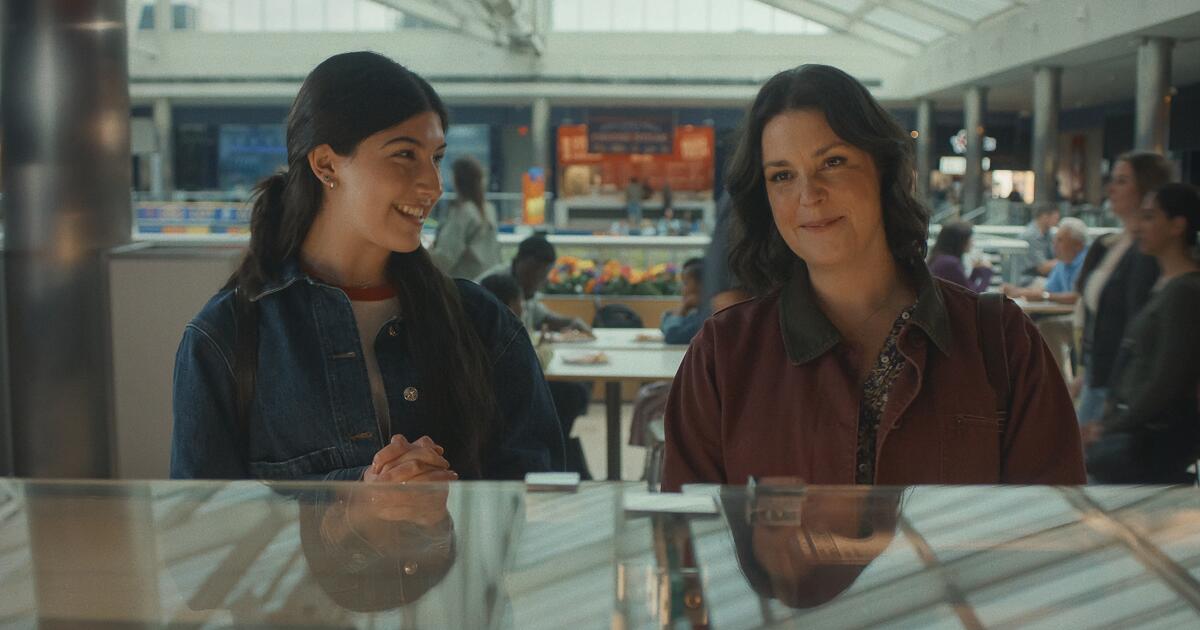
We meet normal kid Sophie Birenbaum (Sunny Sandler) as she anxiously prepares for a day that will include auditioning for her high school’s production of “Waitress.” While her father, Ted (Max Greenfield, marvelously transformed by a beard), wrangles her rambunctious younger twin brothers, her mother, Elizabeth (Melanie Lynskey), assures her that she is talented and beautiful and will do just great. These sentiments are echoed by Sophie’s best friend, Carolyn (Scarlett Estevez), who joins her at the audition where the director is the super-cool Ms. Parker (“Brooklyn Nine-Nine’s” Stephanie Beatriz) and even theater department queen bee Mallory (Elyse Bell), who everyone knows is going to get the lead, is pretty nice.
It’s a high school experience that’s about as far from “Euphoria” or even “Glee” as one can get while still being situated on Earth. Still, all is not perfect in Sophie’s world. When Elizabeth learns that her cancer has returned, Sophie overhears her parents’ subsequent conversation via a butt-dial from her father’s phone. Her first impulse is to flee the audition; instead her emotional turmoil fuels a powerful performance that (spoiler alert?) lands her the lead role.
Determined to downplay the seriousness of her illness, Elizabeth insists that life continue on as normal — she and Ted own a local deli, which offers some nice bagel versus wrap shade and a Jon Lovitz cameo. Though Sophie is worried, she believes her mother who says she will beat cancer again. So she throws herself into the stomach-churning rigor of being the star of the show, which includes a painful separation from her bestie, a crush on her co-star and a struggle to find the confidence to let her obvious talent shine.
“Don’t Say Good Luck” is, obviously, a showcase for Sandler, whose parents, Adam and Jackie Sandler, serve as producers (which may have had something to do with the extraordinary supporting cast, which also includes Bebe Neuwirth and Steve Buscemi as Elizabeth’s parents). Adam Sandler and his Happy Madison Productions have a long and lucrative partnership with Netflix, which recently debuted “Happy Gilmore 2” and announced “Grown Ups 3” as part of their deal. One could see this as yet another case of nepo-baby triumph — streaming is currently littered with the progeny of famous parents — or simply a living example of the film’s theme. Like the Birenbaum parents, the Sandlers want to help their daughter shine in her chosen career and that she certainly does.
Adam Sandler serves as a producer, which may have had something to do with the extraordinary supporting cast, which also includes Steve Buscemi as Sophie’s grandfather.
(Netflix)
Though Sophie is the only older daughter ever to escape the task of caring for her younger brothers (or doing any chores at all), Sandler makes her completely believable as a nice, self-conscious kid who just needs a push to trust her talent. If the tone of the film is 1970s-family-comedy aspirational (particularly in the mother-daughter scenes), that shouldn’t be construed as a low level of difficulty.
Indeed, it is almost revolutionary to see emotionally resonant teenage characters who aren’t mired in abuse, addiction or some kind of horror; leveraging dysfunction has become shorthand for “drama.” “Don’t Say Good Luck” is based on the real-life experience of co-writer Laura Hankin (collaborating here with Hart and Jordan Horowitz), and though the stakes are emotionally high, portraying a loving family doing their best to get through a devastating situation with minimal meltdowns is its own act of bravery.
It certainly helps that this family is firmly anchored by Lynskey, who proves, yet again, that she can do anything. Her Elizabeth is neither martyr nor saint, just a woman who wants to live as she’s always lived for as long as she can. Lynskey lifts what could have been a sappy (or even worse, guilt-inducing) cancer-mom tale into a quietly transcendent contemplation of motherhood. (A scene in which she flips through the calendar trying to figure out when to let the kids know what’s really going on drove the breath from this mother’s body.)
Does “Don’t Say Good Luck” skirt around the grim realities of cancer as cavalierly as it paints a Pinterest mood-board vision of high school? Absolutely. But that doesn’t mean the message and the feelings (yes, you absolutely will cry) are not just as authentic. Love is the root of much pain, but it’s also what conquers it in the end.

Melanie Lynskey as Elizabeth, Max Greenfield as Ted and Jon Lovitz as Lenny in “Don’t Say Good Luck.”
(Netflix)
Read the full article on the original site
