




Business Insights: Global Markets, Strategy & Economic Trends
- Driver used Tesla automated driver-assistance; Model 3 left the road at high speed and struck a home.
- Victim Martha Avila, 76, was airlifted to a hospital and later pronounced dead.
- National Highway Traffic Safety Administration said such "special crash investigations" examine accidents under unusual circumstances.
- Autopilot and Full Self-Driving have been implicated in multiple accidents; a 2023 recall affected more than two million vehicles.
- Tesla settled in 2024 over the 2018 death of Wei Lun Huang; owners' manuals warn keeping hands on the wheel.
The main federal auto safety agency said on Monday that it was investigating a Tesla crash that killed a woman in Katy, Texas, near Houston, on Friday night.
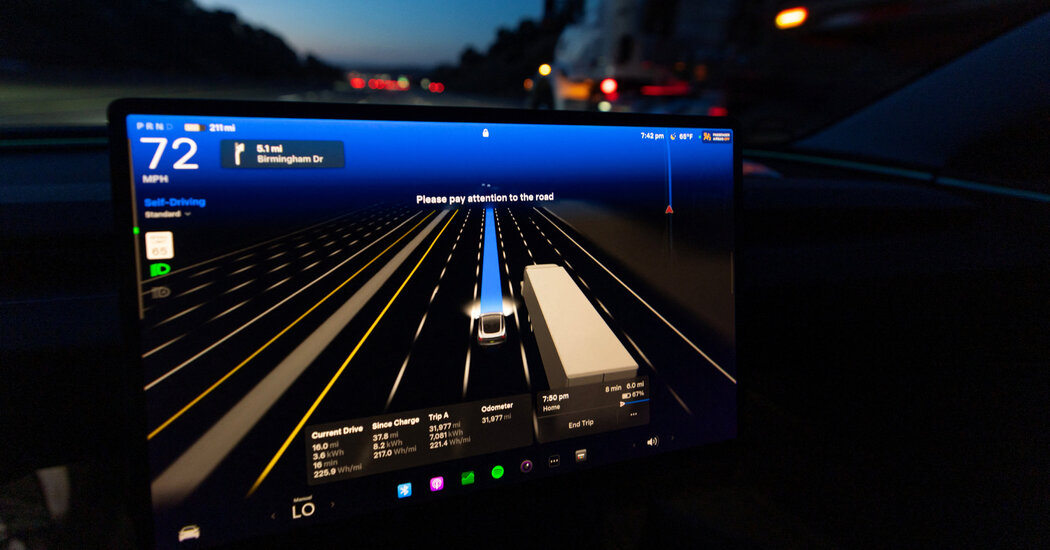
The driver was using Tesla’s automated driver-assistance system when his Model 3 left the road “at a high rate of speed” and struck a home, local officials said. A woman in the home, Martha Avila, 76, was taken by a medical helicopter to a hospital, where she was pronounced dead, the Harris County Sheriff’s Office said in a statement on Saturday. The driver did not show signs of intoxication, the office said.
A spokesman for the National Highway Traffic Safety Administration, the division of the Department of Transportation that opened the federal investigation, said he could not provide details. According to the agency’s website, such “special crash investigations” are intended to examine accidents that happen under unusual circumstances.
No charges had been brought against the driver as of Monday afternoon, the Sheriff’s Office said. “Once all evidence has been gathered, it will be presented to the Harris County district attorney’s office to determine whether charges are appropriate,” a representative for the office said in an email.
Ms. Avila’s daughter, Jennifer Barbour, told KHOU, a Houston television station, that she did not know where to place blame. “I don’t know if it’s his fault or the car’s fault or what really happened,” she said, adding, “I’ve never seen a car go that fast.”
Tesla did not immediately respond to a request for comment.
The company’s driver-assistance systems — Autopilot and Full Self-Driving — have been implicated in a number of accidents, some of them fatal.
In 2023, Tesla recalled more than two million vehicles after federal regulators said the company had not done enough to ensure that drivers remained attentive when using Autopilot, a system that can steer, accelerate and brake cars automatically.
Tesla owners’ manuals tell drivers that they should keep their hands on the wheel and take over if anything goes wrong while using Autopilot or Full Self-Driving. But lawsuits and police reports have documented cases in which drivers became distracted and failed to intervene before an accident.
In 2024, Tesla settled a lawsuit that blamed the automaker’s driver-assistance software for the death of a California man in 2018. The man, Wei Lun Huang, died after his Tesla Model X veered from a highway in Mountain View, Calif., and smashed into a concrete median barrier. Mr. Huang’s family brought a lawsuit that blamed defects in Autopilot for the crash.
Read the full article from the original source
