




Faith & Reflection: Voices from the Black Church and Beyond
- Discovery of a 75-page manifesto 'The New Crusade: Sons of Tarrant', praising Brenton Tarrant and white supremacist violence.
- Manifesto and linked social accounts idolized school shooters, neo-Nazism, and hatred toward Muslims, Jews, Black people, Latinos, LGBTQ+.
- Attack targeted worshippers during Dhul Hijjah, affecting children in mosque school and preschool.
- Elected officials and activists escalated anti-Muslim rhetoric, including Randy Fine, Tommy Tuberville, Greg Abbott, and Laura Loomer.
- Dehumanizing rhetoric normalizes violence, the Institute of Social Policy and Understanding found the Islamophobia Index rose 2022-2025, linking stereotypes to policy tolerance.
(RNS) — That the teenage gunmen in the shooting deaths of three Muslim Americans at the Islamic Center of San Diego shared white supremacy ties and anti-Muslim hate is no surprise to Muslims across the United States. It was the first thing that came to my mind as I looked for more information and worked sources to corroborate the obvious.
And it didn’t take long.
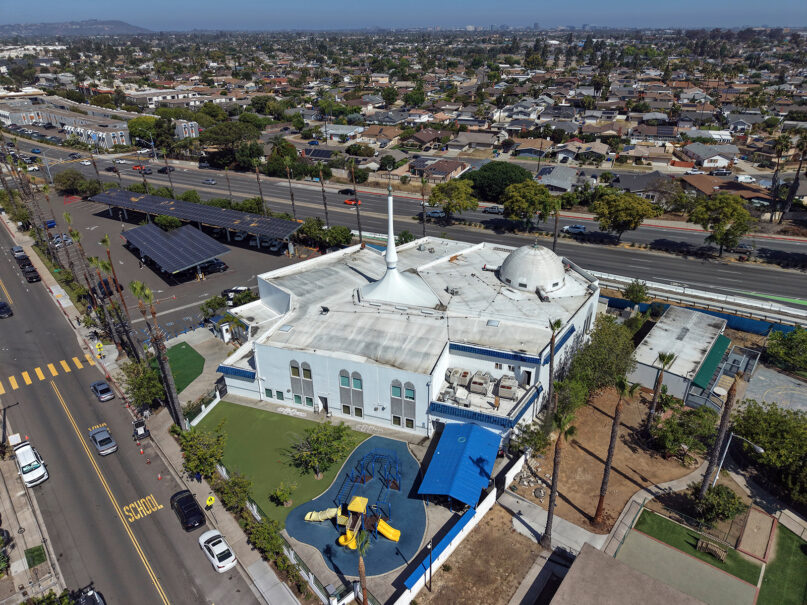
First came San Diego Police Chief Scott Wahl’s press conference hours after the murders of security guard Amin Abdullah, mosque shopkeeper and caretaker Mansour Kaziha and Nadir Awad, a neighbor of the mosque whose wife was a kindergarten teacher there. Wahl said that because the killings occurred at a house of worship, San Diego police were treating the case as a hate crime until more information on motive could be found.
Within 72 hours, motive became more clear with the discovery of a 75-page manifesto titled “The New Crusade: Sons of Tarrant,” filled with Islamophobic and anti-Muslim rhetoric, antisemitic statements and the promotion of hate and violence, as law enforcement shared with the Los Angeles Times. Tarrant refers to Brenton Tarrant, who murdered 51 Muslim worshippers and injured 89 at two mosques in Christchurch, New Zealand, in March 2019.
In a review of the manifesto along with social media accounts believed to be used by one of the shooters, the Times found hatred toward not only Muslims but also Jews, Black people, Latinos and the LGBTQ+ community, as well as praise and idolization for school shootings, neo-Nazism, far-right extremism and the white nationalist movement.
But the targeted community was Muslims at an Islamic center, which included dozens of children in school and preschool. It happened on the first day of the Islamic month of Dhul Hijjah, a period considered to be among the holiest days for Muslims around the world and those in preparation for the Hajj pilgrimage. And that is also no surprise to many Muslim Americans.
Attendees react during a vigil the day after a shooting, outside of the Islamic Center of San Diego, May 19, 2026, in San Diego. (AP Photo/Jae C. Hong)
Consider the recent hate-filled social media posts from elected officials such as Republicans Rep. Randy Fine of Florida and Sen. Tommy Tuberville of Alabama. Or Texas Gov. Greg Abbott’s relentless attacks on Muslim communities and his campaign to have the Council on American-Islamic Relations be declared a terrorist organization.
Then there is the far-right political activist (and adviser to President Donald J. Trump) Laura Loomer, who said that the answer to shootings at mosques is to deport all Muslims. All this following a contentious recent hearing of a House Judiciary subcommittee titled “Shariah-Free America: Why Political Islam and Shariah Law are Incompatible with the U.S. Constitution.”
With all this, headlines like this one from Time magazine — “San Diego mosque attack highlights growing anti-Muslim threats nationwide” — feel like an insult.
As NBC News and MS Now commentator and journalist Ayman Mohyeldin said in an Instagram post: “What did we think was going to happen? … Let’s stop pretending here that rhetoric doesn’t matter. This is what dehumanization [of Muslims] does. It creates a permission structure where hate is learned and fear is taught. And the end result is a culture in America where Muslims are seen as less worthy. Less worthy of empathy, of innocence, less worthy of being American.”
But it goes beyond being seen as less worthy. Islamophobia rose sharply from 2022 to 2025, according to the Institute of Social Policy and Understanding’s Islamophobia Index, which has tracked anti-Muslim rhetoric since 2016 when Trump was first elected. The index has measured public endorsements of “five false, negative stereotypes associated with Muslims in America.” The research links the stereotypes with greater tolerance for anti-Muslim policies.
The problem is not just the persistent and consistent dehumanization of Muslims in the United States, but the parameters placed upon them to prove their worth and Americanness and defend their right to exist and worship not just on an everyday basis, but more painstakingly so when they and their communities are subjected to violence and hate.
Take the example of the execution-style killing of three college students — Deah Shaddy Barakat, 23; his wife, Yusor Mohammed Abu-Salha, 21; and her sister Razan Mohammad Abu-Salha, 19 — by their neighbor Craig Stephen Hicks in their Chapel Hill, North Carolina, condominium in February 2015. Chapel Hill police stated through their preliminary investigation that the motive for the shootings was a parking dispute with no connection to the victims’ religion.
The victims’ families argued for months that the murders constituted a hate crime, that Hicks targeted the students because of their faith and visibly Muslim appearances. Hicks’ social media history was rife with anti-religious posts against Muslims and many other faiths. In interview after interview, to the detriment of their own mental health and amplification of their grief, the families sought to highlight their loved one’s lives to humanize them.
I spoke with Nancy Khalil, an assistant professor of Arab and Muslim American studies at the University of Michigan and co-chair of the Islamophobia Working Group. She said the pipeline from Islamophobia to hate, bigotry, discrimination and ultimately tragic violence is inevitable given the explosive rhetoric being peddled. And Muslims who lose their loved ones to violence become victims of “a soft violence of dehumanization.”
“They’re not allowed to just deal with the grief of such a horrible tragedy in their lives,” Khalil said. “Instead, they’re denied that, and they have to face the public and give press conferences in just the right tone and using just the right words so they can convince the world they did not deserve for their loved ones to be killed. That they are just like everyone else, and they hurt too, and they too want to live in peace.”
In 2019 after the Christchurch mass shooting, I spent a week painstakingly reporting on each of the 51 victims, putting together a story that shared details about each one. Each Muslim who lost their life that day was a human and not a caricature of some evil Muslim trope. Seven years later, three Muslim men in San Diego lost their lives — and in doing so saved the lives of about 140 children — at the hands of two teenage gunmen who seemingly wanted to continue the work of the Christchurch killer.
Tributes are pouring out for Abdullah, Kaziha and Awad. This country should know who these amazing men were and the gaping hole of grief that their murders have left behind. One could argue that the trauma endured by the Barakat and Abu-Salha families 11 years ago in pressing for their loved ones’ murders to be considered hate crimes was a large part of the painful groundwork borne by Muslim and other faith communities that led to the San Diego police treating the shootings as a hate crime at the beginning of their investigation.
But at what cost? On this day of Arafat, which is considered to be the heart of the Hajj and the holiest of days, when Muslims around the world engage in deep worship and prayer, so many Muslim Americans are left wondering what the next act of violence against them will be. And will anybody care?
(Dilshad D. Ali is a freelance journalist. The views expressed in this commentary do not necessarily reflect those of RNS.)
Read the full article on the original source
