




Faith & Reflection: Voices from the Black Church and Beyond
- Young conservatives radicalized and mobilized at events like Turning Point USA, finding belonging and political purpose.
- Alyssa's online harassment and social ostracism in hometowns pushed students toward conservative campuses such as Liberty University.
- Liberty University serves as a training ground, cultivating female leaders via Young Women for America chapters and internships.
- Organizations like Concerned Women for America and leaders such as Penny Nance mentor young activists into national political roles.
- The conservative youth pipeline is vast and heavily female, reshaping conservatism by fusing traditional womanhood with political power.
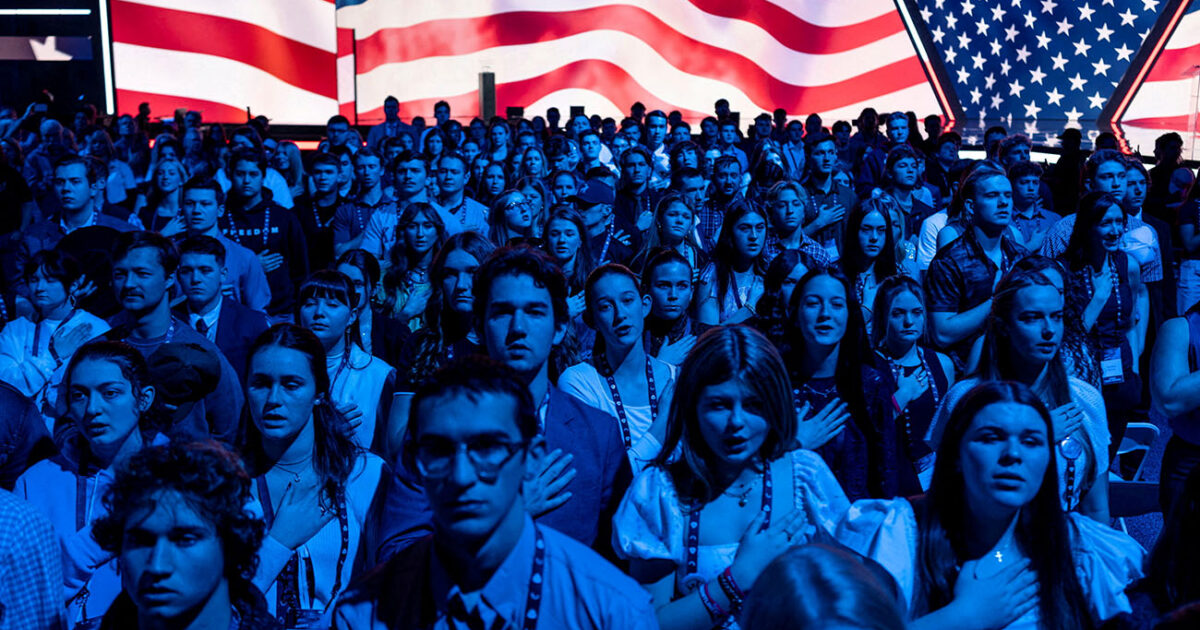
(College Students gather at a Turning Point USA summit. Image source: First Amendment Watch/Reuters/Chenney Orr)
The following excerpt comes from Katie Gaddini’s Esther’s Army: The Christian Women Who Power the American Right (W.W. Norton & Company, 2026). The book explores how conservative Christian women, from college students on university campuses to mothers in the suburbs, empower right-wing politics throughout the United States.
This excerpt comes from the book’s first chapter, “The Liberty Flames and Regent Royals.”
***
On December 19, 2019, a seventeen-year-old girl named Alyssa stood among a packed audience of young people at Turning Point USA’s student action summit in West Palm Beach. She watched as Donald Trump’s personal attorney, Rudy Giuliani, delivered what would become, for her, a life-altering speech. She had flown across the country from Seattle with her sister and two friends to join nearly four thousand conservative high school and college students. Until recently, Alyssa had felt isolated in her convictions. She, like the other young people filling the convention center, had come to Florida hoping to find others who shared their sense that America was slipping away from them, and into the hands of the so-called radical left.
Giuliani paced the stage as he delivered his impassioned remarks. Twenty-four hours earlier, the House of Representatives had impeached the President on charges of abuse of power and obstruction of Congress.
“This impeachment is a coup,” Giuliani cried. “It’s about taking our constitution and tearing it up!” The crowd roared in response. Alyssa leaned forward in her seat. Even though she had been defending conservative positions since childhood, something about this moment felt different. This wasn’t merely about what she called “cultural issues” anymore. This was about the truth.
The experience that would really cement this belief came eight months after the Turning Point conference. This was late summer 2020 and Seattle had been rocked by months of protests following George Floyd’s murder in Minneapolis. Against that backdrop, Alyssa and her sister took a day trip outside the city. Along the way they spotted a Trump sign, unusual for that part of Washington, and Alyssa pulled the car over for a photo op. While they drove away, Alyssa uploaded the photos to her Instagram page, unaware that she was about to discover just how polarized her city had become.
The next morning, Alyssa found her Instagram inbox overflowing with messages. Several students from her high school had screenshotted her picture and posted it to their stories, where it quickly spread. Alyssa watched as the messages rolled in, the jarring juxtaposition of furious, hateful words alongside images of other smiling, fresh-faced high school students.
“That woke me up,” Alyssa told me, just a few days after Trump won the 2024 election. After reading out the messages, she placed her phone face down on the high table around which we crowded at a coffee shop in Lynchburg, Virginia. Alyssa is petite, with green eyes, bright and lively. She is equally comfortable dissecting US politics and unpacking the latest trends in fashion and pop culture. At Liberty, she’s majoring in political communication.
When the school year started a few weeks later, Alyssa realized she had become a pariah. Students avoided her, and her best friends stopped speaking to her. She continued to receive vicious messages on social media, mounting into the hundreds. Once, while waiting for the bus after volleyball practice, a group of girls ran toward her shouting, “There’s Alyssa, the Trump supporter!” They chased her until she got away and called her mom to pick her up. Then, a classmate made a TikTok video mocking her, which amassed thousands of views. Another student threatened to burn down her house, at which point her parents called the police. When Alyssa reflects on this time, she admits it was hard. She didn’t have any friends at school, and everyone in her family faced criticism for that one social media post.
“But at the same time, I felt a burning passion within me for the truth. I knew the truth and I knew God was listening to me,” Alyssa said resolutely.
These experiences strengthened Alyssa’s commitment to conservative politics, which led her all the way to Liberty, the famous conservative evangelical university where she is a senior, and where she will receive fortification and training to advance in the conservative movement. It is a key stop on a journey she started years ago. And at Liberty, for the very first time, Alyssa is no longer alone in her beliefs.
***
Founded in 1971 by Jerry Falwell Sr., architect of the Christian Right, Liberty is a shiny behemoth of a college that resides on a hilltop overlooking the city of Lynchburg. It boasts a total enrollment of over 140,000 students, making it the country’s largest conservative Christian university. More than 55 percent of these students are women, in line with the national average.
But it wasn’t always this way. Liberty is a training ground for right-wing leaders. Historically, this has meant right-wing men, since politics was formerly men’s domain, especially in evangelical circles. But four waves of feminism have also washed into conservative Christianity, and as a result, more women than men now attend this incubator for conservative leaders.
At Liberty, Alyssa met other women who felt canceled for supporting Trump and conservative issues while in high school. She introduced me to Adaline, from New Hampshire, who traced her political awakening to the isolation of the pandemic and watching Tucker Carlson with her family every night. And to Faith, from Tennessee, who told me she’d received backlash from pro-choice activists while volunteering at a crisis pregnancy center.
All three women were members of Liberty’s Young Women for America chapter, the youth arm of Concerned Women for America, a right-wing Christian organization started in 1979 by Beverly LaHaye. In the mid-1980s Beverly LaHaye explicitly argued that conservative women needed to organize on college campuses to compete with feminism. “The college young women need to hear from the side of traditional women who hold a different standard of morality and values than the feminists,” she wrote.
In the subsequent decades, LaHaye’s mission to promote a traditional, Christianized form of femininity has been only partly realized. And her anti-feminist agenda, so prominent among rightwing activists in the seventies and eighties, has simmered on low in recent years. Today, the members of Young Women for America borrow feminist mantras promoting girl power, and tout feminist “having it all” rhetoric. They look up to powerful women like Nikki Haley, Amy Coney Barrett, and Kayleigh McEnany, and applaud these women for combining motherhood with a political career.
Faith, who is artistic and reserved, explained that Liberty’s Young Women for America chapter meets weekly to pray, discuss politics, and organize conservative events on campus. Once a year, all the chapters gather in Washington, DC, for a multiday leadership summit where young women they receive inspiration and “hands-on training.” The conference features notable conservative speakers such as JD Vance, before he became vice president, and Senators Marsha Blackburn and Cindy Hyde-Smith. It equips young women with skills like how to lobby and write legislative briefs so they can make an impact and further conservative politics. It also fosters friendships.
“Being surrounded by so many women with a heart for the political culture was so encouraging,” Adaline said of the event. She had taken the train from Lynchburg to DC with a group of women from the Liberty chapter. “It was absolutely life-changing.” I remembered the loneliness she described experiencing in her liberal hometown, during the pandemic, finding relief only when huddled on the couch with her family at night to watch Tucker Carlson. By contrast, the yearly Young Women for America conference brings women together to show them proof that they are not alone.
***
After her second year at Liberty, Alyssa moved to DC to intern at the Concerned Women for America headquarters. She left Lynchburg, their serene city on a hill, and stepped into a world of power suits and prayer circles, of bustling streets, breaking news, and urgent press releases. She advanced to the next stage of training: right at the center of the nation’s political engine.
During summer 2024, transgender rights were under intense attack from the right. As an intern, Alyssa sat in on hearings, heard activists like Chloe Cole and Riley Gaines testify, and even got to meet them afterward. She posted pictures of herself with the other interns to social media, and amassed hundreds of likes from her Liberty friends.
Alyssa found herself mesmerized by Penny Nance, the president of Concerned Women for America. A flamboyant woman in her fifties, Nance commanded every room she entered, her voice rising and falling with the cadence of a Sunday sermon as she dissected the latest legislative battles. A Liberty grad herself, Nance has been in the conservative political game since the 1980s, including a stint on Trump’s pro-life council during his first administration. “I came here as a blank slate,” Nance reported in a 2020 article in Liberty’s college newspaper. “Jerry Falwell Sr. was very intentional on bringing women leaders to come speak to us, which sparked in me a desire to speak up.” Her own history illustrates the female conservative pipeline in action.
After the summer, Alyssa returned to Liberty profoundly changed. She’d been at the Capitol, feeling the thrum of the country’s beating heart. Now she didn’t just have political ideas, she had political experience.
A few months later, the Liberty women testified in front of the Virginia Senate Committee on Education and Health to promote a bill that would prohibit transgender athletes from participating in girls’ sports. At the hearing, Alyssa, wearing a sleek white pantsuit, delivered her brief remarks. “I am a student at Liberty University, and a former volleyball athlete. I strongly support this bill and I am begging you to let it pass to protect and defend the rights of women everywhere.”
For Alyssa and the other Liberty women, this bill represented more than just a policy proposal. It stood for the preservation of traditional womanhood, and their belief that God didn’t make mistakes: if he created you male, you were male. Testifying was also an act of defiance. In stating their beliefs publicly, they rebuked all the liberals they’d encountered over the years— the classmates and neighbors, online trolls, and school officials— who they thought had tried to silence them. It was their way of saying that they refused to be canceled.
The bill passed in committee, with nine senators in support and five against. For the Liberty women, this marked a major victory, and a promising sign of what might be possible in the future. Last week the Supreme Court ruled that states may bar transgender girls from girls’ and women’s sports. Young Women for America members celebrated in front of the Capitol with signs reading “This one’s for the girls!!!”
Young conservative women like Alyssa are entering uncharted territory. They have never been so well equipped, so well trained, and knowledgeable. More important, there have never been quite so many of them. The conservative youth pipeline is hundreds of thousands of young people strong. And now, that pipeline is heavily female. Their support for President Trump goes beyond policy; it’s about carving out space for their voices, solidifying their belonging in something bigger than themselves, and, ultimately, redefining what conservatism looks like for a new generation.
Katie Gaddini, author of Esther’s Army: The Christian Women Who Power the American Right, is a visiting scholar at Stanford University and associate professor of sociology at University College London. She has written for Time, The Hill, and the San Francisco Chronicle and has appeared on BBC, NPR, and international media outlets.
***
Interested in more on this topic? Check out episode 73 of The Revealer podcast: “Christian Women Empowering Right-Wing Politics.”
Read the full article on the original source
