




Black Travelers: Explore Culture, Adventure & Connection
- Preparation & entry: Multiple entry paths—lottery, charity, qualifying time, tour packages—require months of training and careful logistics planning.
- Race experience: Iconic start on the Verrazzano, borough-by-borough atmosphere, huge spectator support, and musical moments fuel runners through 26.2 miles.
- Finish & perks: Central Park finish, medal and orange poncho, long exit, plus post-race discounts and celebratory city-wide offerings.
Getting to that start line isn’t easy, and that’s not even considering the months of training. You can qualify by time, run for charity, volunteer with NYRR, take your chances with the lottery, or earn a guaranteed entry by running it virtually the year before. After several unsuccessful lottery attempts, I decided to put myself out of my misery and go with a marathon tour company.
It was my third World Major and my third marathon in seven weeks, and having someone else handling the logistics—race entry, hotel, transportation to the start—made the experience even more enjoyable. And bonus points for the unforgettable after-party at the Hard Rock Café.
Getting to New York City: Flights, Transfers and Transportation Tips
After landing at JFK Airport with way too much luggage (because I’m team “too much” and always check a bag), I opted for a $70 taxi ride into Manhattan. Pricey, yes, but worth it after a long flight. My home base for marathon week was the Marriott Marquis, right in the heart of Times Square—bright lights, constant buzz, and everything you’d expect from New York City.

Getting back to the airport was a different story, and a much cheaper one. I took an Uber to Penn Station for about $20, then hopped on the Long Island Rail Road (LIRR) to JFK for just $5. It was easy, efficient, and much more budget-friendly—especially after I’d already spent plenty at the NYC Marathon Expo.
Recommended Post: ALTERNATIVES TO SECURING MARATHON ENTRIES
A newer option worth considering is the Uber Shuttle, which was available only to LaGuardia Airport when I ran but now also services JFK. Shuttle prices vary depending on your pickup point, departure time, and promotions, but expect it to land somewhere between the $70 taxi and the $5 train.
Pro Tip: Choose what fits your budget, schedule, and post-race energy level. If you’re traveling with lots of luggage or sore legs, convenience may win out over savings.
Pre-Race Experience & Expo
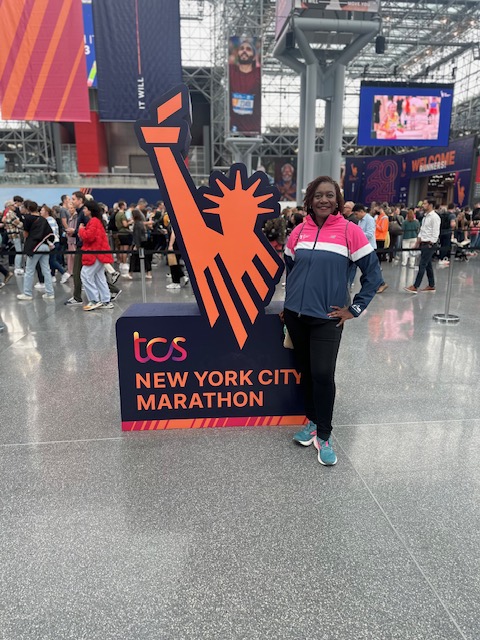
The New York City Marathon Expo feels like Christmas morning for runners. From new gear to gels, from the buzz of race-day nerves to the sight of thousands of excited athletes picking up bibs, it’s pure running joy.
Held at the Javits Center, a stunning glass-walled venue on Manhattan’s West Side, the expo perfectly matches the scale and spirit of the city itself. Despite its size, it’s very well organized, so you can soak up the atmosphere without feeling overwhelmed.

Once you’ve collected your bib, spend some time exploring the booths for official race merchandise, new products, brand activations, and all the photo opps. It’s great for making content for social media or your race diary. Try to limit how long you stay on your feet. Between the expo, sightseeing, and all that walking, your legs can tire more quickly than you realize. You don’t want to tire yourself out before race day.

In the days leading up to the race, there are countless shakeout runs across the city. The official Abbott 5K—which finishes at the marathon’s iconic finish line in Central Park—sells out fast, giving runners a sneak preview of the final stretch. I didn’t get an entry this time, but joined a shakeout run organized by my marathon tour group instead. Later that morning, I stopped by the Abbott 5K finish area to cheer runners, meet a friend, and grab a few photos.
Recommended Post: BERLIN MARATHON GUIDE
Pro Tip: If you can’t secure an official 5K entry, join a tour-organized shakeout or keep an eye out for one of the many brand or local run crew events happening around the city. They’re smaller, more personal, and an excellent way to connect with fellow runners before race day.
Race Day Logistics & Tips
Confession: I didn’t turn on my alarm. I know. But God! Thankfully, I still made it to the buses on time—one of 550 buses! heading from Midtown to the start village on Staten Island.
Whether you take the bus or the Staten Island Ferry, getting to the start is a journey in itself. If you’re on the bus, bring a throwaway blanket or trash bag to sit on once you reach the Athletes’ Village because you’ll have plenty of time to wait. If you’re taking the ferry, you’re in for a treat as you’ll get to watch the sunrise over New York Harbor and get a close-up view of the Statue of Liberty. Be sure to give yourself plenty of time: after the ferry, you’ll still need to board a bus and go through security before reaching the village.
Once you arrive at the Athletes’ Village, the energy is buzzing. It’s cold, so layer up with throwaway clothes, and don’t skip a visit to the therapy dogs—they’re there to help calm nerves and add joy to the morning.
Be sure to get the iconic orange Dunkin’ Donuts beanie. Yes, it does look a little ridiculous but it’s a badge of honor. Some runners wear it during the race, others stuff it into their shorts for good luck.

Pro Tip: Safety-pin your beanie to the back of your shirt or shorts if you don’t plan to wear it. It adds a fun New York touch to your race photos.
Start Waves & Corrals
The marathon starts in five waves, each beginning 35 minutes apart:
- Wave 1: 9:10 a.m.
- Wave 2: 9:45 a.m.
- Wave 3: 10:20 a.m.
- Wave 4: 10:55 a.m.
- Wave 5: 11:30 a.m.
You’ll be assigned a color-coded start based on your wave and corral:
- Blue and Orange runners start on the upper deck of the Verrazzano-Narrows Bridge. It’s exposed and can be windy, but the views are spectacular.
- Pink runners start on the lower deck, which can feel a little underwhelming at first, but it’s sheltered from the wind and slightly faster.
No matter where you start, remember: it’s a marathon, not a sprint. The New York City Marathon! Enjoy every second—the skyline, the anthem, the cannon, and the sound of Sinatra—this is an extraordinary event.
Here’s a short race morning checklist based on what worked for me:
- Trash bags: Sit on one and keep an extra in case it rains in the morning but clears later.
- Power banks: Between photos, tracking apps, and texting while you wait, your phone battery will drain fast.
- Throwaway clothes: Old sweatpants, a hoodie, or a robe will help you stay warm.
- Sunscreen: Even on cool days, those hours in the sun add up.
- Hand sanitizer and a small sealed bag with folded toilet paper: Porta-potty essentials that you’ll thank yourself for later.
Pro Tip: The wait before your wave starts can feel long. Bring a snack, stay hydrated, make friends, and don’t panic if the nerves kick in. Everyone feels it, even veterans.

Once your corral opens and you line up on the Verrazzano-Narrows Bridge, everything quiets down for a moment. Then comes the cannon blast, Sinatra’s voice, and 26.2 miles through The Big Apple.
Start Spreadin’ the News
Like most U.S. marathons, the New York City Marathon begins with the national anthem. But unlike any other race, it’s not just a start, it’s a show. A cannon fires, and suddenly Frank Sinatra’s timeless ode to the city fills the air. “Start spreadin’ the news, I’m leavin’ today, I want to be a part of it—New York, New York.”
That cannon shot truly spreads the news: more than 55,000 runners are “leavin’” Staten Island, eager to be a part of it. Vagabond shoes have been traded for sleek, carbon-plated ones as runners set out to stride “right through the very heart of it—New York, New York.”
“I wanna wake up, in a city that doesn’t sleep, and find I’m king of the hill.” The day begins early, but thanks to the end of daylight saving time, runners get an extra hour of rest before making the pilgrimage to the Staten Island start village, a rite of passage for this World Marathon Major. From there, it’s a rite of passage: crossing the Verrazano-Narrows Bridge, the race’s first “hill” and one of its most breathtaking sights. The Manhattan skyline glimmers in the distance, the harbor sparkles below, and excitement pulses through the crowd. But as Frank sings, “I wanna wake up in a city that doesn’t sleep, and find I’m king of the hill,” remember that this hill is nearly a mile long. Don’t let adrenaline take over too soon; the city has plenty of hills left to conquer.

“These little town blues are melting away” as you leave Staten Island behind and head into Brooklyn, where the real party begins. With each neighborhood you pass, the crowd gets bigger, louder, and more electric. Millions of spectators line the streets, their cheers melting away any nerves or fatigue.
“If I can make it there, I’ll make it anywhere.” By the time you cross into Queens and start the climb up the quiet Queensborough Bridge, Sinatra’s voice fades, replaced by another New York anthem: Alicia Keys and Jay-Z’s “Empire State of Mind.” “In New York, concrete jungle where dreams are made of, there’s nothing you can’t do.” The stillness on the bridge feels surreal, but then you turn left onto First Avenue, and it’s like the city roars back to life. The wall of sound from the crowds will carry you for miles.

As you continue uptown, “these streets will make you feel brand new, the lights will inspire you.” A brief visit to the Bronx brings high energy and Bronx pride before you head back to Manhattan for the home stretch.
“Let’s hear it for New York…” The final miles wind through Central Park, where rolling hills test whatever strength you have left. The park’s golden leaves and cheering spectators make for a grand finale worthy of its history. Opened in 1858, Central Park has hosted countless moments of triumph, and as you turn onto the final stretch and hear Frank again—“New York!”—you realize you’ve just lived the song.
Course and Landmarks
The New York City Marathon isn’t just a race, it’s a moving tour of the five boroughs, powered by cheers, music, and emotion. Each stretch tells its own story, and every neighborhood adds its own beat to the rhythm of the city.

Staten Island (Miles 1–2):
Enjoy the anthem, the cannon, and Sinatra’s “New York, New York.” The Verrazano-Narrows Bridge is beautiful but deceptive. It’s nearly a mile uphill. Keep your pace easy and enjoy the breathtaking view of the Manhattan skyline and New York Harbor.

Pro Tip: Savor the moment and take it slow. The downhill off the bridge into Brooklyn can tempt you to surge, but resist the urge. You’ll need that energy later.
Brooklyn (Miles 3–13):
Brooklyn, as they say, is in the house! The crowds, the signs, the music—it’s a full-on celebration. Neighborhoods blend together in a blur of color and sound, from Bay Ridge to Williamsburg to Greenpoint. Every block feels like a block party, and the energy will carry you for miles.

Pro Tip: Stay relaxed and steady. Brooklyn’s excitement can make you run faster than planned, but the race is only halfway done when you reach Queens.
Queens & the Queensboro Bridge (Miles 14–16):
Next comes the Queensboro Bridge, often considered the turning point of the race. The crowds fade, the noise disappears, and you start wondering if the incline will ever end. It’s mentally brutal. Dig deep. Be like Nike and just do it.
Pro Tip: Embrace the quiet, or better yet, cue up your power songs. Use this stretch to reset your focus and prepare for the explosion of sound waiting for you when you round the corner into Manhattan.
Manhattan, Bronx & Central Park (Miles 17–26.2):
Coming off the bridge onto First Avenue is a moment you’ll never forget. The sound hits you like a wave: wall-to-wall spectators, signs everywhere, people screaming your name. It’s pure electricity.
By the time you reach Harlem and cross into the Bronx, you’ve found your rhythm again and you’re running through neighborhoods that give the race its soul. The Bronx doesn’t last long on the course, but it leaves a mark—music, pride, and community joy that give you a needed boost as you head back toward Central Park. The thousands of spectators lining the streets are amazing, but there’s nothing like seeing familiar faces in that sea of strangers. I’m almost always alone at these events, but in New York, I had a couple of supporters. One friend who lives in the city showed up with a sign listing the names of all her friends running—mine included. Later, around mile 23, I spotted another friend volunteering at a water station. Hearing my name shouted by people I actually knew hit differently. In the thick of a marathon, it’s pure fuel for the heart.
 Finally, you reach Central Park, the final stretch. The crowds scream, your legs scream louder, but your heart is full. The rolling hills test your strength (and at this point, your patience), and you’re not sure if exhaustion or exhilaration is winning the tug of war inside you.
Somewhere near the end, a woman tapped my arm and laughed, “I’ve been chasing your gold skirt for 25 miles!” She passed me around 800 meters from the finish, still smiling. “I finally caught you!” she said. I love moments like that—little flashes of connection that remind you what this race is all about.
Recommended Post: CHRISTMAS IN NEW YORK CITY
Pro Tip: The final 800 meters curve through the park before you see the grandstands. Muster up whatever kick you have left when you hear the roar of the finish line; it’s closer than it feels. And don’t forget to smile for the camera—you’ll want that immortal finish line picture forever.
The Finish Line and Beyond
Crossing the line in Central Park is magic. It’s exhaustion, relief, and triumph all rolled into one. A volunteer slips that fabulous New York City Marathon medal around your neck, and suddenly the pain morphs into pride. You’ve just completed one of the most famous races in the world, through the beating heart of New York City.

Then comes the post-race fashion moment: the fleece-lined poncho is draped around your shoulders. The New York City Marathon ponchos—bright orange, warm, and emblazoned with the race logo —are the height of marathon fashion (if you know you know). It feels like being wrapped in accomplishment, comfort, and a little bit of New York swagger.
Medal and poncho secured, it’s time for the post-race zombie walk out of the park. Exiting Central Park takes time—about a mile to a mile and a half depending on where you finish. Take it slow. Everyone shuffles together, half limping, half floating.
 If you’re not heading to the Family Reunion area, you can exit the park at several points along Central Park West. Wherever you go, take a moment to look back. You’ve just conquered New York.
Pro Tip: Avoid trying to grab a cab or Uber after the marathon. Road closures make traffic nearly impossible. Instead, walk west to reach the 1/2/3 subway lines, which are close to the park exits. Just be warned: there will be stairs. And if you’re lucky, some of the subway attendants will let marathoners ride for free—one of those little New York kindnesses that feels extra sweet after 26.2 miles.
Post-Race Extras: Discounts, Freebies, and Victory Perks
New York City knows how to celebrate its runners. For several days after the marathon, flashing your medal or bib, unlocks all kinds of discounts and freebies across the city. It’s one of the many reasons to keep that medal visible—and maybe even wear it proudly to dinner.

Pro Tip: Check the official NYC Marathon app and local listings for current offers. The deals change each year, but some crowd favorites always return.
In the past, these post-race perks have included:
- Free or discounted admission to select museums and attractions
- Discounted Broadway tickets for runners
- Free pasta or celebratory drinks at participating restaurants
- Free medal engraving at select stores
- And a personal favorite from the year I ran: a free burger at Shake Shack
It’s all part of what makes marathon week in New York more than just a race—it’s a full celebration of perseverance, community, and joy. From the cannon blast on Staten Island to the last bite of a post-race burger, this city makes every runner feel like they belong here.
See the full story on the original site
