




Game On: Sports News, Highlights & Commentary
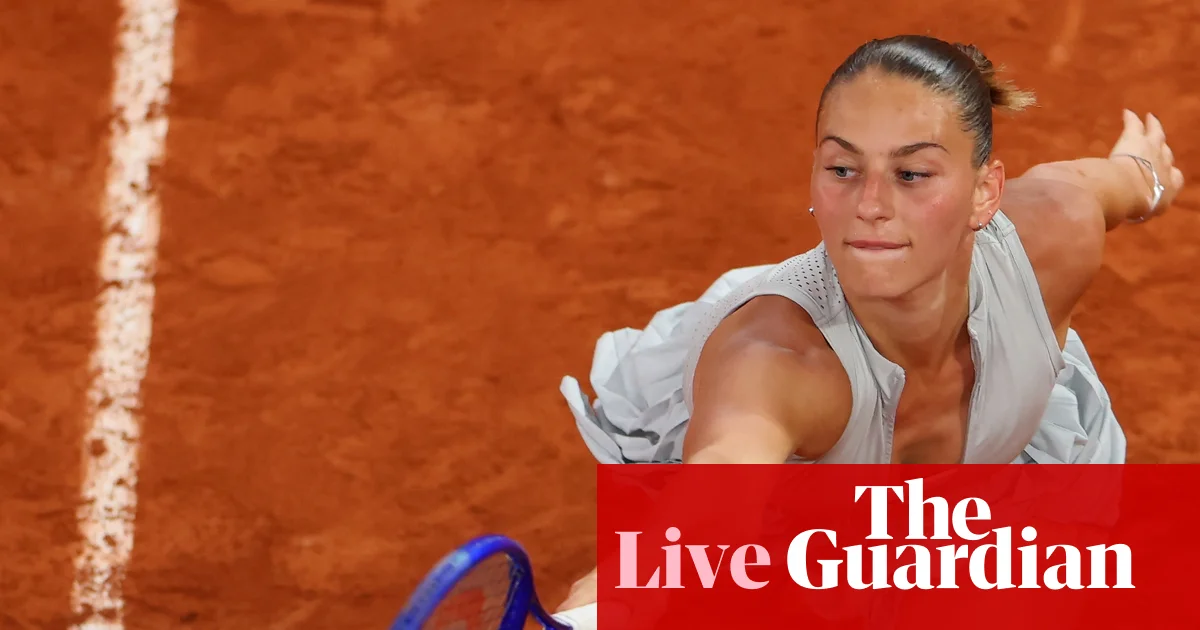
- Marta Kostyuk edges Elina Svitolina in a tense Ukrainian quarterfinal, power and 15-match clay streak make her favourite to reach first Roland-Garros semi.
- Mirra Andreeva defeated Sorana Cirstea 6-0 6-3, a majestic, ruthless performance; timing, footwork and explosive forehand propelled her to the semi.
- Elina Svitolina returned from maternity and Marta Kostyuk competed amid family hardship, both embody Ukraine's resilience and national significance.
Key events
Kostyuk makes 0-15 but then thwacks a swing-volley wide; the match remains on her racket, but that’s as much the case when she’s sending backhands into the net, as she does here, than when she’s hitting winners. “Hit through the ball,” says her coach, and have a look at what she does next, exactly that; you can’t be tentative against anyone, all the more so when power is in your favour. And it doesn’t just work for her, but against Svitolina who, next rally, is incited to go for more and misses; seconds later it’s 30-40 and break point. That’s saved, but then a big forehand sets up a pair of overheads, the second dispatched for advantage, and when a desperate return offers a swing-volley putaway, the pressure tells and Svitolina gives it too much. Kostyuk leads 5-3, and if trusts herself while handling the situation, she should win this match.
Oooh, without doing too much Svitolina makes 0-30 and is well up in the next rally, but a terrific get, a forehand squash-shot from corner to corner, sets up the forehand winner … only for a double to donate break-backs points at 15-40. And only one is required, a backhand down the line slices fractionally wide; without playing especially well, Svitolina is back on serve at 3-4. Can she build on that, or will the pattern remain the same?
The way this set is going, the only way Svito can win it is if Kostyuk gets nervous, and at 30-15, we see a point that illustrates the point, the difference in power and anticipation allowing a simple putaway at net. Oh, and a netted backhand offers the chance for a double break, Kostyuk stepping miles inside the baseline to attack a second serve. But when she doesn’t do enough with it, the riposte is sent to her ankles, and from there, Svitolina closes out a vital hold which keeps her in the set at 2-4.
Svitolina makes 0-15, but a service winner levels the game then, at 30-15, Kostyuk waits for one that sits up on the clay, then creams a backhand winner down the line. But she’s not the only one who can hit big shots, a cross-court return flying past her for 30-40, then an error donating deuce. Svitolina will know her younger opponent isn’t used to this kind of pressure and looks to up it by coming to net, but the approach doesn’t ask any questions, so Kostyuk passes her cross-court – she’s been excellent in that aspect so far today, aggressive without overhitting, and quickly closes out to lead 4-1 in the first. So far, she’s handling the opponent and situation perfectly, targeting the forehand and letting her hands go.
Svitolina needs to get herself into the match and she makes 30-0 in short order, then constructs a really good point, hitting lines as she sends Kostyuk nashing about the court from side to side. She holds to love and seems to have realised that in order to win this, she needs to hit harder – otherwise she’ll spend the match on the defensive, hoping her opponent misses. Kostyuk leads 3-1.
Kostyuk’s third-round win over Swiatek will have given her enormous confidence, the first time she’d beaten a top player at a slam. It was only a couple of days ago, but it feels like there’s more authority in her play now, the way she’s rallying marked by composure and patience. At 30-all, she finds a nice backhand slice that helps her to game point, and she puts the next one together nicely too, only to direct a slice into the net; deuce. For all the good it does Svitolina, Kostyuk rushing towards her consolidation and a 3-0 lead, dominating the match so far.
And she unloads immediately, making 15-30, then hauling a backhand cross-court and on to the sideline, raising two break points. I like the loop she’s getting on her forehand, which is pushing Svitolina back, and when the defensive lob comes, she confidently spanks her overhead into the corner – as her opponent could not – to lead 2-0.
Behind in the first rally, Kostyuk tries a lob, not an especially good one … and Svitolina flaps her overhead long. A service winner follows, then a return hooked wide, and when the younger woman reads an attempted putaway, she’s able to direct a forehand winner cross-court to secure the love hold. That’s an impressive start for a player playing the most important match of her career, and I’d expect her to attack Svitolina’s serve and see how she reacts to the pressure.
Kostyuk will serve, ready … play.
Svitolina and Kostyuk are out, competing to become the first Ukrainian to reach the last four of this competition. Both of them are in terrific nick, Kostyuk with the bigger game and the higher ceiling, but for the same reason, the lower floor, while Svitolina has experience and equilibrium on her side. Now that you ask, I’m leaning Kostyuk, but Chrissy has gone Svito; I’ll leave it to you to decide which of the two of us knows more about tennis.
I especially enjoyed the cleanliness of Andreeva’s hitting – her timing today was beautiful, a facility of her confidence. She committed to her aggression from the first ball, but the question now is how that works against someone able to do likewise or turn it against her.
Coming up next: Elina Svitolina (7) v Marta Kostyuk (15).
Andreeva says it’s always tough against Cirstea – last time they played and also when they practise, as they’ve done a fair bit. She knew the match wouldn’t be easy and would take all her focus and intensity, against an opponent who’d look to be aggressive and pressure her whenever she could, so she’s glad she was able to get in first.
Fabrice tells her the first time he saw her play, aged 16, and he was very impressed with her understanding of the game, and she explains that she never learnt how to play, she was just always excited to be on court. She assumed everyone read the game and didn’t think the way she did it was anything special, she just always knew which decision to make, though sometimes when she’s nervous they’re not always good; today, though, everything was on point.
Asked why she thanks herself when she wins titles, she laughs that originally it was something she’d heard Snoop Dogg say when receiving an award, that she pinched as a gag, but now she thinks about it, she knows it’s true – you need to thank yourself for the work you do and sacrifices you make so she wants to tell herself every time.
Ultimately, if you can’t outhit Andreeva, you’ve got a very big problem, and Cirstea could not. Even so, the performance was close to perfect and felt like a step forward, destroying a wily, confident veteran with apparent ease; she’s growing in front of our eyes, the question now whether she can dominate against other members of the elite. I can’t wait to find out, and here she is…
Mirra Andreeva (8) beats Sorana Cirstea (18) 6-0 6-3
A majestic, mature performance from Andreeva, locked-in from the start and ruthless to the end, a forehand winner to the corner securing the win. She’s into her second grand slam semi and will face the winner of our next match between Svitolina and Kostyuk.
Cirstea knows the jig is bust, going for everything because what else can she do. But an error hands over 15-30 and a backhand winner down the line raises two match points.
Sure enough, Andreeva breaks to 15, and she’s enjoying herself out there. Her backhand, in particular, is a delightful shot, but it’s her footwork and ability to change pace and direction with her shots that makes her special; her tennis IQ has been there, more or less, since the start – it’s just about building the strength and experience to go with it. She breaks, consolidates, and at 6-0 5-3 is now a game away, Cirstea doing all she can, but powerless against the onslaught.
Cirstea, though, isn’t going away, making 0-30, then at 15-30 Andreeva comes in and stretches for a putaway, sending it wide. And though she saves the first break point with a backhand winner, she then nets a forehand and that’s the break back for 0-6 3-3. In comms, Chrissy points out that a dip was always likely because it’s not possible to play as well as Andreeva was for an entire match, and that’s true – though, at the same time, it’s impossible not to think about how ridiculously Sabalenka performed last evening, against a far superior opponent, and wonder if that’s what it’ll take to challenge the world no 1.
Andreeva’s ability to explode from the off is extremely impressive, a statement that tells Cirstea – and the rest of the field – that she’s ready, the serious stuff beginning now. Only the best can do that, cycling through the gears at will, and she holds easily then, from 15-all, plays a gorgeous half-volley that has Conchita Martinez, her coach, almost eating her own face in delighted smiles, then two definitive groundstrokes secure the break as if she’d simply decided it was time. This is very impressive behaviour, perhaps the most commanding i’ve ever seen her at this stage of a slam, and she leads 6-0 3-2.
If Cirstea can keep holding, the set’ll come down to a few points here and there, but up 40-15 she invites pressure by going long on the forehand … then closes out the game with a serve out wide and clean-up swing-volley. Andreeva leads 6-0 1-2.
This is, of course, a sad day for all ADHD-types – no longer can our eyes dart around three or four screens, various matches compartmentalised into various parts of brain, while merging into one in another. But what an opportunity to hyper-focus and fully immerse into what we hope will be a succession of epics … in which regard Cirstea has closed from 40-0 to 40-30 with the help of a lovely backhand winner and a double, then Andreeva goes long and do we got ourselves a ball-game? Er, well a forehand winner is followed by an ace – the umpire has to check the mark as both players thought it was wide – and we’re level at 1-1 in set two.
Ah, and Cirstea is on the board, a hold sparing her the embarrassment of a double bagel. But can she compete?
In the time since play started, Andreeva has imposed herself, a bagel set putting her in complete control; the roof is closed.
Preamble
Salut à tous et bienvenue à Roland-Garros 2026 – dixième jour!
On the one hand, we’ve only three singles matches in this session … and on the other, just look at them!
We saw Mirra Andreeva coming a mile off, a talent so luminous so young and technique so pretty, it was hard to believe she was only 15 … except she looked and acted like she was only 15, a cheeky, impetuous sprite with very obvious flaws. Now a venerable 19, the obvious flaws remain – we are who we are – and also, she’s much better at working with them – we create ourselves afresh every day. But is she ready to win a grand slam?
Her defensive inclination, the consequence of power yet to fully develop, is unlikely to undermine her against Sorana Cirstea, a veteran of composure and nous, but the matchup is no gimme. “There is no expiration date for ambition and for dreams,” Cirstea said after her fourth-round win, evidence of a burgeoning sense of mission – understandably so, given she’d just set a record for the longest gap between a player’s first two quarter-finals at a women’s singles major in the open era. We can be almost certain she won’t shrink, and if she can take away what Andreeva does best, denying her width, angle and backhands, she has a chance.
Following them on to court is a Ukrainian derby of affirming excitement. Elina Svitolina is a wonder of womanhood, taking time off to have a baby and returning an entirely different player: stronger, fresher and attacking her shots with the conviction of equilibrium. She knows she represents something bigger than herself – her family and her people – using emotion to elevate, and bringing the crowds with her.
Marta Kostyuk’s story is not dissimilar. The night before her round one match, a Russian bomb hit close to her family home and, like Svitolina, it’s taken her a while to find her identity as a player, struggling to assimilate her vast toolbox into the maelstrom of moments and the stress of elite sport. But she’s there now, unbeaten through the clay-court swing having won 15 matches in a row, her power, agility and brain synchronised into the very model of a modern major tenniser. She’s ready to win today and, for the first time, she’s ready to contest a semi-final and final.
We complete our day-sesh with le bangeur of a men’s match. After his undressing by Jannik Sinner in last year’s Aussie Open final, Alexander Zverev – the best player never to win a grand slam – clearly thought his time had gone and rightly so. But the absence of Carlos Alcaraz along with the exits of Sinner and Novak Djokovic mean he is now the overwhelming favourite, the chance of lifetime – one he surely thought he’d never get – bringing with it overwhelming pressure.
And Rafael Jodar will only compound that, the soaring 19-year-old unknown a year ago and now a serious force in the game – especially on clay. His forehand is terrifying and line backhand nasty, but even more apparent is his temperament: to get here, he’s won two five-setters in a row, riding the fluctuations and undulations with maturity and joy. We don’t know what he’s got left; we do know we’ll see absolutely all of it.
All of which is a long-winded way of saying we’re in for an absolute treat. Chauette! On y va!
Read the full story from the original source
