




Business Insights: Global Markets, Strategy & Economic Trends
- Guo Wengui allied with Trump aides, notably Stephen K. Bannon, forming the self-declared New Federal State of China
- He funneled supporters' funds into lavish properties and a Bugatti; seized assets will be liquidated to repay victims
- Prosecutors said hundreds of victims lost life savings; assistant U.S. attorney Juliana Murray called him an opportunist and fraudster
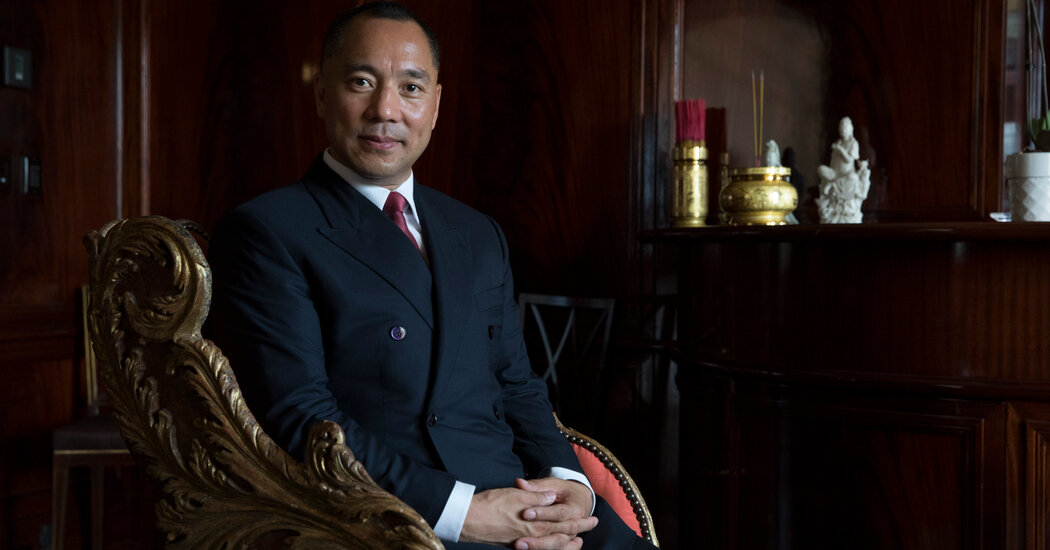
Guo Wengui, a Chinese businessman who transformed himself from a Beijing insider into an anti-Communist crusader and ally of the American far right, was sentenced to 30 years in prison on Monday for defrauding investors, including many of his own fervent supporters, of hundreds of millions of dollars.
Mr. Guo, who had made a fortune in Beijing as a real estate developer and had forged an alliance with a corrupt intelligence official there, fled China in 2015, settling in a $68 million Manhattan penthouse overlooking Central Park. There, he took to social media and YouTube, denouncing the Chinese Communist Party and luring thousands of followers convinced that Mr. Guo would harness his wealth and inside knowledge to bring democracy to China.
He took them into his confidence and they showered him with money, buying shares in his media company, dubious club memberships and a fake cryptocurrency that he promised would make them all rich beyond belief.
Mr. Guo, also known as Miles Kwok, used that money to fund a lavish lifestyle, buying an estate in rural New Jersey, a mansion in Greenwich, Conn., and a $4.4 million Bugatti supercar. He was arrested at his Manhattan apartment in 2023 and convicted in federal court the following year of racketeering conspiracy, securities fraud and money-laundering conspiracy.
Judge Analisa Torres of Federal District Court in Manhattan said on Monday that Mr. Guo had “preyed on people seeking to bring democracy to China,” causing them “substantial financial and emotional harm.”
She handed down a 30-year sentence, the punishment requested by federal prosecutors, who had likened Mr. Guo’s crimes to those of the notorious fraudster Bernard Madoff.
Mr. Guo, who is about 58, looked a diminished man. Once trim and smartly dressed in his signature Brioni suits, he entered the courtroom in a two-piece tan prison uniform. He appeared to have gained weight in the years since his trial. His dark, close-cropped hair had grayed.
His sentencing, originally scheduled for November 2024, was delayed after the former billionaire, who had earlier declared bankruptcy, asked for new, court-appointed lawyers.
The Monday hearing also started late, after Mr. Guo was taken to the hospital early that morning for a fall. He claimed to have been vomiting and bleeding and spent most of his remarks — possibly the last public address he will make for a quarter-century or more — in a rant against a prosecutor who had called him a malingerer.
After settling in Manhattan in 2015, Mr. Guo moved quickly to build a political network in America akin to the one he had left in China. By 2017, he was a member of Mar-a-Lago, the newly elected president’s resort in Palm Beach, Fla.
Before his arrest, Mr. Guo built political and business connections with some powerful people in President Trump’s orbit. Among them was Stephen K. Bannon, the former Trump aide, who had a $1 million consulting contract to advise Mr. Guo and his media company.
The two men formed an alliance, with Mr. Guo boosting Mr. Bannon’s podcast on his Chinese-language media network. Mr. Bannon was by his side in June 2020 when Mr. Guo, with the Statue of Liberty as a backdrop, declared the formation of the “New Federal State of China.” Peter Navarro, another Trump aide, would be the shadow government’s “international ambassador.”
“From this day forward, the Communist Party is not the legal government of China!” Mr. Guo declared.
A few months later, he released a song called “Take Down the C.C.P.,” which briefly held the No. 1 spot on the iTunes chart.
While aboard Mr. Guo’s yacht, the Lady May, in August 2020, Mr. Bannon was arrested on charges of defrauding investors. (Mr. Trump eventually pardoned him.)
Got a confidential news tip? The New York Times would like to hear from readers who want to share messages and materials with our journalists.
Later in 2020, Mr. Guo inserted himself deep into the presidential campaign. It was on his media network that material from a laptop belonging to Hunter Biden, the soon-to-be president’s son, first appeared. On Oct. 10 that year, Mr. Guo hosted Mr. Bannon and Rudolph W. Giuliani, the Trump lawyer and former New York mayor, at his Manhattan penthouse for dinner and cigars, The New York Times reported.
But Trump lost that election, and in the years that followed, Mr. Guo focused on drawing funds from his growing ranks of supporters. Ryan B. Finkel, one of the prosecutors, said that 235 victims had given statements, many of them claiming they had lost their life savings. “I lost my will to live,” one victim said.
Judge Torres said the U.S. government would dispose of the assets it had seized after Mr. Guo’s arrest — including the mansions, the supercar and cash — and use the money to repay victims.
Despite Mr. Guo’s political alliances, a presidential pardon appears unlikely. In 2017, Mr. Trump considered deporting Mr. Guo to China, where he faced a slew of criminal charges stemming from his alliance with a high-ranking Chinese spymaster, Ma Jian, whose arrest on corruption charges in early 2015 had prompted Mr. Guo to flee the country.
On both sides of the Pacific, Mr. Guo practiced a ruthless form of business.
In China, when a Beijing vice mayor stood in the way of Mr. Guo’s developing a plot of land adjacent to the site of the 2008 Summer Olympic Games, Mr. Guo obtained a tape showing the official having sex with a mistress. The official was ousted and given a suspended death sentence for bribery.
In America, supporters of Mr. Guo hounded a bankruptcy trustee overseeing the liquidation of his properties, accusing the trustee of being a tool of the Chinese Communist Party. They even gathered outside the Massachusetts school where the daughter of the trustee worked, holding signs such as one that read: “How does living off your father’s attempted extortion of a Chinese dissident make you feel?”
Mr. Guo saved his choicest words for senior Chinese leaders and their families. In early 2017, after two years of keeping a low profile, Mr. Guo burst onto social media, accusing the Communist Party’s ruling elite of corruption.
That was part of a long effort to reshape himself as a principled political activist, and during the trial, his lawyers asserted that his actions had been in pursuit of a democratic China.
It didn’t sway the jury.
“Is Miles Guo a real political activist or not? I don’t know, I don’t care and neither should you,” Juliana Murray, an assistant U.S. attorney, told the jury as the trial was wrapping up. “He’s an opportunist. He’s a fraudster.”
Still, dozens of Mr. Guo’s supporters packed the courtroom on Monday, while more than 100 others watched in an overflow room. After he was sentenced, Mr. Guo turned around and smiled at them. Many clasped their hands in a gesture of respect.
As he was escorted out, Mr. Guo thanked them and shouted in Mandarin, “It has only just started!”
Read the full article from the original source
