




Wellness That Matters: Black Health News & Community Care
- My husband Kenny had an unexpected ischemic stroke at 41; emergency care led to wakefulness and planned recovery.
- I stayed present, singing the Sanskrit mantra Lokah Samastah Sukhino Bhavantu, breathing and connecting to shared human fragility while waiting.
- Doctors found a small hole in his heart and a gene causing thicker blood; he had surgery, takes daily aspirin, and rebuilt strength.
- The crisis stripped pretense, prompting deeper honesty, vulnerability, gratitude, and a daily reminder that time is not promised.
The form said my husband might not survive.
If the doctors were right, the drug would dissolve the blood clot and prevent any further damage to the brain.
If they were wrong — if there was bleeding they hadn’t detected — the medication would kill him instantly.
“We need your consent,” the doctor said calmly.
I was 31 years old, sitting alone in a fluorescent-lit hospital room in Brisbane, Australia, staring at a clipboard while my husband lay a few feet away in a hospital bed, curled on his side and barely responsive
Suddenly our entire marriage had become a percentage.
Ninety percent he lives. Ten percent he dies.
I didn’t do it because I wasn’t terrified. I did it because 90% felt like the only number I was allowed to believe in.
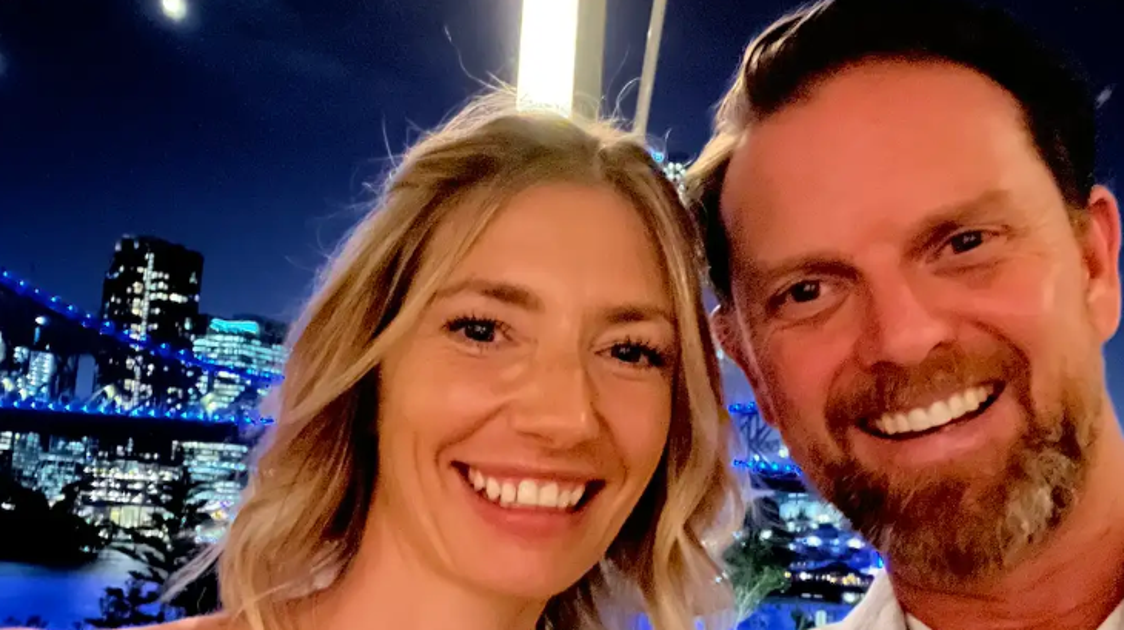
Kenny and I had only been married for two years at that point.
We had eloped in Las Vegas on a Sunday afternoon in December after knowing each other for only four months, with my best friends as our witnesses, a $50 white lace dress, and a pianist playing Canon in D. We had moved countries, navigated immigration paperwork, and learned how to merge two fiercely independent lives into one tiny Bondi apartment.
Courtesy of Katie Delimon
We thought we knew what stress was.
Then on a Thursday morning in early February, Kenny was at his office in Brisbane while I was across the CBD teaching a lunchtime corporate yoga class in another building. We had argued the night before — nothing dramatic, just the low-grade friction of two people navigating life and not quite reaching each other.
We didn’t properly kiss goodbye that morning.
As I walked back into Kenny’s office building, I noticed an ambulance parked outside. I remember getting a strange pull in my chest and silently sending a quick prayer toward whoever it was there for.
I had no idea it was my husband.
The moment I walked through the doors, the building cleaner rushed toward me with a look on her face I had never seen before.
“Katie — the ambulance. It’s for Kenny.”
The elevator ride to level eight felt endless.
When the doors finally opened, the silence hit me first.
Kenny was seated on the floor of a meeting room with two paramedics holding him upright. His eyes were bloodshot and unfocused, and he couldn’t speak. He kept trying to pull his shirt off like he was too hot, like something inside his body had become unbearable.
“Are you his wife?” one of the paramedics asked.
“Yes. What happened? Is it his heart? His father’s had multiple heart attacks.”
“Symptoms are not consistent with a heart attack,” he said carefully. “Possibly a stroke. We’ll know more once we get him to the hospital.”
That word — “stroke” — seemed to alter the air around me.
Kenny was 41, healthy, active, and rarely ever sick. None of that, it turns out, guarantees anything.
At the hospital, everything accelerated.
Doctors spoke in clipped sentences while nurses moved quickly around the room attaching monitors, drawing blood, and wheeling Kenny in and out of scans. Medical language flew over me while I tried to stay calm enough to understand what was happening.
Then a doctor sat beside me holding a clipboard.
An ischemic stroke. A blood clot.
There was a medication they could administer immediately that might dissolve it, but if there was undetected bleeding on the brain, the medication would kill him instantly.
I remember staring at the clipboard thinking how absurd it felt that just hours earlier we had been annoyed at each other over something insignificant that I can’t even remember now. And suddenly I was sitting in a hospital being asked to potentially gamble with my husband’s life.

Courtesy of Katie Delimon
Death has always been my greatest teacher, although I didn’t fully realize that until years later.
I lost my mother to ovarian cancer when I was 26. Before that, my biological father had died from kidney cancer — although I wouldn’t discover he was my biological father until I was 38 after an AncestryDNA test unravelled decades of family secrets.
Loss has a way of rearranging your perspective permanently.
It teaches you that life can split into before and after within a single phone call, a single sentence, a single moment.
But sitting in that hospital taught me something even deeper: The illusion of time is one of the greatest illusions we live under.
We think we have time to say the thing later. To repair the argument tomorrow. To stop being so guarded. To become softer, more honest, more vulnerable eventually.
And then life interrupts you.
After I signed the form, a nurse dimmed the lights in Kenny’s hospital room and quietly prepared to leave us alone.
Before she walked away, she paused.
“Just so you know,” she said gently, “when he wakes up, we don’t yet know what kind of damage there may have been to the brain. We’re not sure whether he’ll be able to walk, talk or what his recovery may look like yet. We’ll have to assess things when he wakes up.”
I remember sitting there in the half-dark listening to the sound of hospital machines and feeling my mind immediately trying to race ahead into the future.
Should I call his parents? Who do I call first? What if he wakes up and he’s different? What if he doesn’t wake up at all?
I write about this experience in my memoir “Trust the Flames” in a chapter called Oxygen — both the thing Kenny’s brain desperately needed and the thing I kept reminding myself to breathe in while I waited for him to wake up.
Just stay in your body, don’t get lost in your head.
Not in the future. Not in the fear. Here.
Instead of spiraling, I chose to stay present.
I sat beside Kenny quietly singing a Sanskrit mantra I had learned during yoga teacher training. Lokah Samastah Sukhino Bhavantu — may all beings everywhere be happy and free.
I sang it for Kenny. For the elderly woman down the hall. For the family with the sick child. For myself.
Somewhere in the middle of that hospital waiting room, I realized uncertainty and grief was everywhere. Every person in that emergency department was carrying some version of pain.
And strangely, that awareness softened something in me.
Instead of disappearing deeper into the belief that I was alone in something unbearable, it connected me back to humanity. To the unavoidable reality that all of us, eventually, will sit beside someone we love and pray they stay.
The mantra became less about escaping fear and more about staying connected — to myself, to other people, to the shared fragility of being human.
And then, two hours later, Kenny woke up.

Courtesy of Katie Delimon
He knew his name. He could walk. He could talk.
Doctors later discovered Kenny had a small hole in his heart and a gene that thickened his blood. There was also evidence on his cerebellum suggesting this wasn’t his first stroke — just the first one anyone had caught.
He would need surgery. Recovery. But he was alive.
What nobody tells you about almost losing someone is that the real reckoning often comes after the crisis ends. You start seeing everything differently. The argument. The rushed goodbye. The small resentments you thought mattered.
Kenny and I didn’t fall apart after his stroke. We fell into deeper honesty. Deeper vulnerability. Deeper gratitude.
I grew up in a family where silence often felt safer than truth. Where vulnerability was viewed as dramatic and difficult conversations were avoided at all costs. But almost losing Kenny stripped something away in me.
When you sit in a hospital being asked to sign a form that says your person may not survive, pretending suddenly feels exhausting. The walls come down. The conversations become real. You realize love is not something you find, it’s something you choose moment to moment. Messily. Honestly. While you still can.
Today, Kenny is healthy, strong, funny, and somehow still has more energy than me despite being 10 years older. He takes daily aspirin, had the surgery, and continues moving through life with the same grounded steadiness he always has.
And I remain the woman who learned far earlier than most that death asks us to wake up while we are still here. That Thursday mornings are ordinary right up until the moment they aren’t.
Death is something I think about daily — not to live in fear, but to remember something most of us spend our lives trying not to think about: The time you think you have is not promised.
Katie Delimon is a trauma-informed coach, keynote speaker, podcast host of “Inner Self-Confidence” and author of the bestselling memoir, “Trust the Flames,” which reached #6 on Amazon’s Hot New Memoirs list. She specializes in nervous system regulation, boundaries, and inner self-confidence, helping women move from overthinking and people-pleasing to speaking up with clarity and calm. Her writing has been featured in Mamamia, Daily Mail, Women’s Agenda, HuffPost and more. She is currently working on her second book, “Lies We Inherit.” For more, visit www.katiedelimon.com, follow her on Instagram at https://instagram.com/katiedelimon, or explore her book “Trust the Flames” at https://www.katiedelimon.com/trust-the-flames.
Do you have a compelling personal story you’d like to see published on HuffPost? Find out what we’re looking for here and send us a pitch at pitch@huffpost.com.
Read the full article on the original site
