




Tech Trends & Innovation: The Latest in Tech News
- Reserve security slots with Copenhagen Optimization's Virtual Queuing to avoid lines and optimize staffing in real time.
- Create reusable e-ink luggage tags with the Bagtag app, using Bluetooth and NFC plus airline APIs for paperless, scannable baggage tracking.
- Idemia Public Security's biometric boarding uses 3D and infrared imaging plus antispoofing to match faces to IDs, with no biometric data retained.
- Smiths Detection's X-ray diffraction identifies molecular composition, reducing false positives and automating luggage threat detection without manual inspections.
- Amazon's Just Walk Out stores use cameras and shelf sensors so travelers tap in, grab items, and leave, auto-charging purchases.
Take a look around the airport during your travels this summer and you might spot a string of new technologies at every touchpoint: from pre-arrival, bag drop, and security to the moment you board the plane.
In this new world, your face is your boarding pass, your electronic luggage tag transforms itself for each new flight, and gate scanners catch line cutters trying to sneak onto the plane early.
It isn’t the future—it’s now. Each of the technologies to follow is in use at airports around the world today, transforming your journey-before-the-journey.
Virtual queuing speeds up airport security
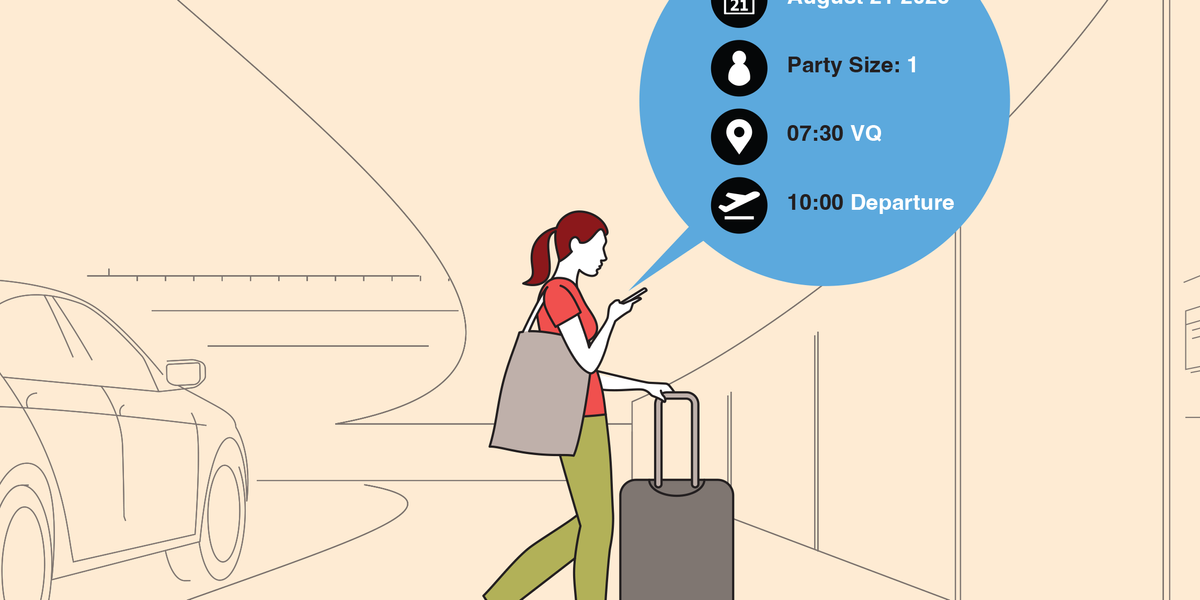
As you pack the night before your trip, you ponder the age-old travel question: What time should I get to the airport? The right answer requires predicting the length of the security line. But at some airports, you no longer have to guess; in fact, you don’t have to wait in line at all.
Instead, you can book ahead and choose a specific time for your security screening—so you can arrive right before your reserved slot, confident that you’ll be whisked to the front of the line, thanks to Copenhagen Optimization’s Virtual Queuing system.
Copenhagen Optimization’s machine learning models use linear regression, heuristic models, and other techniques to forecast the volume of passenger arrivals based on historical data. The system is integrated with airport programs to access flight schedules and passenger-flow data from boarding-pass scans, and it also takes in data from lidar sensors and cameras at security checkpoints, X-ray luggage scanners, and other areas.
If a given day’s passenger volume ends up differing from historical projections, the platform can use real-time data from these inputs to adjust the Virtual Queuing time slots—and recommend that the airport make changes to security staffing and the number of open lanes. The Virtual Queuing system is constantly adjusting to flatten the passenger arrival curve, tactically redistributing demand across time slots to optimize resources and reduce congestion.
While this system is doing the most, you as a passenger can do the least. Just book a time slot on your airport’s website or app, and get some extra sleep knowing you’ll waltz right up to the security check tomorrow morning.
Electronic bag tags
MCKIBILLO
Checking a bag? Here’s another step you can take care of before you arrive: Skip the old-school paper tags and generate your own electronic Bagtag. This e-ink device (costing about US $80, or €70) looks like a traditional luggage-tag holder, but it can generate a new, paperless tag for each one of your flights.
You provide your booking details through your airline’s app or the Bagtag app, and the Bagtag system then uses application programming interfaces and secure data protocols to retrieve the necessary information from the airline’s system: your name, flight details, the baggage you’re allowed, and the unique barcode that identifies your bag. The app uses this data to generate a digital tag. Hold your phone near your Bagtag, and it will transmit the encrypted tag data via Bluetooth or NFC. Simultaneously, your phone’s NFC antenna powers the battery-free Bagtag device.
On the Bagtag itself, a low-power microcontroller decrypts the tag data and displays the digital tag on the e-ink screen. Once you’re at the airport, the tag can be scanned at the airline’s self-service bag drop or desk, just like a traditional paper tag. The device also contains an RFID chip that’s compatible with the luggage-tracking systems that some airlines are using, allowing your bag to be identified and tracked—even if it takes a different journey than you do. When you arrive at the airport, just drop that checked bag and make your way to the security area.
Biometric boarding passes
 MCKIBILLO
Over at security, you’ll need your boarding pass and ID. Compared with the old days of printing a physical slip from a kiosk, digital QR code boarding passes are quite handy—but what if you didn’t need anything besides your face? That’s the premise of Idemia Public Security’s biometric boarding-pass technology.
Instead of waiting in a queue for a security agent, you’ll approach a self-service kiosk or check-in point and insert your government-issued identification document, such as a driver’s license or passport. The system uses visible light, infrared, and ultraviolet imaging to analyze the document’s embedded security features and verify its authenticity. Then, computer-vision algorithms locate and extract the image of your face on the ID for identity verification.
Next, it’s time for your close-up. High-resolution cameras within the system capture a live image of your face using 3D and infrared imaging. The system’s antispoofing technology prevents people from trying to trick the system with items like photos, videos, or masks. The technology compares your live image to the one extracted from your ID using facial-recognition algorithms. Each image is then converted into a compact biometric template—a mathematical representation of your facial features—and a similarity score is generated to confirm a match.
Finally, the system checks your travel information against secure flight databases to make sure the ticket is valid and that you’re authorized to fly that day. Assuming all checks out, you’re cleared to head to the body scanners—with no biometric data retained by Idemia Public Security’s system.
X-rays that can tell ecstasy from eczema meds
 MCKIBILLO
While you pass through your security screening, that luggage you checked is undergoing its own screening—with a major new upgrade that can tell exactly what’s inside.
Traditional scanners use one or a few X-ray sources and work by transmission, measuring the attenuation of the beam as it passes through the bag. These systems create a 2D “shadow” image based on differences in the amount and type of the materials inside. More recently, these systems have begun using computed tomography to scan the bag from all directions and to reconstruct 3D images of the objects inside. But even with CT, harmless objects may look similar to dangerous materials—which can lead to false positives and also require security staff to visually inspect the X-ray images or even bust open your luggage.
By contrast, Smiths Detection’s new X-ray diffraction machines measure the molecular structure of the items inside your bag to identify the exact materials—no human review required.
The machine uses a multifocus X-ray tube to quickly scan a bag from various angles, measuring the way the radiation diffracts while switching the position of the focal spots every few microseconds. Then, it analyzes the diffraction patterns to determine the crystal structure and molecular composition of the objects inside the bag—building a “fingerprint” of each material that can much more finely differentiate threats, like explosives and drugs, from benign items.
The system’s algorithms process this diffraction data and build a 3D spatial image, which allows real-time automated screening without the need for manual visual inspection by a human. After your bag passes through the X-ray diffraction machine without incident, it’s loaded into the cargo hold. Meanwhile, you’ve passed through your own scan at security and are ready to head toward your gate.
Airport shops with no cashiers or checkout lanes
 MCKIBILLO
While meandering over to your gate from security, you decide you could use a little pick-me-up. Just down the corridor is a convenience store with snacks, drinks, and other treats—but no cashiers. It’s a contactless shop that uses Just Walk Out technology by Amazon.
As you enter the store with the tap of a credit card or mobile wallet, a scanner reads the card and assigns you a unique session identifier that will let the Just Walk Out system link your actions in the store to your payment. Overhead cameras track you by the top of your head, not your face, as you move through the store.
The Just Walk Out system uses a deep-learning model to follow your movements and detect when you interact with items. In most cases, computer vision can identify a product you pick up simply based on the video feed, but sometimes weight sensors embedded in the shelves provide additional data to determine what you removed. The video and weight data are encoded as tokens, and a neural network processes those tokens in a way similar to how large language models encode text—determining the result of your actions to create a “virtual cart.”
While you shop, the system continuously updates this cart: adding a can of soda when you pick it up, swapping one brand of gum for another if you change your mind, or removing that bag of chips if you put it back on the shelf. Once your shopping is complete, you can indeed just walk out with your soda and gum. The items you take will make up your finalized virtual cart, and the credit card you entered the store with will be charged as usual. (You can look up a receipt, if you want.) With provisions procured, it’s onward to the gate.
Airport-cleaning robots
 MCKIBILLO
As you amble toward the gate with your luggage and snacks, you promptly spill that soda you just bought. Cleanup in Terminal C! Along comes Avidbots’ Neo, a fully autonomous floor-scrubbing robot designed to clean commercial spaces like airports with minimal human intervention.
When a Neo is first delivered to the airport, the robot performs a comprehensive scan of the various areas it will be cleaning using lidar and 3D depth cameras. Avidbots software processes the data to create a detailed map of the environment, including walls and other obstacles, and this serves as the foundation for Neo’s cleaning plans and navigation.
Neo’s human overlords can use a touchscreen on the robot to direct it to the area that needs cleaning—either as part of scheduled upkeep, or when someone (ahem) spills their soda. The robot springs into action, and as it moves, it continuously locates itself within its map and plans its movements using data from wheel encoders, inertial measurement units, and a gyroscope. Neo also updates its map and adjusts its path in real time by using the lidar and depth cameras to detect any changes from its initial mapping, such as a translocated trash can or perambulating passengers.
Then comes the scrubbing. Neo’s software plans the optimal path for cleaning a given area at this moment in time, adjusting the robot’s speed and steering as it moves along. A water-delivery system pumps and controls the flow of cleaning solution to the motorized brushes, whose speed and pressure can also be adjusted based on the surface the robot is cleaning. A powerful vacuum system collects the dirty water, and a flexible squeegee prevents slippery floors from being left behind.
While the robot’s various sensors and planning algorithms continuously detect and avoid obstacles, any physical contact with the robot’s bumpers triggers an emergency stop. And if Neo finds itself in a situation it’s just not sure how to handle, the robot will stop and call for assistance from a human operator, who can review sensor data and camera feeds remotely to help it along.
“Wrong group” plane-boarding alarm
 MCKIBILLO
Your airport journey is coming to an end, and your real journey is about to begin. As you wait at the gate, you notice a fair number of your fellow passengers hovering to board even before the agent has made any announcements. And when boarding does begin, a surprising number of people hop in line. Could all these people really be in boarding groups 1 and 2? you wonder.
If they’re not…they’ll get called out. American Airlines’ new boarding technology stops those pesky passengers who try to join the wrong boarding group and sneak onto the plane early.
If one such passenger approaches the gate before their assigned group has been called, scanning their boarding pass will trigger an audible alert—notifying the airline crew, and everyone else for that matter. The passengers will be politely asked to wait to board. As they slink back into line, try not to look too smug. After all, it’s been a remarkably easy, tech-assisted journey through the airport today.
From Your Site Articles
Related Articles Around the Web
Read the full article from the original source
