


Close Menu
Savannah HeraldSavannah Herald
    • Home
    • News
      • Local
      • State
      • National
      • World
      • HBCUs
    • Events
    • Directories
    • Weather
    • Traffic
    • Sports
    • Politics
    • Lifestyle
      • Faith
      • Senior Living
      • Health
      • Travel
      • Beauty
      • Fashion
      • Food
      • Art & Literature
    • Business
      • Real Estate
      • Entertainment
      • Investing
      • Education
    • Guides
      • Summer Camp Guide
      • Juneteenth Guide
      • Black History Savannah
      • MLK Guide Savannah
    We're Social
    • Twitter
    • Facebook
    • YouTube

    Subscribe to Updates

    Get the latest creative news from FooBar about art, design and business.

    Trending
    • San Antonio’s Housing Bond Created or Saved More Than 3,100 Homes
    • Spring Orzo Pasta Salad with Creamy Basil Vinaigrette – Plant Based RD
    • DJ Screw’s Sound Shaped Hip-Hop. Now, His Music Is Heading To DSPs
    • JLo Shuts Down Interview Question About Brett Goldstein
    • HBCU choirs earn national spotlight with new Stellar Awards category
    • “Air Hits the Cancer and Spreads It”- A Dangerous Myth That Is Costing Black Lives
    • These Macs Won’t Support macOS 27 Later This Year
    • New Gwinnett County early learning academy aims to expand affordable preschool access
    Facebook X (Twitter) Instagram YouTube
    Login
    Savannah HeraldSavannah Herald
    Savannah HeraldSavannah Herald
    Home » a review of Water & Wave by Eugene Datta – Compulsive Reader
    Art & Literature

    a review of Water & Wave by Eugene Datta – Compulsive Reader

    Savannah HeraldBy Savannah HeraldFebruary 4, 20267 Mins Read
    Facebook Twitter Pinterest LinkedIn WhatsApp Reddit Tumblr Email
    a review of Water & Wave by Eugene Datta – Compulsive Reader
    Share
    Facebook Twitter LinkedIn Pinterest Email

    Black Arts & Culture Feature:

    Key takeaways
    • Datta confronts traumatic events through intimate, observational poems rooted in eyewitness detail and memory.
    • Poems blur lines between journalism and lyric, embodying poetry of witness as evidentiary, emotional testimony.
    • Recurring theme: the limits of empathy and the claim that "there's no such thing as objective experience."
    • Memory and photographs are unstable mediators of truth, shaping what witnessing can convey.
    • Collection charts the poet's evolution as a witness, ending with stark distinctions between mind, body, and experience.

    Reviewed by Peter Siegenthaler

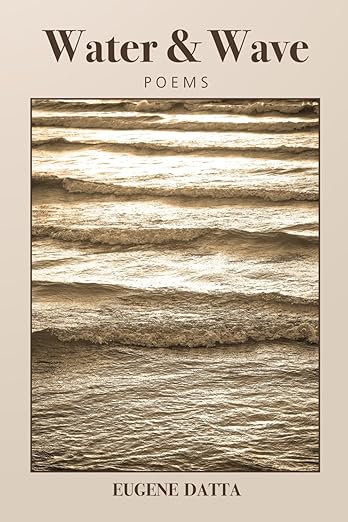
    Water & Wave
    by Eugene Datta
    Redhawk Publications
    May 2024, 108 pages, ISBN-13: 978-1959346517

    A journalist and editor, born in Calcutta (Kolkata) and living now in Aachen, Germany, Eugene Datta has seen the world and paid close attention to its details. He was serving as a stringer for a U.S.-based newspaper when in 2001 he went to the northwest Indian region of Jammu and Kashmir to report on communities wracked by sectarian violence. Earlier that year, he witnessed the terrible results of the Gujarat earthquake that killed more than 20,000 people, destroying whole villages in western India and leaving hundreds of thousands of people homeless. Water & Wave is filled with portraits of people and places. He draws from Kolkata and Gujarat, but also Bhutan, Normandy, Moscow, Rwanda, and the Ukraine, impressions, voices, and visions.

    Datta’s craft is most immediately felt in pieces that re-vision traumatic events whose effects he has encountered firsthand. Writing of the border region of Jammu in 2001, as separatist violence brought bloodshed and destruction, he zeroes in on the monomania of a suicide bomber and its results for his family:

                       Veiled faces gazed

    out of windows back in the martyr’s village; his father
    hit his own head against a brick wall, again

    and again, as the women wailed and others
    stared in silence. Thin spirals of smoke rose

    to the spring clouds hanging low over Ganderbal.
    My son got what he wanted, the father said. (“Ganderbal” p. 22)

    In these poems, truisms of the inescapability of religious affiliations and national loyalties are swept aside by direct experience. Walking in the rubble of a town nearly obliterated by the 2001 earthquake, Datta recreates a conversation:

    How can you cremate this person without knowing if they
    were Hindu? we’d asked. The shape of a human foot
    in the flattened flesh.

    We don’t know, he said. No one is alive to tell who was who.
    We cremate the bodies we retrieve, the Muslims bury the ones
    they find. (“Anjar, 2001” p. 23)

    Many times in the collection, recognition of the thinness of affiliations leads to an inability to speak, in words crossed out and replaced with others that reach for a different truth. Taking a stroll in his German neighborhood after the Russian invasion of Ukraine, he observes:

    An Indian father, out for a walk with his half-
    Ukrainian daughter, aged eight, said they worried

    about their family in Ukraine. I didn’t
    I couldn’t tell them my children were half-

    Russian. (“Not Our Colors, but Our Colors Now” p.44)

    Not all of Datta’s observations are firsthand, and here is where the issue of witness comes to the forefront. Datta recognizes and explores the difference between information gained directly at the source and what is remembered or captured in another’s photograph. Describing in detail three photographs he took in Bhutan decades before, he admits,

    The prints and negatives are all likely lost; in memory they
    keep
    fading; so here, the most remembered details put down in black
    & white. (“In Black & White” p. 62)

    One wonders what it means to witness, if one’s information about the event is mediated by time, memory, and the frame of the remembered photograph itself. How much weight can the scene journalistically reconstructed from notes, photographs, or memory itself convey?

    As Carolyn Forché notes in her opening essay for Poetry of Witness: The Tradition in English, 1500–2001 (p. 21), the act of witnessing in poetry takes two forms. The first is what she terms “documentary literature, or poetic reportage,” what we might expect a skillful journalist to produce when not writing to a deadline. The second, standing on the many strengths of poetry – observational but also emotional and empathetic – erases the distance between the observing poet and the traumatic sights observed and recorded. “In my sense of the term,” she writes, poetry of witness “is a mode of reading rather than of writing, of readerly encounter with the literature of that-which-happened, and its mode is evidentiary rather than representational – as evidentiary, in fact, as spilled blood.”

    It is a particular strength of Water & Wave that in the poems Datta repeatedly confronts his position in relation to what he’s seen, heard, and experienced. Prompted by news of the eruption of a volcano off the coast of South America, and the projected domino effects of a tsunami and outbreak of the Omicron variant of the coronavirus, he questions the capacity of any of us to empathize with others who are suffering:

    If you’re lucky to have been unharmed, you do not
    cannot know what it’s like to be
    otherwise. There’s no such thing as objective
    experience. You cannot fathom

    the absolute value of anything, let alone life
    and death. Imagining pain isn’t
    equal to suffering it, and knowing there’s suffering
    changes nothing (“January, 2022” p. 46)

    “There’s no such thing as objective experience,” the poet writes, suggesting we have no escape from our own limited view of the world, unable to know other people or understand others’ suffering. The final set of pieces in the collection emphasizes and amplifies this existential alienation. In a poem based in his thoughts while sitting with his young son on the patio of a café and watching a “rough-edged disk of aluminum foil” blown by a breeze, he writes,

    The rolling, tinkling sound is gossamer-
    thin – rising and falling, stopping and starting

    like a child who’s just learned how to walk.

    …What I see is how my mind
    looks: it is the world I see.

    …what I see is the fruit

    of my mind, just as a dream is (“The World I See” pp.78–9)

    In Datta’s view, the brain is a “doughy mass” of “flesh-soft mind-matter” (What Is It Like? pp. 86–7), the mind the operator of a machine who complains to its body that it is trapped

    inside this airless,

    lightless cavity, trying, for your sake and mine, to make
    sense of the world outside, based on what the senses
    tell me. (“Water & Wave” p.96)

    In the end, Water & Wave succeeds by telling the story of the poet’s own evolution as a witness to experience. From the poems early in the book that treat memory and the writer’s capacity to evoke it with few caveats, to the final title poem in which the distinctions between mind and body, thought and experience, are stark and unable to be overcome, Datta brings us to the present moment.

    In the early twenty-first century, few of us have been spared at least the photographic, if not the cinematic vision of horrors that in past eras were more often described in words than experienced directly. Forché echoes poets such as Holocaust survivor Paul Celan in arguing that people “blessed to survive” the horrors of the twentieth century wrote “not after such experiences but in their aftermath – in languages that had also passed through these sufferings” (Poetry of Witness p. 19). Our twenty-first century discourses retain the deep fissures and traumas of the past century. In its uncertainty, in the tentativeness of Datta’s work, we see the common residue of our tortured language. In these poems, we see the power of trauma as clear and as potent “as spilled blood.”

    About the reviewer: Raised near Boston, Peter Siegenthaler lived in Philadelphia, Hong Kong, and Austin before returning to New England in 2019. Formerly an editor at The American Poetry Review, Zoland Books, and Oxford University Press, he holds a B.A. in English Literature, an M.A in Communication Studies, and an M.A. and PhD. in Asian Cultures and Languages. He teaches Japanese, Asian, and World history, serves in the leadership of his local food cooperative, and writes in several genres. He has published his work widely in literary and scholarly journals. Find out more at https://www.petersiegenthalerwriter.com/

    Read more from the original source


    African Art African Textiles Afrofuturism Art and Identity Arts and Culture News Black Art History Black Artists Black Authors Black Creators Black Literature Black Sci-Fi and Fantasy Black Women in Art Black-Owned Bookstores Book Reviews Contemporary Black Art creative expression Cultural Commentary Fashion and Expression Poetry and Prose Street Art and Design
    Share. Facebook Twitter Pinterest LinkedIn WhatsApp Reddit Tumblr Email
    Savannah Herald
    • Website

    Related Posts

    Entertainment June 5, 2026

    DJ Screw’s Sound Shaped Hip-Hop. Now, His Music Is Heading To DSPs

    Entertainment June 5, 2026

    JLo Shuts Down Interview Question About Brett Goldstein

    Art & Literature June 4, 2026

    Piccolo art show confronts Charleston’s roots in rice plantations 

    Entertainment June 4, 2026

    M-Appeal Seals Deals on ‘Downtown,’ ‘Garden We Dreamed,’ ‘Truly Naked’

    Art & Literature June 3, 2026

    COMMENTARY: Joy of Educating Black Boys

    Entertainment June 3, 2026

    Reviewing the 2026 Acura MDX Type S SH-AWD Advance

    Comments are closed.

    Don't Miss
    Business August 28, 2025By Savannah Herald01 Min Read

    South Africa Units the Stage for Starlink Approval

    August 28, 2025

    Group Insights: Worldwide Markets, Technique & Financial Traits A proposed governing adjustment will surely allow…

    The Truth About MA “Extras”: Dental, Vision, and Hearing

    February 1, 2026

    6 Best HBCU Football Coaches of All Time: Legends Who Built Empires

    January 18, 2026

    Does Masculinity Have to Be the Opposite of Femininity? – Feminism and Religion

    May 1, 2026

    Darcey & Georgi Call Adnan ‘Over-Controlling,’ Think He Needs To Grow Up & Not ‘Force’ Tigerlily For Conversion!

    September 20, 2025
    Archives
    • June 2026
    • May 2026
    • April 2026
    • March 2026
    • February 2026
    • January 2026
    • December 2025
    • November 2025
    • October 2025
    • September 2025
    • August 2025
    • July 2025
    • June 2025
    • May 2025
    • April 2025
    • March 2025
    • February 2025
    Categories
    • Art & Literature
    • Beauty
    • Black History
    • Business
    • Climate
    • Culture
    • Education
    • Employment
    • Entertainment
    • Faith
    • Fashion
    • Food
    • Gaming
    • Georgia Politics
    • HBCUs
    • Health
    • Health Inspections
    • Investing
    • Lifestyle
    • Local
    • Lowcountry News
    • National
    • National Opinion
    • News
    • Politics
    • Real Estate
    • Senior Living
    • Sports
    • State
    • Tech
    • Transportation
    • Travel
    • World
    Savannah Herald Newsletter

    Subscribe to Updates

    A round up interesting pic’s, post and articles in the C-Port and around the world.

    About Us
    About Us

    The Savannah Herald is your trusted source for the pulse of Coastal Georgia and the Low County of South Carolina. We're committed to delivering timely news that resonates with the African American community.

    From local politics to business developments, we're here to keep you informed and engaged. Our mission is to amplify the voices and stories that matter, shining a light on our collective experiences and achievements.
    We cover:
    🏛️ Politics
    💼 Business
    🎭 Entertainment
    🏀 Sports
    🩺 Health
    💻 Technology
    Savannah Herald: Savannah's Black Voice 💪🏾

    Our Picks

    City of Savannah Appoints Ashley Reynolds Marshall as Community Services Chief • Savannah Herald

    May 14, 2026

    Savannah Arts Academy women football 1 win from the first state title

    August 28, 2025

    How to Sell My House Fast for Cash in Indianapolis

    May 30, 2026

    HIV drug Yeztugo not covered by CVS Health plans

    November 3, 2025

    Can Iran Be Trusted After Ceasefire? History Suggests Otherwise. – ThyBlackMan.com

    April 16, 2026
    Categories
    • Art & Literature
    • Beauty
    • Black History
    • Business
    • Climate
    • Culture
    • Education
    • Employment
    • Entertainment
    • Faith
    • Fashion
    • Food
    • Gaming
    • Georgia Politics
    • HBCUs
    • Health
    • Health Inspections
    • Investing
    • Lifestyle
    • Local
    • Lowcountry News
    • National
    • National Opinion
    • News
    • Politics
    • Real Estate
    • Senior Living
    • Sports
    • State
    • Tech
    • Transportation
    • Travel
    • World
    Copyright © 2002-2026 Savannahherald.com All Rights Reserved. A Veteran-Owned Business

    Type above and press Enter to search. Press Esc to cancel.

    Manage Consent
    To provide the best experiences, we use technologies like cookies to store and/or access device information. Consenting to these technologies will allow us to process data such as browsing behavior or unique IDs on this site. Not consenting or withdrawing consent, may adversely affect certain features and functions.
    Functional Always active
    The technical storage or access is strictly necessary for the legitimate purpose of enabling the use of a specific service explicitly requested by the subscriber or user, or for the sole purpose of carrying out the transmission of a communication over an electronic communications network.
    Preferences
    The technical storage or access is necessary for the legitimate purpose of storing preferences that are not requested by the subscriber or user.
    Statistics
    The technical storage or access that is used exclusively for statistical purposes. The technical storage or access that is used exclusively for anonymous statistical purposes. Without a subpoena, voluntary compliance on the part of your Internet Service Provider, or additional records from a third party, information stored or retrieved for this purpose alone cannot usually be used to identify you.
    Marketing
    The technical storage or access is required to create user profiles to send advertising, or to track the user on a website or across several websites for similar marketing purposes.
    • Manage options
    • Manage services
    • Manage {vendor_count} vendors
    • Read more about these purposes
    View preferences
    • {title}
    • {title}
    • {title}
    Ad Blocker Enabled!
    Ad Blocker Enabled!
    Our website is made possible by displaying online advertisements to our visitors. Please support us by disabling your Ad Blocker.

    Sign In or Register

    Welcome Back!

    Login below or Register Now.

    Lost password?

    Register Now!

    Already registered? Login.

    A password will be e-mailed to you.