




Lowcountry Local News Feature:
- Michelle Kaye Washington's Against the Grain confronts the human cost of Charleston's rice plantation economy through layered rice imagery.
- Works depict enslaved labor with neutral tones and layered rice: pieces like Ague, Ague II, and Resting Place emphasize suffering.
- Studio owner Arun Drummond pivoted his Piccolo presentation at Drummond Studio Gallery to amplify African American voices during Piccolo Spoleto.
- The exhibit fosters dialogue about resilience, Charleston's rice-built wealth, and ongoing projects including displays at City Gallery and Mosquito Beach.
With a brush in one hand and her nursing newborn in the other, Michelle Kaye Washington, 34, paints individual rice grains.
Stroke by stroke, she creates a scene of enslaved Black hands wading through a pile of rice. Her brushwork is microscopic, but together the grains fold on top of one another to create something much bigger.
“I have the choice of doing this, and even though it’s hard, I have a choice in this,” Washington said. “The people that depend on this story didn’t.”
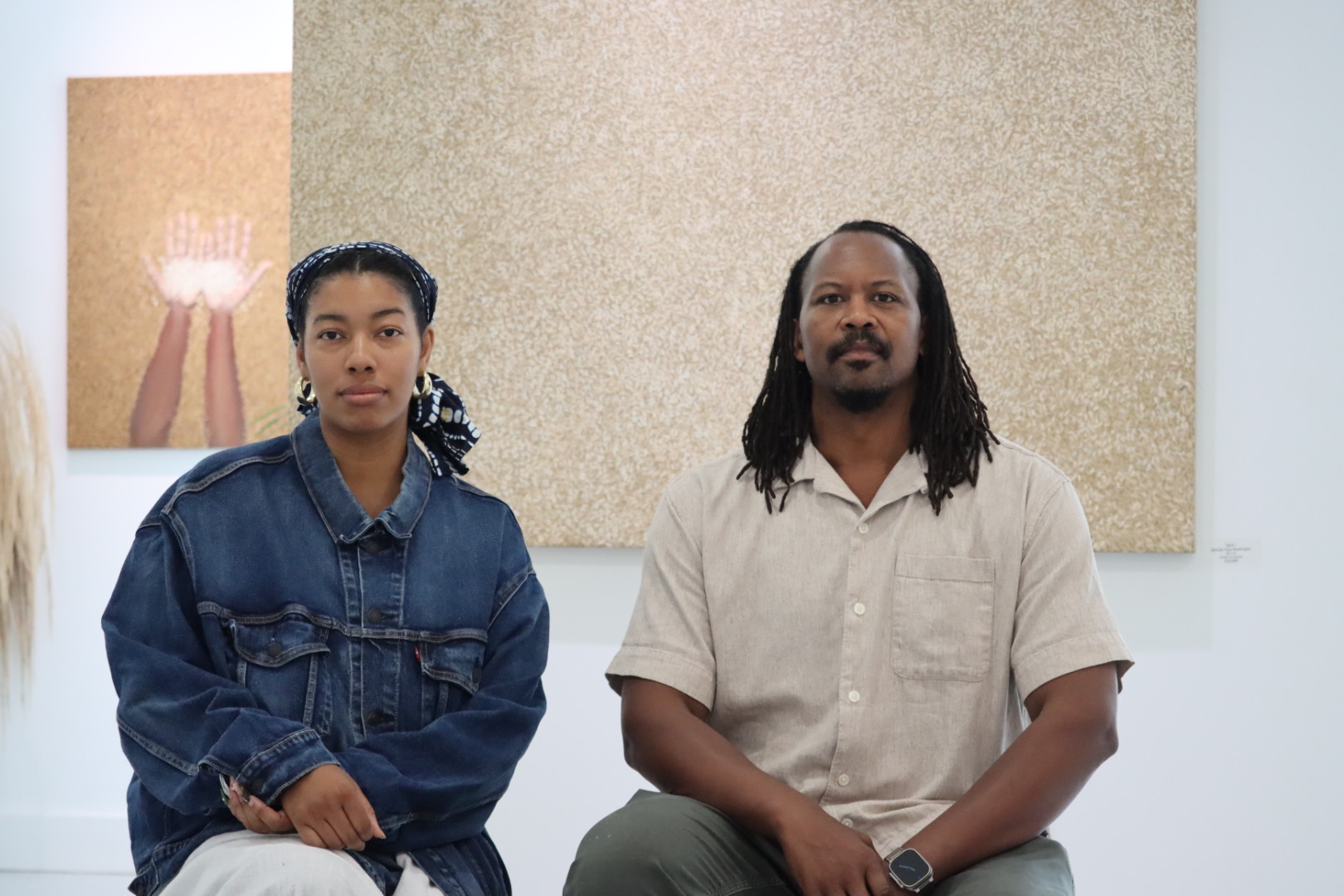
Washington’s latest exhibition, “Against the Grain,” confronts the human cost of the rice plantation economy in the Lowcountry. The exhibition debuted at Drummond Studio Gallery on May 22 for the Piccolo Spoleto 2026 festival.
Washington revealed her creative process during an artist talk on Friday. The show remains on display until June 12.
“Against the Grain” is a 23-piece collection centered on rice. The exhibition explores the exploitative side of American history as this year’s Spoleto Festival USA and Piccolo Spoleto coincide with celebrations of the nation’s 250th anniversary.
It’s serious, yet approachable. Walking into the studio is an emotional gambit as each work tells the story of enslaved labor with intricate shading, layering and neutral tones.
The series marks Washington’s first solo show in the state. Originally from Pasadena, California, Washington moved to Charleston nearly two years ago and has only been involved in the local art scene for half of that time. A visit to Middleton Place last summer sparked Washington’s inspiration for “Against the Grain.”
“The scenery was similar, but the feeling that I got off it was a lot different than when I would visit other horticulture spaces, other gardens,” Washington said during the talk. “And so this kind of came about trying to resonate with that feeling.”
Charleston’s wealth was built on rice. Beginning in the late 1600s, rice plantations shaped and reshaped the Lowcountry’s geography and economy, making Charleston one of the wealthiest cities in the world. Plantations such as Middleton Place depended on enslaved labor.
Studio owner Arun Drummond had a completely different series planned for Piccolo, but when “Against the Grain” came into his periphery, he pivoted.
“I wanted to make sure that on the biggest festival stage that African American voices were heard,” Drummond said.
Drummond has been involved in the local art scene for 22 years. His newly opened studio is a metaphor for the title of the show, he said. It goes against the grain to provide spaces for stories like these to be heard.
The energy in the room completely shifted when Washington first brought her work in, Drummond recalled.
“You could feel the presence of those paintings when they weren’t even hung,” Drummond said. “And that’s when I knew we were on to something special.”
Some pieces feature feet and hands submerged in rice, representing the labor behind the commodity. Others, such as “Native Species,” offer what Washington calls “glimmers of hope.” The circular piece features an Eastern tiger swallowtail butterfly layered atop rice, symbolizing freedom.
Washington omitted few details in the collection. Painted rice grains even trickle onto the sides of the canvases. Her paint palettes — swirls of neutral tones with occasional pops of color — are also for sale.
The pieces “Ague” and “Ague II” represent the three- to seven-year life expectancy of enslaved people on rice plantations because of malaria. Tiny black mosquitoes hide among a sea of rice grains. The larger works remind viewers of the consequences of the living conditions endured by enslaved people.
It took Washington about six months to create the series. A single layer of rice in “Ague” took 36 hours to complete. Three more layers followed. She said the layering process intimidated her at first. After finishing the first piece, “The Price of Rice,” she found the confidence to continue.
“I was like, ‘okay, this is a little bit more physical,’ that process,” Washington said during the talk. “‘I was just like, all right, we’re going to do this.’ And I just started working in the rice.”
Developing “Against the Grain” was different stylistically for Washington. Most of her previous work focuses on portraiture. Her piece, “Genesis,” a portrait of her friend and fellow artist Genesis Tramaine, received an honorable mention at the Piccolo Spoleto juried art show at City Gallery.
“Resting Place” is the only piece featuring portraiture. A mound of rice swallows a tired face. With only a sliver of a face showing, one can feel the heaviness of the story it tells.
“It just takes a few people to take a stand, few people to acknowledge injustice, few people to set the course of rectifying wrongs,” Washington said. “This is the way in which I am able to do it, through the gifts that I have.”
Older works of Washington’s also tend to be bold in color. But this series, she intended to feel grounded. The color tones in the series blend like an earthy mosaic made of rice. “Shades,” a smaller section of the series, offers a sprinkle of colors like indigo and moss green.
“We are not operating from the antiquated ways that the museum and the gallery systems have been set up so far,” Drummond said. “We’re making our own rules, and we’re giving folks a seat at the table that they wouldn’t normally have one.”
More of her work can be found around the city. One of her portraits is on display at City Gallery. Redux Contemporary Art Center features three charcoal portraits, and The College of Charleston’s Avery Research Center will debut another charcoal piece on June 9.
“Against the Grain” is not in its final state. James Island’s renovated Mosquito Beach hotel will feature some of Washington’s rice paintings. This commissioning will draw a closer look at the Jim Crow Era, when Mosquito Beach served as one of the few beaches accessible to Charleston’s Black community.
Washington plans to continue the series with a new installment. Having mastered shading — a technique that once intimidated her — she wants to explore indigo as a theme. She also hopes to incorporate more fauna, portraiture and family history.
On her father’s side, Washington’s family once worked as sharecroppers in Louisiana. Her mother’s family migrated from Jamaica, where her ancestors relied on rice grown in the Carolinas.
“This is not just South Carolina history; this is American history, it’s world history,” Washington said. “And the impact it has had is as prevalent as rice.”
No matter the focus of future installments, Washington’s goal remains the same: fostering dialogue and education around the legacy of labor. “Against the Grain” is ultimately a story of resilience.
“Rice, even though it’s so small, seems really insignificant,” Washington said during the talk. “It represents choices that we make that may seem small or, individually, not very impactful, but, culminated together, it has a big impact even on the trajectory of the world.”
IF YOU WANT TO GO:
“Against the Grain” is on view at Drummond Studio Gallery at 12 Line Street from 10:00 a.m. to 2:00 p.m now through June 12.
Contact the studio for a private showing. There will be a closing reception on June 12.
Read more from The Island Packet
