




Tomorrow’s Tech, Today: Innovation That Moves Us Forward
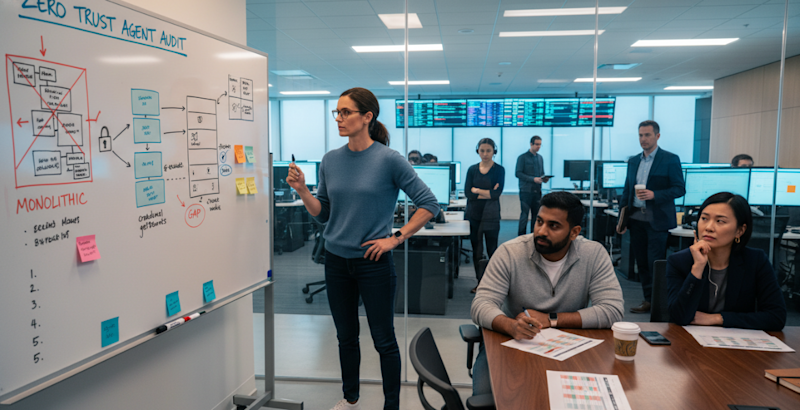
- Monolithic agents store model, execution, and credentials together, enabling prompt injection to exfiltrate tokens and compromise connected services.
- Anthropic Managed Agents split brain, hands, and session; credentials remain in an external vault, so compromised sandboxes yield nothing reusable.
- Nvidia NemoClaw layers kernel sandboxing, intent verification, and real-time observability, but some messaging tokens are injected into the sandbox.
- The crucial divide is credential proximity: structural removal eliminates single-hop exfiltration; policy-gating reduces but does not eliminate exposure.
- Operational priorities: audit agents for in-sandbox tokens, require credential isolation, verify session recovery, staff observability, and track indirect prompt injection roadmaps.
Four separate RSAC 2026 keynotes arrived at the same conclusion without coordinating. Microsoft’s Vasu Jakkal told attendees that zero trust must extend to AI. Cisco’s Jeetu Patel called for a shift from access control to action control, saying in an exclusive interview with VentureBeat that agents behave “more like teenagers, supremely intelligent, but with no fear of consequence.” CrowdStrike’s George Kurtz identified AI governance as the biggest gap in enterprise technology. Splunk’s John Morgan called for an agentic trust and governance model. Four companies. Four stages. One problem.
Matt Caulfield, VP of Product for Identity and Duo at Cisco, put it bluntly in an exclusive VentureBeat interview at RSAC. “While the concept of zero trust is good, we need to take it a step further,” Caulfield said. “It’s not just about authenticating once and then letting the agent run wild. It’s about continuously verifying and scrutinizing every single action the agent’s trying to take, because at any moment, that agent can go rogue.”
Seventy-nine percent of organizations already use AI agents, according to PwC’s 2025 AI Agent Survey. Only 14.4% reported full security approval for their entire agent fleet, per the Gravitee State of AI Agent Security 2026 report of 919 organizations in February 2026. A CSA survey presented at RSAC found that only 26% have AI governance policies. CSA’s Agentic Trust Framework describes the resulting gap between deployment velocity and security readiness as a governance emergency.
Cybersecurity leaders and industry executives at RSAC agreed on the problem. Then two companies shipped architectures that answer the question differently. The gap between their designs reveals where the real risk sits.
The monolithic agent problem that security teams are inheriting
The default enterprise agent pattern is a monolithic container. The model reasons, calls tools, executes generated code, and holds credentials in one process. Every component trusts every other component. OAuth tokens, API keys, and git credentials sit in the same environment where the agent runs code it wrote seconds ago.
A prompt injection gives the attacker everything. Tokens are exfiltrable. Sessions are spawnable. The blast radius is not the agent. It is the entire container and every connected service.
The CSA and Aembit survey of 228 IT and security professionals quantifies how common this remains: 43% use shared service accounts for agents, 52% rely on workload identities rather than agent-specific credentials, and 68% cannot distinguish agent activity from human activity in their logs. No single function claimed ownership of AI agent access. Security said it was a developer’s responsibility. Developers said it was a security responsibility. Nobody owned it.
CrowdStrike CTO Elia Zaitsev, in an exclusive VentureBeat interview, said the pattern should look familiar. “A lot of what securing agents look like would be very similar to what it looks like to secure highly privileged users. They have identities, they have access to underlying systems, they reason, they take action,” Zaitsev said. “There’s rarely going to be one single solution that is the silver bullet. It’s a defense in depth strategy.”
CrowdStrike CEO George Kurtz highlighted ClawHavoc (a supply chain campaign targeting the OpenClaw agentic framework) at RSAC during his keynote. Koi Security named the campaign on February 1, 2026. Antiy CERT confirmed 1,184 malicious skills tied to 12 publisher accounts, according to multiple independent analyses of the campaign. Snyk’s ToxicSkills research found that 36.8% of the 3,984 ClawHub skills scanned contain security flaws at any severity level, with 13.4% rated critical. Average breakout time has dropped to 29 minutes. Fastest observed: 27 seconds. (CrowdStrike 2026 Global Threat Report)
Anthropic separates the brain from the hands
Anthropic’s Managed Agents, launched April 8 in public beta, split every agent into three components that do not trust each other: a brain (Claude and the harness routing its decisions), hands (disposable Linux containers where code executes), and a session (an append-only event log outside both).
Separating instructions from execution is one of the oldest patterns in software. Microservices, serverless functions, and message queues.
Credentials never enter the sandbox. Anthropic stores OAuth tokens in an external vault. When the agent needs to call an MCP tool, it sends a session-bound token to a dedicated proxy. The proxy fetches real credentials from the vault, makes the external call, and returns the result. The agent never sees the actual token. Git tokens get wired into the local remote at sandbox initialization. Push and pull work without the agent touching the credential. For security directors, this means a compromised sandbox yields nothing an attacker can reuse.
The security gain arrived as a side effect of a performance fix. Anthropic decoupled the brain from the hands so inference could start before the container booted. Median time to first token dropped roughly 60%. The zero-trust design is also the fastest design. That kills the enterprise objection that security adds latency.
Session durability is the third structural gain. A container crash in the monolithic pattern means total state loss. In Managed Agents, the session log persists outside both brain and hands. If the harness crashes, a new one boots, reads the event log, and resumes. No state lost turns into a productivity gain over time. Managed Agents include built-in session tracing through the Claude Console.
Pricing: $0.08 per session-hour of active runtime, idle time excluded, plus standard API token costs. Security directors can now model agent compromise cost per session-hour against the cost of the architectural controls.
Nvidia locks the sandbox down and monitors everything inside it
Nvidia’s NemoClaw, released March 16 in early preview, takes the opposite approach. It does not separate the agent from its execution environment. It wraps the entire agent inside four stacked security layers and watches every move. Anthropic and Nvidia are the only two vendors to have shipped zero-trust agent architectures publicly as of this writing; others are in development.
NemoClaw stacks five enforcement layers between the agent and the host. Sandboxed execution uses Landlock, seccomp, and network namespace isolation at the kernel level. Default-deny outbound networking forces every external connection through explicit operator approval via YAML-based policy. Access runs with minimal privileges. A privacy router directs sensitive queries to locally-running Nemotron models, cutting token cost and data leakage to zero. The layer that matters most to security teams is intent verification: OpenShell’s policy engine intercepts every agent action before it touches the host. The trade-off for organizations evaluating NemoClaw is straightforward. Stronger runtime visibility costs more operator staffing.
The agent does not know it is inside NemoClaw. In-policy actions return normally. Out-of-policy actions get a configurable denial.
Observability is the strongest layer. A real-time Terminal User Interface logs every action, every network request, every blocked connection. The audit trail is complete. The problem is cost: operator load scales linearly with agent activity. Every new endpoint requires manual approval. Observation quality is high. Autonomy is low. That ratio gets expensive fast in production environments running dozens of agents.
Durability is the gap nobody’s talking about. Agent state persists as files inside the sandbox. If the sandbox fails, the state goes with it. No external session recovery mechanism exists. Long-running agent tasks carry a durability risk that security teams need to price into deployment planning before they hit production.
The credential proximity gap
Both architectures are a real step up from the monolithic default. Where they diverge is the question that matters most to security teams: how close do credentials sit to the execution environment?
Anthropic removes credentials from the blast radius entirely. If an attacker compromises the sandbox through prompt injection, they get a disposable container with no tokens and no persistent state. Exfiltrating credentials requires a two-hop attack: influence the brain’s reasoning, then convince it to act through a container that holds nothing worth stealing. Single-hop exfiltration is structurally eliminated.
NemoClaw constrains the blast radius and monitors every action inside it. Four security layers limit lateral movement. Default-deny networking blocks unauthorized connections. But the agent and generated code share the same sandbox. Nvidia’s privacy router keeps inference credentials on the host, outside the sandbox. But messaging and integration tokens (Telegram, Slack, Discord) are injected into the sandbox as runtime environment variables. Inference API keys are proxied through the privacy router and not passed into the sandbox directly. The exposure varies by credential type. Credentials are policy-gated, not structurally removed.
That distinction matters most for indirect prompt injection, where an adversary embeds instructions in content the agent queries as part of legitimate work. A poisoned web page. A manipulated API response. The intent verification layer evaluates what the agent proposes to do, not the content of data returned by external tools. Injected instructions enter the reasoning chain as trusted context. With proximity to execution.
In the Anthropic architecture, indirect injection can influence reasoning but cannot reach the credential vault. In the NemoClaw architecture, injected context sits next to both reasoning and execution inside the shared sandbox. That is the widest gap between the two designs.
NCC Group’s David Brauchler, Technical Director and Head of AI/ML Security, advocates for gated agent architectures built on trust segmentation principles where AI systems inherit the trust level of the data they process. Untrusted input, restricted capabilities. Both Anthropic and Nvidia move in this direction. Neither fully arrives.
The zero-trust architecture audit for AI agents
The audit grid covers three vendor patterns across six security dimensions, five actions per row. It distills to five priorities:
-
Audit every deployed agent for the monolithic pattern. Flag any agent holding OAuth tokens in its execution environment. The CSA data shows 43% use shared service accounts. Those are the first targets.
-
Require credential isolation in agent deployment RFPs. Specify whether the vendor removes credentials structurally or gates them through policy. Both reduce risk. They reduce it by different amounts with different failure modes.
-
Test session recovery before production. Kill a sandbox mid-task. Verify state survives. If it does not, long-horizon work carries a data-loss risk that compounds with task duration.
-
Staff for the observability model. Anthropic’s console tracing integrates with existing observability workflows. NemoClaw’s TUI requires an operator-in-the-loop. The staffing math is different.
-
Track indirect prompt injection roadmaps. Neither architecture fully resolves this vector. Anthropic limits the blast radius of a successful injection. NemoClaw catches malicious proposed actions but not malicious returned data. Require vendor roadmap commitments on this specific gap.
Zero trust for AI agents stopped being a research topic the moment two architectures shipped. The monolithic default is a liability. The 65-point gap between deployment velocity and security approval is where the next class of breaches will start.
Read the full article on the original site
