


Close Menu
Savannah HeraldSavannah Herald
    • Home
    • News
      • Local
      • State
      • National
      • World
      • HBCUs
    • Events
    • Directories
    • Weather
    • Traffic
    • Jobs
    • Sports
    • Politics
    • Lifestyle
      • Faith
      • Senior Living
      • Health
      • Travel
      • Beauty
      • Fashion
      • Food
      • Art & Literature
    • Business
      • Real Estate
      • Entertainment
      • Investing
      • Education
    • Guides
      • Summer Camp Guide
      • Juneteenth Guide
      • Black History Savannah
      • MLK Guide Savannah
    We're Social
    • Twitter
    • Facebook
    • YouTube

    Subscribe to Updates

    Get the latest creative news from FooBar about art, design and business.

    Trending
    • Off-Roading Adventures for Black Americans’ Physical and Mental Well-Being
    • Alicia Keys to Perform “Empire State of Mind” at Knicks Championship Celebration
    • Jelly Roll: Daughter Speaks As Fans React To Bunnie XO Divorce
    • MEAC adds women’s flag football and women’s golf
    • 10 Executive Branding Strategies | Obsidi®
    • JD Vance Faces off With ‘The View’ Hosts, Defends Trump Policies
    • Laughlin wins Work-Based Learning scholarship
    • The ‘Black Chef Series’ Is Turning Juneteenth Jubilee Into A Movement On Martha’s Vineyard –
    Facebook X (Twitter) Instagram YouTube
    Login
    Savannah HeraldSavannah Herald
    Savannah HeraldSavannah Herald
    Home » AI job losses: Look up which workers are most vulnerable
    Tech

    AI job losses: Look up which workers are most vulnerable

    Savannah HeraldBy Savannah HeraldMarch 16, 20267 Mins Read
    Facebook Twitter Pinterest LinkedIn WhatsApp Reddit Tumblr Email
    AI job losses: Look up which workers are most vulnerable
    Share
    Facebook Twitter LinkedIn Pinterest Email

    Tech Trends & Innovation: The Latest in Tech News

    Key takeaways
    • Many white collar tasks, including programming, marketing, financial analysis, and customer service, have high AI exposure.
    • A smaller group faces low adaptability: largely female clerical and administrative workers, like secretaries, who may struggle to find comparable jobs.
    • Economists and researchers urge humility; conflicting studies from Stanford, Anthropic, and others make precise forecasts unreliable.
    • History shows automation both destroys and creates work; policy should prioritize retraining and support for low-adaptability workers.

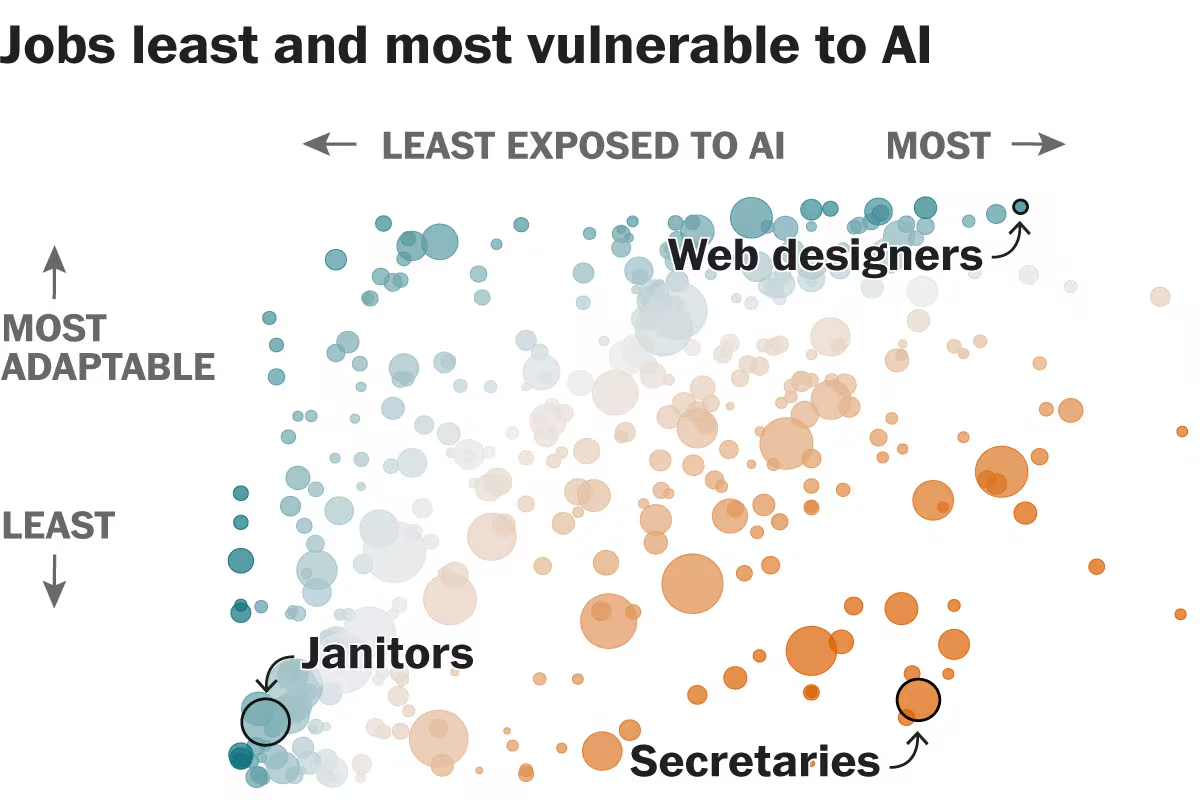
    No one has a perfect road map to the future, but researchers at GovAI, which studies technology policy, and the Brookings Institution, a Washington think tank, used a novel approach to estimate which workers may be most and least able to adapt to AI.

    They concluded that many people most at risk if AI transforms work are also the best placed to find new jobs. You can use the search box and interactive chart above to explore which occupations may have bright prospects and which may not.

    But history shows that economists and researchers have been terrible at predicting the effects of new technologies on work and workers, so take forecasts like this one seriously but not literally. Even researchers cranking out studies of AI in workplaces caution that they’re making useful but fallible best guesses.

    “All the important questions about AI’s effects on the labor market are still unanswered,” Jed Kolko, a senior fellow at the Peterson Institute for International Economics, recently concluded. Economists at Anthropic, the AI start-up behind the Claude chatbot, stressed the need for “humility” in their analysis of AI seeping into occupations. (Humility is uncommon in Silicon Valley.)

    Sifting through reports about AI-related job displacement will make you dizzy with the apparent contradictions.

    One influential Stanford University analysis last year found it’s probable that AI is bleeding jobs from young people in occupations such as software development and customer service, where AI adoption has been fastest. Different research, from the Economic Innovation Group think tank, essentially concluded the opposite, that young workers in those occupations were faring better than their peers in less AI-exposed fields such as fitness training and roofing.

    The Federal Reserve Bank of Dallas has said it’s unlikely AI is coming for jobs in the next decade, while prominent CEOs keep predicting that AI will put millions of people out of work soon.

    A flood of sometimes conflicting analyses shows the yawning gap between what little is known about how AI is changing work and everyone’s understandable hunger for certainty. The divide lets Americans, business leaders and policymakers cherry-pick their preferred narratives. If you’re afraid of being cast aside for AI, there’s informed and uninformed evidence to fuel your nightmares. There’s plenty of support, too, if your think your job is safe.

    Two points of general agreement stand out: There’s no measurable evidence so far that AI is putting Americans as a whole out of work, economists say. And while the victims of past workplace automation were mostly factory and trade workers, it’s white collar jobs that are first in line for AI shake-ups today.

    That’s where the recent research, led by Sam Manning, a senior research fellow at GovAI, and his colleague Tomás Aguirre, took a novel approach.

    They started with an industry-standard measure of more than 350 occupations’ AI “exposure.” That estimates how many job-related tasks a worker can plausibly do more efficiently with AI, such as a teacher grading homework.

    Those estimates find that skills used in computer programming, marketing, financial analysis and customer service have high overlap with AI capabilities, and therefore in theory workers might be more easily replaced by machines. (There are spicy debates in economics over measuring AI “exposure” and whether high AI exposure helps or hurts workers.)

    The researchers went one step further and also sought to quantify how easily people within occupations could shift to other good-paying work if AI killed their jobs. The researchers figured that people with more education and varied work experience could more easily switch occupations, and that it would help to be wealthier, under 55 years old and live in cities where jobs are plentiful.

    While web designers and secretaries both scored high in the research for exposure to AI, they diverged in their estimated ability to adapt. Secretaries were among the 6.1 million largely clerical and administrative workers considered both highly exposed to AI and with the lowest estimated adaptability, Manning and Aguirre found. (Manning is also affiliated with the technology policy research group the Foundation for American Innovation.)

    The young woman at left works as a secretary in a New York City office in 1947. (Eric Schwab/AFP/Getty Images)

    The findings suggest that the majority of workers whose jobs may be transformed by or lost to AI can bounce back. But a smaller share of workers may have a harder time finding new jobs.

    Women make up about 86 percent of those most vulnerable workers, the researchers said, suggesting the negative effects of automation won’t be borne equally across society.

    Mark Muro, a senior fellow at Brookings who assessed the policy relevance of the research, said the most vulnerable workers “may be out of sight and out of mind” to policymakers and the American public. The researchers cautioned that it’s hard to accurately assess the likelihood of people finding other jobs.

    Job held mostly by women

    By men

    4M workers100k

    Sources: GovAI and Brookings Institution

    Allison Elias, a professor at the University of Virginia business school, said that previous technology shifts show why people in female-dominated clerical occupations might be on the losing end of the AI revolution.

    In her historical research, secretaries and other administrative staff often hoped that new technologies would free them to do higher-level work and help advance their careers. Instead, she said, workers were often expected to do more work for the same or lower pay. They continued to report low levels of job satisfaction.

    “These people are really vulnerable because they won’t have a lot of decisions over how AI is used, and their exit opportunities are going to be pretty low,” said Elias, who was not involved in the GovAI and Brookings analysis.

    Economists say it’s nearly impossible to forecast AI’s effect on the labor market from the current capabilities of the technology or the business sectors it’s seeping into first. And they point to the track record of past technology revolutions, such as electricity and smartphones, that eliminated some types of jobs but also created new work and economic growth few foresaw.

    The predictions mostly didn’t pan out from a prominent study more than a decade ago that estimated nearly half of jobs could be destroyed by computer automation. Forecasts were off base that ATMs would wipe out bank tellers, that earlier forms of AI would decimate radiologists and that player pianos would kill the jobs of pianists. Few people imagined that smartphones would usher in new jobs in social media marketing and influencing. And you’re probably not experiencing the 15-hour workweek that economist John Maynard Keynes forecasted in 1930.

    “We do not have a good track record of predicting how technological change will play out in the labor market,” said Martha Gimbel, executive director of the Budget Lab at Yale University. It would have been hard to predict that the invention of electricity would lead to the new occupation of elevator operators, and that a subsequent innovation — “buttons,” she said — would wipe out those jobs.

    Some of the 300 operators and supervisors required to run the switchboard at the Pentagon in Arlington, Virginia, in 1942. (AP)

    Another extinct occupation, telephone switchboard operators, offers reasons for both hope and pessimism about AI’s effects. It was once one of the most common jobs for American women, but jobs were wiped out as telephones modernized starting in the early 20th century, according to a research paper published in 2024 by James Feigenbaum and Daniel Gross.

    Switchboard operators who lost their jobs were far more likely than their peers to never find other work or to take lower-paying jobs, the research found. But within years, new opportunities opened for young women as secretarial and restaurant work boomed. “I read that as somewhat hopeful,” Feigenbaum, a Boston University economic historian, said in an interview.

    Feigenbaum doesn’t buy the argument that AI will be much different for American workers than prior technology revolutions. The invention of electricity, the internal combustion engine and the internet were massively transformative technologies, he said, and “that didn’t eliminate all jobs.”

    Taylor Telford contributed to this report.

    Read the full article from the original source


    AI and Machine Learning artificial intelligence Consumer Electronics Cybersecurity Updates Data Privacy Digital Trends Enterprise Technology Future of Work Gadget Reviews Green Tech Mobile Tech Robotics News Science and Technology Silicon Valley News Software Development Startups and Tech Tech Industry Insights Tech Innovation Tech Policy Technology News
    Share. Facebook Twitter Pinterest LinkedIn WhatsApp Reddit Tumblr Email
    Savannah Herald
    • Website

    Related Posts

    Tech June 17, 2026

    10 Executive Branding Strategies | Obsidi®

    Tech June 16, 2026

    What Are Google Gemini Gems?

    Tech June 16, 2026

    Scottish minister clarifies police facial-recognition approach

    Investing June 16, 2026

    Big Questions for Warsh as New Era for the Fed Begins

    Tech June 16, 2026

    Intel CPUs with Nvidia RTX integrated graphics are targeting an early 2028 release

    Tech June 15, 2026

    This Ultra-Thin Inspection Borescope With iPhone & Android Support Is 50% Off For Limited Time

    Comments are closed.

    Don't Miss
    Local October 2, 2025By Savannah Herald02 Mins Read

    Chatham County – New Flood Insurance Rate Maps

    October 2, 2025

    City of Pooler Neighborhood Update: Uploaded 9/ 12/ 2025 The Department of Homeland Safety and…

    CAT Reaffirms Zero Tolerance Policy After Assault On Bus Operator And Passenger – Chatham Area Transit (CAT)

    February 28, 2026

    Superman Stars Share Insights on Roles in Summer Blockbuster

    September 3, 2025

    How a SCOTUS Decision on Birthright Citizenship Could Impact Education Access

    April 5, 2026

    Early Sauropodomorph Dinosaur Unearthed in China

    May 4, 2026
    Archives
    • June 2026
    • May 2026
    • April 2026
    • March 2026
    • February 2026
    • January 2026
    • December 2025
    • November 2025
    • October 2025
    • September 2025
    • August 2025
    • July 2025
    • June 2025
    • May 2025
    • April 2025
    • March 2025
    • February 2025
    Categories
    • Art & Literature
    • Beauty
    • Black History
    • Business
    • Climate
    • Culture
    • Education
    • Employment
    • Entertainment
    • Faith
    • Fashion
    • Food
    • Gaming
    • Georgia Politics
    • HBCUs
    • Health
    • Health Inspections
    • Investing
    • Lifestyle
    • Local
    • Lowcountry News
    • National
    • National Opinion
    • News
    • Politics
    • Real Estate
    • Senior Living
    • Sports
    • State
    • Tech
    • Traffic
    • Transportation
    • Travel
    • World
    Savannah Herald Newsletter

    Subscribe to Updates

    A round up interesting pic’s, post and articles in the C-Port and around the world.

    About Us
    About Us

    The Savannah Herald is your trusted source for the pulse of Coastal Georgia and the Low County of South Carolina. We're committed to delivering timely news that resonates with the African American community.

    From local politics to business developments, we're here to keep you informed and engaged. Our mission is to amplify the voices and stories that matter, shining a light on our collective experiences and achievements.
    We cover:
    🏛️ Politics
    💼 Business
    🎭 Entertainment
    🏀 Sports
    🩺 Health
    💻 Technology
    Savannah Herald: Savannah's Black Voice 💪🏾

    Our Picks

    “Freedom and Abolition Went Together”: Julia Gaffield on Jean-Jacques Dessalines

    November 6, 2025

    NPR asks court to quit CPB from taking cash for satellite system far from NPR: NPR

    May 14, 2026

    I Tried the Internet’s Favorite Curly Hair Routine

    November 16, 2025

    CAT Service Changes Expected for St. Patrick’s Day; City of Savannah Sponsors Free Rides – Savannah Herald

    March 12, 2026

    Diddy’s Prison Sentence: Impact and Implications

    May 23, 2026
    Categories
    • Art & Literature
    • Beauty
    • Black History
    • Business
    • Climate
    • Culture
    • Education
    • Employment
    • Entertainment
    • Faith
    • Fashion
    • Food
    • Gaming
    • Georgia Politics
    • HBCUs
    • Health
    • Health Inspections
    • Investing
    • Lifestyle
    • Local
    • Lowcountry News
    • National
    • National Opinion
    • News
    • Politics
    • Real Estate
    • Senior Living
    • Sports
    • State
    • Tech
    • Traffic
    • Transportation
    • Travel
    • World
    Copyright © 2002-2026 Savannahherald.com All Rights Reserved. A Veteran-Owned Business

    Type above and press Enter to search. Press Esc to cancel.

    Manage Consent
    To provide the best experiences, we use technologies like cookies to store and/or access device information. Consenting to these technologies will allow us to process data such as browsing behavior or unique IDs on this site. Not consenting or withdrawing consent, may adversely affect certain features and functions.
    Functional Always active
    The technical storage or access is strictly necessary for the legitimate purpose of enabling the use of a specific service explicitly requested by the subscriber or user, or for the sole purpose of carrying out the transmission of a communication over an electronic communications network.
    Preferences
    The technical storage or access is necessary for the legitimate purpose of storing preferences that are not requested by the subscriber or user.
    Statistics
    The technical storage or access that is used exclusively for statistical purposes. The technical storage or access that is used exclusively for anonymous statistical purposes. Without a subpoena, voluntary compliance on the part of your Internet Service Provider, or additional records from a third party, information stored or retrieved for this purpose alone cannot usually be used to identify you.
    Marketing
    The technical storage or access is required to create user profiles to send advertising, or to track the user on a website or across several websites for similar marketing purposes.
    • Manage options
    • Manage services
    • Manage {vendor_count} vendors
    • Read more about these purposes
    View preferences
    • {title}
    • {title}
    • {title}
    Ad Blocker Enabled!
    Ad Blocker Enabled!
    Our website is made possible by displaying online advertisements to our visitors. Please support us by disabling your Ad Blocker.

    Sign In or Register

    Welcome Back!

    Login below or Register Now.

    Lost password?

    Register Now!

    Already registered? Login.

    A password will be e-mailed to you.