




From Hollywood to Home: Black Voices in Entertainment
- Denim Tears frames clothing as image and history, garments carrying Black stories and reverence.
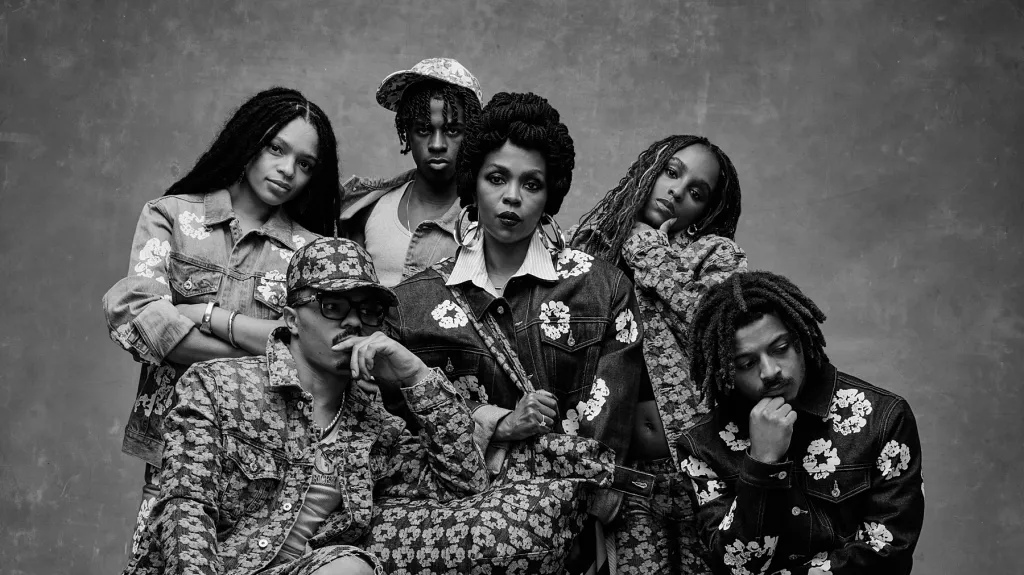
- Lauryn Hill joined the Spring/Summer 2026 shoot with most of her children, giving the campaign familial reverence and emotional weight.
- The cotton wreath evolved into a talisman for America; bootlegs extended its reach, and Tremaine Emory accepts diverse reactions as valid.
- Tremaine Emory's Queens upbringing, family history, and years in London sharpened his view of America's promise and brutality.
- Tremaine Emory rejects limiting assumptions, refuses labels like athlete or angry Black man, insisting he is first an artist and a human being.
Designer Tremaine Emory never intended for Denim Tears to speak only to one corner of the culture. When asked about the brand’s relationship to Black imagery and Black audiences, he widens the frame. “Denim Tears speaks to the world,” he says. “It speaks to America and the world. Because Black culture influences all cultures, and it’s also influenced by all cultures. And when you talk about African Americans, we are American. America is us. It’s not separated.”
That idea sits at the center of Denim Tears: clothing as image, image as history, history as something you carry, whether or not it makes people comfortable. It’s why Lauryn Hill appearing with her children in the brand’s Spring/Summer 2026 campaign felt natural, like a family portrait.
“Everything comes from the gut,” Emory says of enlisting Hill for the campaign. “I have a friendship with her daughter. And so it was very natural. It wasn’t really calculated.” The way Emory tells it, the idea arrived almost casually: “Oh, you know what? Is your mom down?”
Hill agreed to participate, but with a condition that became the emotional core of the shoot: She wanted all of her kids in the photos. Ultimately, her son Zion couldn’t make it, but five of Hill’s six children were present. “It’s deep, the reverence of the shoot and how amazing the family looked and what they represent,” Emory says. “Ms. Hill was just a beautiful human to be around. There was a lot of love on that set.”
Reverence is a word that comes up repeatedly in Emory’s conversations. Reverence for family. Reverence for Black cultural history. Reverence for the stories embedded in clothing. But he is careful about what Denim Tears does and does not represent. Though he launched its first collection in 2019 on the 400th anniversary of slavery’s start in America, with a cotton-floral motif at its center, “the brand doesn’t represent slavery,” he says. “The brand represents the breadth that’s in the glory and the plight of Black people and the stories that come from it.”
The cotton wreath, Denim Tears’ most recognizable symbol, has become one of the most widely circulated images in contemporary fashion. Bootlegs have taken on their own afterlife. Emory does not sound bothered. “Meaning hasn’t changed,” he says. “For me, it is as I created it eight, nine years ago: The cotton wreath is a talisman for America. Nothing more, nothing less.”
And the more people wear it, the farther that message travels. “I love the bootlegs,” he says. “I have friends and family that get upset about it, but I hung out with a friend who sees the bootlegs in Nairobi. Think about that.”
Lauryn Hill and Denim Tears founder Tremaine Emory
Liam McRae and Justin Sarinana/Courtesy of Denim Tears
For Emory, that distance matters. He’s from Queens — “southside Jamaica” specifically. His family is from Harlem, Georgia: “A thousand people, small town.” The fact that an image born from his own family’s history and America’s unfinished business can move through the world is not something he takes lightly.
He thinks back to his grandmother, who died a few years ago. “When the Ku Klux Klan used to walk through Harlem, Georgia, my grandfather would bring her to the porch and he’d have his gun and he’d sit on the porch and tell her, ‘Don’t be scared. These guys are cowards. That’s why they wear hoods.’”
To Emory, the United States has always contained its promise and its brutality at the same time — whether back then or today. “America does great things, and America does horrible things,” he says. “So there’s nothing new. There’s nothing surprising.”
Living outside of the U.S. sharpened that understanding. In 2010, Emory moved to London to work for Marc Jacobs. When he returned to New York in 2018, he “saw America in a different way,” he says. “That was not because America changed. It was because I lived outside of America for eight years.”
Post-London, Emory served as a creative consultant for Kanye West, and then spent several years at Supreme. But he is not sure Denim Tears would exist in the same form had he never left the States. “I got to see my country from, I don’t know, from the moon,” he says. “It made me feel things more.”
That is why criticism of the cotton wreath does not move him the way it once might have. “People are entitled to their opinions,” he says. “If someone doesn’t like the cotton wreath or it hurts them, that’s valid. Someone loves it and inspires them, that’s valid. If someone thinks it’s ugly, that’s valid. So I don’t care.”
What he can do is explain the intention. “The only thing I could say if someone’s interested is: The cotton wreath’s a talisman for America. It’s what America was built on.”
For Emory, the abstraction is also daily and personal. “I flew to Europe last week,” he says, citing an example. “Can’t tell you how many times I got asked in business class if I was an athlete.”
He pauses on the insult buried inside the assumption. “And it’s like, ‘I’m just supposed to eat that,’” he says. “No, I’m actually a fucking worldwide artist. More important, I’m a human being.” Then he says it plainly: “I could be anything. Why do you think I’m an athlete? But then if I get into that conversation, I’m too woke. I’m an angry Black man. Actually, no, I suck at basketball, and I’m great at art.”
This feature appears in VIBE’s Summer 2026 print issue.
Read the full article on the original site
