




Local Hilton Head News Update:
- Mitchelville began in 1862 as a self-governing village where formerly enslaved built education, property ownership, civic life, faith, and family.
- New Archaeological Research Facility and Auditorium restore the wooded Mitchelville site, enhancing interpretation, research, and public education about Gullah heritage.
- Recognition grows through films like The Spirit We Move With, community projects, government support, and philanthropy such as the Mellon Foundation.
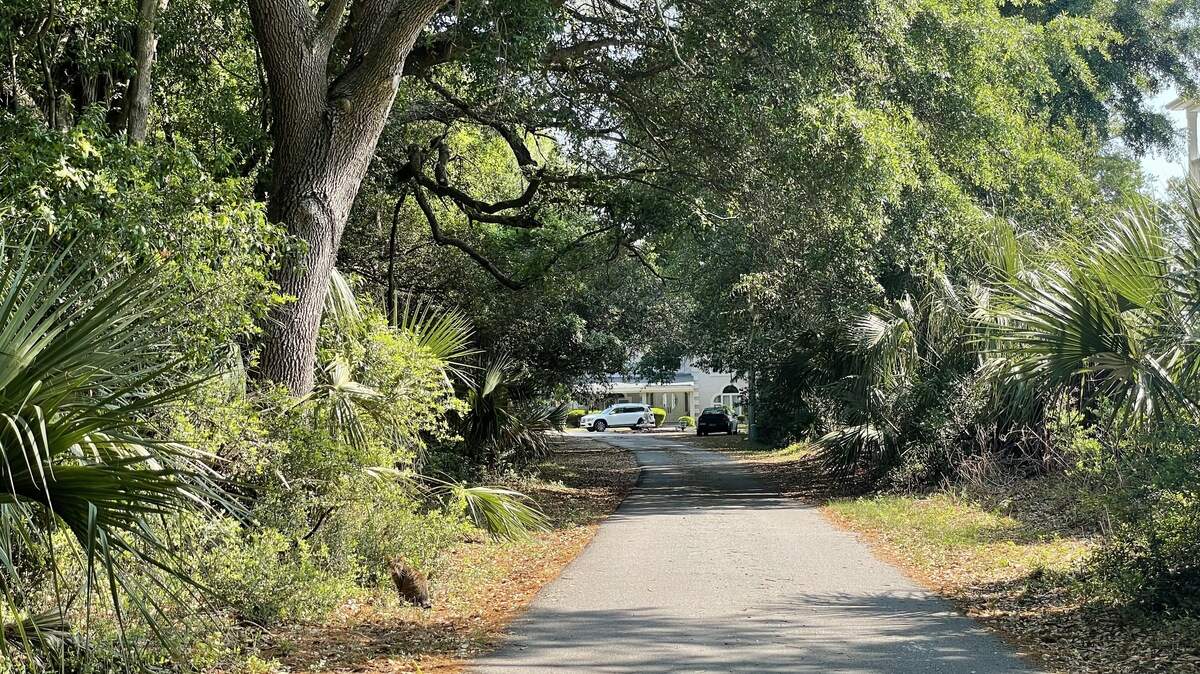
A shaded driveway in the Mitchelville District leads to a home and a hidden historic graveyard.
lkhan@islandpacket.com
A day like this comes around only once every 164 years.
Let history note that on sunny Oct. 28, 2026, a large group attended a ribbon cutting ceremony for the first permanent building in the Historic Mitchelville Freedom Park on Hilton Head Island.
“Mitchelville stands as one of the most important communities in the story of American freedom,” reads a sign unveiled by park executive director Ahmad Ward. It lists reasons the Mitchelville story is now available for lessons in schools across the state.
“Through Historic Mitchelville Freedom Park, visitors today can explore a legacy shaped by education, civic engagement, opportunity and the determination to build a better future.”
Those were all elements in the self-governing village established in 1862 near Port Royal Sound along what we call Beach City Road. It is where freedom began.
Mitchelville came to life rapidly on land occupied by Union forces during the Civil War – long before the formerly enslaved were freed constitutionally, and even before the final Emancipation Proclamation was issued.
Now the new Archaeological Research Facility and Auditorium gives a stronger sense of place to the wooded tract that once held 500 homes and gave many a place to become families and citizens and students and deacons.
In other words, a place to prove that the widely accepted arguments for slavery were all wrong.
Such recognition of Mitchelville’s place in Hilton Head and American history has long been a vision for the likes of Thomas C. Barnwell Jr. and other island elders who shouted into the wilderness that Mitchelville and the story of the island Gullah deserves to be explored, honored, told and retold.
That’s why Oct. 28, 2026 is historic.
And it is historic because society’s establishment seems finally to recognize that heritage, as seen at the ribbon cutting by representatives of the supportive town, county and state governments and the chamber of commerce. Ahmad Ward thanked the many supporters of the new building, especially the Mellon Foundation.
The ceremony follows other recent signs of progress in the spirit of Mitchelville: The award-winning documentary about Gullah heritage and resilience on Hilton Head called “The Spirit We Move With;” the groundbreaking for a new sanctuary for St. James Baptist Church; and Maj. Gen. William “Bill” Green Jr. Day on Oct. 10 to honor this son of Hilton Head for his honorable military career and service as the 26th Chief of Chaplains of the U.S. Army.
It all started with the people of Mitchelville.
The words of Louise Cohen, founder of the Gullah Museum of Hilton Head Island, ring in my ears: “Thank God for our forebears,” she said. “They had us in mind.”
The first ceremony
History has long noted another monumental ceremony at Mitchelville. It was 164 years ago – almost to the day.
On Sunday, Oct. 12, 1862, a small church, one of the first buildings erected in Mitchelville, was “consecrated to the worship of Almighty God.” The ceremony featured an address by one of America’s greatest orators, a small but supercharged man known as America’s father of astronomy before he became a war hero, U.S. Army Maj. Gen. Ormsby M. Mitchel.
Mitchel was new to the island, arriving Sept. 16, 1862 to head the Department of the South here. He jolted new life into the whole operation, and finding a way for the humane treatment and new opportunities for hundreds of the formerly enslaved who flocked to the island was near the top of his to-do list when he outlined the plan for Mitchelville.
Mitchel was invited to speak that day by Abraham Murchison, the pastor of that church we know as First African Baptist, the oldest institution on Hilton Head.
Mitchel said he “endeavored to utter words of encouragement and hope.”
His speech as relayed in a publication called “The American Missionary” in December 1862 centered on the importance of that moment in history. He told his audience that they bore a great responsibility, and they could not dare fail.
He said it was up to them to prove to the watching world what their race could do with, as he put it, “freedom, position, a home and your own families, wives, property, your own soil.
“You shall till and cultivate your own crops; you shall gather and sell the product of your industry for your own benefit; you shall own your own savings, and you shall be able to feel that God is prospering you from day to day and from year to year, and raising you to a higher level of goodness, religion and a nobler life.”
Eighteen days later, Ormsby Mitchel died of yellow fever.
But Mitchelville lived on, despite long odds against the village and its people. It served its purpose as the pillars that still bind the resilient Gullah people came to the fore: faith, property ownership, education and family.
May history look upon us kindly for this new day in Mitchelville.
David Lauderdale may be reached at lauderdalecolumn@gmail.com.
Read more on the original source
