




Business Insights: Global Markets, Strategy & Economic Trends
- Escalation between Iran and the United States ended the truce, raising severe maritime risk in the Strait of Hormuz.
- Attacks and U.S. reprisals sharply reduced transit; many rely on the Omani route escorted by U.S. military.
- Commercial operators face peril and uncertainty, with some avoiding Iranian waters and others risking the Omani route under military protection.
- A renewed shutdown could choke oil and gas flows, lifting fuel prices despite mitigation from pipelines, exports, and strategic stockpiles.
- Iran leverages maritime attacks to influence markets, learning from the Houthis and demonstrating capacity to shape energy prices.
Harry Vafias, a chief executive of a shipping company, recently got one of his vessels out of the Persian Gulf on a route protected by the U.S. military.
But after Iran and the United States attacked each other this week, all but ending the truce the countries agreed to last month, Mr. Vafias, the head of StealthGas, based in Athens, said he was holding off on moving another ship through the Strait of Hormuz.
“Things are becoming uglier by the minute,” he said in an email, “so we are not taking the other out till we see what happens.”
The factors that Mr. Vafias had to weigh typify the dilemma facing numerous other ship operators: They are eager to resume normal business but face great peril if they do. On Friday, an international body that assesses maritime risks reiterated the threat level in the strait as severe.
In the early days of the war, as many as 1,500 ships were stranded when Iran seized effective control of ship traffic in the strait. A deal signed in mid-June by President Trump and Iran’s president, Masoud Pezeshkian, offered hope that more ships would get through. And many did, ferrying supplies critical to global energy markets.
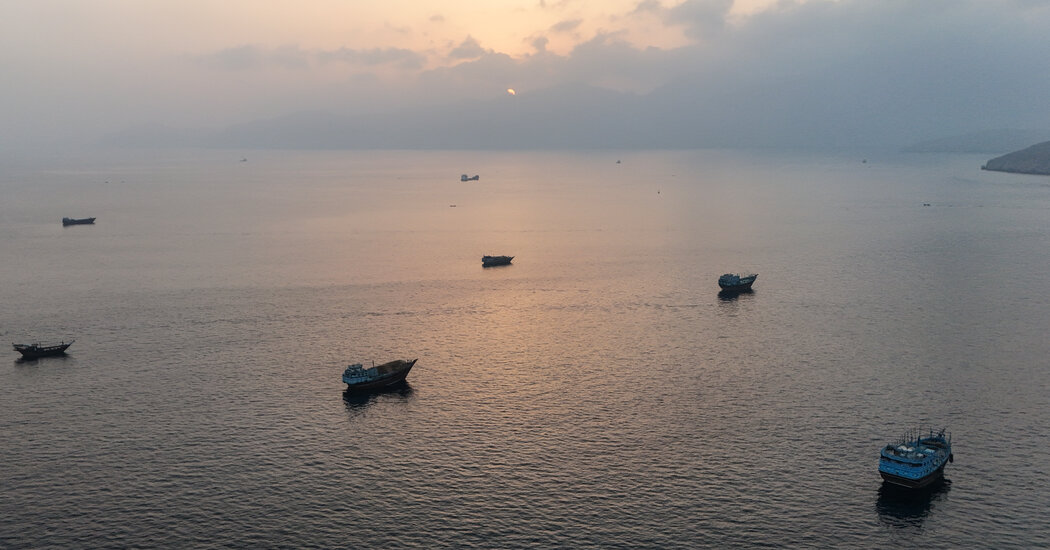
But even after the deal, Iran has continued to claim its waters as the only viable route. In response, ships made more use of paths close to Oman’s coastline, guided and protected by the United States military. The reliance on the Omani route has drawn Iran’s wrath. This week, after Iranian attacks on three vessels, the United States struck 170 targets in Iran in retaliation on Tuesday and Wednesday. Qatari mediators on Friday attempted to salvage the cease-fire.
“Iran would like there to be nothing flowing through the Omani lane, and they have not been able to stop all of what’s happening,” said Daniel Sternoff, a senior fellow at Columbia University’s Center on Global Energy Policy.
Iran’s ship attacks and the U.S. responses caused ship traffic to plummet from the levels reached after the June truce.
On Thursday, 22 ships went through the strait, the lowest level in three weeks, according to Kpler, a maritime data firm. More than 130 vessels passed through daily before the war.
If ship operators stay away, oil and gas flows out of the Persian Gulf could once again slow to a trickle. While the world has taken steps to deal with oil and gas shortages, another shutdown of the strait would again push up prices of gasoline and diesel for consumers.
On Friday, the International Energy Agency reported a “sharp” increase in global oil supply last month because ships had started moving again through the strait. But this week’s hostilities leave the outlook murky.
Now much hinges on whether ship operators will keep using the Omani route with American assistance.
Since early May, the United States has helped more than 800 commercial ships and 380 million barrels of crude oil through the strait, according to Capt. Tim Hawkins, a spokesman for the U.S. Central Command. Many of the vessels going through with U.S. assistance do so with their location trackers turned off, making it hard to independently verify the U.S. tallies.
Another option for ship operators is to seek Iran’s permission to transit the strait through its waters.
Mr. Vafias of StealthGas said he was not considering the Iranian route, which other European shipping companies had used in recent weeks. He said he was concerned that Iran could target the company because it is listed on a U.S. stock exchange. “We want to stay clear of Iranian waters,” he said.
The memorandum of understanding that established the June truce said Iran would use “its best efforts for the safe passage of commercial vessels with no charge for 60 days.” The agreement also said Iran would have discussions with Oman about how the waterway would be administered. Before the war, neither Oman nor Iran administered shipping in the strait.
Ship operators not wanting to deal with the Iranians will have to continue to weigh whether to take the Omani route and risk an Iranian attack. Some companies with customers who want them to enter the Persian Gulf are faced with turning away business.
Captain Hawkins declined to say whether the ships hit this week were going through the strait with U.S. assistance. Central Command has said on social media that it responds in real time to Iran’s attacks on shipping. But those efforts may not be able to prevent all missiles and one-way attack drones from hitting vessels, military experts say.
“It’s extremely difficult at the ranges that we’re talking about, and the various kinds of systems that the Iranian military fields, to be 100 percent effective,” said Joshua Tallis, an analyst at Center for Naval Analyses.
Early in the war, Iran’s threats against shipping stoked fears of lasting shortages of oil and gas. The economic impact of the disruption to supplies has been mitigated somewhat by how the world has adjusted.
More Gulf oil is being transported through pipelines. The United States is exporting more crude, and big oil importers like China have relied on large stockpiles and taken steps to curb consumption.
Still, the oil market is counting on the restoration of the Strait of Hormuz as a reliable option for the seaborne trade in energy.
On Friday, Brent crude oil, the international benchmark, traded at about $76 per barrel. That is well below its peak of $118 a barrel during the war but higher than it was before the truce was called into question this week. The war has shown Iran’s capacity to move energy prices.
“They’re trying to shape market behavior, and as long as they can do that with these sorts of scares and periodic attacks, that’s sufficient,” Mr. Tallis said.
Iran’s attacks on ships around the strait come after years of experience gained watching how the Houthi militia in Yemen, proxies of Iran, has managed to threaten shipping in the Red Sea. Three years after the Houthis began attacking ships in retaliation for Israel’s war in Gaza, Red Sea traffic is at only 55 to 60 percent of what it was before 2023, said Michelle Wiese Bockmann, a maritime intelligence analyst at Windward.
“That’s a very powerful figure that illustrates that just the threat prevents certain shipowners and cargoes interests from using it,” she said. “Iran has learned a lot from what the Houthis have done in the Red Sea.”
Read the full article from the original source
