





Real Estate News & Market Insights:
- Mortgage rates are trending downward, giving buyers more affordability and potential savings over the life of the loan.
- Buyer's market with rising inventory gives buyers negotiating leverage in many regions, though local conditions vary.
- High house prices and economic uncertainty keep many buyers sidelined despite lower rates.
- Financial readiness matters: have savings, good credit, and stable income before making an offer.
- Work with a local agent, get preapproved, and be prepared to act quickly when the right home appears.
Key takeaways:
- If you have the means, now may be a good time to buy a house.
- Mortgage rates are holding near three-year lows, offering homebuyers a clear window of affordability.
- It’s a buyer’s market—there are 600,000 more home sellers than buyers—giving homebuyers leverage.
- Still, most consumers are wary due to record-high house prices, a slow job market, and economic uncertainty, leading to a sluggish housing market.
The spring homebuying season is right around the corner, but the housing market is still stuck in a deep freeze. After a very slow 2025, the same sluggish trends are persisting into 2026: few home sales, limited listings, and record-high prices. Economic uncertainty is adding to the strain.
But there is a silver lining. Mortgage rates are holding near three-year lows following AI investing scare and tariff uncertainty—although with added volatility due to the war in Iran. Rates are predicted to remain lower in 2026, helping homebuyers afford thousands more than they could last year.
A lot is changing, so it’s no surprise that buyers are wondering if now is the right time to take the leap.
In short, whether or not it’s a good time to buy a house boils down to if it’s a good time for you to buy a house. Let’s dive a bit deeper into today’s market trends to help you answer: “Should I buy a house now or wait?”
From Redfin’s Chief Economist
“Now is a good time to buy a home, if you can afford it. Prices keep climbing, pushing people out of the market but also giving buyers an upper hand in negotiations. Plus, mortgage rates are continuing to trend downward. But an uneasy economy is making everyone wary, and local housing markets vary widely. Buyers serious about making offers should consult a local agent and be confident in their finances and future income.” – Daryl Fairweather, Redfin Chief Economist.
What buyers need to know about the housing market
Here are some key market trends to keep an eye on and help you make an informed homebuying choice. We’ll cover house prices, mortgage rates, supply, and demand, and inflation.
House prices are high but could level out soon
The median U.S. sale price is $431,000—up 1.4% from a year ago. House prices have posted year-over-year gains for over two years and are 28% higher than they were five years ago.
Because affordability has been so strained, many prospective buyers are holding out for better deals, causing inventory to build up. Sellers have recently begun taking notice, with more pulling their homes from the market in response. This push-pull dynamic is keeping prices higher and pushing demand down.
Even so, Redfin predicts that affordability will improve this year, as wages outpace home prices and inflation.
>> Read: Redfin’s Weekly Economic Breakdown
Mortgage rates continue their steady improvement
As of March 3rd, the weekly average 30-year fixed mortgage rate sits at 6.15%—above last week’s low but still in line with broader drops.
“Mortgage rates have rebounded from their AI-fueled drop last week, largely because the war in Iran has brought investor focus back to reality,” said Chen Zhao, Head of Economics Research at Redfin. “Rates have been trading between 6.1%-6.3% since late 2025, and we expect this to continue in 2026—with brief dips into the 5% range like we’re seeing now. A weaker labor market will lead the Fed to cut interest rates twice this year, too, but lingering inflation and recession risk will prevent substantial economic improvement.”
Many buyers are jumping to take advantage of the steady rate improvement, with mortgage-purchase applications rising to their highest level in three years. But many are still staying put.
Redfin predicts that mortgage rates will average 6.3% for 2026.
>> Read: Mortgage Rates are Falling. Here’s What Homebuyers and Sellers Should Do About It
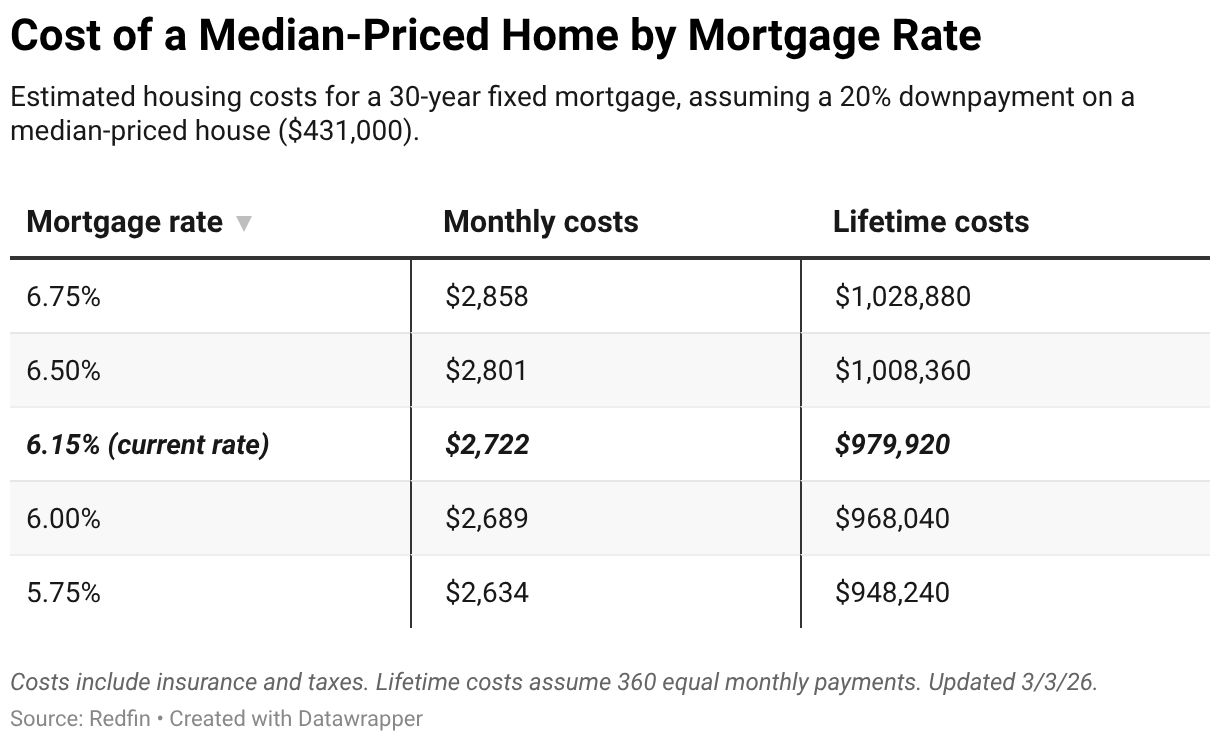
How mortgage rates affect housing costs
Mortgage rates are important for buyers because they directly translate to monthly housing costs. The higher the rate, the more you pay every month. If rates drop, you can save tens of thousands over the lifetime of your mortgage.
Let’s see how your monthly payments change with different rates, using data from our Mortgage Calculator.
Buyers have the upper hand
It’s the strongest buyers market in years: Housing inventory has risen from its post-pandemic low, particularly in the South, giving buyers more negotiating power. However, supply is still limited in parts of the Midwest and East Coast, putting sellers in charge and pushing up prices.
In general, high costs are keeping buyers on the sidelines and freezing home sales. Some households are being forced to make major sacrifices like giving up a pet or postponing divorce in order to afford housing. Younger generations are getting hit especially hard and often turning to family for help.
Inventory is high, but falling
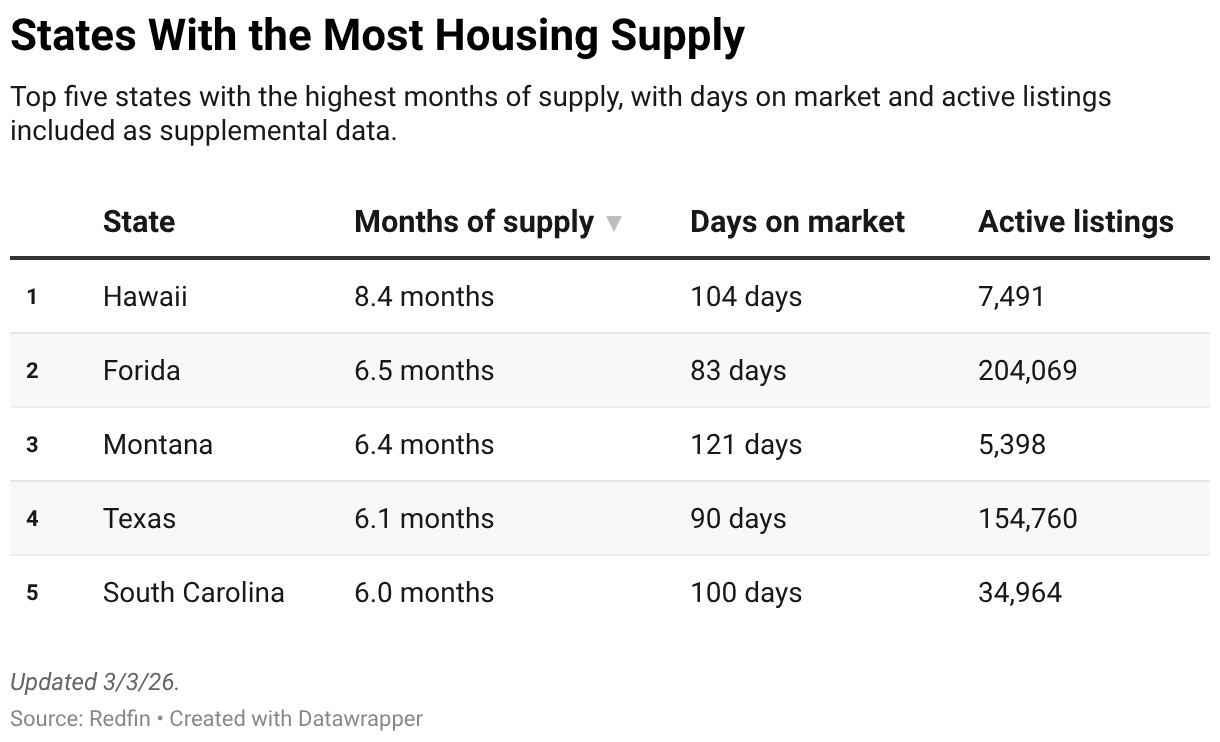
There are nearly 1.7 million homes for sale today—historically low but one of the highest February levels since the pandemic. This is the primary driver behind today’s buyer’s market. Florida and Texas have the most homes on the market today, by far.
Housing inventory is high because a larger share of sellers are listing their homes than buyers are buying them, with the biggest imbalances in disaster-prone areas in Florida. This gives today’s buyers more leverage for concessions.
But many sellers are now starting to pull back after realizing they can’t fetch top dollar, which is beginning to thin out the housing stock. Homebuilding also took a dive in 2025.
Demand is near an all-time low
Even with lower rates and more homes on the market, buyer demand is at a record low due to high housing costs and economic uncertainty. For buyers who have the budget, this could be a good time to enter the market, as sellers may be more open to negotiation.
Buyers have the most leverage in Austin, TX, which was the hottest market in the nation during the pandemic. Following years of price hikes and glut of new supply, though, the tech hub has now flipped to become the slowest major housing market in America.
But there are still pockets of competition. In New York metros like Rochester and Buffalo, strong demand for affordable homes is pushing up prices and putting sellers in charge. The Bay Area recently saw a surge in popularity, too, along with parts of the Midwest.
>> Read: The Most Competitive Housing Markets in the U.S.
How to buy in an uncertain economy
With tariffs, economic whiplash, and volatile mortgage rates, many buyers are wary of getting into the market. Here are a few tips from our economists about navigating this shifting landscape.
- Stick to your budget: This isn’t the time to stretch financially. Recession odds are lower than they have been, but the economy is still unstable. Make sure you have enough in savings to cover mortgage payments if your income changes.
- Negotiate, negotiate: The market favors buyers, so use your leverage. There’s more inventory, and offers are increasingly coming in below asking.
- Be smart about rates: Mortgage rates are down but still relatively high. Shop around, compare lenders, and ask about “float down” options if rates drop significantly after you lock in.
- Sell before you buy: If you own a home, consider selling it first. It will give you a clearer budget and help you avoid the risk of carrying two mortgages.
>> Read: How to Buy, Sell, or Rent a Home Amid Economic Uncertainty
Are you ready to buy and own a house?
When deciding whether to buy a home in today’s climate, you’ll want to think beyond market conditions and focus on your individual circumstances. Here are some personal considerations to keep in mind.
Financial health
Take stock of your current savings, credit score, and debt levels. Can you afford a house? Or does renting make more sense?
Housing is a long-term commitment, so you’ll want a solid emergency fund—ideally covering 3 to 6 months of expenses—for maintenance and unexpected costs.
Monthly budget
Determine how a mortgage payment at today’s rates might impact your lifestyle. Make sure you can comfortably handle monthly payments, property taxes, insurance, and other homeownership expenses.
Job and location stability
Buying a house makes sense if you plan to stay put for several years. A stable job or reliable income is crucial to avoid financial strain, especially if home prices or interest rates rise further.
Choosing your location is also essential. Is your potential home prone to flooding, wildfires, or other climate risks? This is especially important today, as insurers continue dropping homeowners at alarming rates.
Personal goals and timelines
Think about life events, like starting a family, retiring, or relocating. These factors can make owning a home either more appealing or potentially riskier if you need to move soon.
Lifestyle preferences
Homeownership comes with ongoing responsibilities, like maintenance, repairs, and property taxes. Ask yourself if you have the time, resources, and a desire to handle them.
>> Read: Am I Ready to Buy a House? 8 Questions to Help You Decide
So, is now a good time to buy a house?
If you have the means and are ready to own a home, now is a good time to buy a house. Rates are dropping, but with today’s high prices and volatile economy, it’s hard to know what affordability will look like down the line. Waiting for rates to fall further leaves you at risk of competition among buyers and subsequent price hikes from sellers.
In a market this unpredictable, the best approach is to be prepared. Know your budget, connect with a local agent, get preapproved, and move quickly when the right home comes along. The longer you wait, the more competition you could see.
The post Is Now a Good Time to Buy a House? appeared first on Redfin | Real Estate Tips for Home Buying, Selling & More.
Read the full article on the original source
