




Global Black Voices: News from around the World
- Extremists attacked ordinary behavior, pouring used engine oil on a woman in Bordj El Kiffan, targeting couples at the seaside.
- The Association of Algerian Muslim Ulema warned Yoga conflicts with Islamic foundations, urging separation of exercise from spiritual symbols and chants.
- Public calls for a morality police appeared on television; a lawyer on Echourouk advocated creating one, praising guardianship over female students.
- Conservative ideas spread despite electoral decline; scholars link growth of Salafism to the civil war aftermath and amnesty for armed Islamists.
Social Divide
In recent months, prominent Islamist figures and anonymous social media users have issued a growing number of inflammatory statements, particularly against women. The return of a self-appointed “morality police”, seemingly tolerated by the authorities, is worrying opposition parties and intellectuals.
By
Akram Torki
On 18 July, Louisa Hanoune, the leader of the Workers’ party (PT), became the first public figure to condemn social media users who had celebrated the deaths of 11 children in a fire at an orphanage in Mohammadia, a suburb of Algiers, two days earlier. Their reason for rejoicing was that the children had been born outside marriage.
“We are seeing clear signs of a dangerous shift, reflected in behaviour that fuels hatred,” the leftwing leader warned. “Groups have set themselves up as a clergy or as moral tribunals on social media, using them to spread their ideology.”
Is yoga anti-Islamic?
The hardening of attitudes among part of the Islamist movement, which has sometimes led to direct action, is far from an isolated phenomenon.
When the baccalaureate results were published in mid-July, the same self-appointed preachers declared that congratulating a girl on passing the exam was incompatible with Islam. One father, filmed by a television channel embracing his daughter in delight, was even branded a deviant.
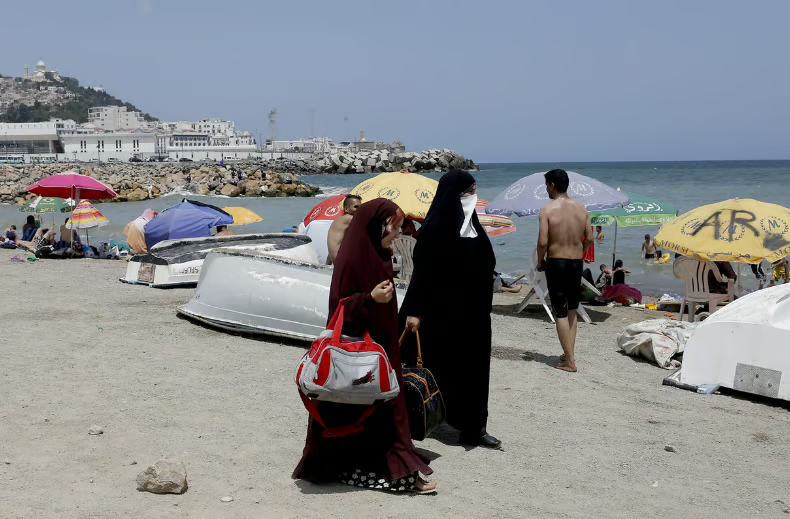
A few days earlier, in Bordj El Kiffan, near Algiers, a young woman seeking relief from the heat fractured her skull after slipping on a rock. An Islamist extremist had poured used engine oil over it, saying he wanted to stop couples from enjoying the seaside.
This summer, the Association of Algerian Muslim Ulema also voiced “reservations” about celebrations marking the 12th International Day of Yoga at Algiers’ Jardin d’Essai in late June. Its statement was published on 5 July, the 64th anniversary of Algerian independence.
The event, organised by the Indian embassy and three well-known Algerian yoga instructors, drew more than 400 people.
“Yoga stems from a philosophical and religious system with spiritual and doctrinal elements that are at odds with the foundations of the Islamic faith,” the association said. It stressed the “need to distinguish physical exercise intended to maintain fitness from practices involving symbols, chants or concepts linked to other beliefs”.
Another example came on 29 June. Appearing on the Echourouk television channel, a young lawyer close to Islamist circles expressed outrage that female students were staying at campsites without a male guardian.
“It is scandalous,” he repeated. “If we need to create a morality police, then we should do so. Enough is enough.”
Has the Hirak been infected?
Are these incidents enough to establish a broader trend? Many believe they are.
As early as 2021, Hanoune said that a growing “obscurantist current” had worked its way into the Hirak protest movement and was seeking to divert it from its democratic aims.
More broadly, many opposition figures believe that the electoral decline of Islamist parties has, paradoxically, been accompanied by the growing influence of conservative ideas across society.
“To be Muslim in Algeria does not mean embracing backward, fundamentalist and reactionary ideas that are alien to our thousands of years of history as free men and women,” said Ramdane-Youssef Tazibt, a member of the PT’s political bureau. “Nor does it mean shutting ourselves away and rejecting universal principles of individual and collective freedom.”
The film-maker Bachir Derrais said: “A quick look through social media turns up plenty of videos of official imams or self-appointed preachers making particularly contemptuous and violent remarks about some Algerians.
“Some insult families who go to the beach. Insults are a criminal offence in Algeria, so why does this kind of rhetoric appear to be tolerated?”
Law 20-05, which covers the prevention of and fight against discrimination and hate speech, provides for prison sentences of between three and 10 years. Does speaking in the name of religion offer a degree of immunity?
A legacy of the civil war
An Islamic studies scholar, speaking on condition of anonymity, believes the authorities tolerate such behaviour in order “to steal the fundamentalists’ thunder and say: ‘We are the guardians of religion, so do not oppose us.’”
In his view, Salafism has been gaining ground in Algeria since the early 2000s.
“It is one of the consequences of the black decade,” he said, referring to the civil war of the 1990s. “That period ended with an amnesty for armed Islamists in return for their renunciation of violence.
“This dealt with the security dimension of the crisis, but not its political roots. It left no room for any real process of remembrance or justice.”
Read the full story from the original publication
