




Aging Well: News & Insights for Seniors and Caregivers
- Fixed $50 monthly copay replaces standard Part D cost-sharing for Bridge Program drugs; deductible and out-of-pocket caps do not apply.
- Eligibility hinges on BMI tiers and qualifying comorbidities; your doctor must document medical necessity and weight-management indication for prior authorization.
- Covered drugs include Wegovy, Zepbound, and oral semaglutide Foundayo; all FDA-approved for chronic weight management.
- CMS manages prior authorization; physicians must submit BMI, comorbidity documentation, and weight-management rationale; reviews typically take a few business days.
- Fill at participating pharmacies; find network locations via Medicare.gov, call 1-800-MEDICARE, or ask your pharmacist; mail-order may be available.
Understanding the Medicare GLP-1 Bridge Program (2026–2027)
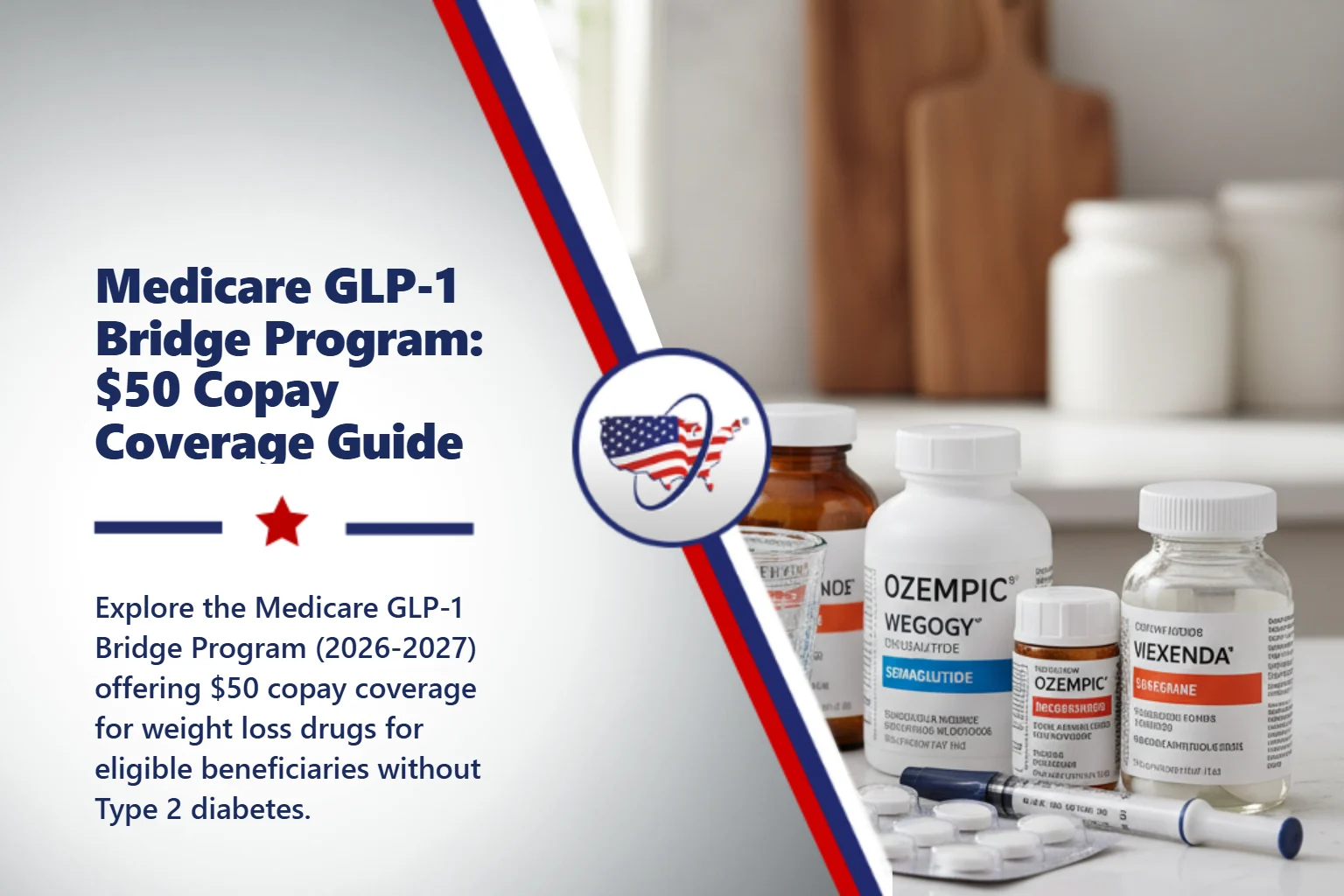
Starting July 1, 2026, Medicare beneficiaries who struggle with obesity but do not have Type 2 diabetes finally have access to GLP-1 weight loss medications at a predictable, affordable cost. The Medicare GLP-1 Bridge Program is a temporary demonstration program administered by the Centers for Medicare & Medicaid Services (CMS) designed to fill a long-standing gap in Medicare Part D coverage for weight management drugs.
Under standard Part D rules, medications prescribed solely for weight loss have historically been excluded from coverage, leaving many beneficiaries paying out of pocket for drugs that can cost well over $1,000 per month. This Bridge Program changes that equation by offering a fixed $50 monthly copay for three FDA-approved GLP-1 medications. Official CMS guidance outlines this copay.
The program runs through December 31, 2027, making it a temporary but meaningful lifeline. Understanding exactly who qualifies, which drugs are covered, and how costs work is essential before you or your doctor takes the next step.
Program At A Glance: Key Facts for Beneficiaries
| Program Detail | Information |
|---|---|
| Program Name | Medicare GLP-1 Bridge Program |
| Administering Body | Centers for Medicare & Medicaid Services (CMS) |
| Program Dates | July 1, 2026 – December 31, 2027 |
| Monthly Copay | $50 (fixed) |
| Number of Covered Drugs | Three (Wegovy, Zepbound, a third oral semaglutide formulation pending FDA approval for weight management) |
| Eligibility Basis | Specific BMI tiers and qualifying comorbidities |
Who Qualifies for the $50 Copay Program?
To participate in the Bridge Program, you must first be enrolled in Medicare Part D, either through a standalone Part D plan or a Medicare Advantage plan that includes drug coverage. You also need a valid prescription and documented diagnosis from a licensed physician. Beyond those baseline requirements, eligibility hinges on which BMI tier you fall into.
Tier 1 applies to beneficiaries with a BMI of 30 or higher. This tier covers individuals diagnosed with obesity as a standalone condition, provided their physician documents the medical necessity of GLP-1 therapy for chronic weight management.
Tier 2 applies to beneficiaries with a BMI between 27 and 29.9 who have at least one qualifying weight-related comorbidity. Comorbidities that qualify in this tier include:
- Hypertension (high blood pressure)
- Dyslipidemia (abnormal cholesterol or triglyceride levels)
- Obstructive sleep apnea (when obesity is the primary driver)
- Cardiovascular disease
Tier 3 covers beneficiaries with a BMI between 25 and 26.9 who have two or more qualifying comorbidities as listed above, with obesity identified as a contributing factor to those conditions. Your physician’s documentation is critical, the diagnosis must specifically link your weight to the comorbid condition.
In all tiers, your doctor must write a prescription indicating that the GLP-1 medication is being used for chronic weight management, not for diabetes or another primary indication. CMS uses this documentation during the prior authorization review.
Exclusion Criteria: Who Cannot Use the Bridge Program?
The most significant exclusion is Type 2 diabetes. If your GLP-1 prescription is primarily for blood sugar management, your medication is already eligible for coverage under standard Medicare Part D. The Bridge Program is specifically for weight management indications, so beneficiaries using GLP-1s for diabetes should continue through their existing Part D plan. You can review Medicare’s GLP-1 diabetes drug coverage for more detail on that pathway.
Additionally, if your physician’s primary indication for the GLP-1 is obstructive sleep apnea or metabolic-associated steatohepatitis (MASH) rather than weight management, you would not qualify through the Bridge Program. Eligibility for those conditions may fall under different Medicare coverage pathways. Always confirm your specific situation with your healthcare provider before assuming you qualify.
Covered Medications and How to Access Them
The Bridge Program covers exactly three medications, all FDA-approved for chronic weight management in adults:
- Wegovy (semaglutide) manufactured by Novo Nordisk, a once-weekly injectable
- Zepbound (tirzepatide) manufactured by Eli Lilly, a once-weekly injectable targeting both GIP and GLP-1 receptors
- Foundayo (semaglutide) an oral semaglutide formulation by Novo Nordisk approved for weight management
Accessing these drugs through the Bridge Program requires a prior authorization (PA) process managed directly by CMS, separate from your Part D plan’s standard PA rules. Your doctor will need to submit clinical documentation supporting your BMI tier and confirming the weight management indication. The PA review typically takes a few business days once complete documentation is received.
Once approved, you pay a flat $50 copay per monthly supply at a participating pharmacy, significantly less than the standard out-of-pocket cost these drugs carry under typical Part D structures. This copay is detailed in CMS program information.
Participating Pharmacies and Networks
Prescriptions must be filled at a participating pharmacy within the Bridge Program’s designated network. Not every pharmacy automatically qualifies, so verifying your pharmacy’s participation before submitting a prescription is a smart first step.
You can find participating pharmacies through these channels:
- Visiting Medicare.gov and using the Bridge Program pharmacy locator tool
- Calling the CMS helpline at 1-800-MEDICARE (1-800-633-4227)
- Asking your local pharmacy directly if they are enrolled in the Bridge Program network
- Contacting the pharmacy benefit manager (PBM) associated with your Part D plan
Mail-order pharmacies that are within the Bridge Program network may also be an option, which can add convenience for ongoing monthly fills. Learn more about mail-order prescriptions and Medicare to evaluate whether that approach fits your routine.
Pro Tip
Before your appointment, ask your doctor to document your BMI, weight-related comorbidities, and the clinical rationale for GLP-1 therapy in a single, clearly labeled note, this accelerates the CMS prior authorization review and reduces the chance of delays or denials. Bring a printed copy of the CMS Bridge Program eligibility criteria to your visit so your physician knows exactly what language the authorization requires.
Navigating Costs: The $50 Copay and Beyond
The Bridge Program’s $50 monthly copay is fixed, it does not fluctuate based on the medication’s Wholesale Acquisition Cost (WAC), which for these drugs ranges into the thousands per month without assistance.
Importantly, standard Medicare Part D cost-sharing rules do not apply here. The Part D annual deductible and the $2,100 out-of-pocket cap that took effect in 2026 under the Inflation Reduction Act are separate from Bridge Program billing, as specified by CMS. Your $50 copay is the total amount you owe each month through this program.
Beneficiaries who receive the Medicare Extra Help program (also called Low-Income Subsidy) may assume their copay will be reduced further. However, LIS/Extra Help benefits do not apply to Bridge Program prescriptions, the $50 copay is the same for all participants regardless of income level.
CMS negotiated a net price of approximately $245 per monthly supply directly with Novo Nordisk and Eli Lilly, which is what makes the $50 beneficiary copay financially sustainable for the program’s duration. This negotiated price is part of the program’s design.
The Bigger Picture: Bridge Program in Context
The Bridge Program did not emerge in a vacuum. It was created largely because Medicare Part D plan sponsors declined to participate in CMS’s earlier BALANCE Model, which had aimed to integrate GLP-1 weight loss coverage into standard Part D drug plans. While the BALANCE Model continued as a Medicaid-focused initiative, the absence of Medicare Part D sponsor buy-in left a significant access gap for older Americans managing obesity.
CMS responded by designing the Bridge Program as a direct-access demonstration, bypassing standard plan structures and creating a parallel coverage pathway with negotiated prices and a centralized prior authorization process.
There is also a broader policy dimension worth watching. Semaglutide (the active ingredient in Wegovy and Foundayo) was selected for Medicare drug price negotiation under the Inflation Reduction Act, with a negotiated price potentially taking effect in 2027. If that negotiated price is implemented, it could directly influence the sustainability or structure of the Bridge Program entering its final months, or inform what a successor program might look like post-2027.
For now, the Bridge Program remains the most concrete and actionable coverage pathway available for Medicare beneficiaries seeking GLP-1 weight management therapy in 2026.
Looking Ahead: Post-2027 Options for GLP-1 Coverage
The Bridge Program ends December 31, 2027. What happens after that date is not yet fully determined, and beneficiaries currently on covered medications should plan for potential disruption.
Several scenarios are plausible. CMS could extend the Bridge Program if the demonstration achieves its weight management and cost-outcome benchmarks. Alternatively, CMS may relaunch a revised BALANCE Model that includes Medicare Part D sponsors, especially if negotiated drug prices make participation economically viable for plans.
Congressional action is another possibility. Legislation to formally add weight management drugs to Medicare Part D’s covered drug categories has been proposed multiple times. The political momentum around obesity as a public health priority may bring renewed legislative attention in late 2027.
If coverage does lapse, manufacturer patient assistance programs from Novo Nordisk and Eli Lilly have historically offered reduced-cost access for qualifying individuals. Exploring those programs before December 2027, rather than scrambling afterward, is a practical step for current Bridge Program participants.
Staying informed through official CMS communications will be essential. Signing up for Medicare notices and checking your Annual Notice of Change letter each fall will help you stay ahead of coverage shifts.
Who This Guide Is For
This article is written for Medicare beneficiaries who are managing obesity and want to understand whether the GLP-1 Bridge Program applies to their specific situation. It focuses on the 2026–2027 coverage window, eligibility tiers, costs, and what to expect moving forward.
This Guide Is Perfect For You If…
- You are enrolled in Medicare Part D and have a BMI of 25 or higher with documented weight-related health conditions
- Your doctor has discussed Wegovy, Zepbound, or other potential GLP-1 medications as a treatment option for weight management (not diabetes)
- You have previously been told that Medicare does not cover weight loss medications and want to know if that has changed
- You are currently paying full price for a GLP-1 weight loss drug and want to know if you can reduce that cost
- You are helping a parent or family member on Medicare explore their options for obesity treatment
This Might Not Be For You If…
- You take a GLP-1 medication (such as Ozempic or Trulicity) primarily for Type 2 diabetes, your coverage runs through standard Part D; review Medicare diabetes coverage instead
- You are not yet enrolled in Medicare, the Bridge Program is only available to current Medicare Part D enrollees
- You are looking for information about weight loss surgery coverage, see Medicare bariatric surgery coverage for that topic
- You want information about GLP-1s covered under Medicaid rather than Medicare, the BALANCE Model governs those pathways
Official Resources and Support
For the most current and authoritative information on the Medicare GLP-1 Bridge Program, start with these official sources:
- Medicare.gov Use the Bridge Program resource page and pharmacy locator tool
- CMS Helpline Call 1-800-MEDICARE (1-800-633-4227), available 24 hours a day, 7 days a week
- Your prescribing physician They can submit prior authorization documentation and advise on your specific BMI tier eligibility
- Your pharmacist Can confirm network participation and explain how the $50 copay will appear on your prescription fill
Program details can change, especially as CMS reviews early program data. Checking official sources periodically, and speaking with a licensed Medicare agent, helps ensure you are acting on the most current information available. You should always verify the latest program details directly with official CMS sources.
Frequently Asked Questions About the Medicare GLP-1 Bridge Program
What is the Medicare GLP-1 Bridge Program?
The Medicare GLP-1 Bridge Program is a temporary CMS demonstration program that provides Medicare Part D enrollees with access to three FDA-approved weight loss medications at a fixed $50 monthly copay. It runs from July 1, 2026, through December 31, 2027, and was created to fill the existing gap in Medicare Part D coverage for weight management drugs.
Which GLP-1 medications are covered by the program?
The Bridge Program covers three medications: Wegovy (semaglutide by Novo Nordisk), Zepbound (tirzepatide by Eli Lilly), and a third oral semaglutide formulation by Novo Nordisk (pending FDA approval for weight management). All three are FDA-approved specifically for chronic weight management in adults.
Do I need a prior authorization for these medications?
Yes. Prior authorization is required and is managed directly by CMS, separate from your Part D plan’s standard process. Your doctor must submit documentation confirming your BMI tier, qualifying comorbidities (if applicable), and that the medication is prescribed for weight management rather than diabetes or another primary indication.
How does the $50 copay work with my existing Medicare Part D plan?
The $50 copay replaces standard Part D cost-sharing for these specific medications under the Bridge Program. Your regular Part D deductible and out-of-pocket cap do not apply to Bridge Program prescriptions, as confirmed by CMS. The $50 is billed separately through the Bridge Program’s billing structure.
Can I get financial assistance for the $50 copay?
No. Medicare’s Extra Help (Low-Income Subsidy) program does not reduce the $50 copay for Bridge Program participants. The $50 rate is uniform for all enrollees regardless of income. Manufacturer patient assistance programs from Novo Nordisk and Eli Lilly are separate options worth exploring if the copay presents a hardship.
What happens if I’m already taking a GLP-1 for diabetes?
If your GLP-1 is prescribed primarily for Type 2 diabetes, you are excluded from the Bridge Program, your medication is already eligible under standard Medicare Part D coverage. The Bridge Program is specifically and exclusively for the weight management indication.
How do I find a participating pharmacy?
Visit Medicare.gov and use the Bridge Program pharmacy locator, or call 1-800-MEDICARE. You can also ask your local pharmacy directly whether they are enrolled in the Bridge Program network. Mail-order options may be available through network PBMs.
What happens to my coverage after December 31, 2027?
Coverage through the Bridge Program ends on that date unless CMS announces an extension. Potential follow-on options include a revised BALANCE Model, congressional legislation expanding Part D coverage, or manufacturer patient assistance programs. Staying current with CMS communications starting in mid-2027 is strongly advised.
Conclusion
The Medicare GLP-1 Bridge Program represents a real, time-limited opportunity for Medicare beneficiaries managing obesity to access clinically proven weight loss medications at a fraction of their standard cost. The $50 monthly copay, the structured eligibility tiers, and the three covered drugs create a clear, if temporary, pathway to treatment.
Because the program runs only through December 2027, acting promptly matters. Talk to your doctor now about your BMI, qualifying comorbidities, and whether a Bridge Program prescription makes sense for you. The landscape of Medicare GLP-1 coverage is evolving quickly, and this window may be the most affordable access point available for some time.
Read the full article on the original source
