




Business Insights: Global Markets, Strategy & Economic Trends
- A.I. infrastructure spending worries investors about sustainability and profit pressure on major technology companies.
- ChangXin Memory Technologies blockbuster IPO intensifies fears of cheaper Chinese competition eroding global memory chip makers' market positions.
- KOSPI plunge and broader Asian chip sell-off spread to U.S. tech indexes ahead of earnings from Meta, Microsoft, Apple, Amazon.
A global technology stock sell-off intensified on Tuesday, underpinned by worries over hefty bills for the build-out of artificial intelligence systems and concerns over tougher competition from China.
The Nasdaq Composite index, chock-full of big technology companies, came close on Tuesday to falling into correction, Wall Street’s term of a drop of 10 percent or more from its recent peak, before rebounding to trade flat for the day. The American chip company Micron fell over 7 percent in early trading on Tuesday, as did Advanced Micro Devices. Nvidia, the leading chipmaker, nudged lower before turning higher, but it remains more than 15 percent below its peak in May. SpaceX, Elon Musk’s rocket and A.I. company, also rebounded from an early morning slide. The stock remains more than 40 percent below its June peak.
The bumpy sell-off has taken hold over the past month, as fears about the ballooning spending by big technology companies on A.I. infrastructure and the threat of cheaper competitors undermining it have come to the fore. Cheaper A.I. models threaten the dominance of a handful of U.S.-listed companies, while competition from China has loosened South Korea’s grip on the market for memory chips critical to A.I.
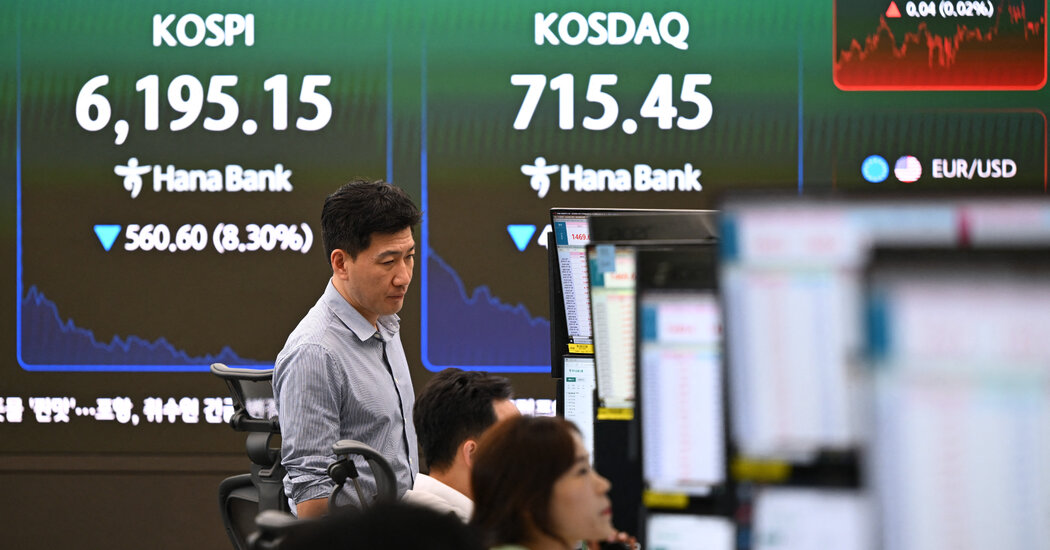
On Tuesday, South Korea’s benchmark KOSPI index plunged nearly 11 percent, at one point triggering a temporary trading halt. The index has lost a third of its value over the past month but remains over 40 percent higher for the year because of the soaring rally that preceded the recent drop. Benchmark indexes in Japan and Taiwan both fell around 4 percent. Stocks in China fell over 2 percent.
The drop in South Korea spread to American exchanges. The Nasdaq 100 index, which strips out banks from the broader index making it further dependent on big tech companies, fell over 1 percent in early trading and is heading into afternoon trading almost 10 percent below its peak in June.
In Europe, the German chipmaker Infineon fell nearly 7 percent, and the Dutch semiconductor equipment maker ASML shed 3.5 percent. The Dow Jones industrial average, which is far less exposed to the tech industry, rose 1 percent on Tuesday, a sign that investors are homing in on concerns surrounding A.I.
The latest market tremor began on Monday, when the shares of China’s leading memory chipmaker, ChangXin Memory Technologies, began trading after a blockbuster initial public offering. The company’s stock soared nearly 500 percent on its market debut, quickly making it the most valuable company on the Shanghai exchange. It slipped 4 percent on Tuesday.
The listing prompted widespread fears that intensifying industry competition could threaten rival global memory chipmakers in South Korea, Japan, Taiwan and the United States.
Rising spending forecasts from the tech firms leading the A.I. infrastructure build out are also fanning fears. The recent market jitters intensify the spotlight on the big tech companies reporting financial results this week. Meta, Microsoft and SK Hynix, South Korea’s semiconductor giant, are set to report on Wednesday, and Apple and Amazon on Thursday.
The declines in Asia began as soon as stocks started trading on Tuesday, with A.I. and semiconductor stocks hit the hardest. Japanese flash memory maker Kioxia fell more than 18 percent. South Korean semiconductor company Samsung Electronics dropped about 13 percent.
Asian markets have been trending downward since late June, weighed down by recurring concerns over the sustainability of this year’s A.I. rally.
The staggering scale of spending required to keep up in the global A.I. race was highlighted this week with OpenAI, the parent of ChatGPT, nearing a deal to lease a $500 billion data center in Ohio, supported by $250 billion in financial backing from Nvidia. Last week, earnings reported by Tesla and Alphabet, Google’s parent company, shook the markets as they revealed their own enormous A.I. spending needs.
On Monday, the Chinese start-up Moonshot publicly released the details of its latest A.I. model, adding to investor concerns about China catching up to the United States in the A.I. arms race.
The latest market turmoil is an unwelcome turn for a region where the A.I. boom has served as a rare economic bright spot. In markets like South Korea and Taiwan, rising chip exports and soaring A.I. valuations have masked broader weakness across their domestic economies, which remain heavily dependent on energy imports from the Middle East.
The war in Iran, another major worry for investors, has rattled markets recently by restricting oil exports from the Persian Gulf and Red Sea, pushing up oil and gas prices. President Trump said on Monday that there was “a good chance” that a new round of diplomatic talks could yield a breakthrough in the monthslong war.
A recent pause in fighting has helped ease oil prices, with Brent crude, the international benchmark, falling to around $84 a barrel on Tuesday. Still, the cost of crude is up more than 15 percent since the start of the war, feeding into higher prices for gasoline and a wide range of products derived from petroleum.
Read the full article from the original source
