




Wellness That Matters: Black Health News & Community Care
- SAVE Act mandates in-person documentary proof of citizenship like birth certificates or passports, disabling community and online voter registration efforts.
- Young people, especially students like Amara, lack accessible documents, so campus and festival registration drives become functionally useless.
- Married women like Denise face name-mismatch hurdles; states may demand marriage certificates, divorce decrees, or court orders to verify citizenship.
- Elders such as Miss Gloria often have incomplete or inaccurate birth records, making documentary proof requirements devastating for older Black voters.
- The bill sidesteps existing verification systems and shrinks electorates, undermining political power and health policy for communities of color.
.ld_fancy_heading_69ebbfda72b9e h1{font-size:36px;}.ld_fancy_heading_69ebbfda72b9e .lqd-highlight-inner{height:0.275em;bottom:0px;}
They’re Not Trying to Protect the Vote. They’re Trying to Shrink It.
The SAVE Act is a threat to your right to vote and it’s already moving.
By the Black Women’s Health Imperative
When you were 22 years old, did you know where your birth certificate was?
Did you even have a passport?
Take a second with that question. Because right now, there is a piece of legislation moving through Congress called the SAVE Act, the Safeguard American Voter Eligibility Act, and its entire premise depends on the assumption that you do. That you always have. That every American citizen keeps their citizenship documents in a neat, accessible place, ready to present at the moment they decide to participate in democracy.
That assumption is false. And the people writing this law know it.
Passed by the U.S. House of Representatives in February 2026 and now in the Senate, the SAVE Act would require every American registering or updating their registration to vote in federal elections to present documentary proof of citizenship in person. Not a driver’s license. Not a state ID. Not a REAL ID. For most Americans, that means one of two things: a birth certificate or a U.S. passport.
The stated goal is to prevent noncitizens from voting. But here’s what the data actually shows: noncitizen voting in federal elections is not a widespread problem. It is rare, routinely investigated, and already illegal. After reviewing more than 2 million registered voters in Utah, officials found one confirmed instance of noncitizen registration and zero instances of noncitizen voting. Federal data shows that just 0.04% of voter verification cases come back flagged as potential noncitizens, and even some of those had already proven citizenship at registration.
So if the problem is that small, why does the solution create barriers this big?
That’s the question we keep coming back to. Because when you look at who gets left out, who the SAVE Act effectively silences, the picture becomes uncomfortably clear.
First, Let’s Talk About the Young People
Picture Amara. She’s 22, a junior at Spelman College in Atlanta. She was born in Savannah, raised in Augusta, and now she lives in a shared apartment in Vine City with three roommates and a borrowed air mattress she still hasn’t returned. She’s the first in her family to go to college, and last semester, someone came to campus during a voter registration drive and she signed up.
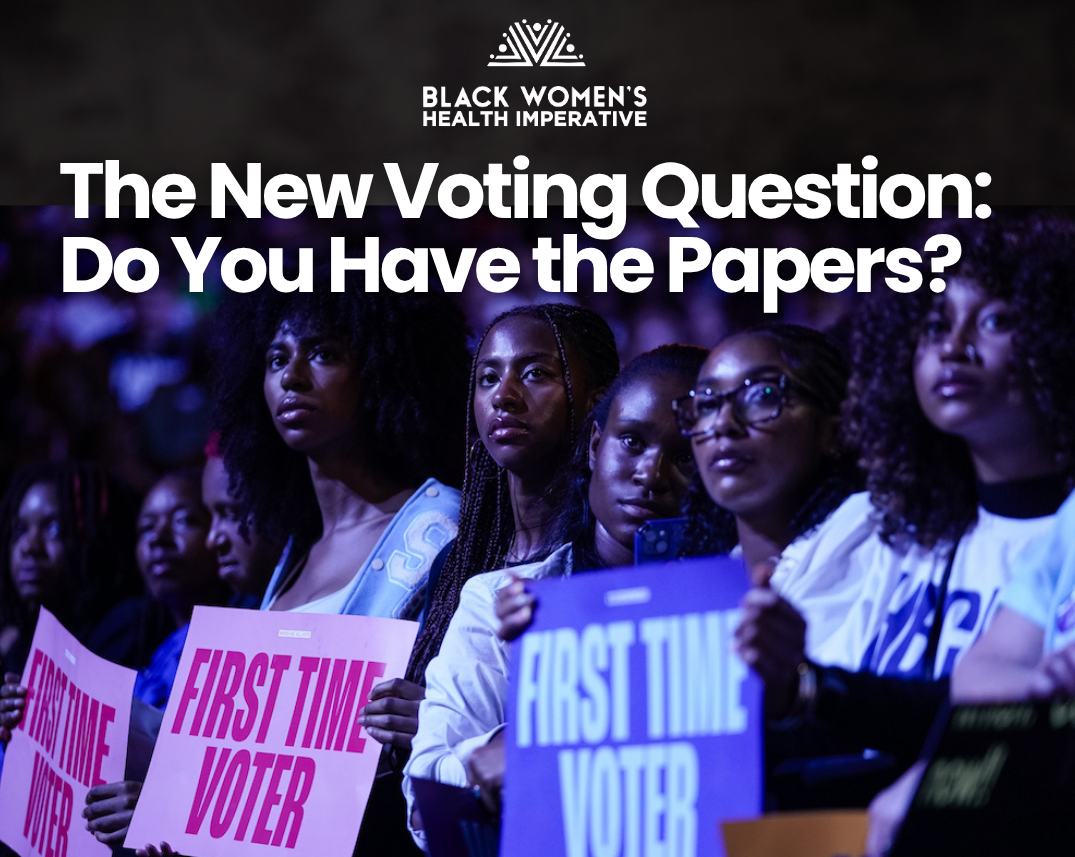
That’s how millions of young people have registered for generations. In the spaces where they already are — at concerts, at campus events, at festivals, at the spot where someone set up a table and said, “Hey, you can register right here.”
Under the SAVE Act, that table becomes useless. Voter registration drives would not be technically illegal, but they would be rendered functionally ineffective. Because in order to complete your registration, you would have to present documentary proof of citizenship in person to an election official. That means a passport or a certified birth certificate. Not a form you fill out at a table. Not something you mail in. Not something you submit online. You would have to show up, in person, at an election office, with physical documents in hand.
No one is carrying their birth certificate to a concert. Nobody shows up to a campus voter drive with their passport. So the drives can still exist on paper, but they lead nowhere. Multiple voting rights organizations including the Center for American Progress, Rock the Vote, and the Fair Elections Center have confirmed that this requirement would shut down most community-based voter registration efforts, which help voters at shopping centers, churches, campuses, and other public places where people simply do not have their citizenship documents on them.
Amara’s birth certificate is in a shoebox in her mother’s closet in Augusta, two hours away. She has never applied for a passport. She doesn’t have $165 to spend on one, and even if she did, passport processing takes weeks. She is not unusual. She is millions of people.
Approximately 146 million American citizens do not have a valid passport. For context, 153 million Americans voted in the 2024 presidential election. In seven states — West Virginia, Mississippi, Alabama, Arkansas, Kentucky, Louisiana, and Oklahoma — fewer than one in three citizens has a valid passport.
Young people are the least likely to have either document readily accessible. They move. They sublet. They live in dorms and rotate between a parent’s house and a friend’s couch. Their documents often live with someone else, in another city, in a filing cabinet they’ve never personally opened. About 24% of Americans under 30 do not have ready access to qualifying documents. Nearly half of Black Americans under 30 do not have ID with their current name and address.
And here is the part that is not coincidence: young people, particularly young Black people, are exactly the population that get-out-the-vote efforts are designed to reach. The SAVE Act doesn’t just raise the bar. It removes the ramp entirely.
Kansas tested a version of this law. Before it was implemented, noncitizen registration there accounted for about 0.002% of registered voters. After the documentary proof requirement went into effect, roughly 31,000 eligible citizens, 12% of all applicants, were blocked from registering. The law prevented far more American citizens from voting than it ever caught a noncitizen attempting to register.
That is not a flaw in the design. That may be the design.
Then There Are the Married Women
Now picture Denise. She’s 38. She’s been married for eleven years. She took her husband’s last name when they married, the way 84% of women who marry still do, and her legal name is now completely different from the name on her birth certificate.
Her birth certificate says “Denise Marie Washington.” Her driver’s license says “Denise Marie Coleman.” She has not thought about this disconnect in years because it has never mattered. Until now.
The SAVE Act creates a nightmare for women like Denise. Because her birth certificate, the primary document meant to prove citizenship, no longer matches her name. And the bill, despite public claims from some of its supporters, does not make a clean exception for her.
What it does instead is push the problem to the states. Each state would get to decide what additional documentation married women must provide to resolve the name discrepancy. That could mean a marriage certificate. But it could also mean a divorce decree if a woman has been married more than once, or court orders for any additional name changes. Every state, different rules. Every woman, a new bureaucratic maze.
As many as 69 million American women are in this position. That number is not hyperbole. That is the estimated count of women whose birth certificate names do not match their current legal names because they changed their surnames after marriage.
Representative Chip Roy of Texas, one of the bill’s chief sponsors, privately acknowledged in a recorded conversation that his own chief of staff encountered serious obstacles getting a new ID under Virginia’s REAL ID requirements, which impose similar name-matching demands. He said that out loud. To other people. The bill passed the House anyway.
For Black women specifically, this burden does not land in a vacuum. It lands on a community that has long been forced to prove its legitimacy at every turn. It lands in a state like Georgia, where polling locations have been closed, lines have stretched for hours, and the barriers to the ballot have never fully come down. Now there is a new one. And this one comes dressed in the language of security.
And Then There Are Our Elders
Miss Gloria is 84. She was born at home in rural Alabama in 1952, the way many Black babies born in the Jim Crow South were born, because hospitals turned their mothers away or charged what their families couldn’t pay. Her birth was recorded eventually, but the paperwork was incomplete. The name is slightly wrong. The date is off.
She has voted in every election she could for over 60 years. She marched for that right. She watched people bleed for it on a bridge in Selma. And now, under the SAVE Act, her vote is in jeopardy.
Elderly Americans, particularly Black elderly Americans in the South, face a disproportionate risk from proof-of-citizenship requirements because their documents are the most likely to be inaccurate, incomplete, or simply gone. Delayed birth registrations were common for Black children born outside of hospitals in the segregated era. Records were damaged or lost. Names were recorded incorrectly by clerks who sometimes didn’t bother to ask the parents what they’d actually named their child.
A passport is not a realistic solution for Miss Gloria. She is on a fixed income. She does not travel internationally. She has never needed one. And now a system built around international travel documents is being proposed as the gateway to the most basic domestic right in a democracy.
This is also an issue for anyone who has moved frequently, been displaced by disaster, or simply aged in a society that has never made document preservation easy for people without resources. These are not edge cases. These are lives.
What the SAVE Act Actually Does
Let’s be plain.
Citizenship is already a requirement to vote. It has always been. When you register, you already attest to it under penalty of perjury. Election officials already use multiple data systems, including federal immigration and Social Security databases, to verify voter eligibility. The system that exists is not perfect, but it is working. The problem the SAVE Act claims to solve is a problem that the data does not show exists at scale.
What the SAVE Act does do, concretely and measurably, is this:
It guts voter registration drives as we know them. It makes online voter registration, used by 8 million Americans in the 2022 election cycle, effectively impossible. It eliminates mail-in registration applications. It requires anyone who moves or changes their name for any reason to show up in person to an election office with physical documentation. And it threatens election officials with criminal penalties of up to five years in federal prison if they register someone who did not present documentary proof of citizenship, which means officials will err heavily on the side of turning people away.
For additional context: only 6% of voters currently register in person at an election office. The SAVE Act would make that the only option.
The people who designed this bill know exactly what they are doing. And the communities who will feel it most, the young, the married woman with a hyphenated name, the elder with an imperfect birth record, are not random. They follow the exact contours of communities that have historically been blocked from power.
This Is a Health Issue
At the Black Women’s Health Imperative, we talk about voting rights as a health issue because it is one. Policy determines who gets access to healthcare. Who gets funded. Who gets seen. When eligible voters are systematically removed from the electorate, the politicians they would have elected, the ones who might have fought for maternal health funding, for Medicaid expansion, for environmental protections in predominantly Black neighborhoods, never make it to office. The decisions that shape Black women’s health are made without us.
That is not a metaphor. That is a mechanism.
The SAVE Act is moving. It has cleared the House. The Senate is next. This is the moment to be clear about what it is and what it costs, not just as voters, but as people who understand that silence in this moment is its own kind of vote.
Your voice is your power. Don’t let anyone legislate it out of your hands.
The post They’re Not Trying to Protect the Vote. They’re Trying to Shrink It. appeared first on Black Women's Health Imperative.
Read the full article on the original site
