




HBCU News Spotlight:
When producers buy hay, they often think about how many tons is needed to feed their livestock through the winter. Few, however, consider hay in terms of the nutrients it actually provides, according to Dr. David Fernandez, Extension livestock specialist and interim dean of graduate studies for the University of Arkansas at Pine Bluff.
“As long as the animals have something to eat, producers often think that’s good enough. But you can feed your animals 33 pounds of pine straw per day and meet their need to eat something, but you will not meet their needs for nutrition,” Dr. Fernandez said. “Unfortunately, most hay producers don’t test their hay, so they can’t know whether they are buying enough nutrients to meet their animals’ needs.”
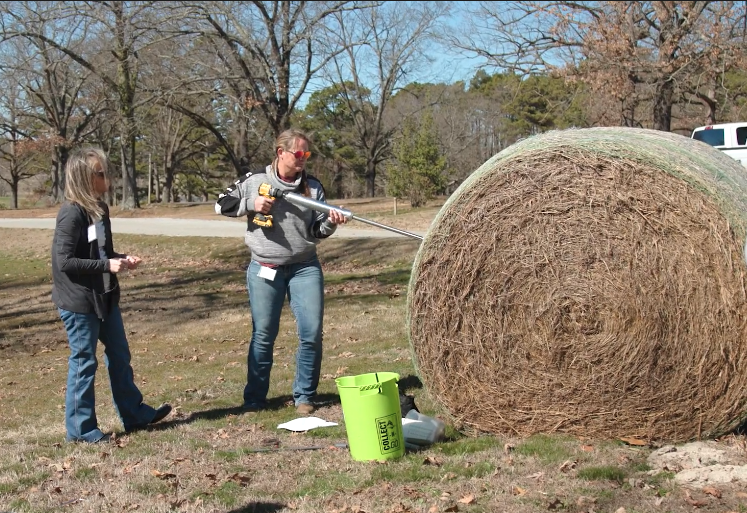
Hay testing is easy, he said. It is as simple as taking a core sample from several of your bales using a hay probe.
“In Arkansas, your county Extension office can often lend you one,” Dr. Fernandez said. “Put the sample in a bag and take it to your county Extension office. Keep it out of the sun so the forage in the sample does not become bleached or ‘cooked’ on the dashboard. You will need to submit about a quart-sized bagful of hay. The hay should come from more than one bale. The cost of a hay analysis is $20 for a routine test.”
Once the results come back, producers may ask what they do from there.
“The analysis tells you how many pounds of nutrients are in each ton of your hay,” he said. “Now you need to take a different look at your animals and their nutritional needs to see if you bought enough nutrients. You will receive two sets of numbers in your analysis: as received and dry matter basis. Use the numbers in the dry matter basis column to determine your hay’s actual nutrient content.”
Typically, producers are most concerned about TDN, a measurement of the energy in the feed, and crude protein (CP). A 1,100-pound pregnant cow will need about 11 pounds of TDN and 1.5 pounds of CP each day, Dr. Fernandez said.
“Suppose your hay analysis comes back and your hay is 60% TDN and 9% CP. In this case, if your cow eats roughly 25 pounds of hay each day, she will get 13.2 lbs. of TDN and 1.98 lbs. of CP. Your hay will more than meet her needs,” he said. “But what if your hay analysis comes back with 45% TDN and 6% CP? She will only receive 9.9 pounds of TDN and 1.32 pounds of CP; not enough to meet her needs. You may have paid the same amount of money for each ton of hay, but you clearly did not buy as many nutrients in the second example.”
Acid detergent fiber (ADF) and neutral detergent fiber (NDF) are measures of your hay’s digestibility. High ADF indicates poor digestibility, and high NDF indicates low palatability, Dr. Fernandez said. Your livestock will not eat as much of this kind of hay and will receive few benefits from it.
“If you are feeding poor quality hay like that from the second example, you will have to supplement your livestock with grain, pellets or cubes,” he said. “A cow consuming this hay will need an extra 1.1 pounds of TDN and a quarter of a pound of CP each day to meet her needs.”
For more details about how to test your hay, ask your county Extension agent for FSA 3114 Test Hays for Nutrient Composition Before Feeding by Dr. Shane Gadberry and Brian See. To learn how to substitute supplements for hay, ask for FSA 3036 Substituting Grain for Hay in Beef Cow Diets by Dr. Shane Gadberry, Dr. Paul Beck and Dr. Ken Coffey. If you have additional questions, contact Dr. Fernandez at 870-575-8316 or fernandezd@uapb.edu.
Pursuant to 7 CFR Section 15.3, the University of Arkansas at Pine Bluff and the School of Agriculture, Fisheries and Human Sciences, 1890 Research and Extension Programs, offers all its Extension and Research programs and services (including employment) without regard to race, color, sex, national origin, religion, age, disability, marital or veteran status, genetic information, sexual preference, pregnancy, or any other legally protected status, and is an equal opportunity institution.
Read more on the original source
