




Black Arts & Culture Feature:
- CPW Vision Awards: Mickalene Thomas and Oluremi C. Onabanjo honored; proceeds support Woodstock AIR residency.
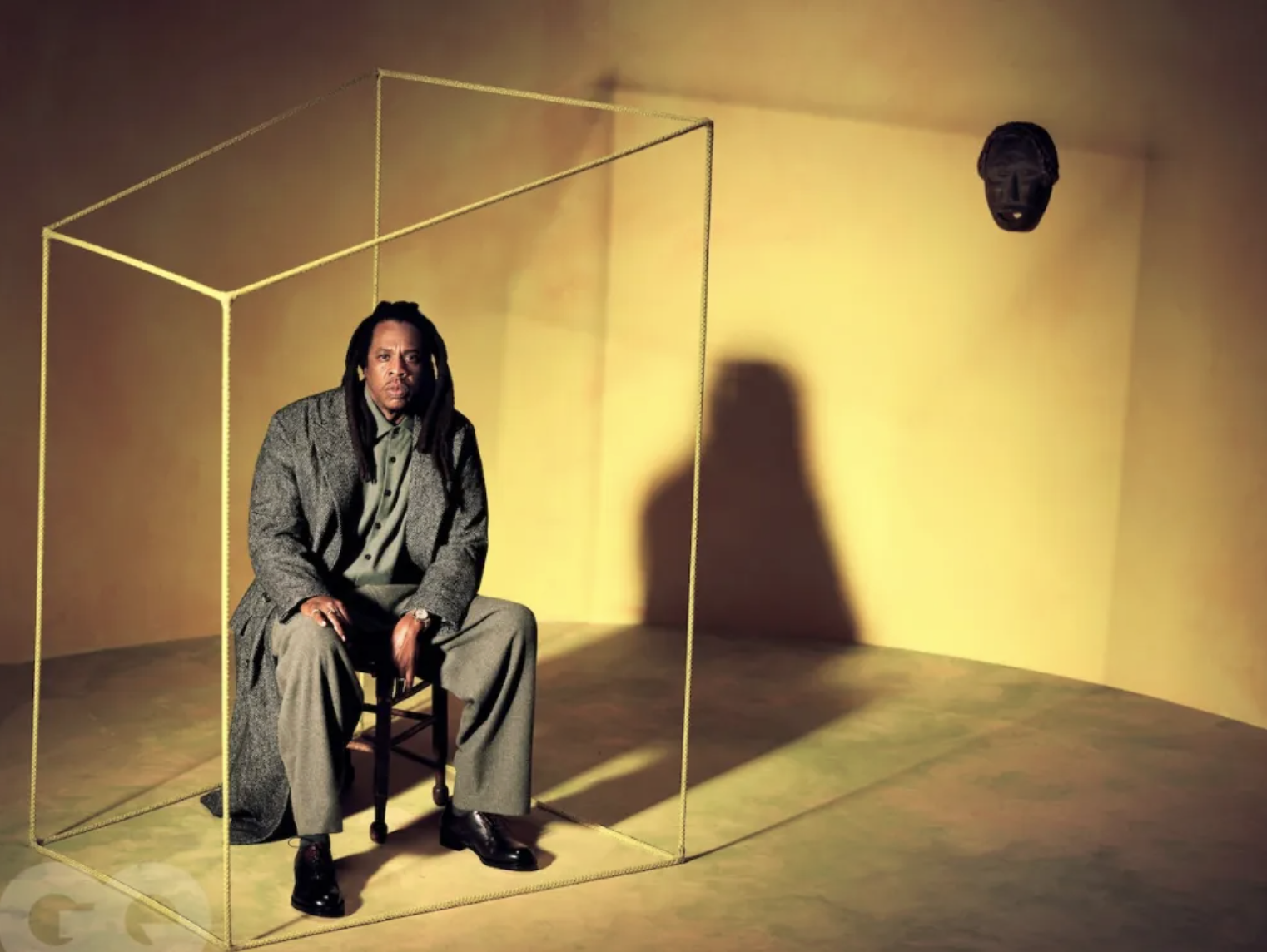
- Rashid Johnson photographs JAŸ-Z for GQ global issue, merging contemporary art and Black subjectivity.
- Gabrielle Goliath's Elegy barred from South Africa's pavilion; will screen at Chiesa di Sant’Antonin, sparking debates on public memory.
- Amoako Boafo mentors emerging artists via Maison Perrier and dot.ateliers, building Accra's creative infrastructure.
Above: Jay-Z, photographed for a special global issue of GQ, on newsstands March 31. Photo by Rashid Johnson, Courtesy GQ
This week in Black Art and Culture, we see creativity defying boundaries and sparking conversation across continents and mediums. From moments of intimate portraiture to bold interventions in public space, artists and thinkers are challenging how we see, remember, and imagine.
This Week in Black Art and Culture is sponsored by the GMCVB
New recognitions, unexpected collaborations, and acts of artistic courage reveal stories that push against convention, honor history, and expand the possibilities of identity and expression.
Dive into our curated stories to discover the gestures, debates, and visions shaping Black art and culture today.
Mickalene Thomas and Oluremi C. Onabanjo Receive 2026 CPW Vision Awards
The Center for Photography at Woodstock (CPW) has announced the recipients of its 2026 Vision Awards, spotlighting a cohort of image-makers and thinkers reshaping the language of photography across generations and geographies. The honorees will be celebrated at a gala on May 16 at CPW’s Kingston, New York headquarters.
While the awards span a global cohort, we foreground Thomas and Onabanjo as part of its ongoing attention to Black artistic and curatorial practices. Mickalene Thomas, named “Photographer of the Year,” is widely recognized for her richly layered images exploring Black femininity and visual culture. Oluremi C. Onabanjo is honored for editing Ideas of Africa: Portraiture and Political Imagination, a publication that examines portraiture as a site of political imagination and self-definition across Africa.
They join fellow honorees, including Lifetime Achievement recipient Danny Lyon, whose decades-long practice has foregrounded civil rights struggles and marginalized communities, and emerging photographer Sridhar Balasubramaniyam.
Now in its 22nd year, the Vision Awards continues to trace photography’s evolving role in shaping identity, history, and resistance. Proceeds from the event will support Woodstock AIR, CPW’s long-running residency program dedicated to artists of color working at the intersection of image-making and social justice.
Rashid Johnson Photographs JAŸ-Z for GQ’s Global Issue
Rashid Johnson steps behind the lens to photograph Jay-Z (now styling his name JAŸ-Z), for a new global issue of GQ, marking the 30th anniversary of his landmark debut album Reasonable Doubt. Our focus rests on Johnson, whose interdisciplinary practice continues to expand the visual language of Black subjectivity.
Known for probing the complexities of the Black male psyche across painting, installation, and photography, Johnson emerges as a fitting collaborator for JAŸ-Z, an artist and cultural figure who has long challenged narrow definitions of Black identity across music, business, and public life. Their convergence here signals a shared commitment to reimagining representation.
JAŸ-Z’s relationship with contemporary art has deepened over the years, from Picasso Baby (a performance staged in dialogue with Marina Abramović’s The Artist Is Present), to Apeshit, filmed in the Louvre Museum. Johnson, fresh from a major survey at the Guggenheim Museum, draws on the photographic legacy of James Van Der Zee, bringing a historical sensibility to this contemporary cultural moment.
Chimamanda Ngozi Adichie Fronts Bvlgari’s 2026 Carrying Culture Campaign

Chimamanda Ngozi Adichie has been named a Global Icon for Bvlgari’s 2026 Carrying Culture campaign, joining a cross-disciplinary group of women including Linda Evangelista, Isabella Rossellini, Kim Ji-won, and Sumayya Vally.
At the centre of Adichie’s participation is a conceptual pairing with “identity,” materialized through the Bvlgari Icons Minaudière, a sculptural circular clutch containing a miniature book she authored, Notes on Creating Culture. Designed to fit the object precisely, the text transforms the accessory into a vessel for thought, positioning storytelling as something carried, preserved, and transmitted.
Photographed by Ethan James Green and designed by Mary Katrantzou, the campaign extends beyond image-making into authorship. In an accompanying video, Adichie reflects on fiction as a record of lived experience, emphasizing emotional truth over ideology.
The campaign announcement arrives amid heightened attention on Chimamanda Ngozi Adichie’s Dream Count, a sweeping, four-woman narrative of love, displacement, and identity that has quickly become one of the defining literary releases of 2025.
Removed Caesar Rodney Statue to Be Reinstalled in Washington, D.C.
Six years after its removal during the Black Lives Matter protests, a statue of Caesar Rodney is set to be reinstalled. But this time, in Washington, D.C. The monument, taken down in Wilmington, Delaware, amid nationwide demonstrations against racial injustice, will be temporarily sited at Freedom Plaza as part of the United States’ 250th anniversary celebrations.
According to reports, the statue’s return forms part of a broader commemorative program marking the nation’s founding, with proponents emphasizing Rodney’s historic “midnight ride” and role in securing independence. Eric Buckson, who has advocated for its reinstatement, framed the installation as an opportunity to foreground this legacy, while suggesting that fuller accounts of Rodney’s life, including his enslavement of more than 200 people, can be addressed separately.
The planned display raises unresolved questions about historical framing and public memory. Officials have not clarified whether the installation will acknowledge Rodney’s role as an enslaver. Its return follows renewed federal support for restoring contested monuments, including those tied to the Confederacy, signaling an ongoing national debate over how histories of power, violence, and identity are publicly remembered.
South African Work Banned from Venice Biennale Explores an Alternate Venue

South African artist Gabrielle Goliath’s performance project Elegy, initially barred from representing South Africa at the Venice Biennale over its tribute to Palestinian poet Hiba Abu Nada, will be shown as a video installation at Chiesa di Sant’Antonin, near the Biennale site, from 4 May.
Elegy, conceived in 2015 to mourn South African student Ipeleng Christine Moholane, features seven operatically trained female performers emerging from a black background, holding a single high note for as long as they can. They then retreat and are replaced by another singer.
The performance on display in Venice commemorates two displaced Nama women who were killed by German colonial forces in the early 20th century, as well as the Palestinian poet Hiba Abu Nada, who was killed in October 2023, at the age of 32, in an Israeli airstrike in Khan Younis, Gaza. It is accompanied by a ghazal, an ancient Arabic form of ode in tribute to Nada’s poem I Grant You Refuge, which she wrote ten days before her death.
South Africa’s pavilion remains empty after Culture Minister Gayton McKenzie blocked Goliath’s entry, citing the work’s “divisive” focus on grieving Palestinian lives. The artist is appealing the decision while staging the Venice show in partnership with London’s Ibraaz, which will host it in October.
Goliath’s show at Chiesa di Sant’Antonin is being presented in partnership with Ibraaz art centre, which will host Elegy in October.
Amoako Boafo Mentors Emerging Artists While Expanding His Practice
Ghanaian painter Amoako Boafo, internationally celebrated for his striking finger-painted portraits, is expanding his practice while mentoring the next generation of artists. His technique, pressing pigment directly onto canvas with his hands, leaves visible traces of gesture, creating an intimate connection between artist, sitter, and surface. Boafo describes this approach as transformative, teaching him to trust his process, to see identity as fluid rather than fixed, and to embrace the evolving, provisional nature of each painting. His works reflect individuality, presence, and the constant possibility of change, echoing his belief that both art and life are always open to improvement.
Building on this philosophy, Boafo has partnered with Maison Perrier to mentor emerging artists in Accra. The program extends his ongoing efforts to develop Ghana’s creative infrastructure and position the city as a site of international artistic exchange. Through initiatives like dot.ateliers, which he founded, Boafo has created platforms that connect local artists, curators, and patrons, enabling collaboration, resource-sharing, and professional development. By investing both time and expertise, Boafo is nurturing talent while ensuring Accra remains a vibrant hub for contemporary African art.
Compiled by Roli O’tsemaye
Read more from the original source
