




Glow & Grow: Black Beauty, Haircare, and Skincare Tips
- Andre Walker's curl typing classifies coils; 4 includes tight textures like 4B and 4C.
- Pattern differences: 4B forms angled "Z" bends and is fluffy; 4C is the tightest, densest, with minimal visible definition.
- Moisture: 4C loses water faster; use layering like LOC or LCO and sealing oils to preserve hydration.
- Detangling: 4B may detangle with a wide-tooth comb; 4C benefits from gentle finger detangling in sections to prevent breakage.
- Shrinkage hides growth; protective styles, low manipulation, and regular trims improve length retention.
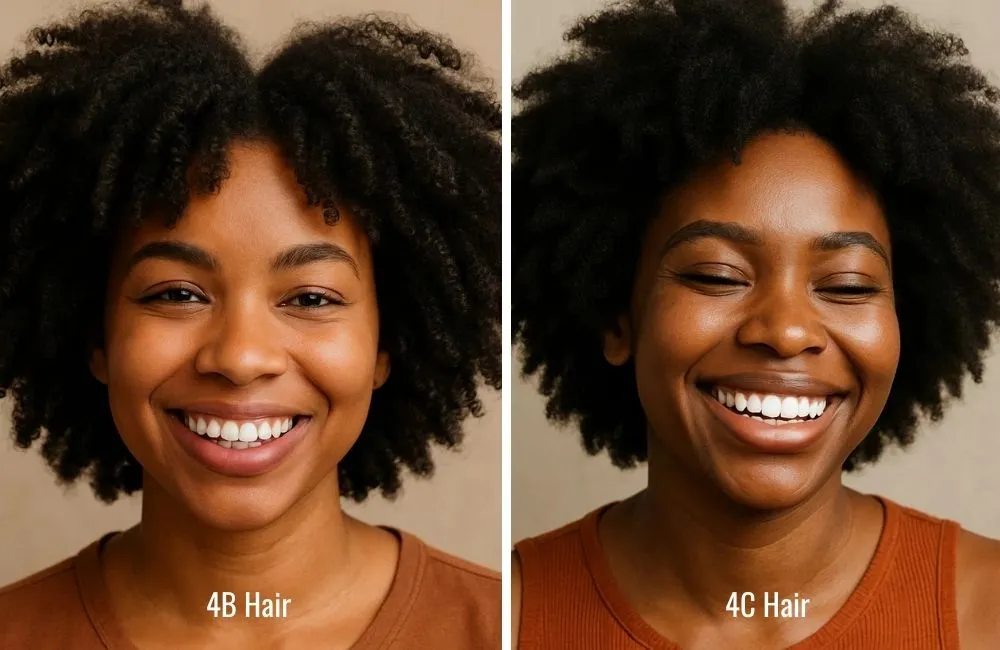
The conversation around 4B vs 4C hair has been happening for years, and for good reason. These curl types often get grouped together because they both fall under the “coily” category, but there are subtle differences that can help you better understand, care for, and style your hair. Whether you’re learning how to identify your curl pattern, exploring style inspiration, or just trying to make sense of what those little letters mean, we’ve got you covered. (And if you like, you can jump ahead to the our quizzes that can really help you know what your hair needs.)
Understanding curl types
Before diving into 4B and 4C hair specifically, let’s zoom out. The hair typing system, created by stylist Andre Walker, organizes curls into numbers (2 for waves, 3 for curls, 4 for coils) and letters (A, B, C) to describe how loose or tight those patterns are. While the system isn’t perfect and doesn’t capture the full range of textures, it’s still widely used as a reference point.
Type 4 hair is the tightest curl category, and within it, 4A, 4B, and 4C hair are known for their density, shrinkage, and versatility. The differences are often small but can make a big impact when it comes to styling and care.
4A vs 4B vs 4C hair: the main differences
When people ask, “What’s the difference between 4A, 4B, and 4C hair?” it usually comes down to the shape of the curl and how much definition you can see.
- 4A hair has an “S” pattern, with well-defined coils about the width of a crochet needle or pen spring. It holds definition easily, tends to have a visible curl pattern, and often appears shiny when moisturized. Shrinkage is around 50–60%.
- 4B hair forms a tighter “Z” pattern with sharp angles rather than loops. It’s fluffy, soft, and prone to more shrinkage—about 70%. The curl definition isn’t as obvious without styling products or manipulation.
- 4C hair is the tightest of them all, with less visible definition. Coils are densely packed and shrinkage can be up to 80%. This texture often looks voluminous, cottony, or cloud-like unless stretched or defined through styling.
In short: 4A coils are springy and defined, 4B coils are more angular and fluffy, and 4C coils are the most compact and dense. Many people also have a mix of all three textures across their head.
How do I know if my hair is 4a, 4b, or 4c?
If you’re wondering, “How do I know my curl type?” try looking at your strands when they’re freshly washed and product-free.
- If your strands form well-defined “S” curls, you’re likely closer to 4A.
- If your strands form sharp, angled bends and look fluffy, you’re likely 4B.
- If your strands clump less, look more cottony, and shrink the most, you’re likely 4C.
And don’t be surprised if you see more than one pattern on your head. Most people do!
Is 4B hair coily or kinky?
Both 4B and 4C textures are considered kinky-coily. 4B hair is often described as “coily” because you can usually see some curl pattern. 4C hair, on the other hand, is what most people picture when they think of “kinky” hair: tight, springy, and less defined.

What does 4C hair actually look like?
Because of shrinkage, 4C hair often looks shorter than it really is. It may appear like a soft cloud or dense halo of coils. Unlike looser curl types, the curl pattern isn’t always visible without defining products or manipulation, like twist-outs or braid-outs.

Caring for 4B and 4C hair and what it means for growth
While 4B and 4C textures are both coily, their differences affect how you care for them and what growth looks like over time.
Moisture needs:
- 4B hair, with its “Z”-shaped coils, can hold onto moisture a bit more than 4C, but still benefits from regular deep conditioning and lightweight creams.
- 4C hair, being the tightest coil type, tends to lose moisture faster. Many people use layering techniques like the LOC method (liquid, oil, cream) or the LCO method (liquid, cream, oil) to hydrate first with a water-based product, then seal it in with oil and/or cream. This step-by-step approach helps lock moisture in longer.
Detangling:
- 4B hair may detangle slightly easier because of looser bends. A wide-tooth comb or fingers with plenty of conditioner usually does the trick.
- 4C hair requires extra patience since strands are more densely packed. Gentle finger detangling in sections can minimize breakage.
Shrinkage and length retention:
- Shrinkage is more pronounced in 4C hair (up to 80%), making it seem like it’s not growing—even though it is.
- Both 4B and 4C grow at the same average rate (about half an inch per month), but because of shrinkage and breakage, progress can look slower. Protective styles, low manipulation, and regular trims all help with length retention.
In short, neither texture “grows slower.” The key is understanding your coil type so you can give it the care it needs to flourish—with 4C often benefiting from extra moisture and sealing to stay healthy.
Style ideas for 4B vs 4C hair
Both 4B and 4C hair are incredibly versatile and can be styled in protective or stretched looks to highlight their beauty.
- Twist-outs and braid-outs: Great for adding definition and reducing shrinkage.
- Afros: Celebrate your volume by picking out your curls into a rounded shape.
- Protective styles: Braids, twists, and faux locs work beautifully and give your hair a break.
- Wash-and-go: With the right product combo, you can rock your natural pattern with pride.
If you’re in NYC, LA, or DC, our Unruly stylists can help you try protective styles that suit your texture, schedule, and lifestyle.
The final strand: Get to know your hair
At the end of the day, whether you identify as 4B or 4C, your hair is unique and deserves care tailored to its needs. Don’t stress too much over fitting into one category. Focus instead on what makes your hair thrive: moisture, low manipulation, and styles that bring you joy. You can learn more about your hair through our many quizzes:
And if you want more inspiration, tips, and stylist recommendations, keep exploring Unruly and follow us on Instagram @wetheunruly.
FAQs
Look at curl definition, density, and shrinkage. 4A has a springy “S” pattern, 4B has fluffy “Z” bends, and 4C looks dense with minimal visible curl pattern.
Neither is “harder” by default. Both need moisture, gentle detangling, and protective styling, but 4C may require more product for definition.
Generally, yes. Both need hydration, but 4C’s tighter coil structure makes it more prone to dryness, so extra sealing is often necessary.
Yes, but shrinkage makes growth less visible. Consistent care and protective styles help retention.
Yes. While type 4 hair is most common among people of African descent, texture isn’t strictly tied to race. Some non-Black people, including white and mixed-race individuals, can have hair that resembles 4C in tightness and density.
Read the full article from the original source

