




Wellness That Matters: Black Health News & Community Care
- Starting a GLP-1 receptor agonist in adults 50 and older associated with lower fragility fracture risk, including hip and vertebral fractures.
- Protection was strongest for vertebral (HR 0.68), hip/femur (HR 0.70), and rib fractures (HR 0.83).
- Associations were independent of changes in BMI and HbA1c, suggesting potential direct skeletal effects of GLP-1 drugs.
- Study used the TriNetX Research Network with 66,803 matched pairs (133,606 adults aged 50–90), excluding osteoporosis and high-energy trauma.
- Findings not generalizable to younger weight-loss users or those with osteoporosis; authors recommend bone monitoring and prospective randomized trials.
- Diabetes and weight loss are associated with an increased risk of fragility fractures, which can be associated with substantial morbidity and mortality.
- In this retrospective study of adults with type 2 diabetes, those starting a GLP-1 drug had a 21% lower risk of fragility fractures over 3 years compared with initiators of a DPP-4 inhibitor.
- The lower fracture risk associated with GLP-1 drugs was independent of changes in body mass index.
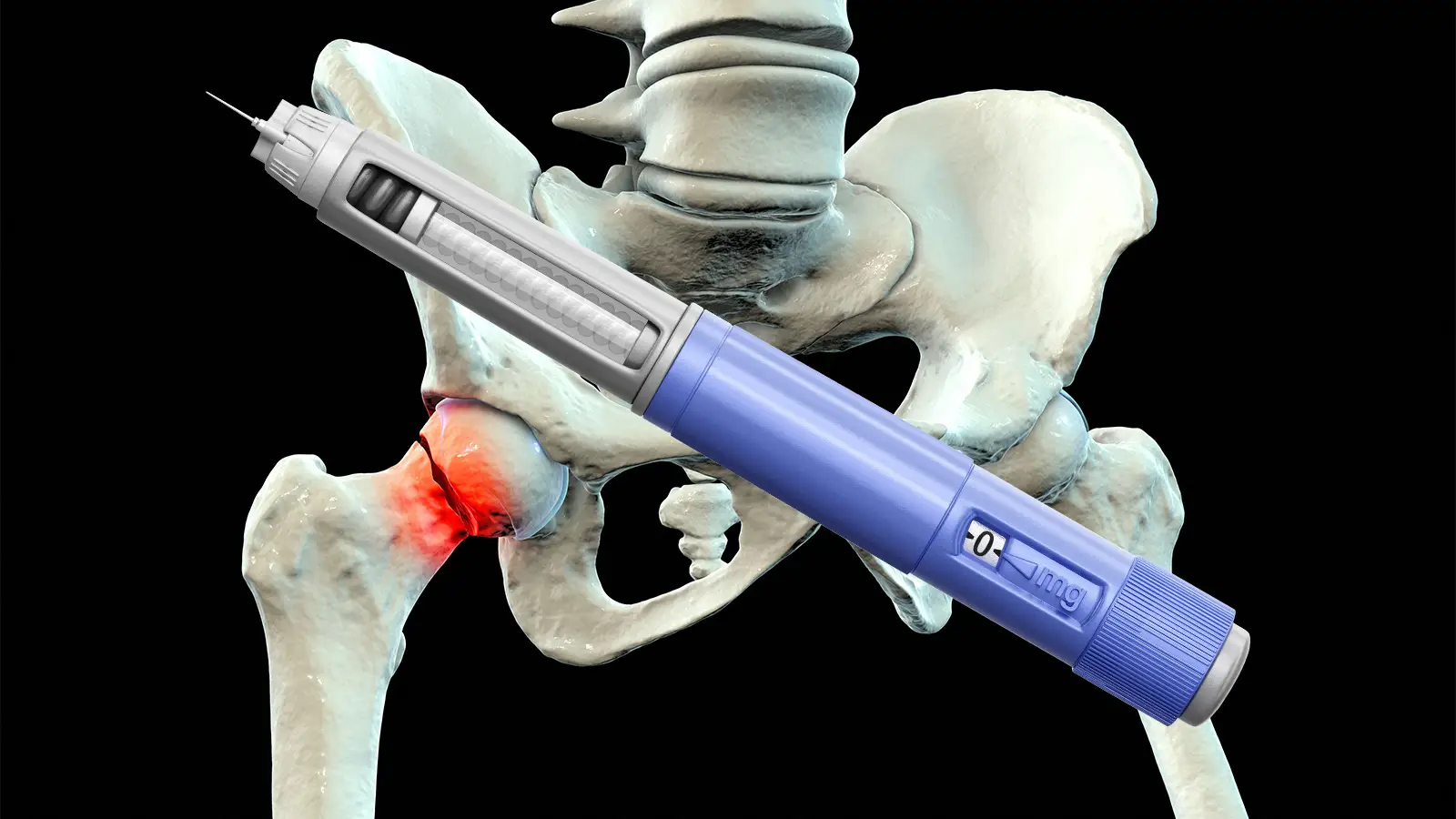
Starting a GLP-1 receptor agonist for type 2 diabetes was associated with a lower risk of fragility fractures in adults 50 and older, including hip and vertebral fractures, according to a large target trial emulation study.
Over 3 years, new users of GLP-1 drugs had a 21% lower risk of fragility fractures compared with new initiators of DPP-4 inhibitors (HR 0.79, 95% CI 0.76-0.83), reported Christopher Hamad, MD, of the University of California Los Angeles, and colleagues.
“Although the absolute risk reduction at 3 years was modest (0.79%), this magnitude is clinically relevant given a baseline 3-year major osteoporotic fracture risk of approximately 3% to 4% in comparable populations and the substantial morbidity and mortality associated with hip and vertebral fractures,” the authors wrote in JAMA Network Open.
Hip fractures, for example, are associated with 1-year mortality rates of up to 25% in women and up to 36% in men. Given the potential for severe outcomes, Hamad’s group emphasized that even modest absolute reductions in fragility fractures — which stem from low-energy trauma like falling from standing height — can prevent meaningful population-level events.
The findings build on several smaller observational studies in patients with diabetes that have similarly linked the use of GLP-1 drugs such as semaglutide (Ozempic, Wegovy) to a reduced fracture risk. Hamad’s team noted their study utilized the largest dataset to date on this topic.
The protective benefit was strongest against fractures that carry the highest morbidity and mortality:
- Vertebral fractures: HR 0.68, 95% CI 0.63-0.73
- Hip or femur fractures: HR 0.70, 95% CI 0.63-0.79
- Rib fractures: HR 0.83, 95% CI 0.77-0.91
No significant associations were found for fractures of the distal radius/ulna or proximal humerus.
Mediation analyses indicated that these associations were independent of changes in body mass index (BMI) and HbA1c, consistent with a potential direct skeletal effect of GLP-1 drugs. This is notable because weight loss is associated with reduced bone mineral density and higher fracture risk, as reflected in the study’s finding that cumulative BMI loss was tied to a 2% increase in fracture risk.
“Yet, GLP-1 RA [receptor agonist] use was associated with lower fracture risk despite these changes, suggesting that potential direct skeletal effects may outweigh the adverse consequences of weight loss,” the authors wrote.
While current American Diabetes Association Standards of Care classify GLP-1 drugs as having neutral skeletal effects, the researchers argued these results suggest that assumption warrants reevaluation. However, they acknowledged that the findings could still reflect unmeasured factors like improved balance or physical activity.
For their comparative effectiveness study, the researchers pulled data from the TriNetX Research Network, analyzing 66,803 matched pairs (133,606 total patients ages 50 to 90 years). Mean age was about 63, roughly 53% were male, 58% were white, and average baseline BMI was around 33.
All had type 2 diabetes and newly initiated a GLP-1 agonist or DPP-4 inhibitor between 2015 and 2022. Dulaglutide (Trulicity), semaglutide, and liraglutide (Victoza) accounted for 91% of the index prescriptions for a GLP-1 drug. Exclusion criteria included high-energy trauma fractures, osteoporosis, and osteopenia.
In subgroup analyses, lower fracture risk was consistent across age groups, sexes, and frailty levels. However, in a separate matched cohort evaluating participants by diabetes status, GLP-1 use had protective associations among adults with type 2 diabetes (3-year HR 0.91, 95% CI 0.88-0.95), but was associated with an increased fracture risk in adults without diabetes (HR 1.13, 95% CI 1.04-1.23, P<0.001 for interaction).
Consequently, the authors emphasized that the findings cannot be generalized to younger individuals using GLP-1 drugs solely for weight management, nor to people with known osteoporosis or prior fragility fractures, who were excluded from the study.
Overall, “the findings do not argue against GLP-1 RA use on the basis of fracture risk, though bone health monitoring remains prudent,” according to the researchers. They called for prospective randomized trials to evaluate the associations observed, including in patients with osteopenia or early osteoporosis, along with preclinical work to understand potential mechanisms.
Read the full article on the original site
