




Scientific research & Exploration: Explore the World With Research Study and Technology
- ClusterCAD and genome mining guided selection of PKS domains and TEs to assemble diverse BKDL biosynthetic pathways.
- ATs promiscuity enabled incorporation of malonyl-CoA analogs in vivo, expanding chemical diversity at the δ-carbon of BKDLs.
- rifM2, mlsB1 and modified debsM6 hybrid modules achieved nonreducing malonyl extension required for BKDL β-keto and α-methylene motifs.
- Escherichia coli yielded low BKDL titers, while Streptomyces, notably S. albus, produced higher BKDL with competing 3-hydroxy acid byproducts.
Biosynthesis of BKDLs utilizing crafted PKSs
We built and tested BKDL synthases using parts from type I modular PKSs, multidomain enzymes that manufacture polyketides from acyl-CoAs in an assembly-line fashion. BKDLs can be synthesized making use of fairly little PKSs consisting of a loading module, 2 expansion components and a thioesterase (TE) that cyclizes the lactone ring during hydrolysis of the product from the synthase (Fig. 2 a While it is vital for the α-carbon of the BKDL to be unsubstituted and β-carbon to be a ketone, the γ-carbon and δ-carbon can be functionalized with various pendant teams. In addition, the stereochemistry of those 2 placements can be specified by the PKS 9 , 10 These features can be utilized to tailor polymer properties, although this stays uncharted.
a , Biosynthesis pathway of BKDLs with recombined PKSs. All substratums are CoA derivatives, including the starter unit and expansion devices. Module 2 should make use of malonyl-CoA (for the α-carbon to be a methylene) and be nonreducing (for the β-carbon to be a ketone). The prolonged polyketide can potentially be hydrolyzed off component 1, causing the side product of 3 -hydroxy acids. b , All BKDLs generated in this research, other than chemically manufactured BKDL 1 c , Titers of BKDL production from E coli K 207 – 3 (light-green bars) and S albus J 1074 (dark-green bars). Comprehensive manufacturings are presented in Supplementary Figs. 5 b– f , 10 a– g and 12 b The items and equivalent E coli and S albus pressures (Supplementary Table 2 that generated the above titers are as follows: 2 , N.A., sZW 37 _ 1; 3 , sSC 30 _ 1, sZW 35 _ 1; 4 , sSC 26 _ 1, sZW 26 _ 1; 5 , sSC 22 _ 2, sZW 23 _ 1; 6 , sSC 27 _ 2, sZW 37 _ 1; 7 , N.A., sZW 39 _ 1; 8 , N.A., sZW 44 _ 1 (N.A. indicates that no item was spotted for any type of pressure). Information are presented as the mean values ± s.d. from 3 biologically independent experiments. d , Titer of BKDL 4 produced by E coli stress sSC 26 _ 2 in 1 -L set activator growings utilizing LB-EZ-Rich medium containing either glucose or glycerol as carbon resources. Information are presented as the mean worths ± s.d. from 2 naturally independent 1 -L bioreactor fermentation experiments. R *, non-active KR.
We utilized a PKS layout software, ClusterCAD 11 , 12 , and genome mining to predict candidate PKS domain names, modules and TEs needed to create a diverse set of BKDLs 2– 11 (Fig. 2 b PKS components and domains were chosen to do the chemistry needed to generate BKDLs from acyl-CoAs that are normally offered or whose biosynthesis could be crafted right into microorganisms. The performance on the δ-carbon is defined by the PKS filling module; the functionality at the γ-position is defined by the initial expansion component and the ketoreductase (KR) because component specifies the stereochemistry at the γ-position and δ-position. Due to the fact that some acyltransferases (ATs) are promiscuous for the malonyl-CoA analogs that they approve, it is feasible to broaden the series of BKDLs (various alternatives on the δ-carbon) by creating various malonyl-CoA analogs in the cell revealing the PKS with the promiscuous AT, a residential or commercial property that we exploited to create several BKDLs artificial insemination (Supplementary Fig. 2 b, c and 3 As BKDLs need to have a β-keto group and a methylene at the α setting, extension module 2 should be nonreducing (no useful KR domain name) and use malonyl-CoA as the expansion substrate 13 There are few all-natural PKSs that have a module with the functions needed of that expansion component; thus, we utilized 3 crossbreed extension component 2 s with different degrees of modifications to check out BKDL biosynthesis (Additional Fig. 4 : expansion module 2 of the rifamycin PKS (rifM 2 14 can be made use of in its indigenous type; extension module 1 of the mycolactone synthase B 1 (mlsB 1 15 normally prolongs with malonyl-CoA but its KR need to be suspended; and expansion component 6 of the erythromycin PKS (debsM 6 16 natively prolongs with methylmalonyl-CoA, where its AT must be traded with one that favors malonyl-CoA (as an example, epothilone PKS expansion module 4 AT, epoAT 4 17 and its KR must be altered to remove its task. Artificial insemination biosynthesis of BKDL 7 with cleansed enzymes was demonstrated prior to execution of the in vivo BKDL production (Supplementary Figs. 2 c and 4 BKDLs 9 — 11 (Supplementary Fig. 3 were created artificial insemination by supplementing lysates of Escherichia coli sharing the PKSs (pressures sZWe 01, sZWe 03 and sZWe 04 for BKDLs 9 and 10 ; sZWe 02, sZWe 03 and sZWe 04 for BKDL 11 with acetyl-CoA, malonyl-CoA and methylmalonyl-CoA (BKDL 9 , acetyl-CoA and malonyl-CoA (BKDL 10 and propionyl-CoA, malonyl-CoA and allylmalonyl-CoA (BKDL 11
In E coli K 207 – 3 (ref. 18 , PKSs with debsM 1 as first extension module and rifM 2 as the 2nd expansion module (strain sSC 05 _ 1; Supplementary Table 2 created 200 μg L − 1 BKDL 4 (Fig. 2 c and Supplementary Figs. 5 b and 6 b , while PKSs with lipM 1 as initial extension component and debsM 6 (epoAT 4, KRnull) as the 2nd extension module (pressures sSC 22 _ 1 and sSC 22 _ 2 produced 100– 220 μg L − 1 BKDL 5 , relying on the duplicate number of both modules (Supplementary Fig. 5 c Provided the low titers of BKDLs 4 and 5 produced by E coli (Supplementary Fig. 5 b, c , we evaluated five Streptomyces spp. ( S albus , S lividans , S coelicolor , S venezuelae and S noursei for the production of BKDLs. The genetics inscribing lipLM-lipM 1 and mlsB 1 *-debsTE, which revealed the most effective efficiency in the in vitro assay, were integrated right into their genomes to create BKDL 8 In 7 -day societies, S albus generated the highest possible titer of BKDL 8 , ~ 2 mg L − 1 , while other types created more very early termination item, 3 -hydroxy- 2, 4 -dimethyl-pentanoic acid, > > 300 mg L − 1 , however much less BKDL 8 , << 0. 1 mg L − 1 (Supplementary Fig. 5 e The low manufacturing was most likely due to the reduced expression of the second expansion component (Additional Fig. 7 , considering that the intracellular degree of malonyl-CoA is one of the most abundant CoA thioesters in S albus J 1074 (ref. 19 Remarkably, nearly 90 % of the BKDL and 3 -hydroxy acids were secreted from the cells (Supplementary Fig. 7 a Feeding cells [13C] L -valine enabled us to additional validate the identity of the items (Supplementary Figs. 8 b and 9 Regular with the in vitro results, the best expansion component 2 in S albus was mlsB 1 *-debsTE (Fig. 2 c and Supplementary Fig. 10 f The titer reached 27 5 mg L − 1 on the 11 th day (Additional Fig. 10 a
With the detection of over 100 -fold even more 3 -hydroxy acid intermediates than BKDL, we suspected that the transfer of the 3 -hydroxy diketide from the very first extension module to the 2nd could be restricted. Consequently, we fused the first and second extension modules, developing a single, big hybrid PKS. Ten recombined PKSs were developed (PKSs 31– 40, Supplementary Table 3 to generate BKDLs with replacements of ethyl (BKDLs 4– 6 and isopropyl (BKDLs 2 , 7 and 8 groups at the δ placement and with methylene or a methyl team at the γ-position. When integrated right into S albus , the engineered PKSs produced the desired BKDLs. While the fusion strategy ensured that expansion components 1 and 2 were shared at the same level, it resulted in really low titers of BKDL (<< 0. 5 mg L − 1 (Supplementary Fig. 10 b– g We hypothesized that the interaction in between the acyl carrier healthy protein (ACP) in the first expansion module and the ketosynthase (KS) in the second extension component might be endangered by the linker in between both domain names and/or by a dissimilar interaction in between the ACP and KS (Auxiliary Fig. 11 Thus, we exchanged the mlsB 1 KS in extension component 2 with the KS from the lipomycin module 2 (M 2 _ lipKS 2 swap) and erased the KR from mlsB 1 (M 2 _ KR 2 deleted). The resulting constructs (strains sZW 46 _ 1 and sZW 44 _ 1 generated 16 5 and 78 2 mg L − 1 BKDL 8 , respectively, with the KR removal having a much more remarkable impact on BKDL manufacturing than the KS exchange (Supplemental Fig. 12
Furthermore, we revealed parts of the pikromycin biosynthetic gene cluster (Pik 127 or Pik 167, which have actually been reported to produce triketide lactones comparable to BKDLs yet containing an α-methyl 20 We replaced the methylmalonyl-CoA-specific AT of pikromycin module 6 with malonyl-CoA-specific borrelidin component 1 AT (borAT 1 or with the pikromycin module 2 AT (pikAT2 The resulting E coli K 207 – 3 pressures (stress sSC 27 _ 2, sSC 26 _ 1 and sSC 30 _ 1 expressing these constructs created ~ 50 mg L − 1 BKDL 6 , ~ 200 mg L − 1 BKDL 4 and ~ 12 mg L − 1 BKDL 3 , specifically (Supplementary Fig. 5 d We then incorporated these constructs right into S albus and accomplished titers of 61 4 mg L − 1 BKDL 4 (Fig. 2 c , still with the second expansion component inadequately revealed. The overall increase in BKDL titers in E coli was attributed to the much greater soluble expression of pikromycin PKSs; increasing the copy number of the plasmid nurturing component 2 so that the degree of component 2 protein was comparable to that of component 1 reduced the amount of side product 3 -hydroxy acid (Supplemental Fig. 7 b More combination of genes encoding malonyl-CoA synthetase and carrier, MatBC, into the K 207 – 3 genome to increase malonyl-CoA supply 21 and scaling of the cultivation process to 1 -L bioreactors effectively boosted the titers of BKDL 4 to 1 09 g L − 1 with glycerol (intake of 12 05 g L − 1 glycerol, 20.0 mM sodium propionate and 5 5 mM salt malonate supplemented) and 1 84 g L − 1 with glucose (usage of 15 86 g L − 1 glucose, 9 mM salt propionate and 0. 1 mM salt malonate supplemented) as the main carbon source in just 24 h (Fig. 2 d and Supplementary Fig. 13 , with 9 4 % and 21 2 % of the theoretical maximum return, respectively ( Supplementary Methods Taken together, we demonstrated manufacturing of 10 different BKDLs, both artificial insemination (Supplementary Fig. 3 and in vivo (Fig. 2 c , and among these BKDLs was scaled in bioreactors to nearly 2 g L − 1 While these titers are still reduced relative to what would be needed for business manufacturing, they are a great beginning point for further optimization.
Style, synthesis and screening of chiral BKDL-PDKs made from BKDLs
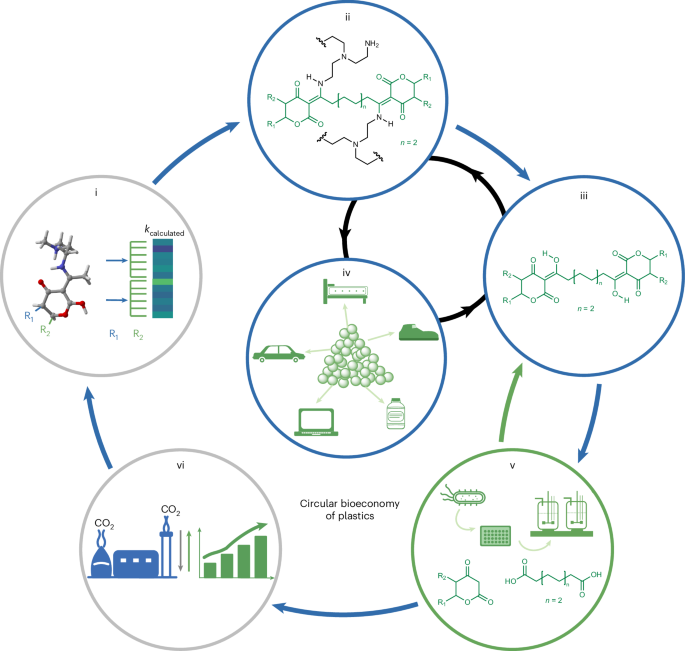
Having recognized kind I PKSs that create BKDLs, we sought to create a computational system that can inform just how the various substituents and their respective stereochemistries might affect the homes of PDKs obtained therefrom. This would permit details targets to be focused on for reusing circularity. As an example, there are 2 probable mechanisms through which substituents might affect recycling circularity: (1 remote substituent impacts can dictate the structure and totally free power of the acidolysis shift state, about starting materials and products and (2 adjustments in hydrophobicity could influence the Δ G solvation of the diketoenamine throughout acidolysis, limiting water uptake and reactive surface.
We selected 144 functionally and stereochemically varied BKDLs with useful groups that are found in all-natural polyketides: eight substituents at the δ-position and 9 substituents at the γ-position in both cis and trans configurations. To give context for the initial device, we executed density useful theory simulations of the reaction collaborates for acidolysis of small-molecule diketoenamines, determining the common free energy of activation (Δ G ‡ for the enhancement of water to the iminium intermediate along the response coordinate 5 , 22 (Supplementary Tables 4 and 5 We used multipath transition state theory 23 , 24 to guarantee the highest degree of arrangement between theory and experiment. To provide context for the 2nd mechanism, we determined Δ G ‡ and Δ G solvation of ionized diketoenamine bonds, which is impacted by the hydrophobicity imparted by the substituents (Supplementary Tables 6 and 7 Through these estimations, we located that the γ-substituent and δ-substituent, no matter stereochemistry, did not substantially modify Δ G ‡ because they create fairly small changes to molecular conformation near the response center (Fig. 3 a Nonetheless, Δ G solvation has a more crucial duty than previously recognized in BKDL-PDK reusing actions. Especially, even little distinctions in Δ G equate to huge distinctions in reaction prices with Eyring scaling (rate ∝ exp(− Δ G ‡ / RT ) and these thermodynamic results are additional intensified in the strong polymer by morphology-dependent and transport-dependent access of water and acid to the diketoenamine bonds (Fig. 3 b

a , b , Warmth maps for computed Δ G ‡ ( a and Δ G solvation ( b for little particles standing for ionizable and hydrolyzable bonds in circular BKDL-based PDKs. Δ G ‡ confirmed no remarkable variation with substitution, whereas Δ G solvation trended with substituent size.
To examine these theories, we chemically synthesized achiral BKDL 1 from methyl acetoacetate and acetone, in addition to 4 chiral BKDLs bearing one-of-a-kind substituents at the δ-position and γ-position (R 1 and R 2 , respectively) (Fig. 4 a BKDLs 2 , 3 and 3 ′ were selected since they can be biosynthesized utilizing crafted PKSs and have differences in both steric results on the change state and emergent hydrophobicity (Fig. 3 We prepared chiral BKDL 2 bearing an isopropyl and a methyl substituent at the δ-position and γ-position, respectively, using a series that consisted of an enantioselective Evans aldol response, acylation of the α-alkyl-β-hydroxy oxazolidin- 2 -one and Claisen condensation from the kinetic enolate, which frees the chiral accessory. For chiral BKDL 3 birthing an ethyl substituent at the δ placement, we performed a catalytic crooked vinylogous Mukaiyama aldol response complied with by base-promoted ring closure to the preferred chiral lactone. As a control, we synthesized BKDL 3 ′ (racemic blend) bearing an ethyl substituent at the δ-position from methyl acetoacetate and propionaldehyde. These synthetic sequences work as recommendation factors for how difficult it would be to produce BKDLs as a commodity chemical at scale, which inspires a biosynthetic route that prevents costly reagents and pyrophorics.

a , Photograph of a BKDL-PDK film held in between thumb and first finger, demonstrating the material’s adaptability and optical clarity. Chemical synthesis of b -PDK 1 — 3 and 3 ′ b , T g of b -PDK 1 — 3 and 3 ′ evaluated by differential scanning calorimetry. c , Acid-catalyzed depolymerization of b -PDK 1 — 3 and 3 ′ and recuperation of their matching monomers at specific temperature level limits.
Condensation of these BKDLs (BKDLs 1– 3/ 3 ′ ; Fig. 4 with sebacic acid gave the corresponding triketones: b -TK 1 (achiral control), b -TK 2 (isopropyl chiral and hydrophobic), b -TK 3 (ethyl chiral) and b -TK 3 ′ (ethyl racemic combination). These triketones were after that polymerized with tris -( 2 -aminoethyl)amine to produce b -PDK 1 — 3 and 3 ′ (refs. 4 , 5 , 6 (Fig. 4 a The materials exhibited different T g ; while b -PDK 1 showed a T g of 98 ° C, b -PDK 2 revealed a T g of 75 ° C and b -PDK 3 and 3 ′ displayed T g of 65 and 53 ° C, specifically (Fig. 4 b The chemical recycling of b -PDK 1 in 5.0 M HCl to triketone b -TK 1 (93 % yield) was full after 24 h at room temperature level (Fig. 4 c 4 , 5 , 6 Significantly, in contrast, hydrolysis of b -PDK 2 under the same conditions was jailed; instead, the example maintained its integrity but lightened over time as the sample swelled somewhat and began to scatter visible light. To promote hydrolysis, we elevated the depolymerization temperature level to 60 ° C, after which total deconstruction of b -PDK 2 to b -TK 2 (96 % return) was observed after 24 h (Fig. 4 c b -PDK 3 and 3 ′ showed a little slower deconstruction rates than b -PDK 1 , as the complete deconstruction of the networks right into their equivalent b -TK 3 and 3 ′ parts required 72 h (both with 93 % yield of recuperated monomer). While we observed differences in structure and thermal buildings, we did not discover that chirality affected the yield (Fig. 4 a or purity ( 1 H nuclear magnetic resonance analysis in Supplementary Fig. 14 of recouped b -TK monomers after PDK deconstruction in solid acid; all were comparably high.
As our objective was to develop a layout model to pick BKDLs on the basis of wanted polymer residential or commercial properties, we contrasted the speculative and computational results. b -PDKs 1 , 2 and 3 had minimal differences in computed Δ G ‡ relative to b -PDK 1 , 0. 36 and 3 18 kJ mol − 1 , specifically, which did not account for the observed distinctions in PDK deconstruction rate (Supplementary Table 8 Taking into consideration the notable distinctions in Δ G solvation observed with the γ-substituent and δ-substituent throughout the screening research and the uniformity in ordering b -PDKs 1 , 2 and 3 between experiment and Δ G solvation (Supplementary Table 9 , we conclude that the distinguished prices of b -PDK acidolysis (Fig. 4 c are linked to the energised expenses of ionizing and solvating diketoenamine residues, instead of remote substituent results linked to γ-methyl and δ-isopropyl substituents in b -PDK 2 In addition, expanding the opportunities of BKDL functionalization opens the door to mixed-plastic and composite recycling; because different BKDL-PDKs depolymerize at various temperatures, blended streams having multiple BKDL-PDK kinds can be reused by consecutive temperature steps, recovering each monomer easily at its specific limit. The increase in hydrophobicity can likewise be exploited for chemical and solvent resistance (Auxiliary Fig. 15
Expense of BKDL production and courses for enhancement
Marketing BKDL-PDKs calls for that they take on incumbent plastics or thermosets on the basis of ecological influences and expense, measured here as minimal asking price (MSP). To establish an initial understanding of the price and recognize opportunities for renovation, we performed a TEA. Integrating this analysis as component of the research allows us to determine its scalability and figure out how renovations in the titer, rate, yield and other procedure problems will affect the capacity for commercializing BKDL-PDKs (Fig. 5 a To this end, we evaluated 3 various situations: production of BKDL at 21 % (based upon experimental information), 50 % (intermediate level of optimization) and 90 % (completely enhanced) of the maximum theoretical return at industrial range (Fig. 5 b Industrial range was specified on the basis of a corn stover input of 2, 000 bone-dry metric bunches per day, meaning that the intermediate scenario produces around 65, 670 statistics lots of BKDL annually, sufficient to satisfy the requirements of multiple BKDL-PDK manufacturing facilities.

a , Schematic systems boundary for BKDL bioproduction. b , Annual BKDL bioproduction and return under the different scenarios, readjusting for variables such as the item return and forecasted performances got at commercial range. c , MSP and life-cycle GHG emissions for this job, as well as intermediate and totally maximized BKDL bioproduction at business range. The dashed lines in c reveal the MSP and life-cycle GHG exhausts per kg of dimedone for comparison, in addition to the lowest-achieved MSP for TAL in Demarteau et al. 8 and an approximated market value range of 1– 3 US$ per kg for raw material inputs, consisting of polyols, propylene, isocyanates and ethylene, for product polymers(which are not functionally comparable yet valuable frames of reference).
To position BKDL-PDKs in a broader economic context, we compared their manufacturing expenses to multiple standards, consisting of dimedone and TAL (Fig. 5 c In BKDL-PDK production, BKDLs work as a substitute for dimedone, a petrochemical priced at 10 US$ per kg. In our analysis, we located that BKDL manufacturing in all 3 various circumstances evaluated in this research study achieves a lower MSP about the market cost for dimedone (Fig. 5 c Our results suggest that commercial-scale BKDL production from corn stover can minimize the cost of PDK in the near term, also at the currently demonstrated return (21 % of academic maximum), offered a bioconversion house time at or below 27 h. The MSP for BKDL based upon the currently shown yield is additionally approximately 1 US$ per kg lower than what was previously reported for TAL using a similar process configuration 8 and more than 3 US$ per kg less than the best-reported TAL efficiency prior to that study 25 We include an approximated range of 1– 3 US$ per kg in Fig. 5 c as a valuable context, indicating that a fully optimized BKDL manufacturing path can also compete in these mature petrochemical markets.
Life-cycle GHG exhausts
Relative to GHG exhausts, the 3 circumstances examined in this research study result in lower cradle-to-gate GHG discharges contrasted to dimedone, reaching around 4 kg carbon monoxide 2 e per kg of BKDL considering experimental yield and 2 3 and 1.0 kg carbon monoxide 2 e per kg of BKDL in the intermediate (getting to 50 % of academic optimum BKDL return) and enhanced (90 % academic yield with various other minor procedure optimizations) circumstances, respectively (Fig. 5 c The GHG results for BKDL reported here are significantly lower than formerly reported GHG emissions for TAL production based on a comparable configuration (which completed 14 kg carbon monoxide 2 e per kg) 8 , already a significant decrease relative to the formerly reported performance representing 22 kg carbon monoxide 2 e per kg) 8 , 25 Much more in-depth waterfall plots for price and GHG emissions can be located in Supplementary Fig. 16 Across all situations, lowering on-site energy use and/or getting 100 % sustainable electrical power is vital to minimizing the GHG footprint of BKDL bioproduction. Lessening bioconversion home time and optimizing product yield are both essential to this power need and emissions decrease objective.
Opportunities for price and exhausts reductions
While BKDL production is presently development combined, checking out future decoupled growth and manufacturing phases can enable a lot more economical two-stage bioconversion with streamlined media and lower oygenation rate in the manufacturing stage. Taking full advantage of item yield can likewise ensure that the substantial contributions from feedstock supply and handling, while pretreatment and hydrolysis remain low sufficient to make certain the GHG footprint of BKDL is listed below that of dimedone.
Residence time, which associates with the production rate, is also crucial for both the price and GHG exhausts; the power needed to freshen and upset the bioreactor while it is operating is a substantial contributor to discharges and the bioreactor funding expenses are additionally dependent on home time. Use alternate hosts such as industry-favored Corynebacterium may minimize the moment in the bioconversion activator, which subsequently will reduce the MSP. Improving the price and, thus, decreasing bioconversion time can also decrease the quantity of on-site power required, which additionally lowers the MSP.
Product recuperation is a crucial location for improvement. Column chromatography is presently used for BKDL healing at research laboratory scale and we have actually cautiously included this method in our version as a result of its demonstrated success in accomplishing adequate purity. Nevertheless, this technique is not practical for commercial manufacturing. Crystallization or rainfall of BKDL monomers stands for the commercially appropriate purification approach, as the relatively reduced aqueous solubility of BKDLs with hydrophobic substituents is anticipated to help with straight recovery from fermentation brew. Transitioning from chromatography to crystallization-based recuperation would significantly decrease both funding and operating costs (5 4 % and 12 % reduces in fixed capital financial investment and total operating costs, respectively; even more details in Supplementary Fig. 16
Added renovations throughout the production system, consisting of enhanced corn stover supply chain, enhanced sugar yields, higher ionic liquid and item recovery prices and enhanced titer, price and return are required to reach the enthusiastic ‘optimized’ expenses. The MSP of 1 34 US$ per kg of BKDL in the optimized situation stands for a functional minimum, beyond which more improvements would be almost difficult, and can be helpful in screening for readily feasible BKDL applications. Although the fully enhanced scenario might not be achieved in the close to term, the understandings from this evaluation supply useful near-term, mid-term and long-term attainable objectives for BKDL bioproduction and process growth.
Paths to commercialization
Although this post goes over BKDLs in relation to a series of products, they are not functionally compatible for any one of the comparators received Fig. 5 c BKDLs offer even more tunability in regards to BKDL-PDK homes and hydrolysis conditions; therefore, they are functionally superior to dimedone. This tunability, affected by γ-substituent and δ-substituent variation, is additional demonstrated by the broader depolymerization temperature array (20– 60 ° C) observed in BKDL-PDKs, together with T g varying 53– 98 ° C (Fig. 4 a, b While virgin commodity plastics (high-density polyethylene (HDPE), poly(ethylene terephthalate) (PET DOG) and polypropylene (PP)) are normally valued at 1– 2 US$ per kg, the crucial advantage of PDKs is their ease of recycling to virgin-quality monomers; previously published results show that the price of round PDK (1 5 US$ per kg) is affordable with various other business plastics such as HDPE (2 3 US$ per kg), polyurethane (PU) (4 US$ per kg) and pet dog (1 2 US$ per kg). TAL-based bio-PDKs have a reported enhanced MSP of ~ 2 US$ per kg with GHG discharges of ~ 14 kg carbon monoxide 2 e per kg; BKDL-based PDKs considerably enhance both metrics. The trick to commercialization (and a major challenge to overcome) is finding market applications that assure high rates of recuperation for PDKs, as their inexpensive and simplicity of reusing are core aspects to their competitiveness and ecological promise. Durable goods where centralized facilities reclaim massive parts for reusing, such as automotive parts, might be one such application.
Check out the complete article from the original resource
