


Close Menu
Savannah HeraldSavannah Herald
    • Home
    • News
      • Local
      • State
      • National
      • World
      • HBCUs
    • Events
    • Directories
    • Weather
    • Traffic
    • Jobs
    • Sports
    • Politics
    • Lifestyle
      • Faith
      • Senior Living
      • Health
      • Travel
      • Beauty
      • Fashion
      • Food
      • Art & Literature
    • Business
      • Real Estate
      • Entertainment
      • Investing
      • Education
    • Guides
      • Back to School Savannah
      • Summer Camp Guide
      • Juneteenth Guide
      • Black History Savannah
      • MLK Guide Savannah
    We're Social
    • Twitter
    • Facebook
    • YouTube

    Subscribe to Updates

    Get the latest creative news from FooBar about art, design and business.

    Trending
    • Delaware North Sportservice brings banana-themed menus to Progressive Field for Banana Ball games
    • WNBA rookie apologizes after blocking A’ja Wilson
    • Porsha Williams Reveals She Had an Emergency Partial Hysterectomy
    • The HBCU dreams inspired by ‘A Different World’
    • It’s Hard To Predict Who Will Be Suicidal. It’s Easier To Ensure People Can’t Shoot Themselves.
    • Book Creator joins forces with Kami
    • Georgia Trend Daily – Sept. 21, 2026
    • It’s Fall Festival Season in Savannah!
    Facebook X (Twitter) Instagram YouTube
    Login
    Savannah HeraldSavannah Herald
    Savannah HeraldSavannah Herald
    Home » Researchers hope powerful new microscope will reveal ‘root cause’ of incurable bowel disease | Health
    Health

    Researchers hope powerful new microscope will reveal ‘root cause’ of incurable bowel disease | Health

    Savannah HeraldBy Savannah HeraldSeptember 14, 20265 Mins Read
    Facebook Twitter Pinterest LinkedIn WhatsApp Reddit Tumblr Email
    Researchers hope powerful new microscope will reveal ‘root cause’ of incurable bowel disease | Health
    Share
    Facebook Twitter LinkedIn Pinterest Email

    Health Watch: Wellness, Research & Healthy Living Tips

    Key takeaways
    • STED microscope Curie delivers 10-fold resolution improvement, visualizing structures to 20nm and imaging deeper tissues with deformable mirrors.
    • Researchers at the Rosalind Franklin Institute use Curie to map intestinal protein complexes, aiming to identify structural changes linked to IBD root causes.
    • Science minister unveiled Curie alongside new funding for institutes, amid warnings of savings and potential cuts at national UK research facilities.

    The number of young people living with debilitating and incurable bowel conditions worldwide is growing, but researchers now hope a one-of-a-kind microscope will help them understand such diseases and find new treatments.

    According to the British Society of Gastroenterology, more than half a million people in the UK are living with inflammatory bowel disease (IBD), with Crohn’s disease and ulcerative colitis the two main forms.

    While such conditions can develop at any age, experts say they are most often diagnosed between the ages of 15 and 40, blighting lives at a crucial time for education, work and relationships.

    Now a new piece of kit could bring fresh hope to those affected by IBD.

    “What this microscope technology and what the science we do in the lab can bring is really to understand the mechanism [of IBD] better,” said Dr Karina Pombo-Garcia, a group leader at the Rosalind Franklin Institute at the Harwell Science and Innovation Campus, Oxfordshire, where the microscope is housed.

    “With IBD, and with other many diseases that we collaborate with other groups to study, there [are] some treatments, but maybe those treatments still are not maybe the best or the most targeted that we can do because we … fundamentally don’t understand the disease fully.”

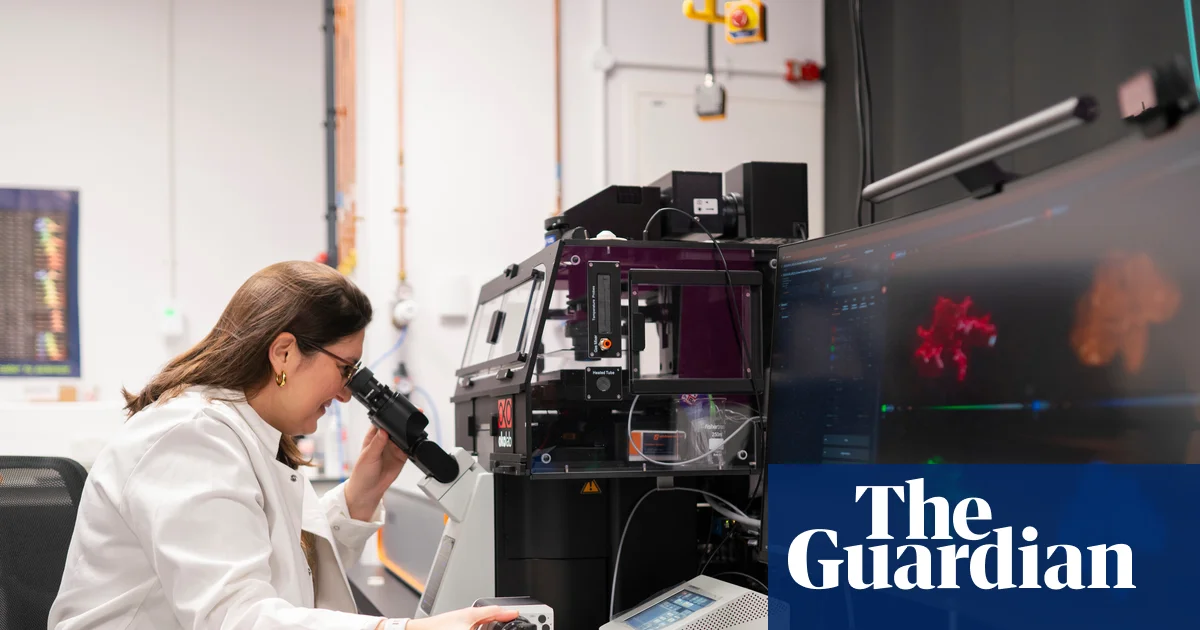
    Dr Pombo-Garcia and Dimitrios Ioannidis, a PhD student, with the new kit, which allows them to see details down to just 20nm in size. Photograph: Adam Gasson/Rosalind Franklin Institute

    With its black casing, grey hoses and a plethora of wires, the microscope is remarkably unobtrusive.

    Yet this is no run-of-the-mill bit of tech: the microscope operates at 10 times the resolution of conventional light microscopy, allowing researchers to see the details down to just 20nm in size.

    chart
    How stimulated emission depletion works.

    To do so, the microscope, which researchers have nicknamed “Curie”, uses a two-laser technique known as stimulated emission depletion (STED) microscopy that scooped its inventors the Nobel prize in physics in 2014.

    In this setup, features of interest within cells are labelled with fluorescent tags – these absorb energy from the first laser beam and then emit light, or fluorescence.

    A second, doughnut-shaped laser beam overlaps with the area illuminated by the first. Crucially, this second beam “switches off” fluorescence within its outer ring, meaning fluorescence is only detected from the centre of the doughnut – a very small region.

    “This allows the microscope to distinguish structures that are much closer together than would be possible using a conventional fluorescence microscope, producing images with exceptionally high resolution,” said Pombo-Garcia.

    The microscope also has additional features, making it the only one of its kind in the UK. These, Pombo-Garcia notes, include deformable mirrors that can correct for optical distortions caused by the sample.

    “This allows researchers to obtain clear images from deeper within relatively thick tissues and mini-organs,” she said. “It also has a temperature-controlled stage, enabling living cells and mini-organs to be studied under conditions close to normal body temperature.”

    PhD student Dimitrios Ioannidis is using the microscope to understand how cells that line our internal organs create protective barriers. Photograph: Adam Gasson/Rosalind Franklin Institute

    Dimitrios Ioannidis, a PhD student, is using the microscope to understand how cells that line our internal organs, including the intestines, come together and create protective barriers.

    “For this to happen, we have specific protein complexes, which we hypothesise might change over time. So using this piece of equipment, we are able to visualise these complexes beyond what [we can see with a] conventional microscope,” he said, adding that he was looking at how the structure of these protein complexes changes from foetal development to adulthood. “If the structure changes, so does the function,” he said.

    Ioannidis noted that by understanding what healthy tissue should look like, and then comparing and understanding the differences seen in people with disease, there was the potential to shed light on what had gone wrong.

    “And then if you work and dig a little bit deeper, you can potentially find the root cause of some of the diseases that are affecting individuals,” he said, noting that this included IBD.

    The microscope was unveiled by science minister Chris McDonald, alongside the announcement of £67m of funding for the Rosalind Franklin Institute over the next five years from April 2027, and a further £90m over the same period for the Henry Royce Institute, which focuses on materials research. In both cases, the funding has come from the Engineering and Physical Sciences Research Council via the core budget of UK Research and Innovation (UKRI) set in the 2025 spending review.

    The announcement comes at a difficult time for UK science facilities. Earlier this year the Science and Technology Facilities Council (STFC), also part of UKRI, revealed it needs to make £162m in savings by 2030 as a result of factors such as soaring energy costs at its national facilities, increasing staffing costs, an expanded portfolio of activities and “unfavourable movements” in foreign exchange rates.

    The situation has put some national facilities at risk of closure, with the Diamond Light Source, Central Laser Facility and ISIS Neutron and Muon Source – all of which sit on the same campus as the Rosalind Franklin Institute – jointly facing a 15% drop in funding, leading to concerns from the scientific community.

    However, McDonald maintained such facilities still receive a very high level of funding, and stressed not every project or initiative backed by the STFC will be funded in perpetuity.

    “I’m not particularly happy about the characterisation of cuts because that’s not the case at the high-level budget,” he said. “But it is right that STFC live within their means and prioritise their own budget,” he said.

    Read the full article on the original source


    Related Posts

    • Apple’s upcoming iPhone lineup is the most exciting we’ve seen in years
    • ‘It’s just straight bigotry’: wave of Islamophobic rhetoric looms over US midterm elections | US midterm elections 2026
    • The Iran Crisis: What Leaders Need to Know
    • Southern Poultry And Dumplings With Canned Biscuits
    • Trip Recap: Biltmore Estate – Southern Curls & Pearls
    • Tinubu’s Dogs: How DSS, Police & EFCC Rape The Law—Part 6
    • Kevin Durant Sends Exclusive Nike Heat to HBCU Hoops Team
    • 3 2026 MAP Graduates Bring Home Bronze
    Disease Prevention Fitness and Nutrition Fitness Trends Health News Health Policy Healthcare Innovation Healthy Habits Healthy Living Immune Health Lifestyle Medicine Medical Breakthroughs medical research Men's health Mental Health Awareness Nutrition News Public health Self-Care Strategies Stress Management Wellness Tips Women's health
    Share. Facebook Twitter Pinterest LinkedIn WhatsApp Reddit Tumblr Email
    Savannah Herald
    • Website

    Related Posts

    Health September 21, 2026

    It’s Hard To Predict Who Will Be Suicidal. It’s Easier To Ensure People Can’t Shoot Themselves.

    Health September 21, 2026

    Young people are not snowflakes, head of mental health review says

    Health September 20, 2026

    These Are the Best Smartwatches to Gift in 2026

    September 20, 2026

    FDA approves pioneering breast cancer drug that nips resistance in the bud

    Health September 20, 2026

    Nordstrom’s Secret On Running Sneaker Sale: Up to 40% Off Popular Shoes

    Health September 19, 2026

    While Washington Debates the Robot Takeover, AI Is Already in Our Exam Rooms

    Comments are closed.

    Don't Miss
    Local May 15, 2026By Savannah Herald03 Mins Read

    Savannah State University pep rally sets the tone for Homecoming Week | News

    May 15, 2026

    Savannah State Update: Students gathered in the bleachers at the 2025 Homecoming pep rally. Lauryn…

    Slow Cooker Cube Steak – Fit Slow Cooker Queen

    March 11, 2026

    What to Know About Medicaid

    November 16, 2025

    A review of One Little Goat by Dara Horn and Theo Ellsworth – Compulsive Reader

    November 1, 2025

    Could SEC 9-game schedule threaten future ‘money games’ for Division I HBCUs?

    November 1, 2025
    Archives
    • September 2026
    • August 2026
    • July 2026
    • June 2026
    • May 2026
    • April 2026
    • March 2026
    • February 2026
    • January 2026
    • December 2025
    • November 2025
    • October 2025
    • September 2025
    • August 2025
    • July 2025
    • June 2025
    • May 2025
    • April 2025
    • March 2025
    • February 2025
    Categories
    • Art & Literature
    • Beauty
    • Black History
    • Business
    • Climate
    • Culture
    • Education
    • Employment
    • Entertainment
    • Faith
    • Fashion
    • Food
    • Gaming
    • Georgia Politics
    • HBCUs
    • Health
    • Health Inspections
    • Investing
    • Lifestyle
    • Local
    • Lowcountry News
    • National
    • National Opinion
    • News
    • Politics
    • Real Estate
    • Senior Living
    • Sports
    • State
    • Tech
    • Traffic
    • Transportation
    • Travel
    • Weather
    • World
    Savannah Herald Newsletter

    Subscribe to Updates

    A round up interesting pic’s, post and articles in the C-Port and around the world.

    About Us
    About Us

    The Savannah Herald is your trusted source for the pulse of Coastal Georgia and the Low County of South Carolina. We're committed to delivering timely news that resonates with the African American community.

    From local politics to business developments, we're here to keep you informed and engaged. Our mission is to amplify the voices and stories that matter, shining a light on our collective experiences and achievements.
    We cover:
    🏛️ Politics
    💼 Business
    🎭 Entertainment
    🏀 Sports
    🩺 Health
    💻 Technology
    Savannah Herald: Savannah's Black Voice 💪🏾

    Our Picks

    Green economy summit 2026 lines up investment-ready ventures

    December 6, 2025

    The History of Harlem Renaissance in the USA

    May 2, 2026

    Damaging Down the Environmental Dangers From Strikes on Iran’s Nuclear Enrichment Websites

    November 25, 2025

    Understanding What the Lord Hates: A Biblical Perspective

    May 8, 2026

    Amateur Baseball Tournament Honors Charlie Blackburn

    August 4, 2026
    Categories
    • Art & Literature
    • Beauty
    • Black History
    • Business
    • Climate
    • Culture
    • Education
    • Employment
    • Entertainment
    • Faith
    • Fashion
    • Food
    • Gaming
    • Georgia Politics
    • HBCUs
    • Health
    • Health Inspections
    • Investing
    • Lifestyle
    • Local
    • Lowcountry News
    • National
    • National Opinion
    • News
    • Politics
    • Real Estate
    • Senior Living
    • Sports
    • State
    • Tech
    • Traffic
    • Transportation
    • Travel
    • Weather
    • World
    Copyright © 2002-2026 Savannahherald.com All Rights Reserved. A Veteran-Owned Business

    Type above and press Enter to search. Press Esc to cancel.

    Manage Consent
    To provide the best experiences, we use technologies like cookies to store and/or access device information. Consenting to these technologies will allow us to process data such as browsing behavior or unique IDs on this site. Not consenting or withdrawing consent, may adversely affect certain features and functions.
    Functional Always active
    The technical storage or access is strictly necessary for the legitimate purpose of enabling the use of a specific service explicitly requested by the subscriber or user, or for the sole purpose of carrying out the transmission of a communication over an electronic communications network.
    Preferences
    The technical storage or access is necessary for the legitimate purpose of storing preferences that are not requested by the subscriber or user.
    Statistics
    The technical storage or access that is used exclusively for statistical purposes. The technical storage or access that is used exclusively for anonymous statistical purposes. Without a subpoena, voluntary compliance on the part of your Internet Service Provider, or additional records from a third party, information stored or retrieved for this purpose alone cannot usually be used to identify you.
    Marketing
    The technical storage or access is required to create user profiles to send advertising, or to track the user on a website or across several websites for similar marketing purposes.
    • Manage options
    • Manage services
    • Manage {vendor_count} vendors
    • Read more about these purposes
    View preferences
    • {title}
    • {title}
    • {title}
    Ad Blocker Enabled!
    Ad Blocker Enabled!
    Our website is made possible by displaying online advertisements to our visitors. Please support us by disabling your Ad Blocker.

    Sign In or Register

    Welcome Back!

    Login below or Register Now.

    Lost password?

    Register Now!

    Already registered? Login.

    A password will be e-mailed to you.