




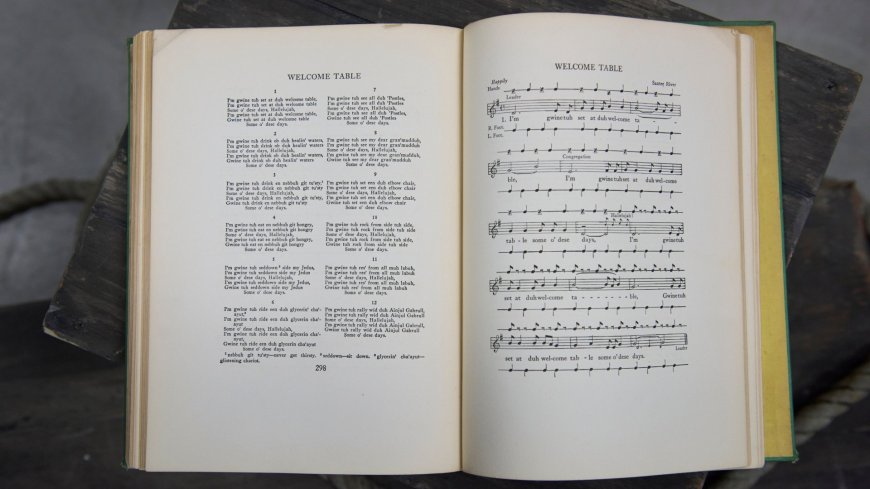
- A dust-covered 19th-century songbook discovery propelled Victor Ryan Robertson into years of research to honor Gullah Geechee spirituals.
- He co-created the work with director Brian Staufenbiel and pianist-conductor Clinton Smith, who arranged harmonies from melody-only sheets.
- The intimate staging features one singer, piano, projections, recorded elder quotes, and a set inspired by the ruined Chapel of Ease; water frames the narrative.
- Robertson aims to grow the piece into a toured production, adding instruments toward a full orchestra to share unseen Gullah Geechee music worldwide.
Opera Parallèle’s 17th season opens with the world premiere of Salt & Spirit, an operatic experience inspired by the music of the Gullah Geechee, descendants of enslaved Africans brought to the South Carolina coast and Sea Islands. Isolated in these regions, they developed a distinctive language, crafts, food, spirituality, and music.
The production was co-created by renowned tenor Victor Ryan Robertson and Opera Parallèle Creative Director Brian Staufenbiel. The show runs November 14–21 at Z Space in San Francisco.
Although Robertson grew up in upstate South Carolina, he had no knowledge about the rich history of the Gullah Geechee living in the Lowcountry. But in 2016, at Spoleto Festival USA in Charleston, where he was singing Sportin’ Life in Porgy and Bess, an admiring patron went down to a cellar and retrieved an old, dust-covered book containing sheet music for 100 spiritual songs of the Gullah Geechee. The patron gave it to him, saying, “Check this out. I really think you should do something with them.”
Robertson needed no convincing.
“Literally from the second I opened that book I was transfixed,” Robertson recalled. “Because I thought I had sung just about every hymn or spiritual in church. But these were different.”
The impact on Robertson was so strong that he began several years of intensive research and discovery to find a way to authentically and artistically pay tribute to this music.
Although many people have never heard of the Gullah Geechee, plenty know a work drawn from their world: George Gershwin’s Porgy and Bess, based on Porgy, the 1925 novel by Charleston-born author DuBose Heyward, who was inspired by the local Black working-class and Gullah residents he observed.
The production has no ensemble cast — just Robertson, singing and speaking about his experiences learning about the Gullah Geechee people. Onstage with him is pianist, conductor, and music director Clinton Smith, who collaborated extensively with Robertson to create the music.
“I speak a good bit through it — about my journey — and how I discovered these songs,” said Robertson. “They had praise houses which I visited, where people would go to gather and worship. The culture has been alive and beautiful, but my journey has been just finding out more, and how it’s affected me and changed me musically, which has just been amazing.”
The versatile tenor made his OP debut in 2016 in Terence Blanchard’s Champion, which is where he first met Staufenbiel. They reunited in 2023 in Atlanta for The Shining, an OP co-production that Staufenbiel directed for The Atlanta Opera. Robertson explained that the two of them really enjoyed working together, so when Staufenbiel asked if he had any other projects they could collaborate on, Robertson told him about the songs he had discovered. A follow-up phone call about creating a small operatic experience together at OP clinched the deal.
“We talked together about creating an actual operatic experience with quotes, sound design, projections and sets, and just with piano, so he could take it all over the country,” said Staufenbiel. “This is an unusual piece in the sense that it isn’t an opera that’s written out with recitatives and a story. There’s a script, there’s a storyline, and all of the normal conceptual design work I do for any production — working with designers on projections and lighting and designing the sets. And at the same time, we have all these beautiful quotes from Gullah Geechee elders that are recorded, that play throughout in between the songs with this beautiful interstitial soundscape. And we put it all together based on his journey.”
Staufenbiel’s set is based on a historic building called the Chapel of Ease, an 18th-century church on St. Helena Island in South Carolina.
“The sets are beautiful — basically an old church that was built by slave labor which now has no roof, rafters, doors, or windows — just walls. It was reclaimed after the Civil War by the Gullah Geechee people, who were using it after that. So we are using it as a kind of form of resilience,” said Staufenbiel. “I took photos of it and created a part of that building that we project onto. The incredible projections put us in a forest, by the ocean, and inside the sky, morphing behind Victor while he is singing all these songs.”
Robertson, who discovered the church while on a visit to South Carolina, thought it would be perfect for the show.
“It is a historic site of the old ruins of a church that is made by former slaves with shells from the ocean and is so spectacular,” said Robertson. “And water is the main theme of the entire show. ‘The water brought us and the water kept us’ is what we read from a Gullah elder, so we used that to start the show and to end the show.”
Of course, the music is also a major part of the show, and this is the piece of the puzzle created by Smith, who goes back a long way with Robertson. They originally did an opera together around 2009 at Minnesota Opera, where Smith was conducting. They stayed in touch, and both eventually ended up in Atlanta, where they have worked on many musical projects together. Smith said that working on the OP project was unlike anything he had ever done before.
~~ Salt-and-Spirit-Web-2160×1080-1-scaled ~~
“I’ve been a pianist for almost 40 years, but have never written or arranged music,” said Smith. “But we’re both from the South so there’s this gospely kind of churchy music that was part of me and part of him.”
Robertson, whose musical repertoire includes not just opera but also jazz, spirituals, and blues, told Smith what he wanted for each song. The sheet music contained only the melodies and words — no chords — so Smith had to create them. Robertson said that he wanted the music to have a “lush, thick and nuanced sound — more of what I want as an opera singer, to be able to sing longer lines and stronger melodies.”
The two of them spent a number of days working through the songs one by one.
“Every song took an hour or more where we would sort of ruminate together,” Smith explained. “He would sing the melody by himself, and I would imagine the harmony and the rhythm around it. And in some cases, he would say, ‘This needs to be more rhythmic, or needs to be sharper,’ so it was an extremely collaborative and creative process.”
“The other thing that I resonated with is the text and the way Vic sang it,” Smith added. “He came in with fully formed images of how the melodies would go. Sometimes you hear levity, sometimes you hear celebrations, sometimes you hear weight and struggle, and that’s what I was reacting to in creating the musical world around it.”
“It’s really cool and very compelling,” he continued, describing the production. “And what I love about it is it’s very simple, direct and stripped down to absolute emotion. I think it’s really going to touch people.”
Robertson said that he plans to expand and tour the show.
“It’s really a marathon, not a sprint. We are really going to keep building the instrumentation, show by show, adding to it and hopefully by next year we will have a full orchestra doing the show. And then I want to be able to tour it worldwide,” said Robertson. “I want to get it out there so people can really hear how beautiful this unheard music is.”
