




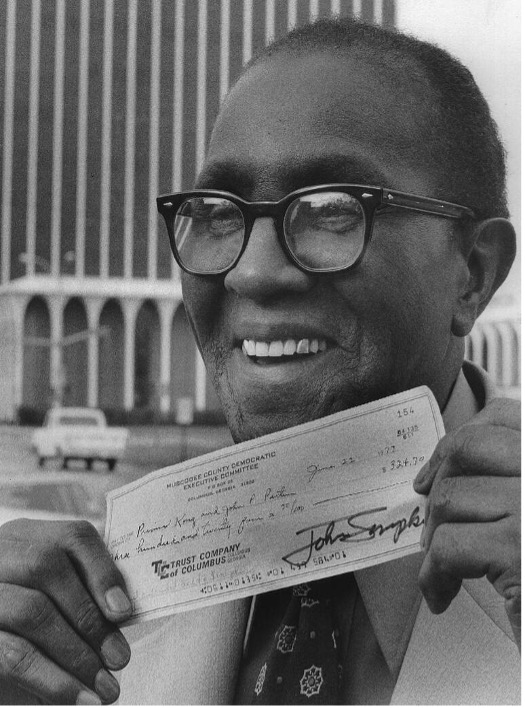
Black Background & Cultural Point Of Views:
- On July 4, 1944, Primus E. King was denied the right to vote in Columbus, Georgia’s Democratic primary.
- King filed King v. Chapman et alia with civil rights leader Dr. Thomas Brewer and attorney Oscar D. Smith Sr.
- In October 1945, federal judge Thomas Hoyt Davis ruled in King’s favor; the decision was affirmed in March 1946.
- The victory undermined the legal basis for Georgia’s all-white Democratic primary, opening state and local primaries to Black voters.
- The ruling was followed by lynchings and renewed White Citizens’ Council activity intended to intimidate Black communities and discourage voting.
Rev. Primus E. King was a Columbus, Georgia, barber and blessed preacher that essentially transformed voting civil liberties in Georgia by effectively taking down the state’s white-only Autonomous primary.
Born February 5, 1900, in the unincorporated community of Hatchechubbee in Russell Area, Alabama, to a sharecropping family members, King later on engraved his name in the record of American freedom. Due to partition and destitution, King obtained no official education, and after relocating 22 miles east to Columbus, Georgia, he worked for the Meritas cotton mill and later on as a driver and butler before discovering the profession of barbering and purchasing his own store. In 1921, he married Genie Mae King, a public-school educator. Following a spiritual conversion, King became a commissioned Baptist minister in 1939, working as pastor of Mt. Pleasant Baptist Church and later on Salem Baptist Church.
On July 4, 1944, King, a signed up citizen, attempted to cast a ballot in the Democratic Event key at the Muscogee Court in Columbus. Met with recalcitrance from a regulation officer, he was averted. Functioning together with civil rights leader Dr. Thomas Brewer and white attorney Oscar D. Smith Sr., King submitted a government suit, King v. Chapman et alia affirming that denying his right to vote broke the 14 th, 15 th, and 17 th changes.
In October 1945, Federal Court Thomas Hoyt Davis of the Center Area of Georgia regulationed in King’s support. The choice was affirmed in March 1946 by the United State Fifth Circuit Court of Appeals. The effect of this legal success effectively took apart the legal basis for the all-white Democratic primary in Georgia, opening up state and regional Autonomous primary elections for Black citizens throughout the state. Because of this legal triumph, a brand-new era dawned for Black Georgia voters. In Atlanta, the city’s Black area of 100, 000 discovered themselves with a powerful voice in state events. It likewise caused a series of lynchings and the revival of White Citizens’ Council task to stoke worry in Black communities so they would certainly not elect. Evidence was seen through the Moore’s Ford lynching, where 4 Black people were lynched (one being seven months pregnant) on the Moore’s Ford Bridge near Monroe, Georgia, on July 25, 1946
The message Primus E. King (1900 – 1986 showed up first on BlackPast.org
Read the complete short article on the initial source
