




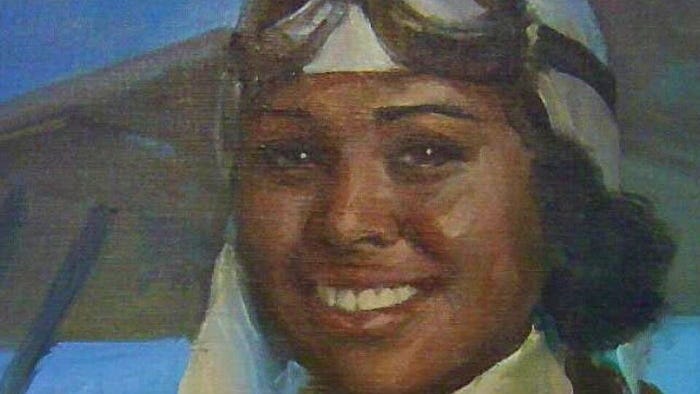
Black History & Cultural Point Of Views:
- Bessie Coleman traveled to France after American flight schools refused to train her, earning an international pilot’s license in 1921.
- Known as Queen Bess, she became a celebrated stunt pilot and used her performances to show Black Americans belonged in aviation.
- She insisted her audiences be desegregated, so Black spectators could attend her air shows without discriminatory treatment.
- Coleman hoped to establish a flying school for Black students, but died in a 1926 plane crash at age 34.
- Her courage inspired future Black aviators and helped expose discrimination, not ability, as the barrier keeping Black Americans out of aviation.
Long prior to the Tuskegee Airmen came to be celebrated figures in American aeronautics, a young Black female from country Texas dealt with a fight couple of Americans might have pictured. She wished to fly planes. It was the early the twentieth century; aviation was still in its early stage, and the USA was a nation where racial partition was not just a social custom-made yet a system of legislations, establishments, and deeply ingrained bias. For a Black female, coming to be a plane pilot seemed a nearly difficult ambition.
Her name was Bessie Coleman. She would eventually come to be the very first African American woman to make a global pilot’s license. Still, the trip required her to leave the United States and take a trip to a country where she can receive the training that American aviation institutions refused to give.
Coleman was not merely curious about flying for entertainment. She recognized that her accomplishment can challenge the presumptions Americans made concerning Black individuals, specifically Black women. She wanted to prove that aviation was not an exclusive advantage scheduled for white males. She additionally wished to develop a flying college where other African Americans could find out to fly without facing the exact same barriers she had experienced. Her story started much from the flight terminals and landing fields where she would eventually become famous.
Elizabeth Coleman was birthed January 26, 1892, in Atlanta, Texas, one of thirteen children born to George and Susan Coleman. Her moms and dads worked as sharecroppers, and the family experienced the poverty and racial discrimination that identified much of Black life in the country South.
Her childhood included selecting cotton, helping her mom with house obligations, and walking considerable ranges to go to college. Education was important to her mom, that urged her kids to seek opportunities past the restricted opportunities available to Black family members in their area. Coleman revealed a passion in maths and completed her early education regardless of the obstacles of going to segregated schools.
After senior high school, she enrolled at the Colored Agricultural and Typical College in Langston, Oklahoma, now Langston College. However, economic troubles avoided her from completing her education. She went to for just one term before returning to Texas.
In 1915, Coleman moved to Chicago, signing up with the movement of African Americans leaving the South looking for employment and higher chances. Chicago offered possibilities that rural Texas could not, although racial discrimination stayed an awesome challenge.
She worked as a manicurist in a barbershop, ultimately making a credibility for her skill and enough cash to boost her situations. In Chicago, her interest in aeronautics began to form.
Throughout World War I, aeronautics recorded Americans’ creative imagination. Airplanes were becoming significantly important in army operations, and stories concerning pilots and aerial fight circulated throughout the nation.
Coleman’s sibling, who had actually offered in France during the war, returned with tales regarding French ladies who flew aircrafts. He supposedly teased his sister concerning the chances offered to females overseas compared with the chances available to American women. His comments assisted stir up a passion that would certainly alter her life. Coleman wanted to end up being a pilot. One issue remained: American trip colleges would not accept her.
The discrimination was both racial and gender-based. White guys dominated air travel, and Black Americans were mostly excluded from the institutions that educated pilots. Even females that managed to enter air travel came across significant resistance.
Coleman worked to discover a means around those obstacles. She came close to American pilots and air travel institutions, yet she can not protect the training she required. Rather than abandoning her aspiration, she looked for support from Robert S. Abbott, the significant author of the Chicago Protector , one of the nation’s essential Black newspapers.
Abbott understood the importance of what Coleman was attempting to complete. He encouraged her to find out French and pursue trip training in France, where aeronautics institutions were much more obtainable.
It was a phenomenal suggestion. Coleman would certainly have to learn an additional language, conserve sufficient money to take a trip overseas, and enter an unknown nation to go after a chance that should have been available in the house. She approved the challenge.
Coleman functioned, examined French, and conserved cash. Support from Abbott and other members of Chicago’s Black community helped make the trip possible.
In 1920, she traveled to France and signed up in the Caudron Brothers College of Air Travel at Le Crotoy.
The experience was requiring. She needed to discover the technicians of flight, comprehend unfamiliar aircraft, and develop the skills to manage an airplane safely. Her training involved the Nieuport 82, a dual-control aircraft made use of for direction.
On June 15, 1921, Coleman completed what no African American female had actually done before. She obtained an international pilot’s permit from the Fédération Aéronautique Internationale.
She was currently the very first African American female to earn an internationally acknowledged pilot’s certificate.
The accomplishment was amazing not merely because she learned to fly, however since she overcame a system that attempted to stop her from entering the career.
She had taken a trip hundreds of miles due to the fact that American organizations would certainly not train her. She had found out French because American trip colleges would not instruct her. She had funded a trip across the Atlantic because the color of her skin and her sex had actually shut the doors readily available to various other aspiring pilots.
When she went back to the United States in September 1921, she restored something more vital than a certificate. She brought back proof that the barriers placed before Black Americans were not steps of their ability.
Coleman promptly attracted attention in the Black press. Newspapers identified the significance of her accomplishment, and she became a resource of satisfaction for African American neighborhoods. But acquiring a pilot’s permit was just the beginning.
She required added training to become an accomplished event pilot, and she went back to Europe for more direction. She examined with experienced aviators in France and Germany, including pilots associated with the Fokker airplane firm. By the time she went back to America, she was prepared to seek a job as a feat pilot.
On September 3, 1922, at Curtiss Area on Long Island, New York City, Coleman made the first public flight by a Black woman in the United States. She did aerial maneuvers, consisting of loopholes and figure, showing the skills that would certainly make her famous. She ended up being called Queen Bess and the Daredevil Aviatrix.
Her efficiencies belonged to the barnstorming circuit, a prominent form of home entertainment throughout the early years of aeronautics. Pilots took a trip from community to town, performing unsafe aerial stunts before paying audiences. Some performed loopholes, rolls, and other maneuvers, while others used guests possibilities to experience trip.
For Coleman, barnstorming used a way to make money, establish a credibility, and show that Black Americans belonged in air travel. However also after ending up being a popular pilot, she continued to run into racial discrimination.
She insisted that target markets at her American events be desegregated. She would certainly not do at occasions that needed Black viewers to enter with different entrances or sit in segregated sections. Coleman understood that ending up being an effective Black pilot while approving the humiliation imposed on Black audiences would certainly weaken the bigger purpose of her accomplishment.
She wanted Black children to see her fly. She wanted Black family members to attend her performances without being dealt with as second-class clients. Her battle was occurring both in the sky and on the ground.
Coleman’s flying profession threatened. Aviation in the 1920 s was considerably less established than it is today. Airplane were unreliable, mechanical failures prevailed, and pilots routinely dealt with dangers that modern-day aviation has largely removed.
On February 4, 1923, Coleman was seriously hurt when an aircraft she was flying in The golden state experienced engine difficulty and crashed during departure. She experienced considerable injuries and spent roughly three months recovering. Many people could have deserted aviation after such an experience. Coleman did not.
She returned to flying and proceeded executing, traveling, speaking, and promoting the possibilities available to African Americans in aeronautics. She likewise pursued a service approach to finance her ambitions. In addition to her flying exhibits, she operated a beauty salon in an effort to create additional income. Her ultimate purpose was to develop an aeronautics institution for Black pupils.
She acknowledged that private achievement might only accomplish so much. If African Americans were mosting likely to join the expanding aeronautics sector, they required establishments that would certainly train them, provide accessibility to aircraft, and prepare them for expert opportunities. Coleman wanted to develop that organization herself.
By 1926, Coleman was still doing and pursuing her air travel occupation. On April 30 of that year, she remained in Jacksonville, Florida, preparing for a forthcoming air program at Paxon Area. I stayed in Jacksonville for seven years and within an hour of Jacksonville for five more years and checking. I still have not encounter any recognition of her visibility.
Coleman boarded a Curtiss JN- 4 Jenny airplane with her auto mechanic and pilot, William Wills. Wills was operating the aircraft while Coleman evaluated the ground listed below, looking for an ideal area for a parachute jump planned for the complying with day’s event.
Coleman was not putting on a seat belt because it hindered her capability to lean over and check out the ground. About ten mins into the flight, the airplane unexpectedly dove and started drawing out of control. Coleman was thrown from the airplane and was up to her death. Wills likewise passed away when the aircraft collapsed.
An examination figured out that a loose wrench had ended up being lodged in the airplane’s control mechanism, stopping the pilot from maintaining control. Coleman was only 34 years old. Her death ended an amazing profession, yet it did not finish the activity she had helped inspire.
Coleman never understood her desire for establishing a flying institution. However various other African Americans continued the work she had started.
In the 1930 s, William J. Powell assisted develop the Bessie Coleman Aero Club in Los Angeles. He promoted aviation as an opportunity for Black Americans and encouraged others to go after careers as pilots and aeronautics experts.
In Chicago, Cornelius Coffey and John C. Robinson assisted create organizations that qualified African American pilots. Females such as Janet Bragg and Willa Brown continued breaking obstacles in aeronautics, developing their own success.
The Tuskegee Airmen would not arise till World War II, almost 20 years after Coleman’s death. Their accomplishments would ultimately become an important chapter in the struggle for racial equal rights in American army aeronautics.
Coleman did not live long enough to witness those developments, however she aided develop a vital criterion. She revealed that excluding Black Americans from aviation was not because of a failure to fly. It was the consequence of discrimination.
Her achievement likewise tested the presumptions surrounding women. Each time when lots of Americans believed flying was also dangerous or requiring for women, Coleman carried out aerial feats that required extraordinary skill and nerve.
She had gone across an ocean to get an opportunity denied to her at home. She had actually returned to America with a worldwide pilot’s license, done prior to thousands of viewers, and firmly insisted that Black target markets be treated just as.
Bessie Coleman was not just the initial African American female to gain a pilot’s license. She supported for a totally various vision of American air travel.
Her tale is specifically vital since it advises us that the history of Black achievement is frequently likewise a history of Black Americans needing to conquer obstacles that should never ever have existed.
Coleman did not ask America for authorization to fly. When America refused to show her, she went elsewhere and learned.
And when she returned, she ensured the nation might no longer pretend that Black females did not belong overhead.
Review the complete write-up on the original resource
