




Empowering Black Entrepreneurship: Stories of Success, Strategy & Growth
- Straw normalizes grief and shows how psychosis in Black women is misread, misdiagnosed, and criminalized by systems.
- Janiyah's grief-driven psychosis unfolds via the $40 motif, job loss, eviction, and tragic hallucinations revealing systemic neglect.
- Teyana Taylor as Officer Raymond models compassionate, community-aware policing, contrasting real-life betrayals like the Central Park Five narrative.
- Tyler Perry forces Black men to reckon with protecting Black women, urging community healing and urgent conversations during Minority Mental Health Awareness Month.
#Straw isn’t just a film — it’s a mirror, a megaphone, and a mic drop all in one. Released around a time meant to amplify marginalized voices around mental health, it does the work of:
Normalizing public grief and emotional breakdowns, especially for Black women
Highlighting how psychosis and trauma are often dismissed or criminalized, not cared for
Forcing conversations in family homes, group chats, and barbershops where mental health has historically been taboo
Showing how racism, policing, and generational neglect can accelerate psychological unraveling
For Black women in particular, it hits like a primal scream followed by a much-needed exhale. It’s not just a movie, it’s a battle cry to be seen. “Nobody sees us”, a powerful delivery by Henson who portrays heroine Janiyah, a poor single mother having an extremely bad day. Or was it all in her mind?

As a writer in therapy, I am going deep this time. So if it’s too much, close the screen, and come back when you’re ready to process. It’s totally okay to not feel okay. There are a lot of spoiler alerts ahead as well. Please take time to protect yourself. It took me days to get these words together. So I get it. If you’ve experienced psychosis, then it was very clear throughout the film, the characters were describing you and your personal experiences.
What Is Psychosis? It’s a mental health condition where a person loses touch with reality, often involving delusions (false beliefs), hallucinations (seeing or hearing things that aren’t there), and disorganized thinking. It’s not a diagnosis itself, but a symptom that can appear in disorders like schizophrenia, bipolar disorder, major depression, or after trauma. Based on the description of symptoms, it’s already pretty clear why many Black Americans and Black people around the world are more likely to be misdiagnosed or undiagnosed. It can be confused with drug use. It can be confused with self-harm. It could be confused with criminal. For Black Americans, especially women, the signs of trauma aren’t interpreted as cries for help; they’re treated as threats.
Savanna calls this film “free therapy” because it heals and because it forces recognition. Watching Straw may feel like looking in the mirror for many Black women who’ve lived through trauma without anyone acknowledging it. When Black women suffer visibly, they are often punished for it—legally, socially, and emotionally. Their breakdowns are read as instability. Their exhaustion is mistaken for attitude. And if they dare to name their pain, they’re told it’s “too much.” Mr. Perry set up a storyline so that we may exhibit and discuss an array of intersections, like community policing and unarmed shootings. Henson’s portrayal is Oscar-worthy, as her determination to get her daughter $40 for the school lunch sets her off on a wild goose chase. Hold onto that, the $40 was the first indication to the audience that something was not right. The next scene takes her to the school where she seems relatively calm for a person who had to leave her job so her kid’s school wouldn’t harass her child for school lunch. As an educator, truly, forty bucks seems like a stretch for some pizza and a juicebox, maybe a cookie.
Let’s back up to an earlier scene where we see Janiah rushing her daughter to take a bath so they won’t be late, this is when she learns about the money for the lunch as she tells her daughter, Aria, that she has to bathe her because she doesn’t want her to fall again, signaling a prior situation where bruises were visible on her skin and back. When Aria is dropped off at school later that morning, her mother waves her off but notices the school administrator weirdly waving back at her. When she returns to the school after getting an emergency call at work about money, she sees ACS at the school and Aria screaming while being taken away. The mom holds back her own emotions to tell her daughter not to get upset, as it’s one of the primary triggers to her seizures. She falls into despair, blaming the same administrator she saw that morning for calling the authorities after knowing her financial situation. “I work two jobs to take care of her!” she exclaims after going back to her grocery clerk gig. Sometimes, the most revolutionary thing you can do for a Black woman is see her.
In reality, her daughter had died the night before at the hospital after experiencing a seizure, and she was experiencing grief-stricken psychosis, a symptom of post-traumatic stress disorder. She was not in the right mind when her clock turned 6:01. She was waking up into a delusional hallucinogenic state. She never bathed her daughter, she was never told about the $40 for lunch that morning, the school never called, it was a bill collector, her daughter wasn’t taken away, the school administrator saw her talking to herself and waving to no one, so she waved back with a concerned look. They must have been alerted that their student had died the night before. As she falls to more confusion and dismay Janiah gets her final straws, the landlord throws her things out in the rain because she doesn’t have the check, she’s late back to work and gets fired because a racist cop side swiped her and went after her with his partner, a very obvious Karen, who impounds her car. A series of unfortunate events becomes an understatement. Janiah starts physically acting out of character, desperate to get her check, she demands that her narcissistic, egotistical Black male boss, portrayed by the talented (find cast names), give her the money.
“Look, I need my check, I can’t wait for the mail,” she says impatiently at the same time a robber reads her name tag to distract from the fact he’s there to get money from the back, and grabs all the money and runs out. The boss feels like she set this up for retribution because he fired her earlier for coming back from the school late, the school that never called, made her lose her real job. Delusion is difficult to unpack, and it’s difficult to grasp if you have never experienced it. To the audience, this scene is the biggest indicator that her behaviors do not necessarily match up to the typical reaction of a normally minded person. She grabs the gun and shoots her boss to get her check. She leaves stacks of cash on the table and grabs her little paycheck. Huh? Right. She’s not thinking clearly. The next scene takes her to the bank, where she is still holding the gun in her grocery clerk’s pocket. She is also carrying a clear book bag with Aria’s science project because it was thrown out in the rain. Throughout her day, the unwavering love and support for her only child is her driving force. She returns to the bank, putting the check on the window. She had gone earlier to see if she could withdraw the forty bucks from the atm, but she couldn’t. The Black bank manager played by Sherri Shepherd didn’t seem to offer her much support at that moment, but seemed to be a person wanting more for her; she let her in after the bank had already closed, prompting the security guard to let her in. The guard, bank patrons, and staff are all Black community representatives with a layered generational understanding of what’s happening on this day. Perry takes our barbershop/beauty shop conversations and delivers them center stage.

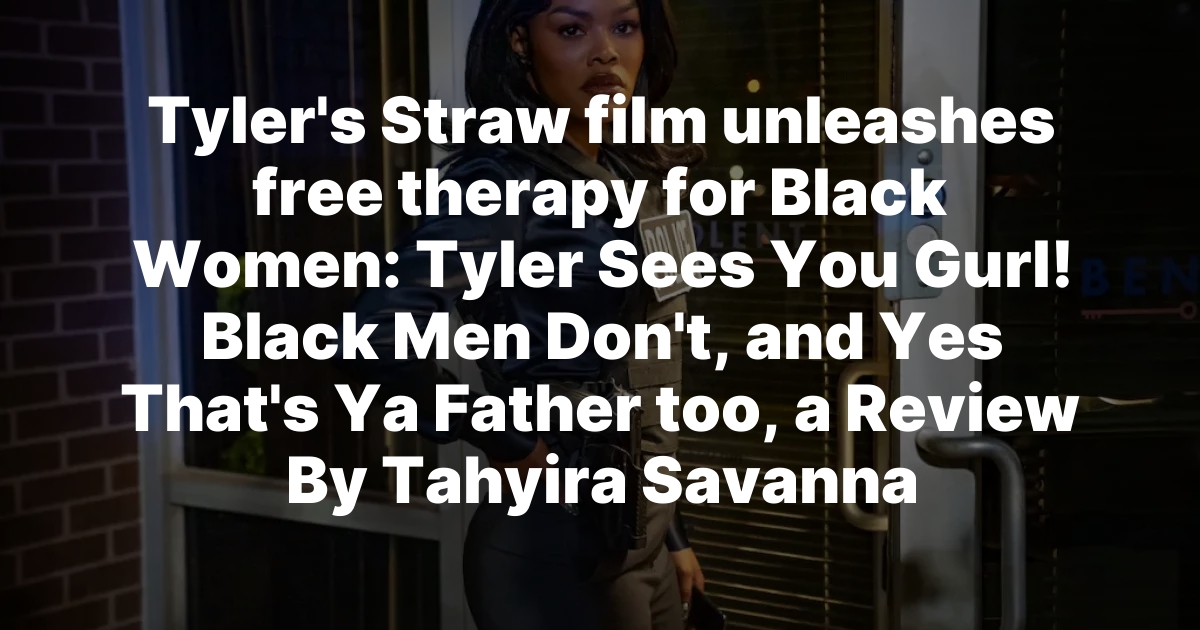
Teyana Taylor portrays Officer Raymond, a fellow single mom and Black woman who is capable of seeing the straws. In Straw, community policing is portrayed as an ideal model for criminal justice reform, one where detectives—when competent and compassionate—extend the benefit of the doubt, a privilege rarely granted to Black people and other marginalized communities. This portrayal contrasts sharply with real-life cases like the Central Park Five, where the presumption of innocence was absent from the start.
In that case, white officers and media outlets constructed a damaging and racially charged narrative, ignoring evidence and pushing for swift punishment. By contrast, the Black officers in Straw operate from a place of community awareness and systemic understanding. Their approach reflects a deeper trust and a more humane, justice-centered form of policing—one that resists the biases and institutional failures that historically harm marginalized populations. “Have you ever seen a bank robber get chairs for people?” Officer Raymond quietly asks her Black male counterpart, forcing her to see what’s presented on the surface. Taylor’s phenomenal performance underscores how figures of authority can embody both power and vulnerability, challenging traditional narratives of law enforcement as cold or unfeeling.
The online chatter hasn’t changed—Tyler Perry continues to provoke the very Black men he’s trying to reach. Through his work, he consistently asks: Where is the protection for Black women? His Madea character, in all her comedic bravado, often fills that void, serving as a protector across cascading story arcs. But when Perry steps off the sound stage and sheds the drag, his question becomes more pointed, more deliberate: Where are you, Black men?
One online user summed up a common frustration: their disdain for Perry stems from the repetitiveness of his storytelling—“Why do we always suffer in his films?” But perhaps that’s the point. The discomfort isn’t in the repetition, but in our unwillingness to confront the mirror he’s holding up. The real takeaway should be: Why are we so quick to reject our suffering when it’s reflected at us?
In Perry’s world, it’s often women who rescue other women. For Black women, that circle of protection is smaller, but immensely powerful, resilient enough to have survived enslavement, Jim Crow, and now, the erasure of bodily autonomy in the wake of Roe. We’ve been told—many of us recently—that our education, our clarity, our voices, have no place in the foreground. That we’re too woke, too bold, too aware.
And so, the retaliation comes—quiet but violent—through workplace exclusion, corporate silencing, and cultural erasure. The world tells us we are too much. But it is our too muchness that has kept us alive.
(For more on this, read “Too Good to Stay, Too Bold to Settle: On Adulthood, Work, and the Weight of Being ‘Too Much’” by Tahyira Savanna.)
Black men’s struggle to confront mental health at even a basic level can be traced back to the plantation system—a foundation of dehumanization that evolved into the corporate systems of the Industrial Revolution and beyond. The question, Why can’t Black men be softer?, isn’t rhetorical. It’s a lived, ongoing dilemma for Black women everywhere.
It’s not just a recurring theme—it’s a rare and deeply uncomfortable conversation. A reckoning. Because when you’ve been stripped of your humanity, and when a society demands that your white male counterparts chase more wealth, more power, more performance, Black men are left bearing a generational weight. Their backs break under the burden, too. But unlike others, they’re not allowed to say it hurts.
And yet, we can start the healing.
Because in our expression, we begin to lift the fog of depression. In our conversations, we find connection, softness, and maybe even liberation. Freedom for it all—freedom to feel, to cry, to rest, to love—is possible.
July is Minority Mental Health Awareness Month. A reminder: we are all we’ve got left. So let’s talk. Let’s feel. Let’s heal.

Related
Read the full article on the original site

