




Empowering Black Entrepreneurship: Stories of Success, Strategy & Growth
President Trump invoked Section 740 of the District of Columbia Home Rule Act to federalize D.C.’s Metropolitan Police Department and deploy 800 National Guard troops to Washington—despite official data showing that violent crime is at historic lows.
President Trump’s framing: He characterized D.C. as overtaken by crime and homelessness—citing graphic visuals and selective data. But data show violent crime is down significantly—some reports cite a 26 % drop year-over-year, and overall crime at 30-year lows.
Federal action: Trump assumed control over the MPD and deployed National Guard troops under his authority—something unusual but allowed under D.C. law.
Mayor Muriel Bowser: Called the move “unsettling” and emphasized the already declining crime rates.
Attorney General Brian Schwalb: Labeled the takeover “unprecedented, unnecessary, and unlawful,” and said there’s no crime emergency.

Congresswoman Eleanor Holmes Norton (D-DC): Decried it as an assault on home rule and pushed for D.C. statehood.

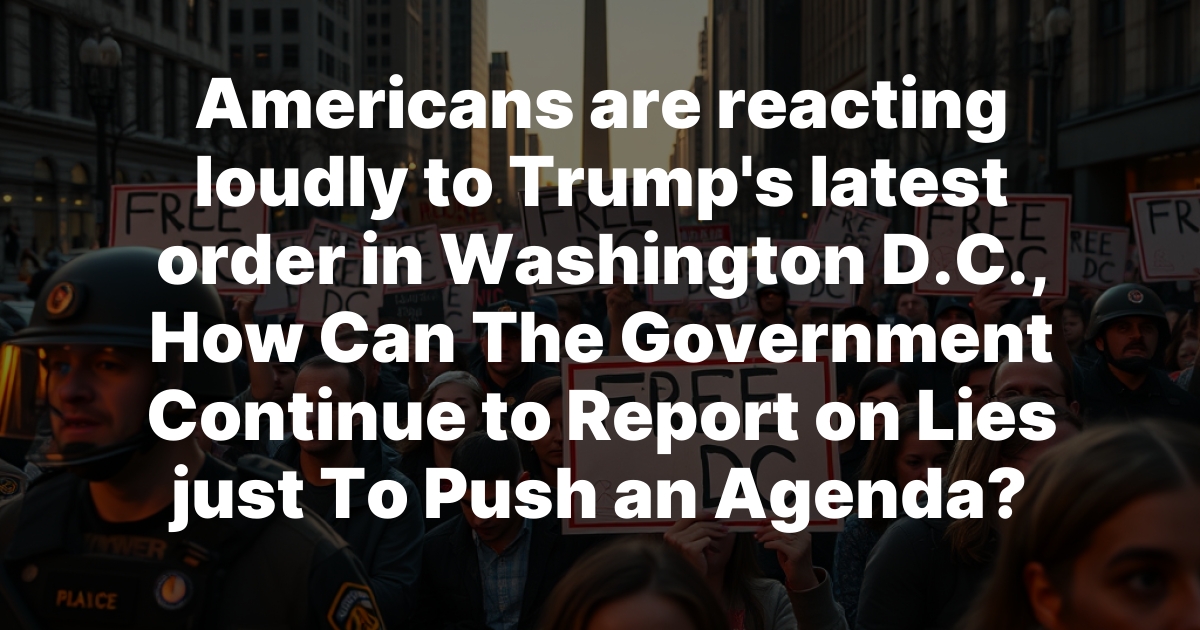
Protesters and activist organizations took the streets and held “Free DC” rallies, warning of authoritarianism targeting a largely Black population. President Trump spoke on expanding his efforts on crime prevention into cities like Oakland, New York City, and Baltimore.
Legally, Trump’s action appears valid under the Home Rule Act—but his portrayal of D.C. as a “lawless,” crime-ridden city doesn’t align with the data. Politically and ethically, this raises serious concerns. Critics see it as a power grab and an attempt to manipulate public sentiment for political gain. While some claims are contradicted by facts, labeling them outright lies suggests malicious intent. The reality may be politically motivated exaggeration, misrepresentation, or selective use of information. Let’s call it a spin instead of a lie.

According to the Metropolitan Police Department (MPD) and Council on Criminal Justice data:

Violent crime fell by 35% (5,345 to 3,469 incidents)
Property crime dropped by 11%
Total crime declined 15%
Homicides decreased from 274 to 187 (−32%)
Violent crime is down 26% compared to the same period in 2024 (2,138 → 1,586 incidents)
Homicides are down by 12% (112 → 99)
Robbery down 28% (1,249 → 898)
Assault with a deadly weapon down 20% (667 → 534)
Property crime down 4%, and overall crime down 7%
| Year / Period | Violent Crime Rate | Property Crime Rate | Notable Trend |
|---|---|---|---|
| 2023 (FBI data) | 1,151 / 100k | 4,307 / 100k | Among highest in U.S. |
| 2024 ↘ early 2025 | — | — | Significant decline (~35% in violent crime) |
| First 8 months of 2025 | — | — | Continued drops across violent & property crimes |

While Washington, D.C., still reports high crime rates relative to other regions, there’s a clear and consistent downward trend in both violent and property crime since 2023—and especially through 2024 and into mid-2025. Recent data show crime falling notably across multiple categories, including homicides, assaults, robberies, and property offenses.
Historically, Hitler did this in Germany with events like the Reichstag Fire Decree (1933), claiming national security threats to suspend civil liberties and override regional authority. Trump gets a lot of his leadership style from the Reich. Trump uses a perceived or exaggerated crisis (often crime, unrest, or “moral decay”) to justify extraordinary powers. Trump centralizes his authority by sidelining local governance. Trump is planning on deploying military or paramilitary forces domestically as a show of strength and control. And Trump frames the action as necessary for public safety while also using it to consolidate more political power. His voters are still asking, where’s the Epstein files?
We’ve studied fascist states. This one is direct from Germany. We’ve actually mapped the alignment with the help of some of our research friends.
Here’s a clear, step-by-step mapping that lines up the authoritarian pattern (what historians call the “crisis → centralize → normalize” playbook) with what happened in D.C. We’ll show each step, how Hitler used it in 1933, how Trump’s D.C. action maps to it, and a short assessment of alignment.
- Create or amplify a crisis narrative
- History (Hitler): The Reichstag fire (Feb 1933) was framed as a Communist plot to justify emergency measures. HISTORYghdi.ghi-dc.org
- This case (Trump): The White House declared a “crime emergency” and the president said federal control was needed to protect federal property and public safety. The White HouseReuters
- Assessment: Partial alignment. Both relied on portraying imminent danger. But in 1933 the event was a sudden arson that was immediately used to sweep-in emergency powers; in D.C. the administration invoked a crime narrative over weeks/months rather than a one-off attack. ReutersAP News
- Use emergency/legal instruments to override local authority
- History (Hitler): The Reichstag Fire Decree suspended civil liberties and allowed the national government to override local/state rules; it cleared the way for the Enabling Act. ghdi.ghi-dc.orgEncyclopedia Britannica
- This case (Trump): The president relied on Section 740 of the District of Columbia Home Rule Act to direct use of the MPD for “federal purposes,” delegating operational control to the Attorney General. The Home Rule Act has a mechanism for temporary federal direction. Council of the District of ColumbiaThe White House
- Assessment: Superficial legal parallel, but big difference in scope. Both used a legal vehicle for federal control — but Hitler’s measures revoked constitutional protections across the whole state and were quickly expanded into permanent one-party rule. The Home Rule Act’s Section 740 is a narrow, temporary authority; its use is controversial but not equivalent to abolishing rights. Council of the District of ColumbiaEncyclopedia Britannica
- Deploy security/military forces to enforce the action
- History (Hitler): Paramilitary and state police were used to intimidate opponents and enforce new decrees; later the SS and police answered to Nazi leadership. Encyclopedia BritannicaHolocaust Encyclopedia
- This case (Trump): The president ordered 800 National Guard troops to D.C. and placed the Metropolitan Police under federal control for the emergency period. ReutersThe White House
- Assessment: Strong tactical similarity (military/security presence in the streets) — but in 1933 such deployments were part of an ongoing campaign to remove checks and terrorize opposition. The U.S. still has institutional constraints, legal pushback, and an independent press that limit unilateral permanence. ReutersAP News
- Control or manipulate information to shape public consent
- History (Hitler): The regime suppressed dissenting media, amplified the “threat,” and used propaganda to manufacture broad support for emergency measures. ghdi.ghi-dc.orgEncyclopedia Britannica
- This case (Trump): Fact-checkers and news organizations say many of the crime claims are exaggerated or misleading compared with MPD statistics showing declines; critics say selective framing is being used to justify the takeover. AP NewsMPDC
- Assessment: Partial alignment. The tactic of selective or exaggerated framing is present. The major difference: U.S. institutions (press, courts, data transparency) are actively contesting and publishing counter-evidence in real time. AP NewsMPDC
- Legalize and normalize the extraordinary step (make it look routine/legal)
- History (Hitler): After the Decree came the Enabling Act (March 1933), which gave Hitler legislative power — turning emergency measures into permanent law. Encyclopedia Britannica
- This case (Trump): The Home Rule Act provides a temporary route; Congress or later actions would be required to make anything permanent. There are already legal challenges and political pushback seeking to reverse or block the step. Council of the District of ColumbiaReuters
- Assessment: Limited alignment now. The potential for normalization exists (if extraordinary steps become repeated and unchallenged), but for now the move is time-limited and under active legal/political scrutiny. AP NewsThe Washington Post
- Target or disproportionately affect political or demographic groups
- History (Hitler): Emergency powers were rapidly used to target political opponents and marginalized groups, removing their civil protections. ghdi.ghi-dc.orgHolocaust Encyclopedia
- This case (Trump): Critics argue federalizing policing in a majority-Black city raises civil-rights and racial-justice concerns; supporters emphasize public-safety aims. The action has prompted protests and warnings about the precedent for targeting cities that oppose federal leadership. AP NewsReuters
- Assessment: Concern is valid and must be watched. There’s an observable risk that centralized reactions could be applied selectively to politically adversarial jurisdictions, but evidence so far shows controversy and resistance rather than unopposed repression. AP NewsMy WordPress
- If repeated or left unchecked, precedent creates long-term erosion
- History (Hitler): One emergency became the legal foundation for a totalitarian regime because checks were removed and opposition crushed. Encyclopedia Britannica
- This case (Trump): The danger is structural: repeated use of emergency claims to override local control could erode norms and expand executive reach. Whether that happens depends on courts, Congress, civic response, and media scrutiny. ReutersAP News
- Assessment: High-risk if normalized. The single event is worrying as a precedent; the best safeguard is robust institutional pushback (legal suits, congressional oversight, civic organizing, data transparency).
Bottom line: there are clear tactical similarities (declare a crisis, use legal authority, deploy forces, control the message). The crucial differences are scale, permanence, and context: 1933 Germany dismantled democracy rapidly and ruthlessly; the U.S. — for now — still has active institutions, courts, press, and political opposition that are contesting this action. That makes a direct equivalence to Hitler incorrect, but the pattern of “crisis → centralize” is a legitimate reason to be alarmed and watchful. ghdi.ghi-dc.orgEncyclopedia BritannicaReutersAP News
Related
Read the full article on the original site

