




Black Travelers: Explore Culture, Adventure & Connection
- Expo essentials: Pick up bib and wristband at Messe Berlin, explore vendors, and hunt pop-up shops for limited-edition gear.
- Race logistics: Use free ABC transit with your bib, follow pacers, and heed strict course time limits and cutoffs.
- Transit tips: Arrive via BER or Hauptbahnhof; prefer S-Bahn/U-Bahn, avoid rental cars, and respect bike lanes and fares.
- Sightseeing strategy: Save walking-heavy attractions for post-race; enjoy boat tours, Reichstag, East Side Gallery, and day trips.
The Berlin Marathon isn’t just one of the six — I mean seven (G’Day, Sydney!) — Abbott World Marathon Majors, it’s a race steeped in history, speed, and unforgettable energy. Flat, fast, legendary, Berlin is the kind of course where world records fall and PRs are made. If you have ever watched Kipchoge glide through the Brandenburg Gate or tracked friends chasing their goals on this iconic course, you know why it belongs on every runner’s bucket list.
But Berlin is about so much more than 26.2 miles (42.2 kilometers). Yes, the course is iconic, but the marathon experience begins the moment you arrive in the city. From mastering the S- and U-Bahn system to exploring Berlin’s cultural highlights, the weekend is as much about the journey as it is about race day.
Whether you are chasing a personal best or soaking in every stride, these Berlin Marathon tips will help you run strong, travel smoothly, and enjoy everything the city has to offer.
The Berlin Marathon Expo
The marathon expo is held at the Messe Berlin grounds, a massive convention complex that is just as lively and energetic as race day itself. This is where you will pick up your bib and the wristband that grants you access to marathon events throughout the weekend. The energy inside is contagious, with runners from all over the globe sharing the same goal: snapping up race merch before it disappears. The easiest way to get there is by public transportation, with Messe Süd (S-Bahn) or Kaiserdamm (U2 line) as the closest stops, both just a short walk away.
Recommended Post: MONIQUE RUNS 50
Beyond bib pickup, the expo is basically runner Disneyland: vendor booths, gear galore, and enough pre-race hype to convince you that yes, you do need more socks, more gels (because you don’t have that flavor), and of course one more water bottle.

Pro tip: Don’t limit your merch hunt to the expo. Major brands often set up pop-up shops around Berlin during marathon weekend, featuring limited-edition gear and Berlin-specific collections you won’t find anywhere else.
Race Day Tips and Course Landmarks
Getting to the start on race morning is straightforward using Berlin’s excellent public transportation system.With thousands of other runners heading the same way, you can switch off Google Maps and just follow the sea of running shoes (carbon-plated, natch), hydration vests, and Garmin watches to the start line. Your bib number doubles as your ticket for the S-Bahn, U-Bahn, trams, and buses across the ABC fare zones from Thursday, September 18, through Monday, September 21. Do not forget your bib, as you will need it for both transport and entry into the start area. The nearest stations to the start/finish area are Bundestag (U-Bahn) and Berlin Hauptbahnhof (Central Station), both a short walk away.
For security reasons, only participants with an official bib number and the athlete wristband (attached when you pick up your race packet at the expo) are allowed into the start and finish area.

If you are chasing a specific finish time, pacers are available for extra motivation and consistent pacing. They will be in each corral and easy to spot, carrying flags with goal times ranging from 3:00 to 5:00 hours. If you are aiming for longer than 5 hours, there are often unofficial pacers. The year I ran Berlin, I stumbled upon an unofficial pace group around mile 23 (37K), right when I had hit the wall and was ready to be done. The leader was guiding her group to a 6-hour finish using the Jeff Galloway run/walk method, and she turned out to be exactly what I needed. I tucked in with the group and crossed the line in 5:53.
Recommended Post: MIDNIGHT SUN MARATHON RECAP
On the course, hydration stations are well-placed and stocked with water, electrolyte drinks, and the occasional gel — basically a rolling buffet, minus the charcuterie. You will have to run Marathon du Médoc for that. If you prefer a specific brand or flavor, bring your own so there are no surprises on race day. Keep in mind that Berlin has a strict time limit of 6 hours and 15 minutes from when you cross the start line, with a cut-off at 3:50 p.m. at kilometer 33. Runners who do not make these limits will be asked to leave the course and will be transported to the finish in the sweeper bus.


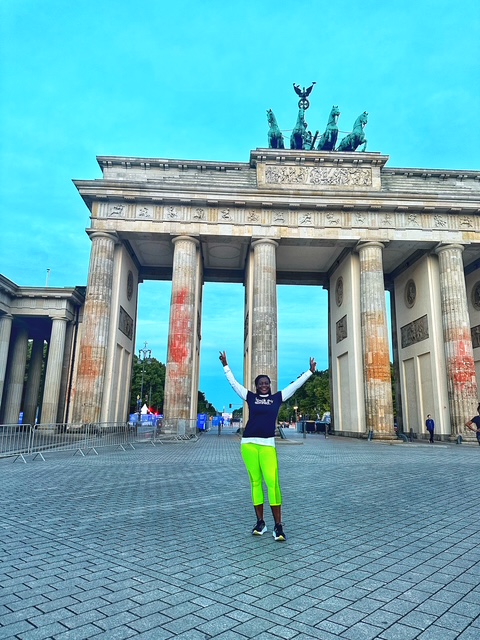
The course itself is what makes Berlin legendary. You will loop past the Victory Column, pass the striking ruins of the Kaiser Wilhelm Memorial Church near the 35K mark, cut through Potsdamer Platz, and run down Unter den Linden before finally passing through the Brandenburg Gate for a picture-perfect finish that crowns you a #BerlinLegend.

Pro tip: Celebrate Medal Monday after the race by heading to the Adidas store for free medal engraving. Also, don’t forget to pick up the local newspaper where you will find your name printed among the official finishers. Both are perfect ways to mark your achievement as a #BerlinLegend.
Getting to Berlin and Transportation
From the Airport to the City
Most international runners will land at Berlin Brandenburg Airport (BER), which sits in Zone C. The marathon course and most hotels are in Zone A, but you do not need to stress. Marathoners receive a free ABC transit ticket valid from Thursday through Sunday night (expiring around 3 a.m. Monday). That pass covers trains, buses, trams, and the U-Bahn.
Your best options:
- Public Transportation (recommended): Take the S9 train directly from the airport into the city center. For the expo, continue to the Messe Berlin grounds. The closest stops are Messe Süd (S-Bahn) or Kaiserdamm (U2 line). Download the BVG Fahrinfo app or use Google Maps, both work well for directions. You will likely be surrounded by fellow marathoners making the same journey, many proudly wearing gear from past races.
- Taxi or Uber: Available at the airport, but more expensive than public transport.
- Rental Car: Not worth it. Parking is scarce and public transit is much faster.
- Scooters: Fun for short distances, but use caution as they can be hazardous for both riders and pedestrians.
Safety tip: Berliners take traffic rules seriously. Bike lanes are everywhere and often look like wide sidewalks, but they are not. Step into one without looking and you will quickly hear a bell or worse. Always cross at lights, watch for cyclists, and remember that fines for fare-dodging or jaywalking are steep.

Arriving by Train
If you are coming from elsewhere in Europe, you might arrive by train. The main hub is Berlin Hauptbahnhof (Central Station), a modern station that connects to S-Bahn, U-Bahn, trams, and buses. From here, you can reach almost anywhere in the city within 20 to 30 minutes. Other stations include Berlin Südkreuz, Ostbahnhof, and Gesundbrunnen, all well connected to the S-Bahn and U-Bahn.
For the expo at Messe Berlin:
- From Hauptbahnhof, take the S5 or S7 toward Westkreuz and get off at Messe Süd.
- From Ostbahnhof, hop on the S-Bahn (S3, S5, S7, or S9) toward Westkreuz.
- From Südkreuz, take the S41 Ringbahn to Westkreuz, then switch to S3, S5, or S7 to Messe Süd.
Berlin’s transit system is reliable, fast, and safe. Whether you arrive by plane or train, you will be well connected to everything you need for race weekend.
Pro tip: Your free ABC transit pass is only valid through Sunday night after the marathon (technically until around 3 a.m. Monday). If you are staying longer, make sure to buy a regular pass so you do not get caught without a valid ticket, fines in Berlin are steep.

Money and Payments in Berlin
When it comes to money matters in Berlin, a little planning will save you hassle and fees. Skip the airport exchange counters and head straight to an ATM for the best rates, ideally using a Wise card or a debit/credit card with no foreign transaction fees. Always choose to pay or withdraw in euros, not dollars, to avoid hidden conversion charges. While card payments are increasingly common, Berlin still leans more cash-preferred than many other European cities. I live in the Netherlands and travel extensively around Europe using my debit card almost everywhere, so I was surprised to find that although debit cards are accepted in Berlin, many places still prefer cash. It is wise to always have euros on hand and keep a stash of coins, too, for tips and for public restrooms, which often charge a small fee. For U.S. runners, note that Visa and Mastercard are accepted almost everywhere, while American Express is hit-or-miss. If you normally rely on AmEx, be sure to bring a backup card.
Pro tip: Always carry at least a little cash in Berlin, even if you are used to paying by card elsewhere in Europe. A few euros and coins in your pocket or travel wallet will save you stress when grabbing a snack, tipping, or paying for a restroom.
What to Do in Berlin
One of the best parts about running Berlin is that the city offers so much to see and do beyond the marathon. The trick is to balance sightseeing with saving your legs for race day.
Pre-Race (low impact): If you want to soak in some of the city’s history and atmosphere without tiring yourself out, opt for experiences that let you sit back and relax. A boat tour along the Spree River is a great way to take in the city’s architecture and landmarks from the water. Hop-on hop-off buses and bike tours are another easy option to cover a lot of ground without logging extra miles on foot.
Pro tip: Save the walking-heavy attractions for after the race, your legs will thank you on marathon morning.

Post-Race Recovery and Sightseeing: Once the medal is around your neck, it is time to dive into Berlin’s cultural treasures. Book tickets in advance to tour the Reichstag dome, a must-see for its sweeping views. Spend time reflecting at the Holocaust Memorial and the Topography of Terror, then head to the East Side Gallery to see the longest preserved stretch of the Berlin Wall covered in vibrant murals. Museum lovers will want to explore Museum Island or climb the dome of the Berlin Cathedral for panoramic views. Other highlights include the Jewish Museum, Berlin’s underground tours, and the Olympic Stadium, which offers guided tours in English. For a bird’s-eye perspective, make your way to Alexanderplatz and ride up the TV Tower.

If you are staying longer, Berlin also makes a great base for day trips. Dresden dazzles with its Baroque beauty, Potsdam is full of palaces and gardens, and Munich, Salzburg, or Prague can all be reached by train if you want to extend your European adventure. Munich is especially popular in late September for Oktoberfest, but it is wise to plan ahead: tickets, trains, and accommodations book up quickly around the festival.
Pro tip: If you are planning a day trip or longer excursion, book your long-distance train tickets early. Prices rise as the date approaches, and a reservation ensures you will have a seat, especially important if you are traveling with friends or family.
First-Time Visitor Tips
If this is your first trip to Berlin, a few small adjustments will make your marathon weekend much smoother. While many people speak English, it is smart to learn a handful of basic German phrases since signs and announcements are often only in German. Follow the rules, as Berliners take traffic laws, bike lanes, and public transport tickets seriously, and fines are steep if you slip up. Expect hotel rooms, elevators, and even parking spaces to feel smaller than what you might be used to in the U.S. Carry a little cash and your ID with you at all times, and remember that tipping usually means rounding up the bill or leaving a few coins. Finally, save your big sightseeing days for after the marathon; you will enjoy Berlin’s history and culture so much more once you have crossed the finish line.

Final Thoughts
Berlin is not just another race. This World Marathon Major combines history, speed, and atmosphere in a way few cities can match. From navigating the expo to cruising past world-famous landmarks on race day, to celebrating with medal engraving and a newspaper keepsake, the experience is unforgettable from start to finish. Add in the city’s culture, museums, and day trip options, and it is easy to see why the Berlin Marathon is a must for every runner’s destination race bucket list. With the right preparation—knowing how to get around, what to pack, how to handle money, and where to spend your time—you will be ready to run strong and soak in every stride. Cross the Brandenburg Gate, celebrate your accomplishment, and take your place among the #BerlinLegend finishers.
See the full story on the original site
