




Black Arts & Culture Feature:
- Emma Amos joined Spiral in 1963 as the group's first and only female member, advocating African American artists' visibility during the civil rights era.
- Emma Amos engaged with feminist collectives, joining the Heresies Collective and collaborating with the anonymous Guerrilla Girls against institutional sexism.
- After working with designer Dorothy Liebes, she integrated weaving, fabrics, and printmaking into vibrant mixed-media paintings.
- Longtime educator at Mason Gross School of the Arts, Rutgers University, she chaired Visual Arts and taught from 1980 until 2008.
- Major late-career recognition included shows like Soul of a Nation, and the retrospective Emma Amos: Color Odyssey in 2021, reaffirming her legacy.
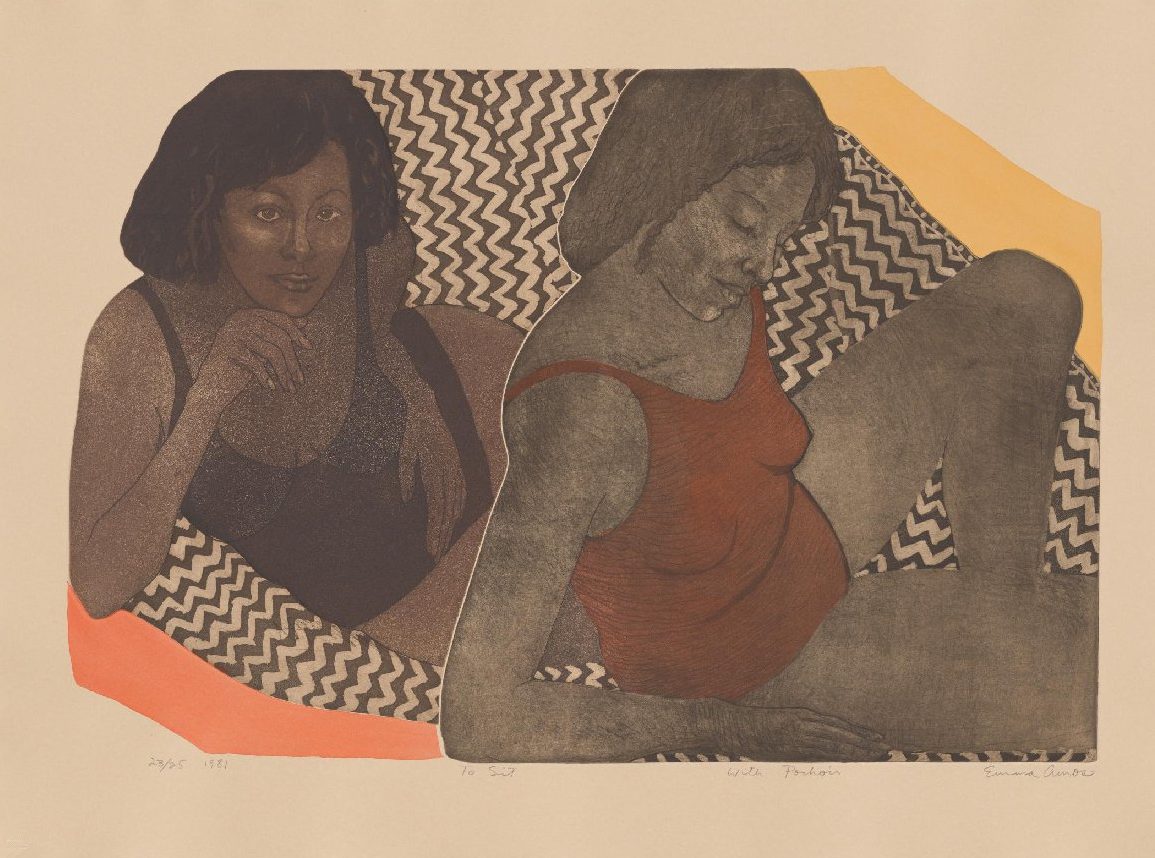
Emma Amos (1937–2020) was a postmodernist artist whose thought-provoking works have left an indelible mark on the art world. Amos emerged as a significant figure in the realms of painting, printmaking, and weaving. Her art is characterized by its bold colors, dynamic compositions, and a profound exploration of themes such as race, gender, and identity.
Youth
Emma Amos was born in 1937 in Atlanta, Georgia. Her parents, India De Laine Amos and Miles Green Amos owned a drug store and worked there. They had many connections within Atlanta’s Black intelligentsia though, including the writer Zora Neale Hurston and the sociologist and activist W. E. B. Du Bois.
At an early age Amos showed a great affinity for the arts and her parents encouraged her to strengthen it. When she was a little girl she created paper dolls and learned how to draw by herself. At 11 she took her first art lessons at Morris Brown College and, when she was in high school, the Atlanta University art shows included some of her works.
About her hometown and her childhood Amos stated:
Even though Atlanta and most cities during my youth were segregated, the arts, schools, and smart creative people were beacons of light. The city was a good place for black people with big dreams, and it continues to be a major site for black colleges, businesses, artists, and political figures. It is important to me to point out that both of my college-educated parents had fathers who were born slaves. This was a good reason for my brother, Larry, and me to believe that we had to continue to excel, as our family had done under much more difficult circumstances.
Emma Amos, Artist’s website.
After she graduated at 17, Emma Amos started studying painting, printmaking, and textile design at Antioch College in Yellow Springs, Ohio. In her fourth year, she went to the Central School of Art in London. There she mastered the techniques of printing, etching, and also began painting with oils.
Career
After her first exhibition at Alexander Gallery in Atlanta, Amos moved to New York in 1960 in order to join a more stimulating art scene. However, in the Big Apple, she didn’t find the open-minded, progressive environment she was looking for. She couldn’t find a job or exhibit her works because art galleries, studios, and colleges rejected her based on her age, gender, or the color of her skin.
But Amos didn’t give up. She found a job as an assistant at the Dalton School, where she finally had the chance to meet artists from the East Hampton art scene.
Then she worked with textile designer Dorothy Liebes and this time as a weaver and designer made her fall in love with fabrics. In fact, we can see the technique of mixing painting and fabrics in many of her pieces.
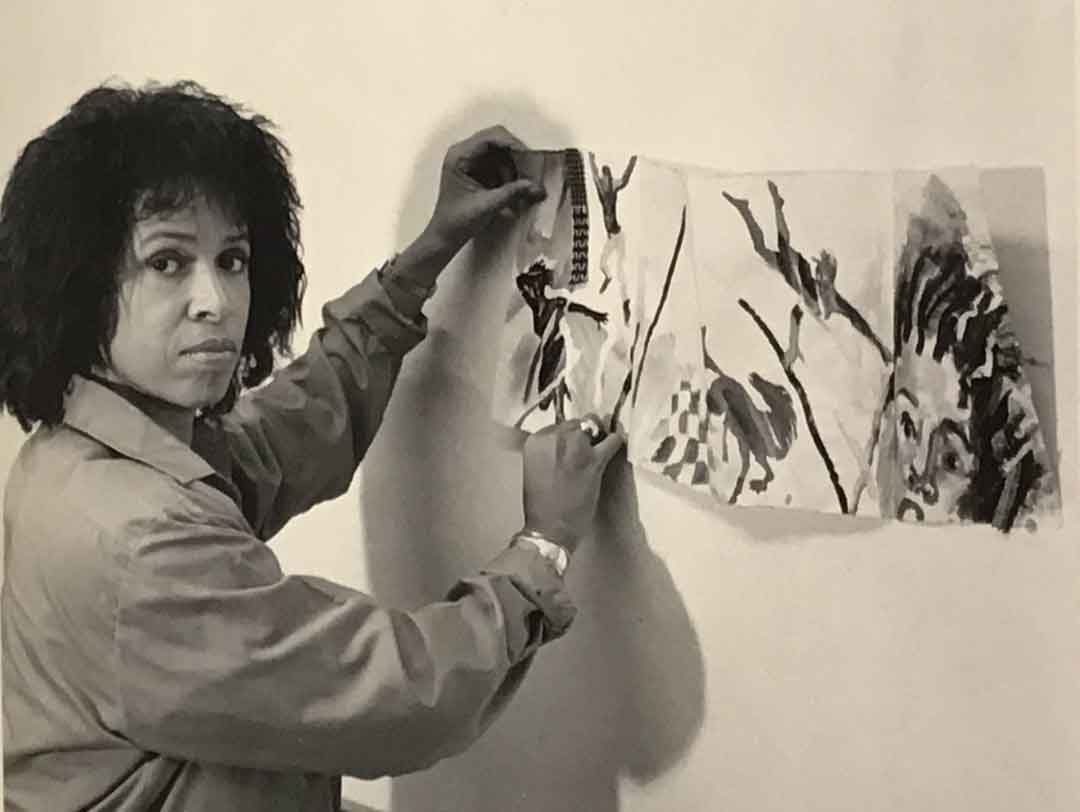 Portrait of Emma Amos in her studio, 1990s, © DR
Her experience grew as she worked with Letterio Capalai in his printmaking studios and as she joined Robert Blackburn’s Printmaking Workshop.
Meanwhile, Amos studied to get an M.A. at New York University. Here she met Hale Woodruff, an artist who knew her parents and who was also teaching there at that time. Woodruff became a lifelong friend to Amos and he was the one who introduced her to Spiral and its members.
Spiral
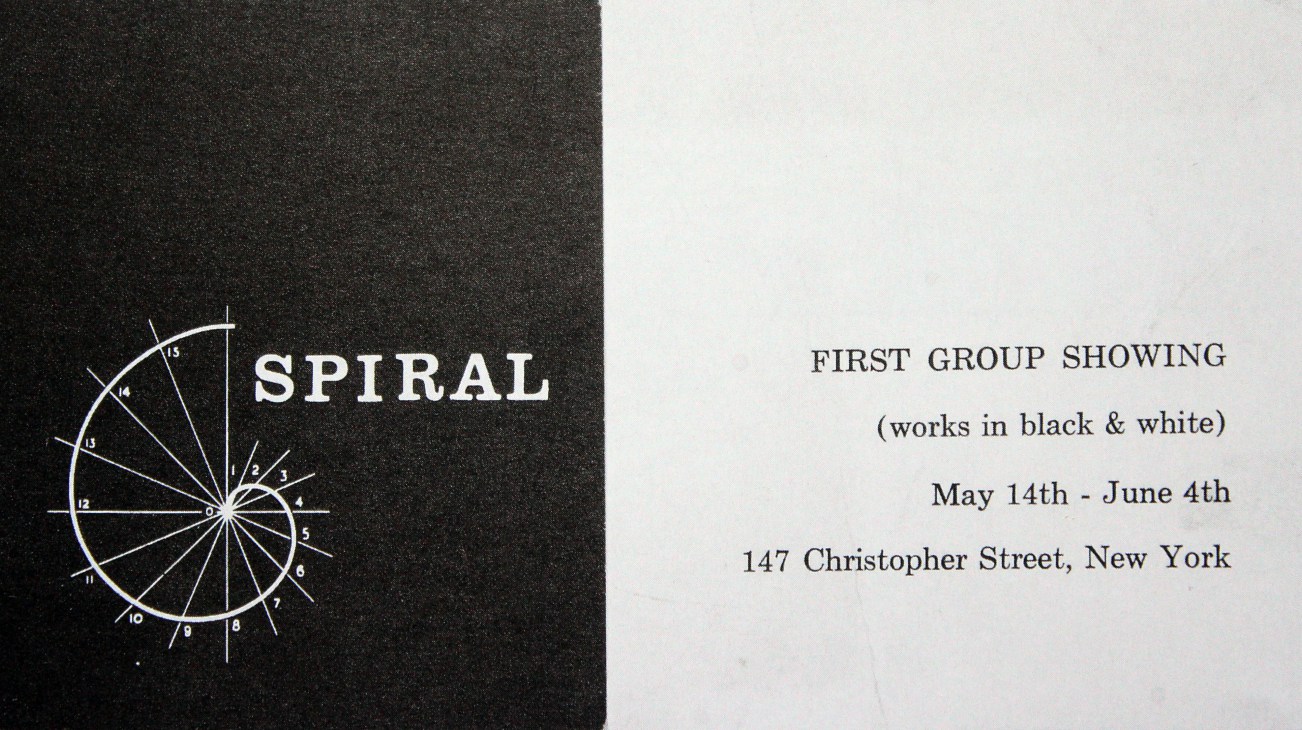
Spiral was a group formed in 1963 by Romare Bearden, Charles Alston, Norman Lewis, and Hale Woodruff, following the March on Washington for Jobs and Freedom. It was a collective of 15 artists who wanted to have a role and a voice in the fight for civil rights. Amos joined Spiral, becoming the first and only female member of the group.
The members organized just one exhibition in 1965, featuring works in black and white. The group disbanded in 1966, but the artists who were part of it had started a debate about the role of African American artists and Black art of the 20th century.
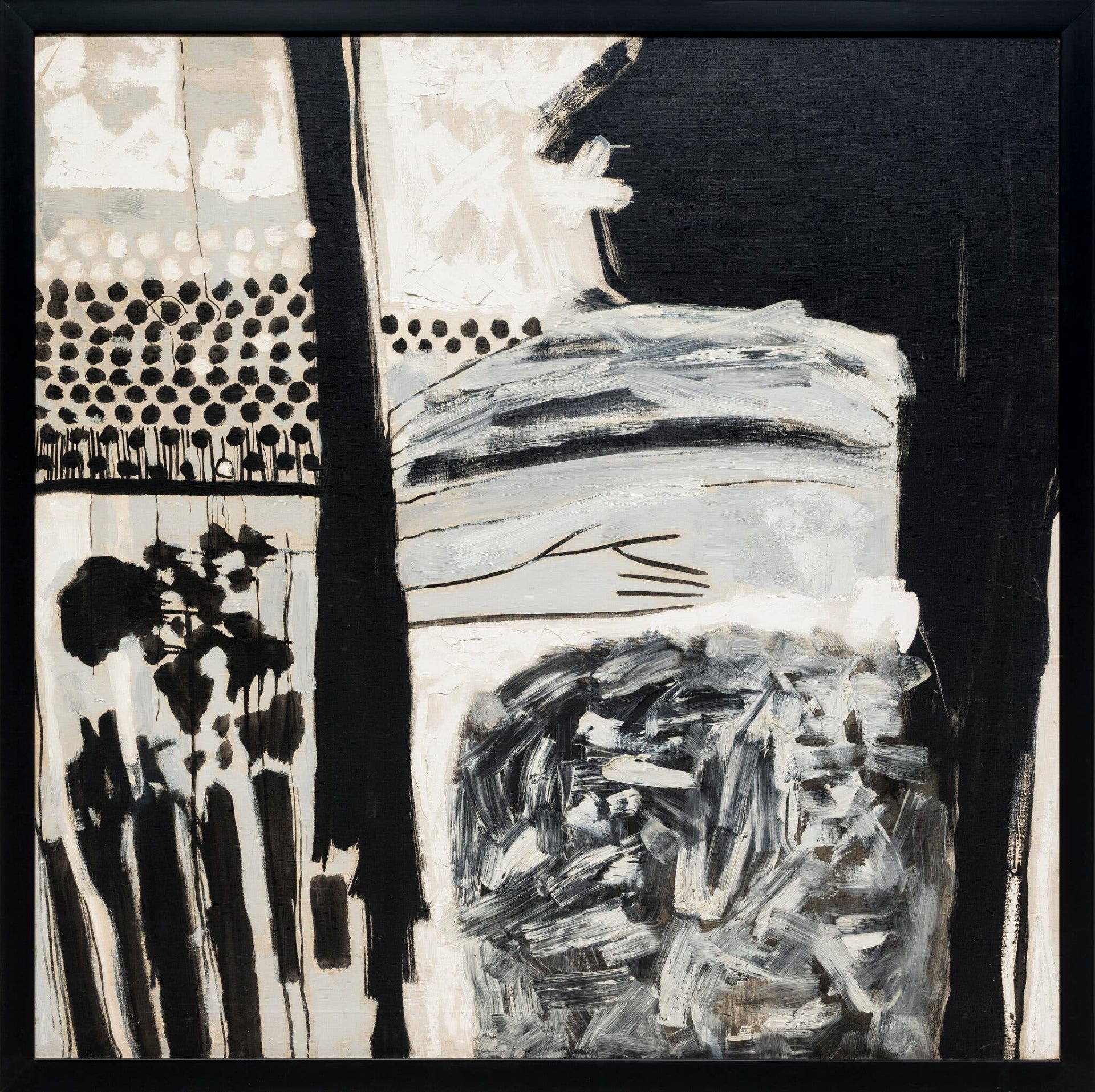
In a statement on her website, Amos wrote:
I also want people to learn to feel my distaste for the notion that there is “art” and “black art.” Yes, race, sex, class, and power privileges exist in the world of art.
Emma Amos, Artist’s website.
She would have wanted a world without any kind of discrimination, at least in art. However, she had to deal with the fact that art institutions were not inclusive as regards African-American artists. Hence she chose to fight for the world she wanted.
Feminist Commitment
Amos wondered why she was the only woman in Spiral at such a young age. She later also thought that they had chosen her because, as a young woman, she was not a threat to them. At the time, the art scene was dominated by men, no matter the color of their skin.
The Heresies Collective
However, Amos didn’t join a feminist group or movement until 1982. This year she found out about the Heresies Collective thanks to one of its founding members, the writer and art critic Lucy Lippard. The Heresies Collective was established in New York in 1976. It was a group of female artists and intellectuals who wanted to share a new perspective on art and politics.
Previously, women were mainly depicted or represented by men. Subsequently, the Heresies Collective wanted to let women express and represent themselves, without the obstacles of the institutional art scene. One of their main activities was the journal Heresies: A feminist publication on art and politics, which was published for over 15 years.
In 2009 a Heresies member, Joan Braderman, made a documentary about the collective with the participation of many of its oldest members, including Amos. If you’re interested, here is the trailer:
Guerrilla Girls
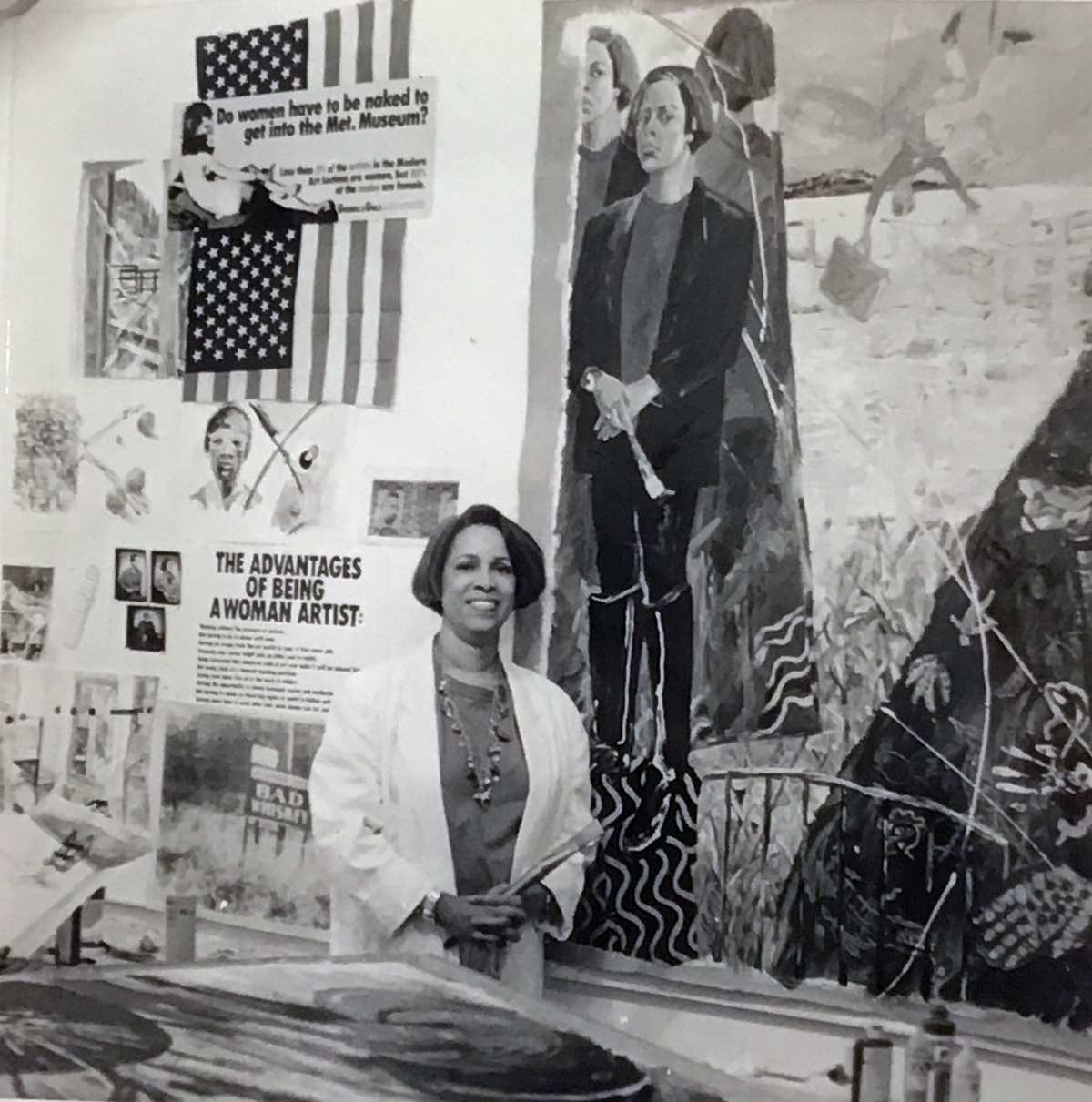
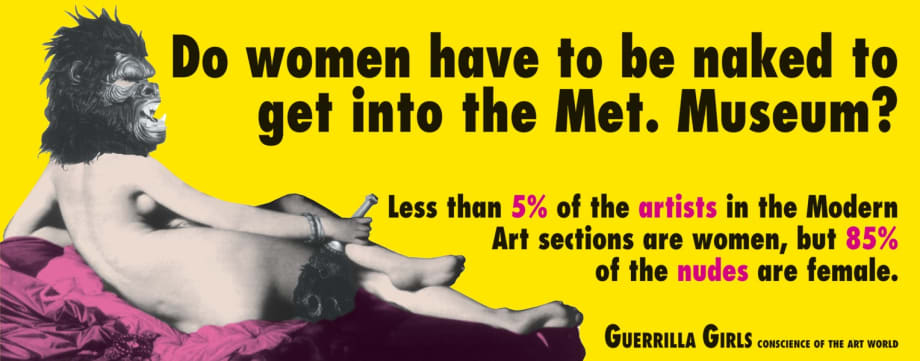
Amos was also part of the Guerrilla Girls, an anonymous group of feminist artists. They are still active and continue to fight against any kind of discrimination. Here is one of their works, you can also see it hanging on the wall in the photo of Amos in her studio (above).
Emma Amos as a Teacher
Amos also had a great career as a teacher. She probably understood that to make a change, it’s fundamental to educate and to shape future generations.
After teaching at Dalton, in 1974 she began working at the Newark School of Fine and Industrial Arts. She then became a professor and later chair of the Visual Arts department at the Mason Gross School of Art at Rutgers University. She worked there for from 1980 until 2008, the year she retired.
Meanwhile, she married Robert Levine, had two children, India and Nicholas, and managed to work as an artist, teacher, and printmaker.
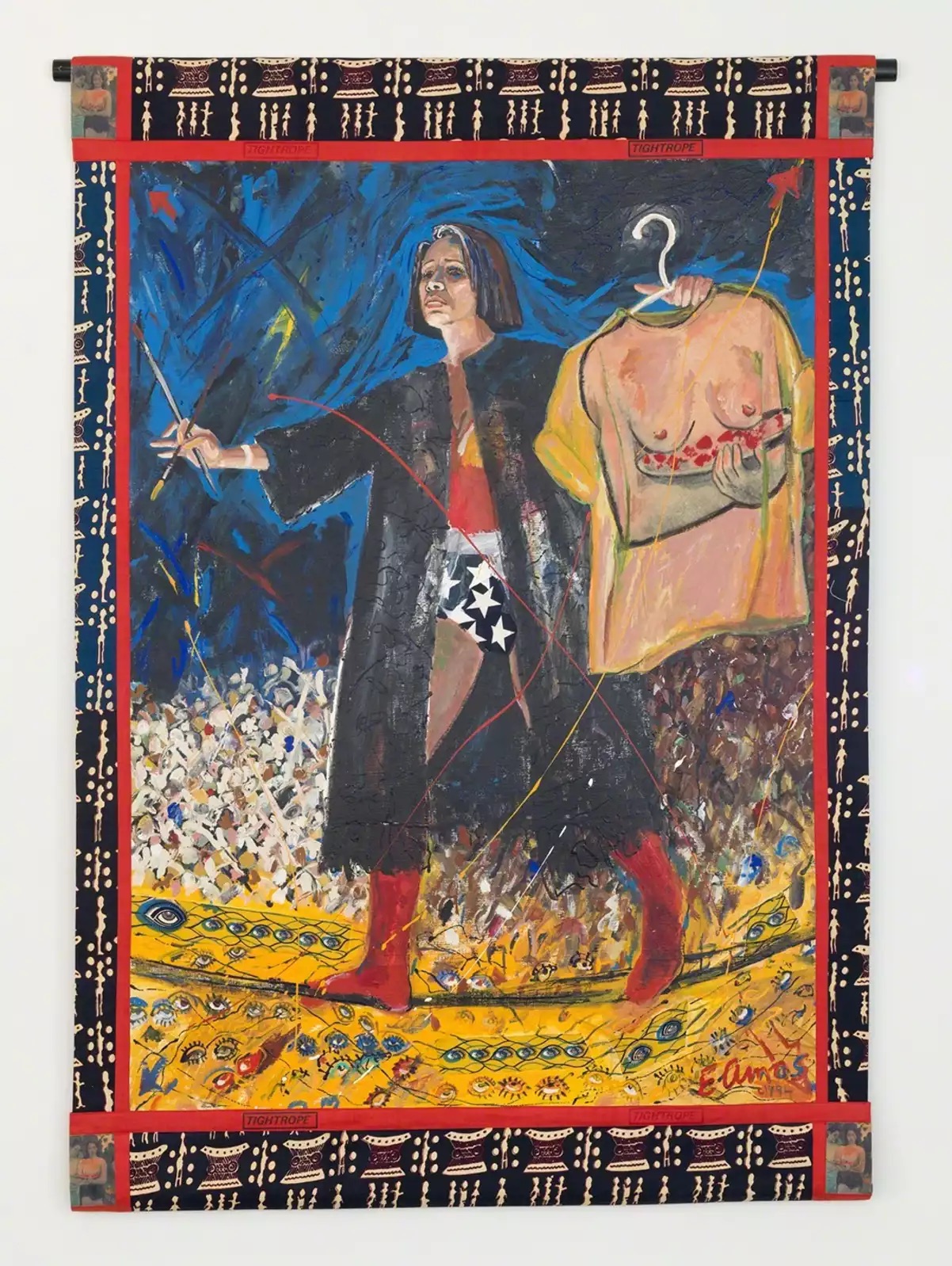
In the painting Tightrope Amos shows the difficult balance she had to maintain as a Black woman, artist, wife, and mother. She represents herself walking on a tightrope, while faceless people and many eyes observe her.
She holds two brushes in her right hand and a t-shirt in her left hand. The t-shirt shows the naked body of Gauguin’s Tahitian, 13 year old bride. Amos loved Gauguin’s work, but the facts of his marriage made her understand how many shades the art world had.
The artist is also wearing a Wonder Woman costume, as what she is managing to do almost requires superpowers. The costume is covered by a black cloak however, which hides her extraordinary abilities from the eyes of others.
Artworks Series
1960s Attitude
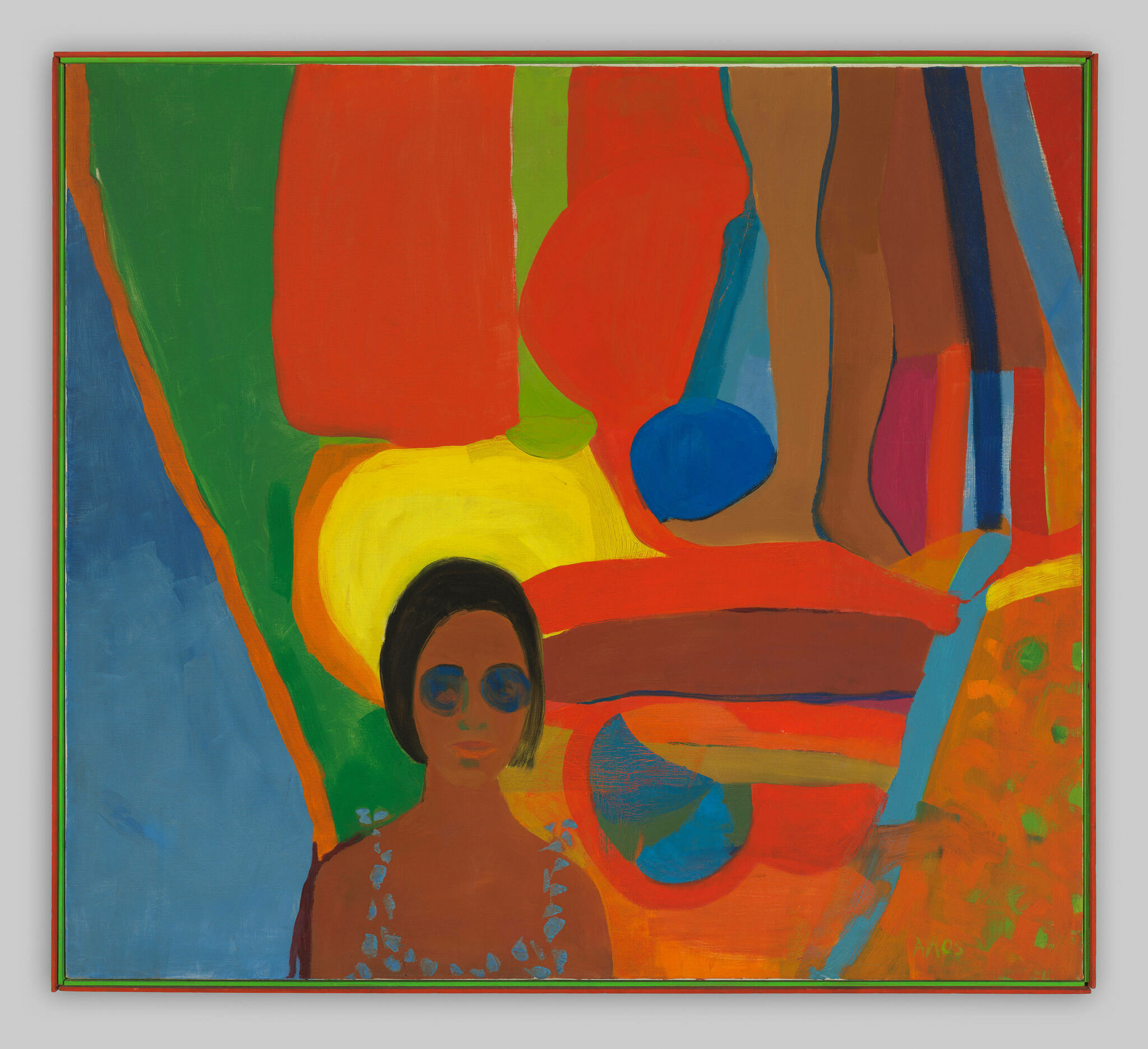
At the beginning of her artistic career, Emma Amos experimented a lot with colors. She was influenced by Abstract Expressionism, Pop Art, and color field painting movements that were taking hold in the America of the 1960s. In her series Attitude, Amos mostly depicted herself and other women of color, a minority that was missing in the art world or only represented from a white, male point of view.
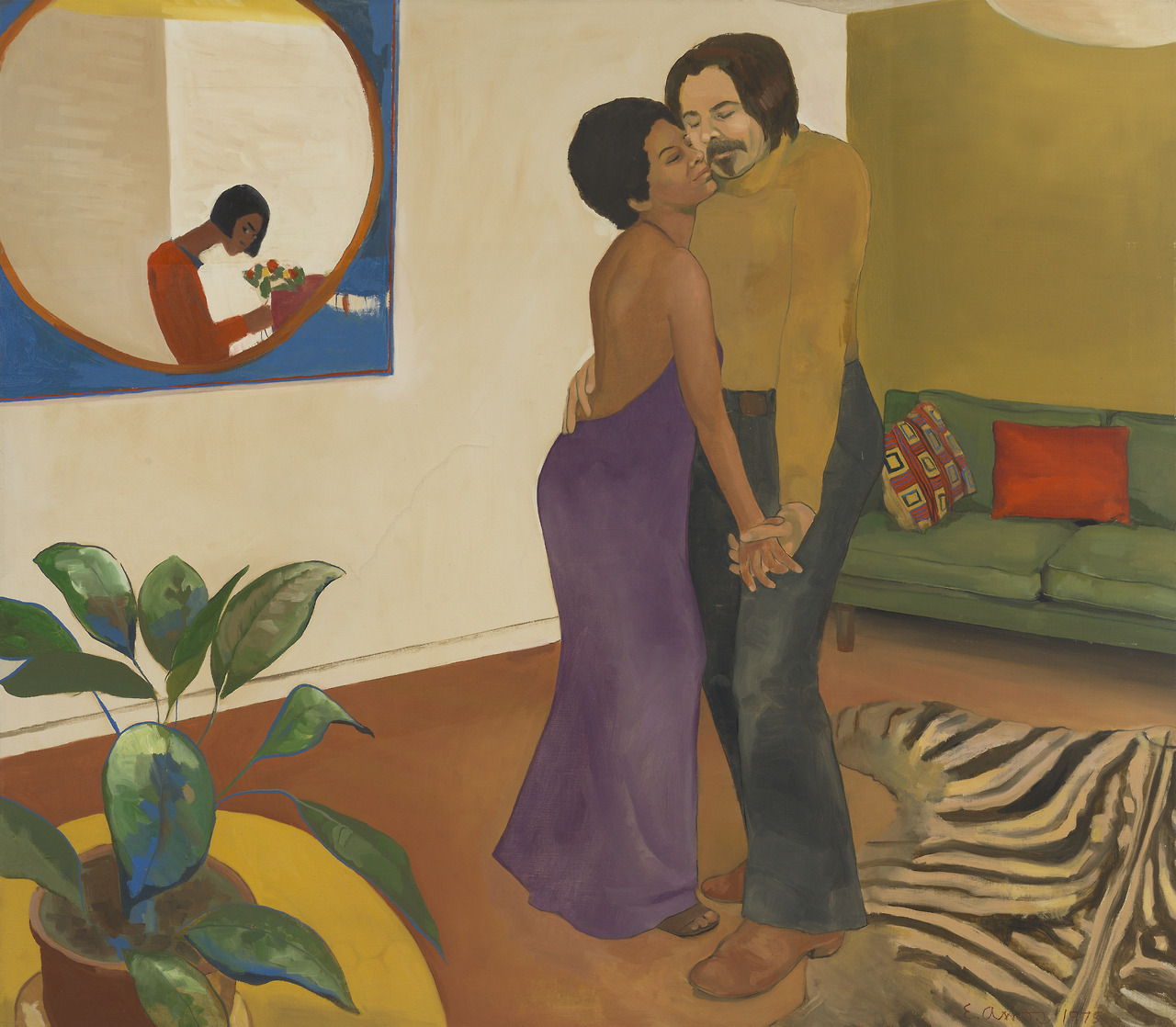
We can see how Amos’ style evolved through the years, becoming more realistic during the 1970s. For example, in the painting Sandy and Her Husband, Amos shows a romantic, domestic moment of a couple dancing in their living room. The composition of this work is very peculiar though. In fact, in the background, the artist depicted one of her 1960s works, Flower Sniffer, which portrays Amos herself looking directly at the viewer.
Even if her drawing technique had changed, Amos kept using bold colors and characteristic compositions, showing the African American culture’s brightness and vivacity.
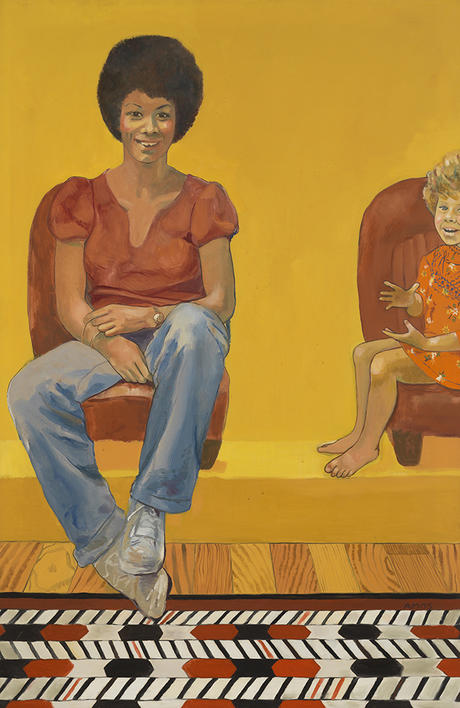
Moreover, in the 1970s Amos started a family, a theme that we can see, for example, in the painting Eva The Babysitter. This artwork almost looks like a photograph, a colorful and cheerful fragment of Amos’ personal life.
1980s Athletes and Animals
During the 1980s Amos become more conscious of her role as an artist and more involved in political and social issues. Plus, her interest in the representation of movement grew, as it was another important component of her culture.
The Athletes and Animals series is the result of all these points. In these paintings, she portrayed Black athletes alongside wild animals including cheetahs, lions, and crocodiles. Furthermore, the animals reference the discriminatory and racist belief that Black people were like beasts.
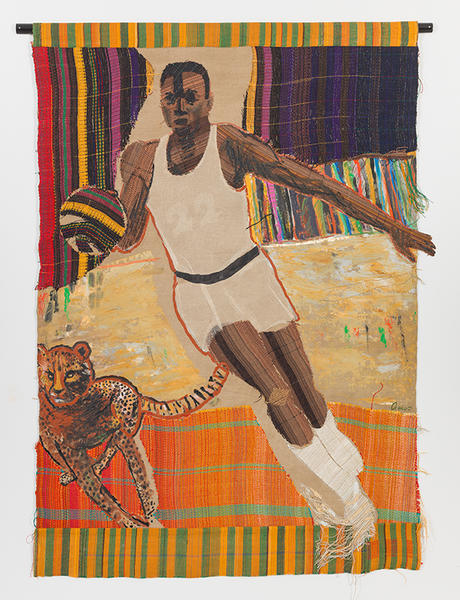
To explain this series Amos also told Lucy Lippard in 1989:
I want to make clear the relationships between artists, athletes, entertainers, and thinkers, and the prowess, ferocity, steadfastness, and dynamism of animals.
Emma Amos to Lucy Lippard in 1989. Artsy.
The Falling Series
Through the 1990s Falling series, the artist wanted to express her fears and anxiety about the history and the future of her country. She depicted both well-known and unknown figures, dancers, or singers falling through undefined spaces. In the background, we see various symbols and architectures, and often the American and Confederate flags.
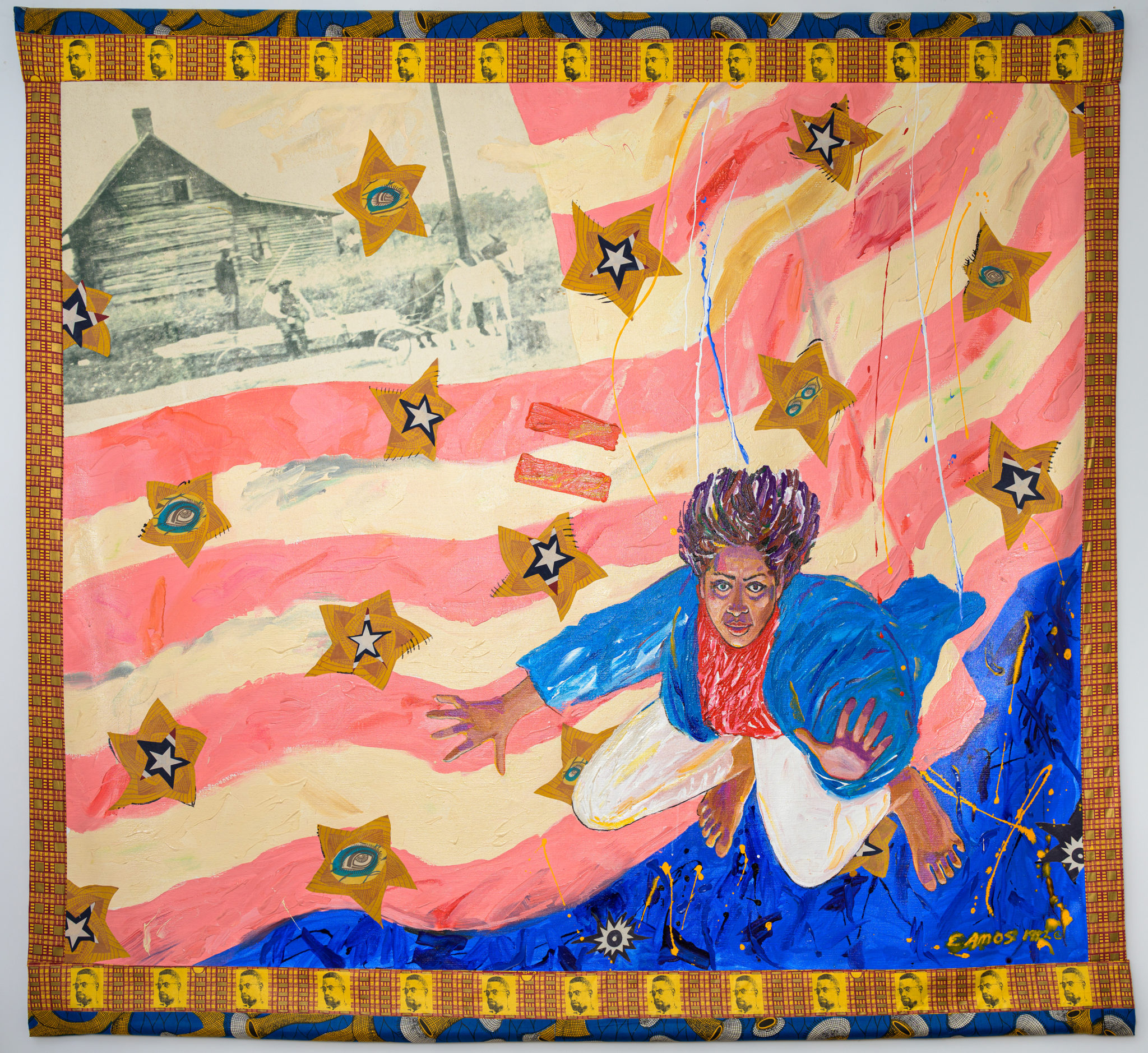
The painting Equals is one of Amos’ most emblematic artworks of this series. African and American colors, symbols and fabrics combine, while an African American woman is falling. She doesn’t look scared though, her determined, proud gaze goes directly to the spectator.
The red equal sign at the center of the composition and the title leave no room for doubt; the woman wants equality. However, She is not asking for it, she is demanding it. Living without being discriminated is a basic human right.
Death and Legacy
Emma Amos kept working until Alzheimer’s forced her to stop. She left us in 2020 but through the 2000s her work became appreciated. Numerous exhibitions showcased her art, for example, Tate’s Soul of a Nation: Art in the Age of Black Power and the Brooklyn Museum’s We Wanted a Revolution: Black Radical Women 1965-1985, both in 2017.
Her first career retrospective in 2021 was held at the Georgia Museum of Art, called Emma Amos: Color Odyssey. Then it traveled to the Philadelphia Museum of Art and the Munson-Williams-Proctor Arts Institute in Utica, NY.
In the end, we can read Amos’ art as a universal message of equality, which relates both to the past and to the present. Her message also opens the door to more personal meanings that each viewer can find and apply to their own life.
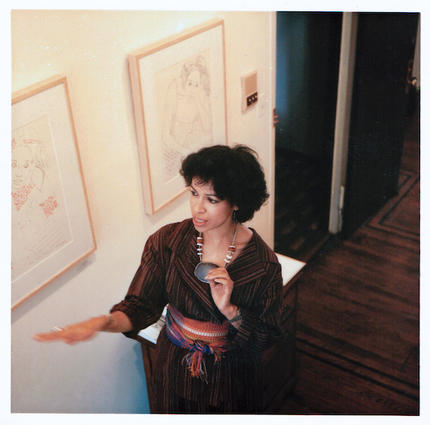
This is what art meant for Emma Amos:
“Many of my paintings, prints, and photographic installations mean to connect more than one form of knowledge or experience with the images within the work. I hope that the subjects of my paintings dislodge, question, and tweak prejudices, rules, and notions relating to art and who makes it, poses for it, shows it, and buys it. The work reflects my investigations into the otherness often seen by white male artists, along with the notion of desire, the dark body versus the white body, racism, and my wish to provoke more thoughtful ways of thinking and seeing. I like being called an imagist but don’t wince (too much) when some see my work as merely figuration without noticing its conceptual commentaries on color and black and white. I like that people can read their own meanings into my paintings and that those readings may be quite different from mine.“
– Emma Amos, Artist’s website.
Through her work and her activism in gender and racial matters, Emma Amos surely made a difference in this world and her story inspires us to do the same, in our own way.
Read more from the original source
