





Black Arts & Culture Feature:
- World-building by Black artists prioritizes sustainable, ethical, and community-centric cultural production over temporary place-making.
- BADS_lab and Galeria do Reggae activate Afro-diasporic infrastructures as living, co-authored sites for practice and care.
- Artists and curators cultivate alternative networks and economies resisting institutional commodification and cultural extraction.
- Creative practices center ritual, collective memory, and transnational solidarity to reshape power, belonging, and futures for Black communities.
Above: Photo at Bienal Opening: BADS_Lab Fellows at opening weekend for 36th São Paulo Biennale; photo credit Muindi Fanuel Muindi.
At the 36th São Paulo Bienal opening, themed “Not All Travellers Walk Roads- On Humanity as Practice,” visitors were welcomed with Theresa Ankomah’s public installation “What Do You See.” On the pavilion’s outer walls featured a myriad of pastel-colored, ribbon-like banners dancing along the park-facing side, inducing visitors to the curatorial exchange led by Dr. Bonaventure Soh Bejeng Ndikung, Alya Sebti, Anna Roberta Goetz, Thiago de Souza Paula, and Kenya Eleison. By situating “humanity as practice”, the public was encouraged to center themselves through their own access and networks as participants of the event. The pavilion reflected the team’s goal of “conjugating humanity,” with visitors experiencing performances, art, and installations of over 120 artists. In a time of conflict and confinement, Ndikung sees this project as a form of resistance, encouraging a relational view of beauty and inviting participation in placemaking that fosters empathy.
As critiques of the 36th SP Bienal are being written, this piece shifts to Ndikung’s reflection on invocation. He begins with Conceição Evaristo’s poem “Of Calm and Silence,” where her reminder that “Not every wanderer walks roads” shows the varied paths humans take. Ndikung emphasises uncovering alternative ways of being, calling us to first situate ourselves in a time of exploitation- identifying our relation to power and our openings. This is crucial in African diaspora faith practices, where meditation on “the crossroads” or where one first finds their place, their community, and guidance, before engaging external forces.
Black artists, collectors, philosophers, and enthusiasts face a crossroads amid global cycles of censorship and commodification of Black cultural production. Ndikung’s vision united many through a project of humanity, fostering a politics of refusal and building connections across the Black diaspora and continent to protect cultural expression. This moment serves as a counter-narrative to the traditional understanding of São Paulo Bienal, which, despite being progressive given its history as the second-longest standing and largest in the Southern Hemisphere, faces institutional limits. While the curated works aimed to relate to viewers, events outside the Bienal built community by celebrating networks that uplift Black voices and experiences, resisting the noise of the space, and transforming ‘Brasil’ into ‘Brazil’ during the event.
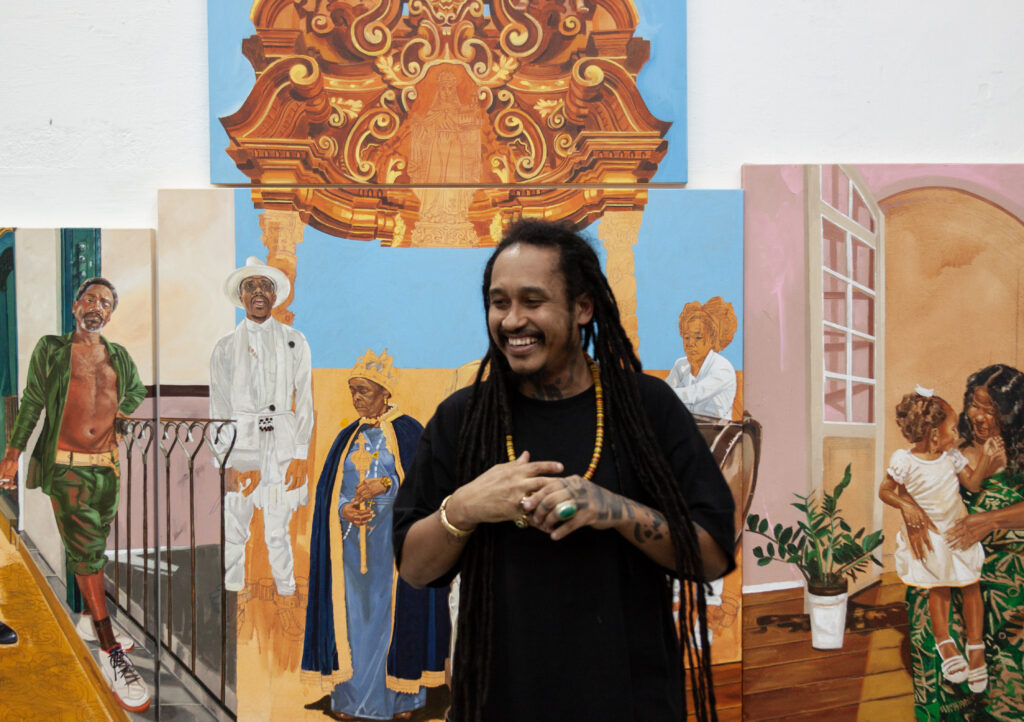
We observed that curators, collectors, social practitioners, and artists affiliated with the Bienal or other projects clearly positioned themselves in this evolving world through their practices and community focus. During the Bienal, Larry Ossei-Mensah of Art Noir, while hosting his curated show at Almeida Dale, organised impromptu gatherings of Black art enthusiasts, aiming to connect people through the Brazilian experience. As he continues to influence Black Brazilian artist incubation and curation, his focus on global engagement supports an active, alternative inclusive infrastructure. Similarly, Afro-Brazilian artists and international collectors praised Fola Adenugba of ISE-DA (Temperature Check) and The 1-54 Arts Fair for leading a well-received studio tour for collectors and researchers. The artists chosen for this trip are renowned or emerging internationally for their merit, innovation, and social impact.
From September 1 to September 9, the festival Black: Cite; Sight-Site, founded by U.S.-based social practitioners Diane Enobabor and Muindi Fanuel Muindi, also founders of Africa is Everywhere, and Black Arts and Decolonial Sciences, activated Galeria do Reggae, as an alternative site of Black placemaking for visitors to the Bienal as a project of social practice. Galeria do Reggae, a shopping center located in the neighbourhood of Republica, in downtown São Paulo, is home to the largest diversity of contemporary African migrants in Brazil. Republica, and particularly the mall of Galeria do Reggae, has been a site of Black diasporic cultural connection through commerce, fashion, music, food, and so forth for over 50 years. The festival featured public events like a roundtable with Bonaventure at SESC 24 de Maio, days before the Bienal opening in downtown São Paulo. It targeted activist artists involved in local social movements. Additionally, there was a week-long residency and curated show by Muindi through BADS Lab.
“It was fitting that BADS_lab’s second iteration unfolded at Galeria do Reggae in downtown São Paulo, a site chosen for its living history as an Afro-diasporic hub. Rather than entering the white cube or academic institution, we scrubbed, patched, and painted the worn storefront ourselves—labour that set the tone. The Galeria mattered because it already held the rhythms of Black commerce, kinship, and survival. To situate the lab there was to honour those infrastructures as co-authors, shopkeepers and braiders as much a part of the conversation as fellows and facilitators.”
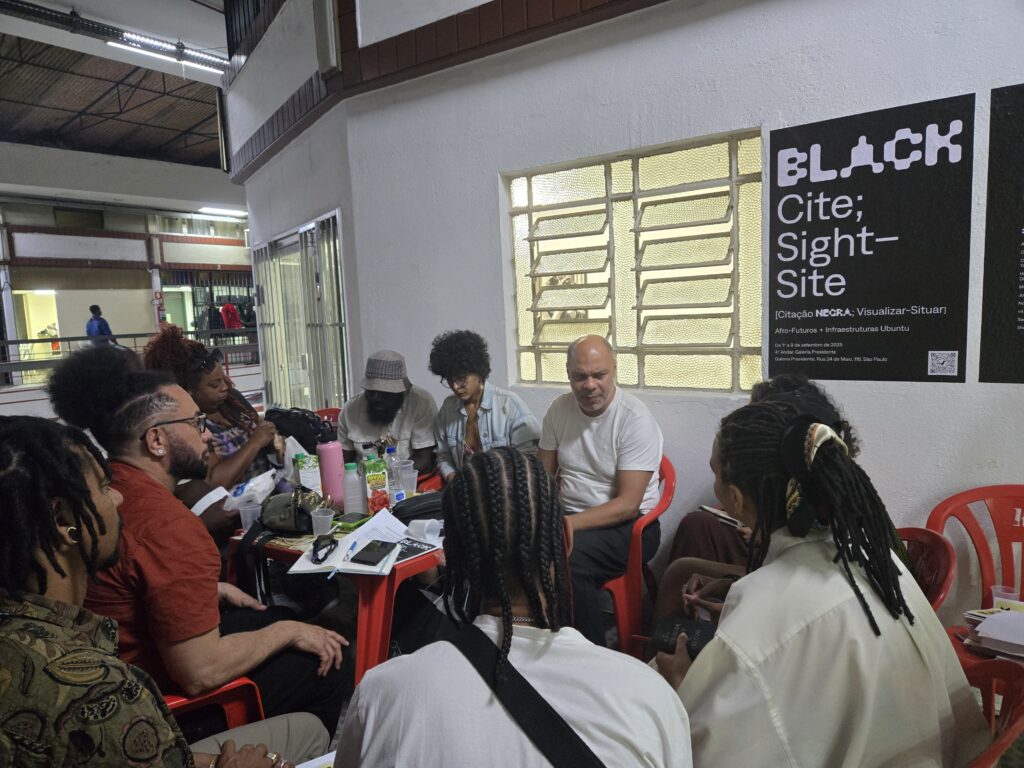
There were ten fellows and additional artists as listed here: Historia da Disputa, Cartografia Negra, Cecilio Henrique Costa and Tiago Almeida Da Silva, Joss Dee and Natasha Felix as APUPÚ, Mariama Bah, Aquiles Coelho Silva, Mônica Garabito, Nduduzo Siba, nii. a.k, Sarah Brito, Shambuyi Wetu, with supporting art from Matheus Trindade, Wilson Tonon, with Tais, Jessica, Micaela, Thaina, and Irene, and Willian Andrade with production assistance from Philomen Media. Invoking this element of what the festival defines as “Ubuntu Infrastructures”, the arts festival and residency called for artists to situate themselves in space/time toward a further understanding of who they were in relation to the other while at Galeria do Reggae, also known as Galeria Black.
Olivier Marboeuf, Villianismo, and No Martins contributed works to the biennial or expanded personal spaces, allowing Black communities to situate themselves through art. Marboeuf’s project mapped African diaspora narratives of survival and resistance, engaging communities via workshops. Villianismo hosted exhibitions for teach-ins and performances in São Paulo, inspired by Theaster Gates, to explore urban space reclamation and arts-based development. No Martins’ atelier in Barra Funda provided private tours, emphasising political Blackness and global awareness, addressing systemic violence and fostering dialogue through art and community. These artists used their platforms to challenge oppression while emphasising joy and collective experience.
On her own experience of the Biennale and community events 36th São Paulo Bienal artist Adama Delphine Fawundu piece, Vibrations from the Deep, Vibrations from the deep, May the hands of the miners roar, let’s chant, vamos canter, tiki toyemba: Florest e vida, O gigantic acordou, May the yams in the farm grow well. Olokun has no rival. Aṣẹ. Axé O!”
“This installation begins with its title—an intentional weaving of voices, chants, and incantations. It references the labor of Congolese miners in Goma, the mass protests for policy reform in Brazil, and the deep wisdom carried through Ifá cosmology, which continues to resonate across the Diaspora and beyond. As visitors step inside the circular structure, they are called into communion with these layers. The space invites gathering, meditation, reflection, and the imagining of new possibilities.
The 36th Bienal de Sao Paulo, made space for these types of artistic expressions “
This historic biennale aligns with artists who are building new systems from the ground up. The real revolution for equity and solidarity in the art world isn’t solely found in these institutional displays.It’s a direct challenge to the traditional art market, which often functions as a system of cultural extraction where the value of the art is high, but the long-term economic stability for the artists and their communities remains low. It’s in the subversive and creative business practices and art experiences being forged by global minded Black artists and cultural producers themselves. They are moving beyond mere “place-making”—the temporary installation of art in a space—and engaging in a profound act of “world-building.” This world-building approach, sustainable, ethical, and community-centric should be centered as an intrinsic aspect of cultural production.
Read more from the original source
