




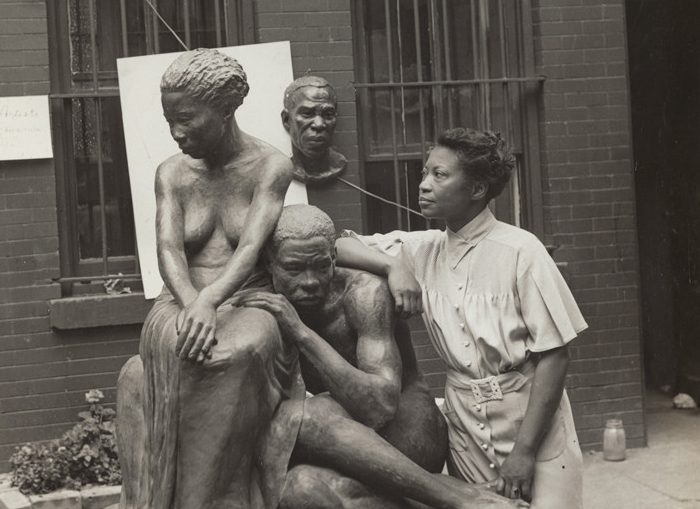
Black Arts & Culture Feature:
- Augusta Savage combined artistry and civil rights activism, making art a vehicle for social change.
- She overcame racism, sexism, and poverty to achieve recognition and mentor younger Black artists.
- Founded the Savage Studio of Arts and Crafts, which evolved into the Harlem Community Art Center, offering pro bono art education.
- Created iconic works like Gamin and the World’s Fair piece Lift Every Voice and Sing, emphasizing dignity and realism.
- Much of her work was lost or destroyed, yet her legacy endures through students, retrospectives, and historical preservation.
Augusta Savage was a sculptress whose name is often missing from the list of illustrious Harlem Renaissance artists. Throughout her life, she merged civil rights activism with art. It is essential to commemorate the woman, her oeuvre, and her struggles.
Harlem Renaissance familiarized the public with names now mainstream in the art canon, like Langston Hughes and Zora Neale Hurston. Luminaries such as these became famous not just for producing art, but cultural criticism as well; their extraordinary efforts to make the life of the African-American “approachable” to outsiders through their rife production in literature, music and, of course, the visual arts, were the keys to their evergreen success and the art movements they have inspired.
Renaissance Woman
To claim that Augusta Savage (1892–1962) was resourceful would be an understatement. Throughout her life, she was a sculptor, a steam laundress, a farmer, a lab assistant, and, above all, a teacher and a mentor. She had to demonstrate extraordinary skill and perseverance to survive all the difficulties she had to face.
Born in 1892 in Florida, Savage demonstrated her artistic tendencies from early on. As a child, she would scavenge for clay native to her local land and use it to craft her own figurines. Her father, a man of religion, was deeply against Augusta’s artistic tendencies, which he saw as wicked, and did everything but nourish them.
Wanting to make a name for herself, Savage eventually decided to move to New York. The Cooper Union offered her a scholarship to study there, choosing the young artist over the hundreds of men who were on the waiting list. Proving herself worthy, she managed to complete her four-year curriculum in only three years.
However, as talented as she was, people still saw her race as a disadvantage; being Black was a burden manifesting itself in different ways within a highly racist America. It is important to remember that today’s iconic civil rights movement figures like Rosa Parks, Ruby Bridges and, of course, Martin Luther King, only surged within the final years of Savage’s life – until then, she must have felt completely on her own, herself against the world.
The turning point in her career was in 1923, marked by her unsubstantiated rejection from an artist residency in Paris. The incident involved the Fontainebleau School of Fine Arts, which rescinded its scholarship offer after discovering Savage was Black. Shaken to her core by this ludicrous injustice, she published open letters to various publications at the time. Her outspokenness could not be taken for granted, not then and not now. It marks the beginning of a fight for equal rights, one that would continue throughout her life and long after it.
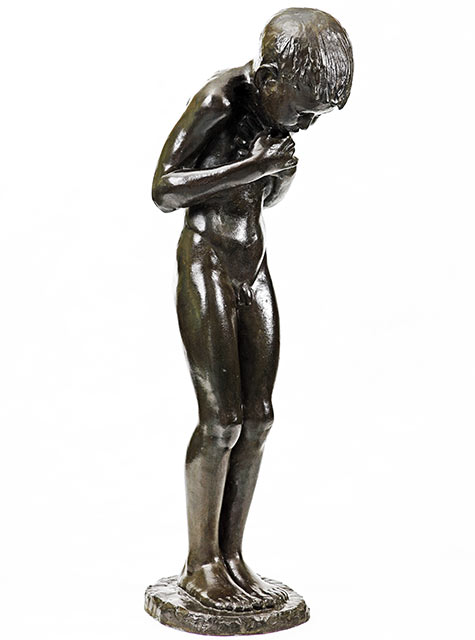 Augusta Savage, The Diving Boy, 1939, Cummer Museum of Art & Gardens, Jacksonville, FL, USA.
After this incident, the artist had to work at a New York steam laundry to support herself. Despite personal problems, she was, for the first time as an artist, commissioned by the Harlem Library for a bust of African American sociologist and civil rights activist William Edward Burghardt Du Bois. The work was very successful, paving the way for more illustrious commissions to come. This was the beginning of a pattern for Savage’s career, in that she chose to only depict members of the African American community, whether prominent or not.
The artist’s struggle with discrimination in an overwhelmingly white, patriarchal art world resonated within her Harlem community, prompting the organization of fundraisers in her support. Savage went against all the art norms of the early to mid-20th century; she was Black, a woman, and not at all affluent. What she ultimately managed to prove is that talent is independent of all obstacles, and so is hard work and dedication.
Eventually, she made it to Paris, where she worked mostly alone. She also traveled around Europe, admiring the ornate sculptures decorating the Catholic churches. Though it may not sound impressive today, a Black woman traveling on her own to a different continent in order to expand her professional horizons was unheard of at the time. Yet so she did, and this European sojourn played a fundamental role in the shaping of her artistry. Visiting and experiencing Paris, the epicenter of modernist thought, was the one-way street to truly becoming a modern artist.
Soon after her return to the United States, she opened her Harlem studio, the Savage Studio of Arts and Crafts. There, she taught pro bono those wanting to learn how to paint or sculpt. The space and the demand gradually grew enough to evolve into the Harlem Community Art Center. Her cultural contribution to the district rendered Savage an icon of sorts – a proponent for equality and artistry.
Sculpture and Style
In 1939, she was one of few women and African Americans to receive a commission for the New York World’s Fair. For this occasion, she created a sculpture titled Lift Every Voice and Sing (the committee then changed its title to the reductive The Harp, which lacked racial undertones), which became a sensation, with fair visitors buying souvenirs of the work. This larger-than-life sculpture showed 12 young Black men and boys opening their mouths to sing in unison. Each boy replaced one string of the ancient instrument, with a divine hand holding the harp together. At the front, an older boy was crouching and holding a card of musical notes.
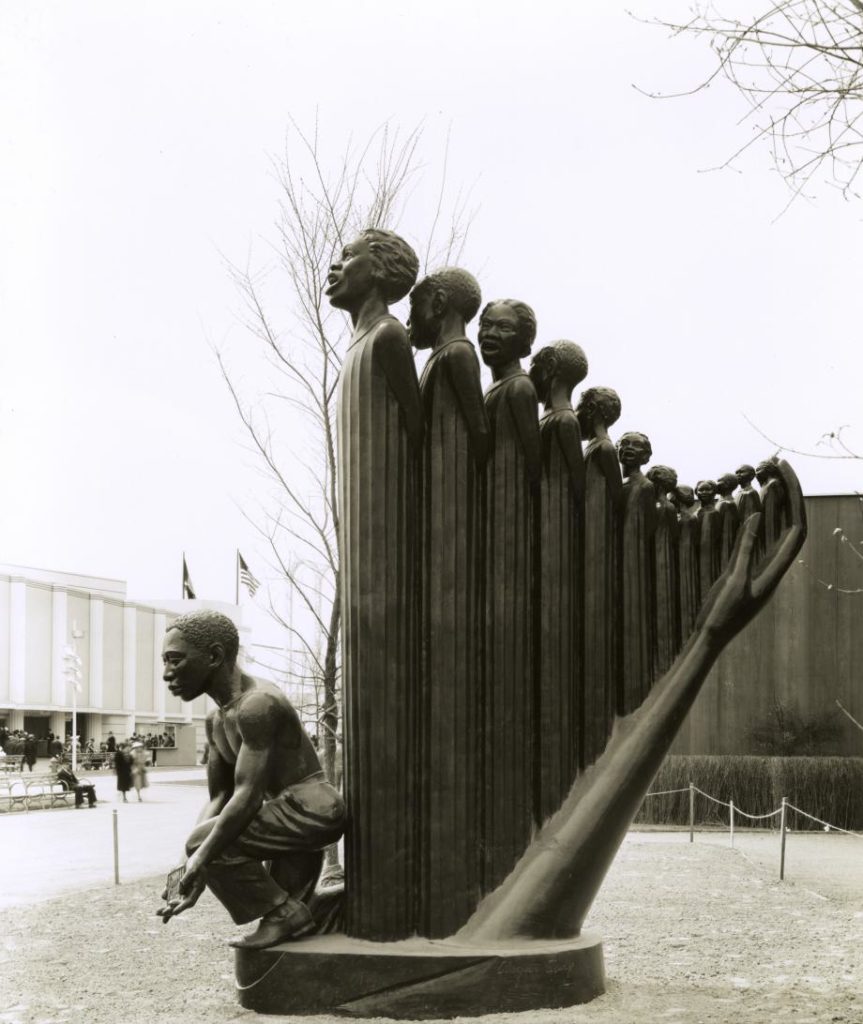 Augusta Savage, Lift Every Voice and Sing (destroyed), 1939, New York World’s Fair. New York Public Library.
The sculpture and its title were obvious references to the homonymous song, which many consider as the Black national anthem. James Weldon Johnson, whose bust Savage also sculpted, initially wrote Lift Every Voice and Sing as a poem. The sculpture symbolized the singular, transcendent relation between African Americans, religiousness, and music. Unfortunately, the sculpture was demolished at the end of the fair, as the artist could neither afford bronze casting it nor storing it. Sadly, out of Savage’s works, only 12 sculptures survived to this day.
Savage’s most precious work has to be Gamin. She likely used her nephew as a model for the boy, famous for his expressive eyes. Unable to afford bronze, she used white plaster, covering it with brown paint and shoe varnish, to mimic the costly material’s effects. From afar this is not particularly noticeable, but, with a close inspection, it is another element adding to the boy’s unkempt look. The story Gamin tells is that of a boy who has had a hard life (his wrinkled cap and shirt are other clues attesting to that). There are no bells and whistles to this bust, just pure realism and humanity. The sculptor approaches the issue of early life as a Black and impoverished child in America with exceptional reverence and sensitivity.
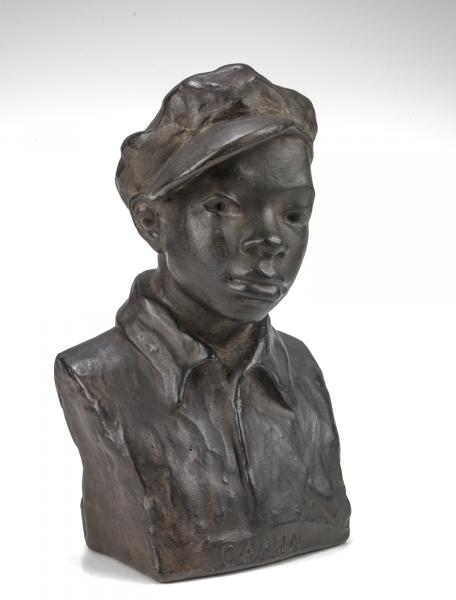 Augusta Savage, Gamin, 1929, Smithsonian American Art Museum, Washington, DC, USA.
There is an interesting, even ironic contradiction that she generates in this work. Busts are usually synonymous with a certain kind of pompousness and authority on behalf of the sitter. Yet, this is one of the very few occasions where we see not a president, leader, or prevalent historical figure, but a boy from a working-class family. According to the coordinator for the first monographic exhibition on Augusta Savage, Wendy Ikemoto, children visitors, in particular, are enchanted by the bust – after all, it is not often that kids get to see their portraits in modern art.
African American Modernism
Augusta Savage’s sculptures stood out because they depicted a real, humane face of African Americans, instead of perpetuating the racist stereotypes that were commonplace in the art of the time, bolstered by movements like primitivism. Being African American herself, the depictions of people from Savage’s community were authentic and realistic. She paved the way for a new kind of sculpture; one that was intimate and representational instead of distant and merely observational.
Augusta Savage is a modern artist and should be more widely celebrated as such. She introduced something completely novel and “foreign” to 20th-century sculpture; the idea that Black people’s lives and artistic voices are of equal significance, beauty and righteousness to everyone else’s. She proved that there were other aspects, outside of the popular white imagination, that occupied the Black American’s mind; there was religion, love, family, poverty and, oftentimes, fun.
The sculptor surpassed the caricature, one-dimensional image that was the norm when it came to depictions of African Americans; a sad and shameful relic of the confederate past. She shattered harmful binaries that affected her community, showing outsiders that it was no longer necessary for a Black person to either belong in the “Uncle Tom”/”Aunt Jemima” categories or be an outlaw. The people depicted in her works were just as human, intelligent and capable as everyone else, with profound thoughts and feelings that went beyond what the racist mind conceived.
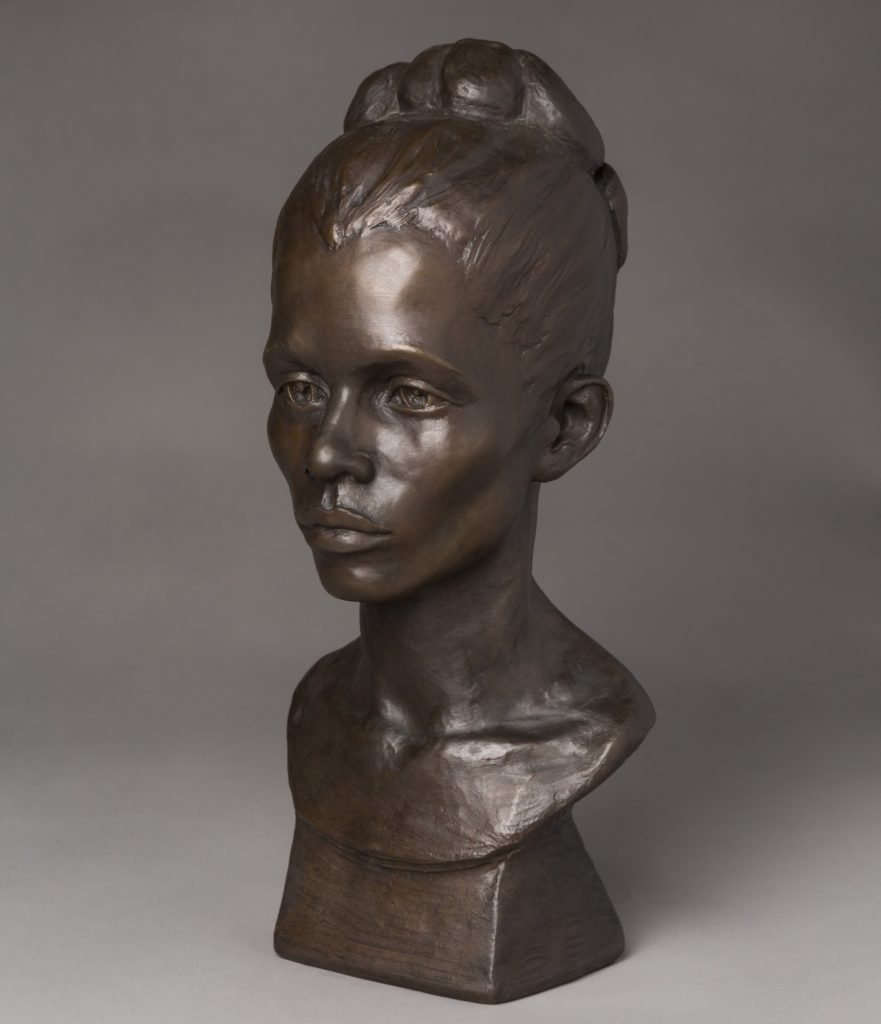 Augusta Savage, Gwendolyn Knight, 1934-1935, Seattle Art Museum, Seattle, WA, USA.
Augusta Savage was a social pioneer – not only did her art move viewers with its realistic approach to Black identity, it also aimed to shake the status quo, which, until then, only saw Black life and its manifestations in art as a commodity, an empty vessel through which to express something entirely different. Having spent most of her life in a society still espousing Jim Crow laws and racial segregation, Savage got the worst side of the coin; she was both African American and a woman, living in early 20th-century United States. Nevertheless, she managed to have a powerful, dismantling impact on the damaging institutions that were set up against her.
Savage was tireless, and she had to be. Thanks to her hard work and unbreakable spirit, she achieved artistic recognition and merit during her lifetime. The 1962 New York Times obituary on her writes “AUGUSTA SAVAGE, 62, SCULPTOR, IS DEAD”*. This is no small feat for an artist who dealt with extreme racism, sexism and poverty during her lifetime. The only support Savage enjoyed was that of her community.
Augusta Savage’s Legacy
Augusta Savage divided her time between art-making and activism, both equally important in her life. Looking for a space in which Black artists can thrive in America, she found none. So, the artist had to quite literally construct that space herself. Her brilliant students, artists like Gwendolyn Knight and Jacob Lawrence, can attest to her influence and impact. It is a sad fact that Savage is not a mainstream Harlem Renaissance figure. The likely explanation to that is the missing state of her artworks. Unlike her well-evidenced influence on the Black arts community, her actual art is either missing or destroyed.

Despite such challenges, in 2018 Dr. Jeffreen Hayes managed to track all of Savage’s existing works. A retrospective exhibition dedicated to the sculptor was curated at the Cummer Museum of Art, in the artist’s home state of Florida. It was aptly titled Augusta Savage: Renaissance Woman. To compensate for the meager number of Savage’s works, the curator chose to also include works of the sculptor’s students. The exhibition was a hit, traveling to the New-York Historical Society and the Palmer Museum of Art.
The sculptor is increasingly gaining the acknowledgment she deserves, albeit posthumously. Her home in Saugerties, New York, is an officially registered historical sight as the Augusta Savage House and Studio. Savage was also included in the Florida Artists Hall of Fame in 2008. As for her birthplace in Green Cove Springs, Florida, there is now a community center with her name. There are still questions pertaining to the whereabouts of her sculptures, with some occasionally resurfacing in auctions. The likeliest possibility is that most of them were destroyed.
Fighting for the visibility of African Americans and women in art was no easy task during the 20th century. For a Black woman, one of the most disenfranchised and chronically scorned figures in history, it must have been nearly impossible. Despite the obstacles, Savage was intent on building a safe space that would nurture her own creativity, as well as that of her students. Decades later, conditions for artists of color have improved, but achieving equal representation still seems like a distant goal. Art historian Richard Powell considered Savage a legend within African American history, an artist whose life was “full of struggle, perseverance, and creativity, all mixed up.”
*According to Augusta Savage’s official date of birth (February 29, 1892), she would have been 70 when she died of cancer, on March 27, 1962.
Read more from the original source
