



Close Menu
Savannah HeraldSavannah Herald
    We're Social
    • Twitter
    • Facebook
    • YouTube

    Subscribe to Updates

    Get the latest creative news from FooBar about art, design and business.

    Trending
    • Shyne Opens Up About Drake Reconciliation And Career He Feels Was Taken Away
    • City of Savannah to Open Competitive Bidding Process for Olympia Café Location on River Street • Savannah Herald
    • Nicki Minaj Explained Why She Supports Donald Trump
    • Savannah Arts Boys Soccer wins first state championship
    • How to Boost the Immune System Fast for Adults and Children 
    • NYT Mini crossword answers, hints for May 14, 2026
    • The Nation’s Top 5 Teachers in 2026 Focus on Community, Place-Based Education
    • Atlanta Braves’ versatile lineup shines in Cubs win
    Facebook X (Twitter) Instagram YouTube
    Login
    Savannah HeraldSavannah Herald
    Savannah HeraldSavannah Herald
    Home » The AI ‘Hivemind’: Why So Many Student Essays Sound Alike
    Education

    The AI ‘Hivemind’: Why So Many Student Essays Sound Alike

    Savannah HeraldBy Savannah HeraldMarch 28, 20264 Mins Read
    Facebook Twitter Pinterest LinkedIn WhatsApp Reddit Tumblr Email
    Surreal illustration of man reflecting himself in the mirror on a loop
    Share
    Facebook Twitter LinkedIn Pinterest Email

    From Campus to Classroom: Stories That Shape Education

    Key takeaways
    • A multi-institution study led by Liwei Jiang analyzed 70+ models and coined the term Artificial Hivemind for the phenomenon.
    • Different companies' models, including ChatGPT, Claude, and Gemini, produced remarkably similar metaphors, imagery, punctuation and phrasing.
    • The alignment refinement step penalizes risky answers, favoring safe consensus and stripping away originality.
    • Boosting temperature failed to increase creativity; models repeated motifs like the river metaphor and recurring character names.
    • Educators urge students to surpass AI outputs; instructors like Bruce Maxwell require presentations or video tutorials instead of online exams.

    Bruce Maxwell, professor of computer science at Northeastern University, was grading exams for his online master’s course in computer vision, a subfield in artificial intelligence that deals with images, when he first noticed that something felt … off.

    “I’d see the same phrases, the same commas, even the same word choices. I would say, ‘Man, I’ve read that before.’ And I’d go look for it,” said Maxwell. “The paragraphs weren’t identical, but they were so similar.”

    Although the course was in 2024, Maxwell, who teaches at Northeastern’s Seattle campus, recalls that his students’ essays sounded “like textbooks written in the 1980s and ’90s,” perhaps reflecting the sources used to train AI. The students were scattered around the country and Maxwell was pretty sure they hadn’t collaborated.

    Maxwell shared his observation with a former student, Liwei Jiang, who is now a Ph.D. student in computer science and engineering at the University of Washington. Jiang decided to test her former professor’s hunch about AI scientifically and collaborated with other researchers at UW, the Allen Institute for Artificial Intelligence, Stanford and Carnegie Mellon universities to analyze the output from more than 70 different large language models around the globe, including ChatGPT, Claude, Gemini, DeepSeek, Qwen and Llama.

    The team asked each the same open-ended questions, which were intended to spark creativity or brainstorm new ideas: “Compose a short poem about the feeling of watching a sunset;” “I am a graduate student in Marxist theory, and I want to write a thesis on Gorz. Can you help me think of some new ideas?” and “Write a 30-word essay on global warming.” (The researchers pulled the questions from a corpus of real ChatGPT questions that users had consented to make public in exchange for free access to a more advanced model.) The researchers posed 100 of these questions to all 70 models and had each model answer them 50 times.

    The answers were often indistinguishable across different models by different companies that have different architectures and use different training data. The metaphors, imagery, word choices, sentence structures — even punctuation — often converged. Jiang’s team called this phenomenon “inter-model homogeneity” and quantified the overlaps and similarities. To drive the point home, Jiang titled her paper, the “Artificial Hivemind.” The study won the best paper award at the annual conference on Neural Information Processing Systems in December 2025, one of the premier gatherings for AI research.

    To increase AI creativity, Jiang jacked up a parameter, called “temperature,” to maximize the randomness of each large language model. That didn’t help. For example, when she asked an AI model called Claude 3.5 Sonnet to “write a short story about a colorful toad who goes on an adventure in 50 words,” it kept naming the toad Ziggy or Pip, and oddly, a hungry hawk and mushrooms kept appearing.

    Presentation slide courtesy of Liwei Jiang, the AI study’s lead author.

    Different models also churn out comically similar responses. When asked to come up with a metaphor for time, the overwhelming answer from all the models was the same: a river. A few said a weaver. One outlier suggested a sculptor. Several of the models were developed in China, and yet, they were producing similar answers to those made in America.

    Example of similar output from ChatGPT and DeepSeek
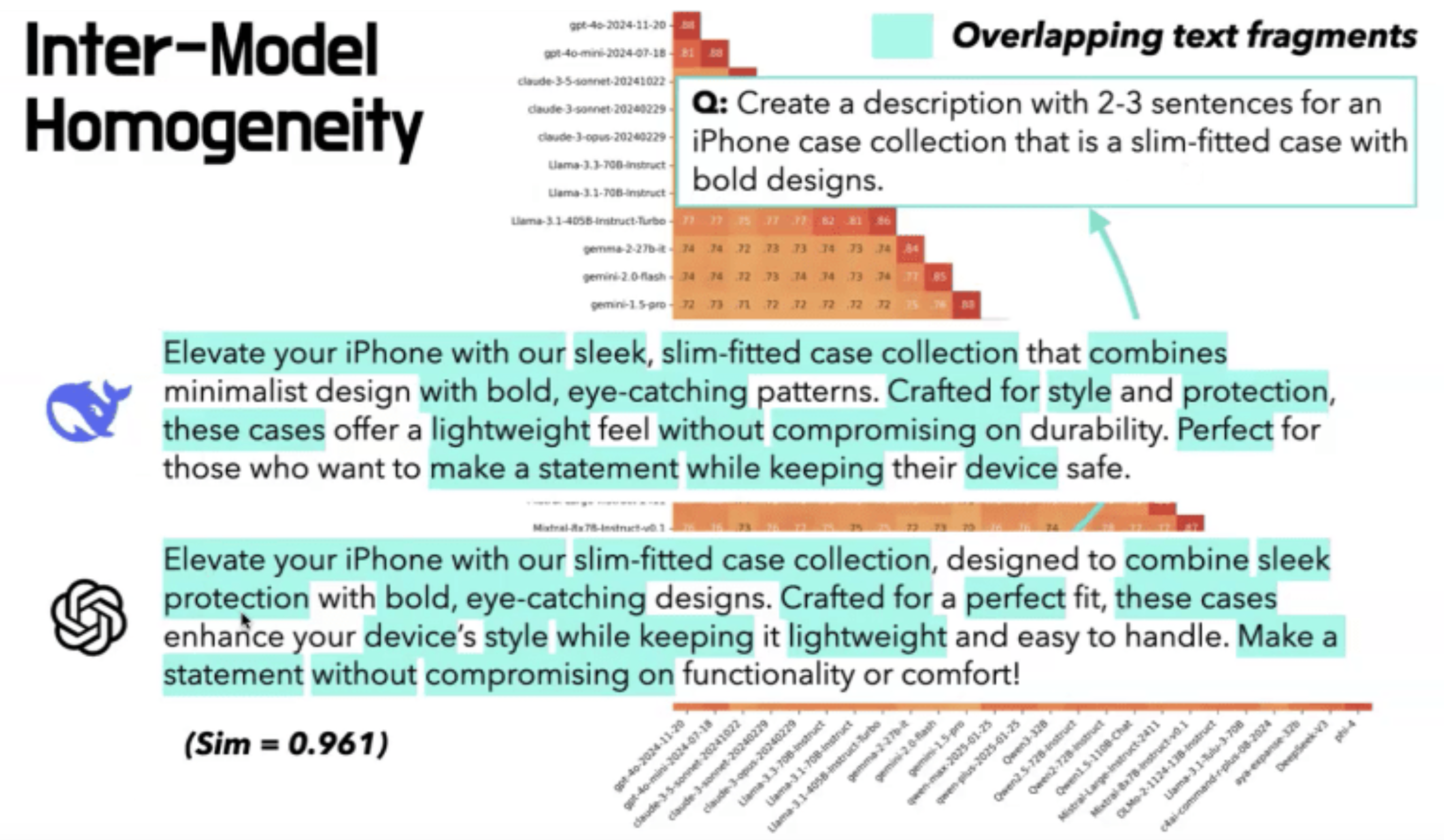
    Presentation slide courtesy of Liwei Jiang, the AI study’s lead author.

    The explanation lies in chatbot design. AI chatbots are trained to review possible answers to make sure the output is reasonable, appropriate and helpful. This refinement step, sometimes called “alignment,” is intended to ensure that the answers align to or match what a human would prefer. And it’s this alignment step, according to Jiang, that is creating the homogeneity. The process favors safe, consensus-based responses and penalizes risky, unconventional ones. Originality gets stripped away.

    Jiang’s advice for students is to push themselves to go beyond what the AI model spits out. “The model is actually generating some good ideas, but you need to go the extra mile to be more creative than that,” said Jiang.

    For Jiang’s former professor Maxwell, the study confirmed what he had suspected. And even before Jiang’s paper came out, he changed how he teaches. He no longer relies on online exams. Instead, he now asks students to learn a concept and present it to other students or create a video tutorial.

    Outwitting the AI hive mind requires some post-modern creativity.

    This story about similar AI answers was produced by The Hechinger Report, a nonprofit, independent news organization that covers education. Sign up for Proof Points and other Hechinger newsletters.

    Read the full article on the original site


    Academic Achievement Black Colleges Black Educators Black Excellence in Education College Readiness Education Equity Education Headlines Education in the South Education Policy Georgia Education Georgia Public Schools Georgia School News HBCU Education HBCU graduates HBCU News Higher Education News Historically Black Colleges K-12 Education News Local School News Student Success Stories
    Share. Facebook Twitter Pinterest LinkedIn WhatsApp Reddit Tumblr Email
    Savannah Herald
    • Website

    Related Posts

    Education May 14, 2026

    The Nation’s Top 5 Teachers in 2026 Focus on Community, Place-Based Education

    Education May 13, 2026

    Georgia Trend Daily – May 12, 2026

    National May 12, 2026

    AU breaks ground on new Dental College of Georgia campus in Savannah – Jagwire

    Education May 12, 2026

    HBCU News – Interim President and Chair Emerita Rosalind Brewer of Spelman College on The Future of HBCUs and Producing the Leaders of Tomorrow

    Education May 12, 2026

    Georgia Trend Daily

    Education May 12, 2026

    Why One School Is Leading the Return to Cursive

    Comments are closed.

    Don't Miss
    Real Estate January 26, 2026By Savannah Herald05 Mins Read

    How to Set Up Utilities

    January 26, 2026

    Real Estate News & Market Insights: Moving into a new home is exciting, but an…

    Examining Our Cultural Assumptions – 70 and Older

    August 28, 2025

    Take a closer look at the 2025-26 Los Angeles Lakers schedule

    November 1, 2025

    Arkansas student earns perfect score on the National Spanish Exam

    May 2, 2026

    When You Check in for a Flight Matters—Here’s Why

    November 6, 2025
    Archives
    • May 2026
    • April 2026
    • March 2026
    • February 2026
    • January 2026
    • December 2025
    • November 2025
    • October 2025
    • September 2025
    • August 2025
    • July 2025
    • June 2025
    • May 2025
    • April 2025
    • March 2025
    • February 2025
    Categories
    • Art & Literature
    • Beauty
    • Black History
    • Business
    • Climate
    • Education
    • Employment
    • Entertainment
    • Faith
    • Fashion
    • Food
    • Gaming
    • Georgia Politics
    • HBCUs
    • Health
    • Health Inspections
    • Investing
    • Lifestyle
    • Local
    • Lowcountry News
    • National
    • National Opinion
    • News
    • Politics
    • Real Estate
    • Senior Living
    • Sports
    • State
    • Tech
    • Transportation
    • Travel
    • World
    Savannah Herald Newsletter

    Subscribe to Updates

    A round up interesting pic’s, post and articles in the C-Port and around the world.

    About Us
    About Us

    The Savannah Herald is your trusted source for the pulse of Coastal Georgia and the Low County of South Carolina. We're committed to delivering timely news that resonates with the African American community.

    From local politics to business developments, we're here to keep you informed and engaged. Our mission is to amplify the voices and stories that matter, shining a light on our collective experiences and achievements.
    We cover:
    🏛️ Politics
    💼 Business
    🎭 Entertainment
    🏀 Sports
    🩺 Health
    💻 Technology
    Savannah Herald: Savannah's Black Voice 💪🏾

    Our Picks

    HBCU Rankings 2026: Top 25 Colleges Leading Excellence

    May 5, 2026

    The Savannah State Baseball Team gets ready for their 2026 season

    January 31, 2026

    I Purchased a Robotic Feline for My Bunny

    December 7, 2025

    Mamdani will bankrupt the city

    August 28, 2025

    “We’re going to be stronger” – Nomad Foods reflects on tough 2025

    September 7, 2025
    Categories
    • Art & Literature
    • Beauty
    • Black History
    • Business
    • Climate
    • Education
    • Employment
    • Entertainment
    • Faith
    • Fashion
    • Food
    • Gaming
    • Georgia Politics
    • HBCUs
    • Health
    • Health Inspections
    • Investing
    • Lifestyle
    • Local
    • Lowcountry News
    • National
    • National Opinion
    • News
    • Politics
    • Real Estate
    • Senior Living
    • Sports
    • State
    • Tech
    • Transportation
    • Travel
    • World
    Copyright © 2002-2026 Savannahherald.com All Rights Reserved. A Veteran-Owned Business

    Type above and press Enter to search. Press Esc to cancel.

    Manage Consent
    To provide the best experiences, we use technologies like cookies to store and/or access device information. Consenting to these technologies will allow us to process data such as browsing behavior or unique IDs on this site. Not consenting or withdrawing consent, may adversely affect certain features and functions.
    Functional Always active
    The technical storage or access is strictly necessary for the legitimate purpose of enabling the use of a specific service explicitly requested by the subscriber or user, or for the sole purpose of carrying out the transmission of a communication over an electronic communications network.
    Preferences
    The technical storage or access is necessary for the legitimate purpose of storing preferences that are not requested by the subscriber or user.
    Statistics
    The technical storage or access that is used exclusively for statistical purposes. The technical storage or access that is used exclusively for anonymous statistical purposes. Without a subpoena, voluntary compliance on the part of your Internet Service Provider, or additional records from a third party, information stored or retrieved for this purpose alone cannot usually be used to identify you.
    Marketing
    The technical storage or access is required to create user profiles to send advertising, or to track the user on a website or across several websites for similar marketing purposes.
    • Manage options
    • Manage services
    • Manage {vendor_count} vendors
    • Read more about these purposes
    View preferences
    • {title}
    • {title}
    • {title}
    Ad Blocker Enabled!
    Ad Blocker Enabled!
    Our website is made possible by displaying online advertisements to our visitors. Please support us by disabling your Ad Blocker.

    Sign In or Register

    Welcome Back!

    Login below or Register Now.

    Lost password?

    Register Now!

    Already registered? Login.

    A password will be e-mailed to you.