




Tech Trends & Innovation: The Latest in Tech News
- Hands-on control of Spot significantly increased comfort and perceived suitability across home, office, hospital, factory, and disaster contexts.
- An adaptive, large-button controller let participants from young children to older adults operate Spot with ease.
- Participants reported strong positive emotions, including excitement and happiness; most called the experience brilliant and would recommend it.
- Hands-on encounters shifted perceptions toward companionship, entertainment, and domestic assistance, reducing emphasis on hazardous or industrial uses.
Building the next generation of robots for successful integration into our homes, offices, and factories is more than just solving the hardware and software problems – we also need to understand how they will be perceived and how they can work effectively with people in those spaces.
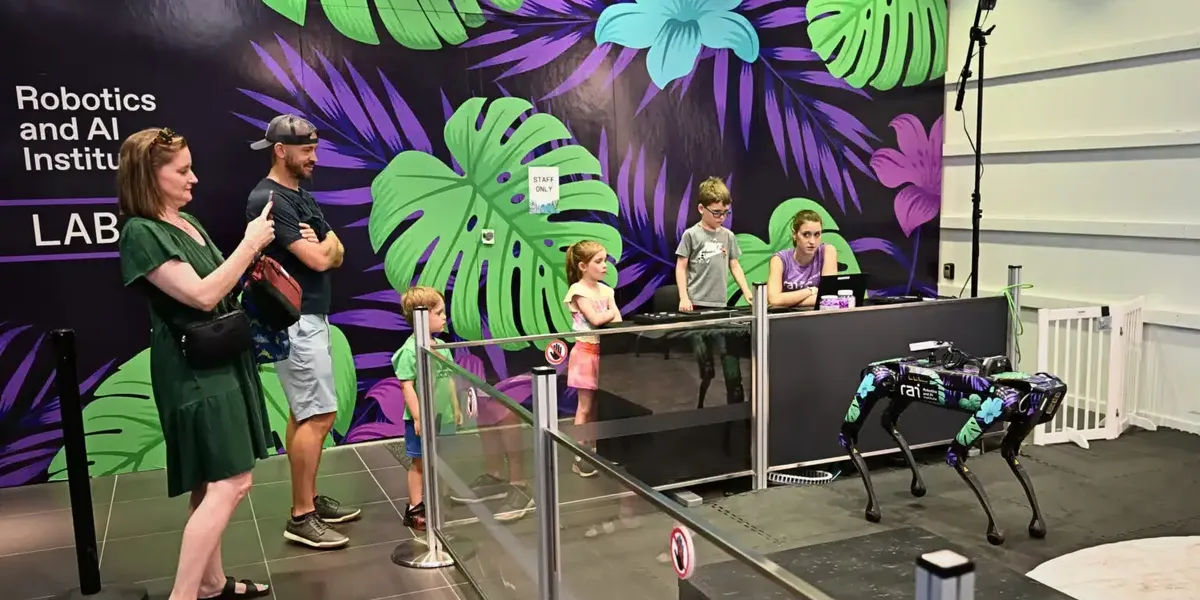
In summer 2025, RAI Institute set up a free popup robot experience in the CambridgeSide mall, designed to let people experience state-of-the-art robotics first hand. While news stories about robots and AI are common, with some being overly critical and some overly optimistic, most people have not encountered robots in the flesh (or metal) as it were. With no direct experience, their opinions are largely shaped by pop culture and social media, both of which are more focused on sensational stories instead of accurate information about how the robots might be used effectively and where the technology still falls short. Our goal with the popup was two-fold: first, to give people an opportunity to see robots that they would otherwise not have a chance to experience and second, to better understand how the public feels about interacting with these robots.
Designing a Robot Experience for the General Public
 Some earlier versions legged robots, built by the RAI Institute’s Executive Director, Marc RaibertRAI Institute
 The ANYmal by ANYrobotics (left) and a previous model of the RAI Institute’s UMV (right)RAI Institute
The pop-up space had two areas: a museum area where people could see historical and modern robots, including some RAI Institute builds like the UMV and an interactive experience called “Drive-a-Spot”. This area was a driving arena where anyone who came by could take the controls of a Spot quadruped, one of the more recognizable, commercially available robots available today.
The guest robot drivers used a custom controller built on an adaptive video game controller that was designed so that anyone of any age could use it. It featured basic controls: move forward, back, left, right, adjust height, sit, stand, and tilt. The buttons were large so that tiny or elderly hands could use the controller and the people who drove Spot ranged in age from two to over 90.
 The guest robot drivers used a custom controller built on an adaptive video game controller that was designed so that anyone of any age could use it.RAI Institute
The demo area was designed to be a bit challenging for the Spot robot to maneuver in – it contained tight passages, low obstacles to step over, a barrier to crouch under, and taller objects the robot had to avoid. Much to the surprise of many of our guests, Spot is able to autonomously adjust itself to traverse and avoid those obstacles when being supervised by the joystick.
RAI Institute
The driving arena’s theme rotated every few weeks across four scenarios: a factory, a home, a hospital, and an outdoor/disaster environment. These were chosen to contrast settings where robots are broadly accepted (industrial, emergency response) with settings where public ambivalence is well-documented (domestic, healthcare).
The visitors who chose to drive the Spot robot could also participate in a short survey before and after their driving experience. The survey focused on two core dimensions:
- Comfort: how comfortable would you feel if you encountered a robot in a factory, home, hospital, office, or outdoor/disaster scenario?
- Suitability: how well would this robot work in each of those contexts?
The survey also recorded emotional reactions immediately after driving, likelihood to recommend the experience, and open-ended responses about what they found memorable or surprising. The researchers were careful to separate the environment participants drove through from the scenarios they were asked to evaluate in the survey). This distinction is important for interpreting the results given below.
Did Interacting with the Robot Change People’s Feelings about Robots?
Out of approximately 10,000 guests that visited the Robot Lab, 10 percent of those drove the Spot and opted-in to our surveys. Of those surveyed, more than 65% of people had seen images or videos of Spot robots online, but most had never seen one of the robots in person.
Increased Comfort Through Experience
Across all five contexts presented in the survey (factory, home, hospital, office, and outdoor/disaster scenarios), comfort scores increased significantly after the driving session. The effects were small to moderate in magnitude, but they were consistent and statistically robust after correcting for multiple comparisons across all participants spanning children to older adults.
The largest gain appeared in the outdoor/disaster context, which started with low comfort despite high-perceived suitability. People already thought Spot would be useful in search-and-rescue scenarios; they just weren’t comfortable with it performing in that scenario. This discomfort may stem from media portrayals of quadruped robots in military contexts. A few minutes of hands-on control appears to partially dissolve that apprehension.
Participants who drove through the factory-themed arena showed no significant increase in comfort, but this scenario already had the highest rating of any rated context at baseline, leaving little room for improvement.
No matter their previous experience, most people were neutral about having a Spot robot in their home before their driving experience. However, after the experience of controlling the Spot robot, people had a statistically significant increase in their comfort at having a Spot in their home and also felt that a Spot robot was more suitable for work in any environment, not just the one they had driven it in.
Better Understanding of Where Robots Can Fit into Daily Life
Perceived suitability for Spot to operate in each context also increased. However, the pattern in the data is different. The largest gains weren’t in the high-baseline industrial and outdoor contexts. They were in home, office, and hospital – the very environments where people started out most skeptical.
Participants who drove the Spot robot in a home-themed environment didn’t just consider homes more suitable for robots; they also rated hospitals and offices as more suitable. This result suggests that hands-on control alters something more fundamental than just context-specific familiarity. It may change a person’s underlying understanding of a robot’s capabilities and, consequently, where they believe robots are appropriate.
Results by Demographic
The hands-on experience seems to be similarly effective across genders, although it does not completely eliminate existing disparities. For example, men reported higher baseline comfort than women across all five contexts. However, all genders improved at similar rates after interaction. The gap didn’t significantly widen or close in most contexts, though it did narrow in factory and office settings.
Age effects were more context dependent. Children (aged 8–17) rated factory environments as less comfortable and less suitable before the study. However, this could be because most children do not have experience with factory settings or industrial environments. After interaction, this gap largely persisted. By contrast, children showed stronger gains in office comfort than older adults and entered the study rating home contexts more favorably than adults did.
 Participants ranged from age 8 to over age 75.RAI Institute
Participants who had previously driven Spot (mainly robotics professionals) began with higher comfort across the board. But after the hands-on session, people with no prior exposure caught up to experienced drivers. This level of familiarity would be difficult to replicate with images and videos alone.
Post-Interaction Results
Post-interaction emotional data was overwhelmingly positive. “Excitement” was reported by 74% of participants, “happiness” by 50%, and only 12% reported “nervousness.” Over 55% rated the experience as “brilliant” and 62% said they were very likely to recommend it to a friend.
The open-ended responses added a lot more color. The most commonly mentioned moments were locomotion and terrain adaptation (22%). This included the way Spot navigated steps, tight spaces, and uneven ground and expressive tilt movements (22%), which people found surprisingly dog-like or dance-like. A smaller set of responses (3%) described anthropomorphic reactions: worrying about “hurting” the robot or finding its behavior “silly” in a way that prompted genuine emotional response.
When asked what tasks they’d want a robot to perform, responses shifted meaningfully. Before driving, answers clustered around domestic assistance and heavy or hazardous labor. After driving, domestic help remained prominent, but entertainment and play jumped from 7.5% to 19.4%. Companionship also appeared at 5%. References to hazardous or industrial tasks declined as people who had operated the robot began imagining it as a companion and playmate, not just a labor-replacement tool.
Key Takeaways from The Robot Lab
In the not-so-distant future, robots will become more common in public and private spaces. But whether that integration into daily life will be accepted by the general public remains to be seen. The standard approach to building acceptance has been passive exposure such as videos, exhibits, and articles. This study suggests giving people agency and letting them actually operate a robot is a qualitatively different intervention.
Short, well-designed, hands-on encounters can raise comfort in precisely the social domains where ambivalence is highest and where future robotics deployment will likely take place. This hands-on experience shouldn’t be limited to tech conferences and museums, as it may be more valuable than just entertaining.
 Fun for all ages!RAI Institute
We consider the popup a success, but as with all experiments, we also learned a lot along the way. For our takeaways, in addition to the increased comfort with robots, we also found that the guests to our space really enjoyed talking to the robotics experts that staffed the location. For many people, the opportunity to talk to a roboticist was as unique as the opportunity to drive a robot, and in the future, we are excited to continue to share our technical work as well as the experiences of our humans in addition to our humanoids.
Does building a space where folks can experience robots firsthand have the potential to create meaningful, long-term attitude shifts? That remains an open question. But the effect’s direction and consistency across different situations, ages, and genders are hard to ignore.
Pop-Up Encounters with Spot: Shaping Public Perceptions of Robots Through Hands-On Experience, by Hae Won Park, Georgia Van de Zande, Xiajie Zhang, Dawn Wendell, and Jessica Hodgins from the RAI Institute and the MIT Media Lab, was presented last month at the 2026 ACM/IEEE International Conference on Human-Robot Interaction in Edinburgh, Scotland.
From Your Site Articles
Related Articles Around the Web
Read the full article from the original source
