




Faith & Reflection: Voices from the Black Church and Beyond
- Recognize your grief; every loss matters; bring it before the Lord, echoing Elisabeth Elliot.
- Offer losses as sacrificial gifts to the Lord, following the example of Abraham and trusting God's purposes.
- Plant yourself and seek the welfare of your place of exile; find purpose even amid trials (reference Jeremiah 29:4-7).
- Surrender pain; God transforms sacrifice into material for His glory and future eternal gain.
- Measure life by loss and love's sacrifice; obedience outweighs worldly attachments, yielding peace and purpose.
I’ve moved a lot on the mission field. Prepped and painted a house once, only to be told by supervisors that we must move to another country. I made curtains to match the paint colors for that house. Now, they would be packed and adjusted for a new place, new windows, or turned into pillow cases. My woes seem minimal compared to those of others who had bought furnishings for a new apartment and then evacuated two months later, never to return.
What do you do when you never seem to hold on to anything? How do you live with the unsettledness of it all?
Recognize your grief
When life turns upside down, and we lose the place or things we, even for a short time, called home, realize you will grieve. Every loss in life is a loss, no matter the size. As Elisabeth Elliot said, “Suffering is having what you don’t want or wanting what you don’t have.” When we have to leave a home or country, we want what we no longer have, and we grieve that loss.
It’s okay to grieve. Recognise it, and take it before the Lord.
Offer your loss to the Lord
Just as Abraham offered his only son, Isaac, to the Lord, we can better face this current pain by offering it to the Lord as a sacrificial offering. How, in this loss, can I offer my empty hands to the Lord? We left with a few suitcases. Our pictures, my children’s artwork, my pots and pans are all stuck back there and lost to me. How can I glorify God in this tent-bound life?
When we had to quickly move from Syria to Lebanon, my land of exile became the birthplace to my two sons. I was grieving what I had lost, but through the words of God in the book of Jeremiah, I found peace to press on.
“Thus says the Lord of hosts, the God of Israel, to all the exiles whom I have sent into exile from Jerusalem to Babylon: Build houses and live in them; plant gardens and eat their produce. Take wives and have sons and daughters; take wives for your sons, and give your daughters in marriage, that they may bear sons and daughters; multiply there, and do not decrease. But seek the welfare of the city where I have sent you into exile, and pray to the Lord on its behalf, for in its welfare you will find your welfare.” (Jeremiah 29:4-7 ESV)
I didn’t always like the land of my exile, but I purposefully chose to plant myself there for the season. The birth of my children brought joy in spite of the trials.
Elliot points to Joseph in a similar vein. When he named his son Ephraim, he said, “For God has made me fruitful in the land of my affliction” (Gen. 41:52). As Elliot said, “It’s not the experience that changed him. It was his response.”
What God does with our sacrifice
When we give our pain and loss up to the Lord, He uses it to His glory. Again, Elliot writes: “You and I have no idea what God has in mind when we make the offering. But everything is potential material for sacrifice.”
What we give up is nothing in comparison to what we gain in the life to come. Our obedience to the Lord’s will is the ultimate sacrifice. We say no to what we would have preferred, no to the place we would have preferred to be, and no to the people we had grown to love in order to say yes to what He has for us today. Elliot writes: “The world and all its passionate desires will one day disappear. The man who is following the will of God is part of the permanent and cannot die.”
In her closing paragraph on the chapter Obedience in her book, Suffering Is Never for Nothing, Elliot quotes Ugo Bassi. This is a word that we can all hold to, no matter the losses or grief we’ve felt and given to the Lord.
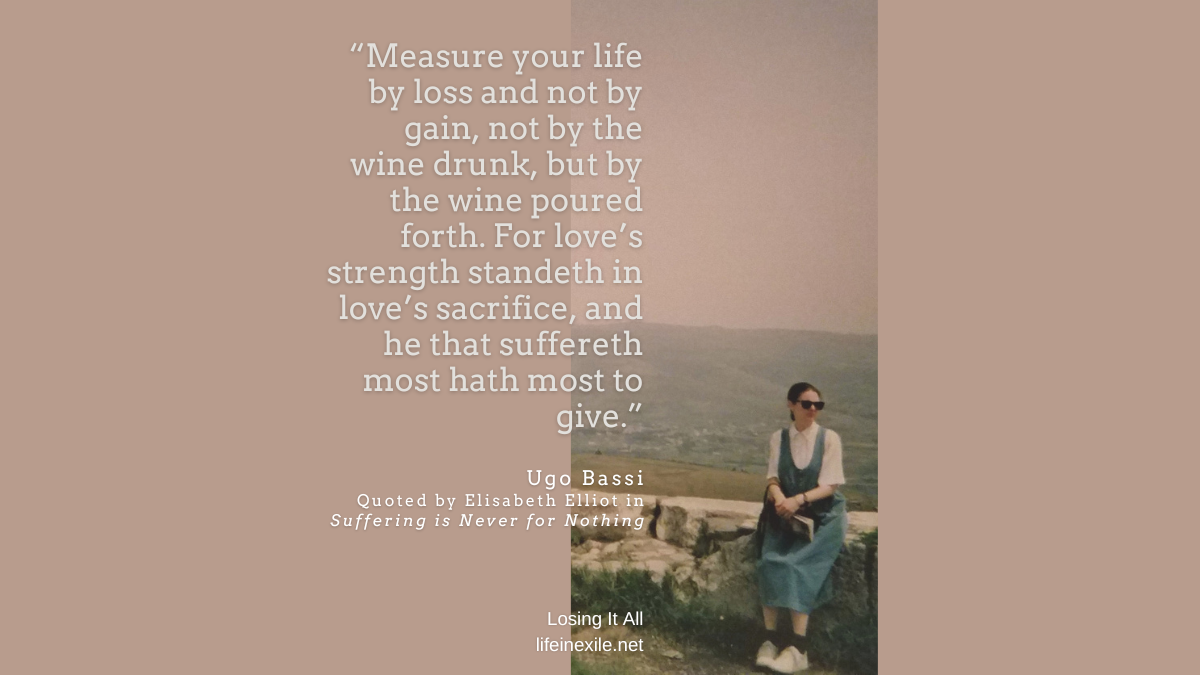
“Measure your life by loss and not by gain, not by the wine drunk, but by the wine poured forth. For love’s strength standeth in love’s sacrifice, and he that suffereth most hath most to give.”
Grace and Peace
If you missed the last Mission Monday post, click HERE, or check out these other posts on trials and sacrifice: We Remember the Altar, Do Missionaries Get PTSD?, Divesting of Self, Pain Understood, and Where Will You Turn?
Discover more from A Life in Exile
Subscribe to get the latest posts sent to your email.
Read the full article on the original source
