




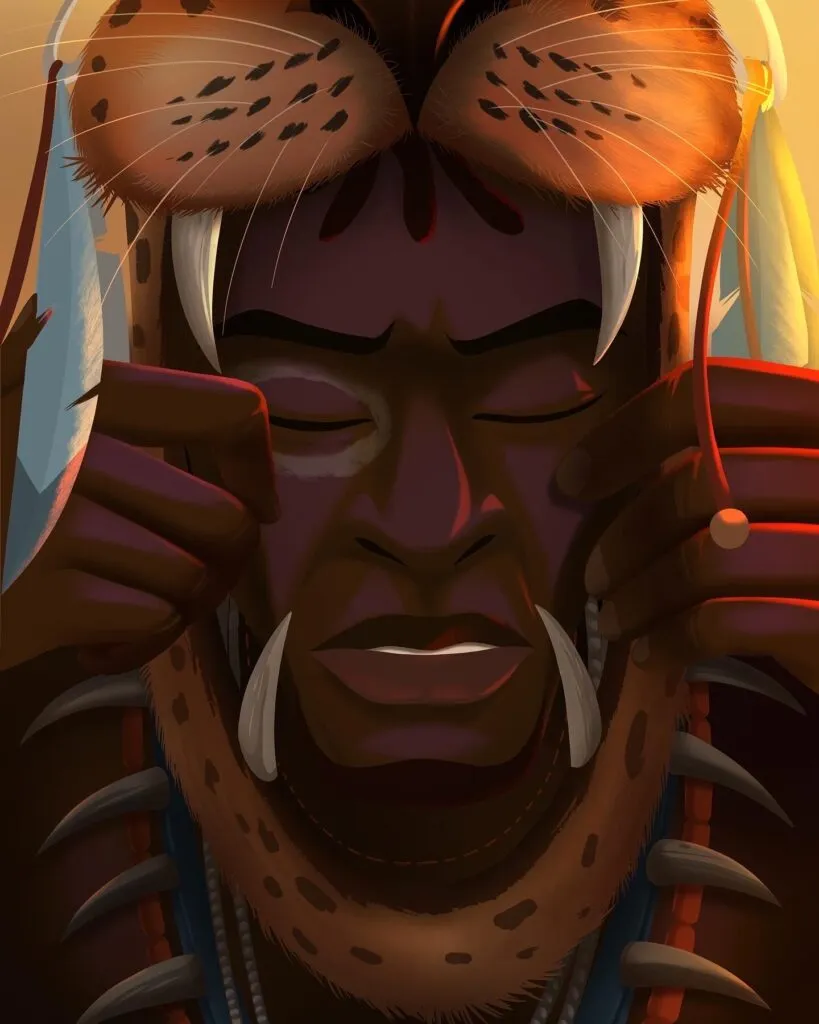
Black Arts & Culture Feature:
- Directed and adapted The Passport of Mallam Ilia, a milestone 2D feature rooted in local research and cultural respect.
- Treats art as a spiritual practice: animation balances hand-drawn textures with digital precision, blending tradition and futurism to reclaim African storytelling.
- Mentors and trains new talent, building a self-sustaining Nigerian animation ecosystem and empowering a new cohort across West Africa.
In Lagos, Nigeria, a new generation of digital artists is redefining what animation means for African storytelling. At the center of this transformation is Chekwube Okonkwo, a director, illustrator, and 2D animator whose work has become a touchstone for contemporary Nigerian animation. As the art director and co-founder of Magic Carpet Studios, Okonkwo has dedicated his creative practice to telling stories rooted in Nigerian history, culture, and imagination—stories that speak to who we are, and who we might yet become.

Building a Visual Language for Nigeria
Okonkwo’s journey into animation began, as he often says, with “a love for drawing and a curiosity about motion.” What started as sketches and comic strips evolved into a lifelong fascination with how images could move, breathe, and tell stories. His early foray into visual storytelling led him to Magic Carpet Studios—a Lagos-based animation company that has trained over a hundred young artists and become one of Africa’s most promising creative studios.
At Magic Carpet, Okonkwo leads a team of animators, storyboard artists, and designers developing original African stories through a uniquely Nigerian lens. He describes the studio as a playground for imagination, a space where artists can experiment, dream, and create without boundaries. Under his direction, the studio’s projects have earned international recognition, including the RTF Best African Animation Hourglass Award.


Directing The Passport of Mallam Ilia
Okonkwo’s most ambitious project to date is The Passport of Mallam Ilia—a 2D animated feature film based on the classic novel by Nigerian writer Cyprian Ekwensi. The story, set in early 20th-century northern Nigeria, follows Mallam Ilia, a man consumed by love and revenge, navigating a landscape marked by colonial tension and cultural transformation.
For Okonkwo, adapting this story into animation is both a creative challenge and a cultural mission. The project represents one of Africa’s first feature-length 2D animated films, a milestone in an industry that has long struggled for recognition and funding. The production, with a reported budget of $1.7 million, combines meticulous research—Okonkwo and his team spent months in Kano gathering visual references—with deep respect for local languages, costumes, and traditions.
He often emphasizes that The Passport of Mallam Ilia is not just about nostalgia; it is about reclaiming the power of storytelling from within Africa. “No one can tell our stories better than we can,” he says—a sentiment that resonates deeply within the African digital art community.
A Philosophy Rooted in the Spirit of Art
Beyond his technical mastery, what defines Okonkwo’s work is his philosophy. To him, art is not simply a craft—it is a spiritual act. “Art is how we experience the soul,” he reflects. “It heals, it restores, it communicates.”
This vision shapes everything he directs. His animation style is both cinematic and poetic—balancing hand-drawn textures with digital precision, and emotion with narrative rhythm. Each frame, each gesture, feels intentional. In his work, the past and present of Nigeria converge: traditional aesthetics meet modern technology, folklore meets futurism.
Okonkwo’s approach places him among a growing wave of African artists who use digital media to explore cultural identity, memory, and mythology. His work bridges generations, speaking to audiences who have grown up surrounded by Western animation yet long for stories that reflect their own landscapes and languages.


Nurturing the Next Generation
As a mentor and educator, Okonkwo is deeply invested in nurturing Nigeria’s creative future. Through Magic Carpet Studios, he has helped train and employ a new cohort of animators, colorists, and storytellers—many of whom are now producing independent work across West Africa. His dedication to capacity building is a reminder that the true power of art lies in community and collaboration.
By investing in education and access, Okonkwo is ensuring that Nigeria’s animation industry doesn’t just depend on a few individuals but grows into a self-sustaining ecosystem capable of global impact.
Redefining African Animation
In an industry where African narratives are often filtered through external perspectives, Chekwube Okonkwo’s work stands out for its authenticity and integrity. His dedication to 2D animation—an art form often overshadowed by 3D trends—speaks to his belief in the emotional immediacy of hand-crafted storytelling.
Projects like The Passport of Mallam Ilia are not merely artistic achievements; they are cultural declarations. They affirm that African animation is not emerging—it has arrived.
Okonkwo’s direction embodies what African Digital Art has long celebrated: the merging of technology, tradition, and vision to create art that is unapologetically African and universally human.
Read more from the original source
