




Faith & Reflection: Voices from the Black Church and Beyond
- Abdul El-Sayed disavowed the Muslim Brotherhood and defended that his Muslim faith does not undermine allegiance to the Constitution.
- He likened the scrutiny to John F. Kennedy's Catholicism and raised questions about religious freedom and law.
- Catholic Sister Nancy Sylvester asked JD Vance how immigration enforcement matched their faith and urged compassion after family separations.
- Vance defended ICE, acknowledged some mistakes but cited no specific cases; exchanges occurred during a pivotal Michigan Senate race.
(RNS) — Two exchanges in Michigan over the weekend put questions about religious identity, political loyalty and immigration enforcement in the spotlight.
At a campaign event in Caro, Michigan, on Saturday, Oct. 17, Democratic Senate candidate Abdul El-Sayed was asked whether he would disavow the Muslim Brotherhood. He said he would, then challenged what he called an assumption that his Muslim faith put his allegiance to the Constitution in doubt.
El-Sayed compared the scrutiny, by a young man who identified himself as Tommy and as a Christian, to the questions President John F. Kennedy faced about his Catholicism. He then asked the man about religious freedom and the role of religious doctrine in American law.
During a CBS News town hall that aired Saturday, Catholic Sister Nancy Sylvester took part in a segment that encouraged voters to ask Vance direct questions. Sylvester asked Vance how the administration’s immigration enforcement reflected their shared Catholic faith. She said sisters working in Detroit had witnessed the effects of family separations and urged the administration to treat immigrants with greater compassion.
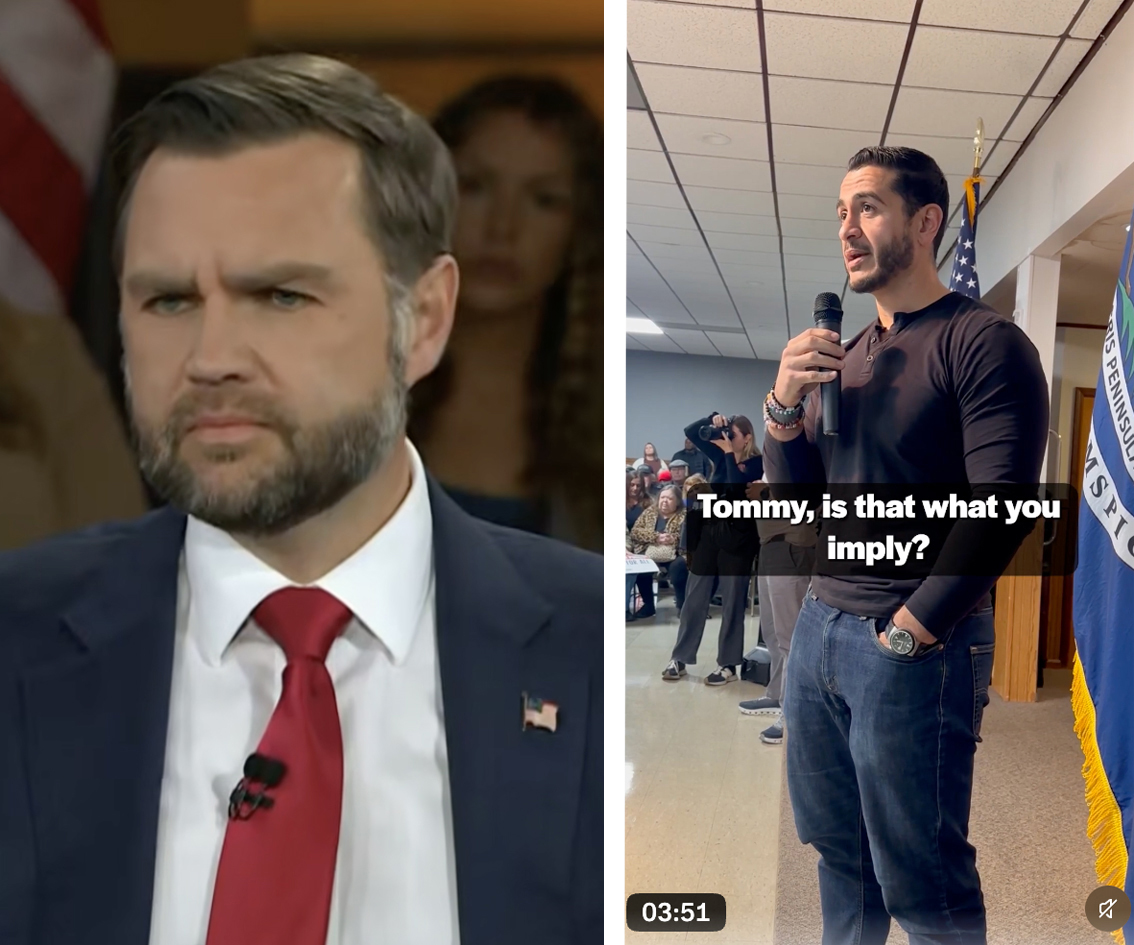
Vice President JD Vance, left, listens to a question from Sister Nancy Sylvester, center, during a town hall. Dr. Abdul El-Sayed, right, discusses his allegiances after being asked a question during a campaign event. Video screengrabs from two different speaking events
Vance acknowledged that some immigration officers had made mistakes but defended ICE’s work. When pressed for examples, he did not cite specific cases.
The exchanges came as Michigan’s closely contested Senate race could help determine which party controls the chamber after November’s midterm elections. Watch RNS’s video for the full story.
Read the full article on the original source
