




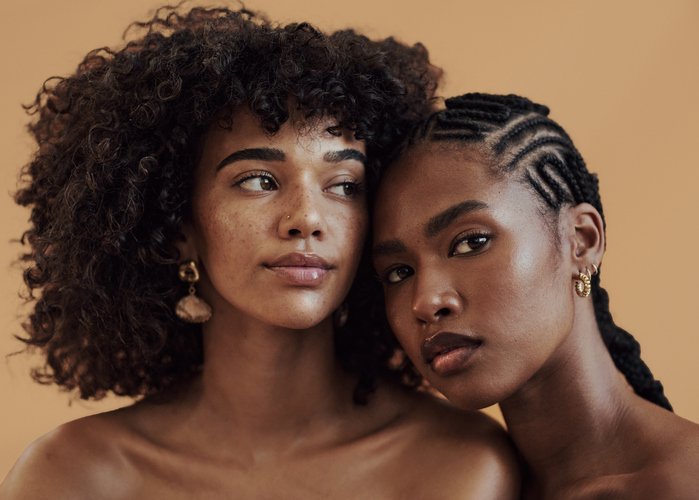
Glow & Grow: Black Beauty, Haircare, and Skincare Tips

Black Hair Joy in 2025 : Embracing Our Beauty and Power
Why Our Hair Still Leads the Culture
by Danielle Cox for CurlyNikki.com
If you judge me because of my wondrous hair, if you are critical of the way my hair naturally grows from my glorious scalp, you are critical of God. And that’s a YOU problem.
Some mornings, you don’t even touch your hair. You just look at it. Let it be. Let it exist.
Not styled. Not stretched. Not manipulated.
It sits there, bold and soft. And for a moment, it feels like prayer. Like standing in front of an altar made of coils and history.
That’s the space we’re in with Black hair right now. PRESENCE. We’ve moved beyond trends and styles. This just is. We just are. Powerful.
In 2025, Black hair is reclaiming its divine seat at the table. In offices, in politics, on red carpets, and in our own mirrors.
What Black Hair Means This Year
To say our hair is political feels both true and tired. It’s always been political. What’s new is the silence around it.
This year, we’re less interested in debating our right to wear it, and more invested in the joy of honoring it.
Wigs? Joy.
Cloud curls? Joy.
Starter locs? Joy.
Pressed and flipped like it’s 2004? Joy.
We’re styling with freedom, not defense. Which, for Black women, is still a radical act. It’s become an afterthought, which, for Black women, is a RADICAL ACT. Our hair is no longer our first thought when it’s time to plan a vacation or schedule a job interview. If you judge me because of my wondrous hair, if you are critical of the way my hair naturally grows from my glorious scalp, you are critical of God. That’s a YOU problem.
Trending Now: The “Tailored Natural” Era
Customization is everything right now. This September, the streets are serving:
There’s no one way to do Black hair anymore.
And that might be the best trend of all.
The Pressure of Being Visible
With more visibility comes more responsibility.
Black hair is featured in more campaigns than ever, but that doesn’t mean it’s always handled with care.
We still see:
-
Discrimination in hiring tied to natural styles
-
School suspensions over “distracting” textures
-
Algorithms that favor straight or slicked-back aesthetics
-
Influencers being penalized for posting their shrinkage
So no, it’s not just hair. It never was.
But it is ours. And that still means everything.
September Black Haircare for the Shift in Seasons
Your curls know the seasons better than your calendar. September air might still feel like summer, but your strands are already whispering fall.
Here’s how to prep:
1. Clarify before you moisturize
Build-up from butters and gels needs to go before layering hydration.
2. Switch your sealant
Trade heavy shea for a lighter oil like grapeseed or jojoba.
3. Add moisture in the middle of the week
A fine mist and a water-based leave-in can change the game.
4. Start a braid-down routine
If you’re protective styling, prep the hair underneath. Care before cute.
5. Trim if needed
Fall is a good time to let go. That includes ends.
The Future of Black Hair Is Unbothered
No more explaining. No more shrinking. No more waiting for permission to show up as you are.
The future of Black hair looks like this:
-
Bonnets in airports without shame
-
Meetings in twist-outs, not tension
-
Curls in campaigns without the “diversity” label
-
Salons that feel like healing spaces
-
Products made for care, not control
The future is soft. Intentional. Full of choice.
And in case you needed the reminder: your hair is enough.
Big. Short. Slick. Wild. Natural. Relaxed. Locked. Covered. Colored.
It’s all valid. And it’s all Black.
BLACK HAIR THROWBACK from 2014- Does Natural Hair Make You Blacker?
Trending topics on social can sometimes be humorous, crass or just plain dumb. But they can also serve as an insight into what a large group of people is buzzing about. Recently, a lively conversation began about whether or not having natural hair makes you “blacker.”
Can you be “blacker” if you’re already black -and “blacker” than who? We decided to get to the bottom of the controversy and add our own opinion to the conversation.
Over the last few weeks, more and more articles and responses have popped up on the Internet regarding natural hair and “blackness.” Sister 2 Sister posted an article that asked this same question: does having natural hair somehow make you “blacker?”
The question spurred a frenzy of comments on Twitter, and the author shared her thoughts on the issue as a woman with a perm. She revealed that she “never believed in the silly notion that Black women who straighten their hair are trying to resemble their White female counterparts with long, silky smooth tresses.”
A look through the comments on the article shows that most women agree with her, and that hair does not define a woman, nor can it be used as a measurement of “blackness.”
Trying to define blackness is like trying to define love; it’s different for every single person and produces unique experiences that can rarely be duplicated. Of course, like love, blackness means something different depending on who you ask.
For some, blackness reflects someone’s interests, clothing or the way they talk. For others, it may have more to do with deeper qualities, such as a knowledge of black history or having and displaying cultural pride.
Historically, natural hair has been used as a source of black pride and resistance to assimilation. The Afro in particular had social and political connotations that reflected the “black and proud” sentiment of the time. Since then, however, the decision to go natural has become popular for all kinds of reasons and has even become a national trend devoid of political implications. >>> Read On
Read the full article from the original source
