




Black Travelers: Explore Culture, Adventure & Connection
- Adaptive reuse preserves original architecture while creating contemporary guest rooms and public spaces suited to modern visitors.
- Original cells, ironwork, stone walls, and prisoner graffiti remain incorporated into restaurants, suites, and landscaped courtyards.
- Conversions range from luxury hotels like The Liberty to single-suite retreats such as The Cell Block.
- Many projects earned preservation awards and attract guests seeking history, architecture, and stays in buildings with unusual pasts.
Hotels that occupy former jails ask designers to solve an unusually difficult preservation problem. Thick masonry walls, barred openings, narrow cells, central corridors, and institutional floor plans were designed for confinement, leaving architects and owners to rethink spaces that were never intended for comfort. Across the United States, a small group of historic hotels and inns has taken on that work through adaptive reuse, retaining enough of the original architecture to make each building’s history immediately recognizable while creating rooms and public spaces suited to contemporary guests.
In some properties, former cell blocks now hold suites, restaurants, or lounges. Exercise yards have become landscaped courtyards, while original windows, ironwork, stone walls, and even prisoner graffiti remain in place. The results range from large luxury hotels to intimate inns and single-suite stays, with each property taking a different approach to balancing preservation with a new purpose. For guests, the appeal lies partly in staying somewhere with an unusual past, but also in seeing how architecture built for one function has been carefully adapted for another.
The Liberty, A Luxury Collection Hotel, Boston
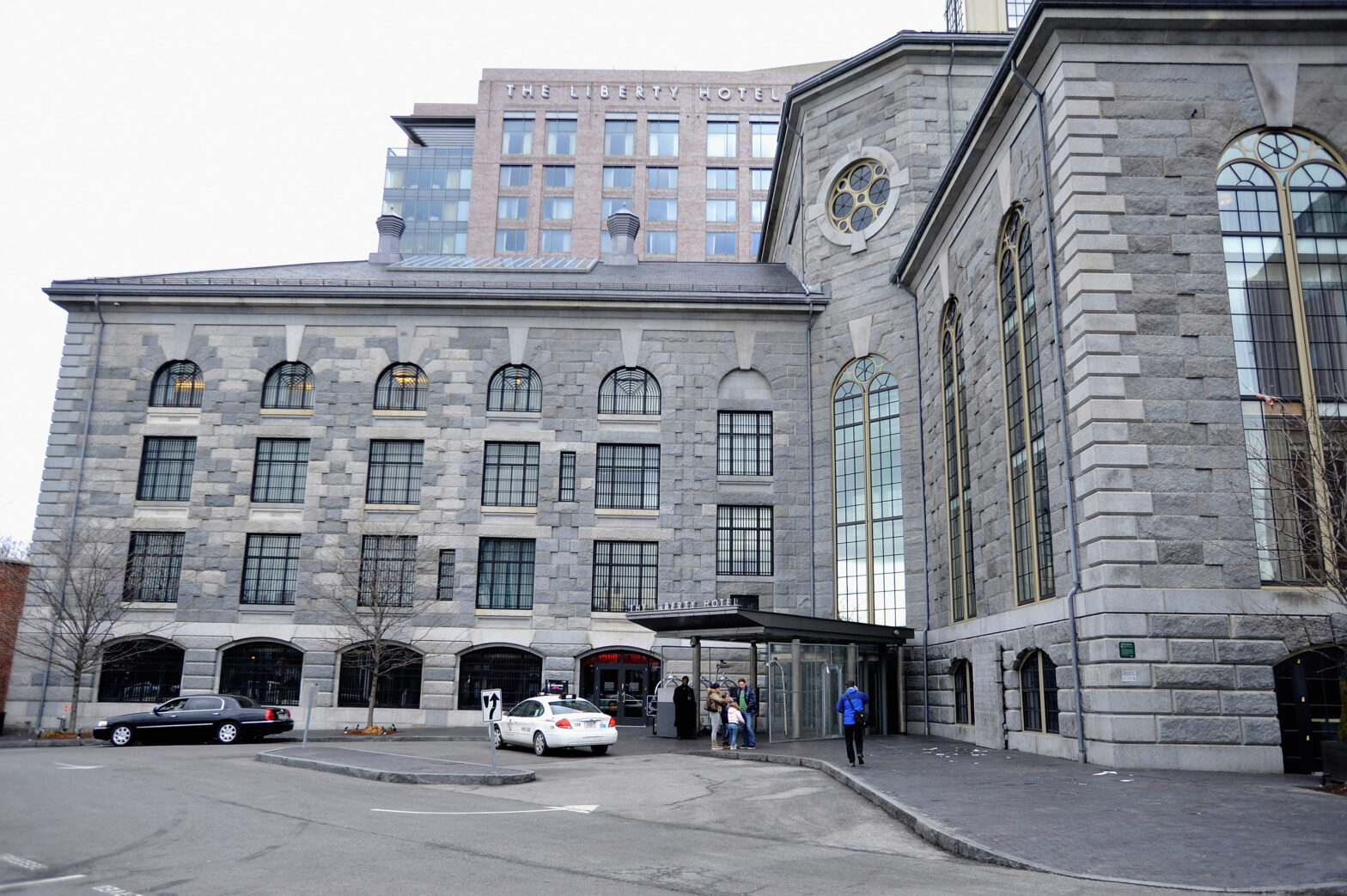
The Liberty Hotel has disguised few traces of the old Charles Street Jail. Guests entering the property still encounter the 90-foot central atrium, historic catwalks, wrought-iron details, and preserved jail cells within the 1851 building, which operated as a jail until 1990. During its conversion, developers also constructed a 16-story guest-room addition beside the historic structure, helping turn the complex into a 298-room hotel.
The former exercise yard now functions as a landscaped courtyard, while CLINK., one of the hotel’s restaurants, incorporates original jail cells into its design. The Boston Preservation Alliance recognized the conversion with a preservation award in 2008. Gary Johnson, a principal at architecture firm CambridgeSeven, said, “We transformed the space from a 19th-century jail to a 21st century hotel.” Today, the restored jail building contains the reception lobby, restaurants, and ballrooms, keeping the original architecture at the center of the guest experience.
Jail Hill Inn, Galena, Illinois
Graffiti carved by former prisoners into original windowsills survived the conversion of the Jo Daviess County Jail into Jail Hill Inn. Completed in 1878, the four-story brick-and-limestone building served as the county jail until 1977. Galena native Matthew Carroll acquired the property in 2015 and converted it into a six-suite inn, welcoming the first guest that December.
Five suites measure 800 square feet, while Suite 301 measures 700 square feet. Original wood beams, vaulted ceilings, sections of concrete flooring, and historic windows remain throughout the building. Suite 302 occupies space where six jail cells once stood, and part of the original cement floor now serves as its fireplace hearth. Landmarks Illinois gave Jail Hill Inn its 2016 Adaptive Use Award for the restoration.
Jailhouse Inn, Newport, Rhode Island
The building now occupied by Jailhouse Inn entered service as Newport’s city jail in 1772, replacing an earlier jail on the same site. It was enlarged in 1800 and renovated again in 1888 before eventually becoming headquarters for the Newport Police Department. Police remained in the building until 1986, when the department moved to a new facility and the old jail was converted into an inn.
Another renovation followed in 2005. The interior has since been reconfigured into 23 hotel-style guest rooms, each with a private bathroom, air conditioning, a mini-refrigerator, and other contemporary amenities. The property sits near Washington Square and Newport Harbor, putting guests within walking distance of restaurants, historic attractions, shops, and the downtown waterfront while staying in a building tied to more than two centuries of the city’s civic history.
Inn At The Old Jail, New Orleans, Louisiana
A Queen Anne Victorian building in Tremé houses one of New Orleans’ more unusual adaptive-reuse projects. The Inn at the Old Jail was completed in 1902 as a New Orleans Police Department jail and patrol station. It later served as a library and community center before falling into disrepair following Hurricane Katrina. Raul and Liz Canache acquired the property in 2013 and spent three and a half years restoring the building.
The project reused salvaged materials and reconstructed architectural features throughout the former lockup, which now operates as a nine-room guesthouse. The Louisiana Landmarks Society included the property among its 2018 Awards for Excellence in historic preservation, listing the Canaches alongside the architects and contractor responsible for the project. High ceilings, restored architectural details, and shared spaces now occupy a building once designed for short-term detention.
Jailer’s Inn, Bardstown, Kentucky
Exactly 190 years separate the first documented use of the Old Nelson County Jail property for prisoners in 1797 and its closure in 1987. The complex that now houses Jailer’s Inn includes a limestone front building constructed in 1819 and a rear jail added in 1874 behind a stone wall. According to Kentucky Tourism, it was Kentucky’s oldest operating jail complex when it closed.
Most of the property now functions as a traditional bed-and-breakfast, with private bathrooms and updated accommodations. One bookable Jail Cell room preserves a more direct link to the building’s former use, retaining a solid steel door, two original bunk beds, and an original shower alongside a modern full-size bed and private bathroom. Guests can also tour the historic jail during their stay. The inn sits in downtown Bardstown, close to restaurants, shops, and several stops associated with Kentucky’s bourbon industry.
The Cell Block, Clifton, Texas
At the opposite end of the scale from The Liberty Hotel, The Cell Block in downtown Clifton contains just one guest suite. The small concrete jail dates to the 1930s and originally contained two cells. Its compact footprint remains easy to recognize even after its conversion into private accommodations for two adults. The original jail bars remain in place, while the former lockup now contains a queen-size bed, full bathroom, gas fire pit, and rooftop deck.
SAH Archipedia, a project of the Society of Architectural Historians and University of Virginia Press, documents the conversion and the retention of the jail bars. The rooftop area also functions as a private outdoor space for guests. Here, the transformation works on a much smaller scale than Boston’s former Charles Street Jail. Still, the basic approach is similar: the architecture remains readable while the building serves an entirely different purpose.
See the full story on the original site
