


Close Menu
Savannah HeraldSavannah Herald
    • Home
    • News
      • Local
      • State
      • National
      • World
      • HBCUs
    • Events
    • Directories
    • Weather
    • Traffic
    • Jobs
    • Sports
    • Politics
    • Lifestyle
      • Faith
      • Senior Living
      • Health
      • Travel
      • Beauty
      • Fashion
      • Food
      • Art & Literature
    • Business
      • Real Estate
      • Entertainment
      • Investing
      • Education
    • Guides
      • Summer Camp Guide
      • Juneteenth Guide
      • Black History Savannah
      • MLK Guide Savannah
    We're Social
    • Twitter
    • Facebook
    • YouTube

    Subscribe to Updates

    Get the latest creative news from FooBar about art, design and business.

    Trending
    • Black Music Month: Singing with ‘Soul’ to Heal America, Ray Charles Led the Nation Forward
    • Charlie Wilson Reveals Multiple Strokes Nearly Ended His Career: “I Had to Learn How to Walk Again”
    • Falcons give Kyle Pitts 3-year contract extension
    • Atlanta ready to handle diseases during crowded World Cup season
    • Indiana weighs ban on NCAA college prop bets
    • Screens are Leaving Schools Fast, Though Some Students with Disabilities Rely on Them
    • Social Circle council approves $9 million general fund budget
    • Black Travel Influencer Group Cruise Guide
    Facebook X (Twitter) Instagram YouTube
    Login
    Savannah HeraldSavannah Herald
    Savannah HeraldSavannah Herald
    Home » Art Brut and American Folklore in Nellie Mae Rowe’s Work
    Art & Literature

    Art Brut and American Folklore in Nellie Mae Rowe’s Work

    Savannah HeraldBy Savannah HeraldMay 12, 20265 Mins Read
    Facebook Twitter Pinterest LinkedIn WhatsApp Reddit Tumblr Email
    Art Brut and American Folklore in Nellie Mae Rowe’s Work
    Share
    Facebook Twitter LinkedIn Pinterest Email

    Black Arts & Culture Feature:

    Key takeaways
    • Early life: Nellie Mae Rowe grew up in a farming family, learned crafts from parents, limited schooling and domestic work shaped resourcefulness.
    • Transformed home and yard into an immersive installation called Playhouse, reusing humble materials to blur boundaries between art and daily life.
    • Nellie Mae Rowe made drawings, sculptures, gum dolls, and altered photos, embedding faith including African Methodist traditions and folklore; later nationally recognized.

    Some artists are meant to prove the importance of a vision, others the importance of never giving up on it. Nellie Mae Rowe belongs to both categories. A late bloomer and self-taught artist, Rowe turned to art after the death of her second husband. Without formal training but with a fully formed visual instinct, her expansive universe and her vision resonated with the public, consecrating her as a fundamental figure in contemporary American art.

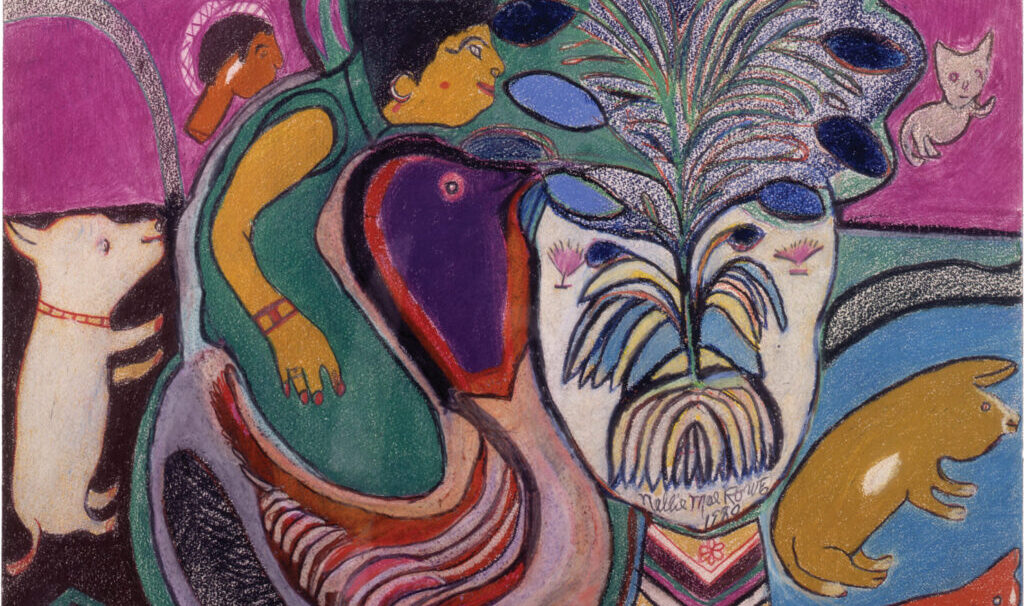
    Her works, distinctive and yet difficult to categorize, were particularly renowned for incorporating sculptures, collage, altered photographs. They are considered an early form of installation art, and span themes and techniques that are innovative but, at the same time, rooted in tradition. She turned everyday materials into a universe about imagination, spirituality, and memory. Situated between the individual impulse of Art Brut and the collective memory embedded in African American folklore, her work is so unique that it resists a single definition and positions her as a radical figure in art history.

    From Farming to Art Making

    Rowe grew up as one of 10 children in a farming family. Her early life was marked by financial hardship and physical labor in the fields, and she left school after only a few years of formal education. Her father, a formerly enslaved man, worked on a farm while engaging in crafts like basket weaving and blacksmithing, while her mother was skilled in sewing and quilting. From them, Rowe absorbed early lessons in making objects by hand and transforming simple materials into something meaningful.

    Even as a child, she showed a strong inclination toward drawing and handicrafts. Yet her creative expression had to remain secondary to work as she struggled for daily sustenance. At 16, Rowe left home in order to escape exhausting farm labor. She married young and spent much of her early adult life moving between rural communities near Atlanta.

    After the death of her first husband and later her second, she continued to work as a domestic worker, a role that defined much of her life under the racial and social structures of the 20th-century American South. But those years of restriction and repetition also somewhat formed the emotional and experiential foundation for her later artistic language.

    The Playhouse: A Lived-In Installation, A Place for Experimentation

    A decisive shift in Rowe’s life came after the death of her second husband. At the time, she began transforming her home and yard into what she called her Playhouse, a space where art, living, and imagination came together.
    In doing so, her house in the rural community of Vinings in northwest Atlanta, was surrounded by stuffed animals and dolls, among an assemblage of everyday objects.

    Echoing, in a radically different cultural context, the immersive experience of Kurt Schwitters’ Merzbau, the Playhouse became a lived-in installation, a manifesto, and an open space for both the artist and her visitors to play with. In the Playhouse, nothing was too humble to be reused. Chewing gum became sculptural material, scraps of cloth turned into figures, and discarded household items were reimagined as part of a larger visual world. This environment was more than decorative.

    The Playhouse was total, creative, and personal; a universe built through accumulation, intuition, and play. Visitors often described it as overwhelming and extraordinary, while neighbors were at times suspicious or openly hostile. But it became a place where the boundaries between inside and outside, between art and life, disappeared.

    Creating a World

    Alongside the Playhouse, Rowe expanded her practice to include other media. Throughout the years, she produced sculptures, drawings, paintings, and photographs, all of which reveal a highly original visual language. Her drawings and paintings often combine scenes from everyday life with dreamlike or symbolic elements. Figures float, merge, and hybridize, dissolving distinctions between human, animal, and symbolic forms and creating whimsical compositions where realism gives way to imagination.

    Spirituality also plays a central role in Rowe’s work. A devoted Christian connected to the African Methodist tradition, Rowe often included handwritten phrases, prayers, and religious references directly into her work. These inscriptions reflect a belief that creativity and faith are nothing but deeply connected. They corroborated Rowe’s view that artistic ability a gift tied to divine purpose. At the same time, her imagery resonates with broader African American spiritual traditions, including references to spirits and folklore signifying broader cultural histories.

    Beyond drawing, Rowe created a wide range of three-dimensional works. Her dolls, often made from stockings or fabric scraps, were carefully assembled and dressed with improvised clothing, yarn hair, and small decorative details. Some sculptures were made from chewing gum, shaped, hardened, and then painted to repurpose the most ordinary material into expressive figures. She also worked with photography, altering black-and-white images by hand. Through drawing, coloring, and framing, she infused personal visual narratives into conventional portraits, reclaiming representation through direct intervention.

    Late Recognition and Legacy

    For much of her life, Rowe created without the intention to gain institutional recognition. This changed in the 1970s, when artists, collectors, and curators began to discover her work. Her home began to attract attention, and exhibitions soon followed in Atlanta and New York. In the final years of her life, Rowe experienced growing visibility in the art world, with her work shown nationally in major exhibitions on American folk and self-taught art. She kept on creating before she died in 1982.

    After her passing, her house was demolished, and a hotel later took over the site. Today, only a plaque marks the place where her Playhouse once stood. Despite this physical disappearance, Rowe’s artistic legacy has only expanded. Her work is now recognized not simply as folk art, but as a powerful and complex contribution to 20th-century art history, one that redefines creativity as survival, imagination, and freedom.

    Read more from the original source


    Related Posts

    • The 9 Worst Things to Say to Someone Getting Divorced
    • Decriminalising abortion: how could the House of Lords amend the legislation? | Abortion
    • Marshall Faulk has a familiar connection with new Southern football coaches
    • A breast cancer survivor knits prostheses in Kenya as silicone ones are costly
    • How to Get a Braider to Come to You (And What It Costs in LA)
    • Special: New Claude Design Causes Safeguards at Anthropic
    • My Nordstrom Anniversary Sale Wish List: Shop The Best Deals
    • German watchdog blocks Tönnies takeover of Vion meat assets
    20th century African Art African Textiles Afrofuturism Art and Identity Arts and Culture News Black Art History Black Artists Black Authors Black Creators Black Literature Black Sci-Fi and Fantasy Black Women in Art Black-Owned Bookstores Book Reviews Contemporary Black Art creative expression Cultural Commentary Fashion and Expression folk art Installation Art Nellie Mae Rowe Poetry and Prose Street Art and Design USA
    Share. Facebook Twitter Pinterest LinkedIn WhatsApp Reddit Tumblr Email
    Savannah Herald
    • Website

    Related Posts

    Entertainment June 28, 2026

    Black Music Month: Singing with ‘Soul’ to Heal America, Ray Charles Led the Nation Forward

    Entertainment June 27, 2026

    Charlie Wilson Reveals Multiple Strokes Nearly Ended His Career: “I Had to Learn How to Walk Again”

    Entertainment June 27, 2026

    The ”JAŸ-Z30” Exhibits Are a Time Capsule in Hip-Hop History: Photos

    Entertainment June 27, 2026

    Black Women Leaders Are Not Burnt Out, We Are Being Extracted From

    Entertainment June 27, 2026

    Daryl Hall Shares Positive Health Update After Successful Kidney Transplant

    Entertainment June 26, 2026

    Ann Blyth, film star of 1940s-50s famed for ‘Mildred Pierce’, dead at 98

    Comments are closed.

    Don't Miss
    Senior Living May 14, 2026By Savannah Herald05 Mins Read

    When to Switch Medigap Plans: What You Need to Know

    May 14, 2026

    Aging Well: News & Insights for Seniors and Caregivers A Medicare Supplement, or Medigap, plan…

    Looseness of the bowels and stomachaches tormented Roman soldiers based at Hadrian’s Wall surface, exploration of tiny bloodsuckers locates

    December 18, 2025

    How the Dobbs Decision Has Shaken the Health Care Landscape

    May 23, 2026

    3 times chosen authorities did the ideal point.

    November 16, 2025

    How Babies’ Brains Develop – BlackPressUSA

    May 23, 2026
    Archives
    • June 2026
    • May 2026
    • April 2026
    • March 2026
    • February 2026
    • January 2026
    • December 2025
    • November 2025
    • October 2025
    • September 2025
    • August 2025
    • July 2025
    • June 2025
    • May 2025
    • April 2025
    • March 2025
    • February 2025
    Categories
    • Art & Literature
    • Beauty
    • Black History
    • Business
    • Climate
    • Culture
    • Education
    • Employment
    • Entertainment
    • Faith
    • Fashion
    • Food
    • Gaming
    • Georgia Politics
    • HBCUs
    • Health
    • Health Inspections
    • Investing
    • Lifestyle
    • Local
    • Lowcountry News
    • National
    • National Opinion
    • News
    • Politics
    • Real Estate
    • Senior Living
    • Sports
    • State
    • Tech
    • Traffic
    • Transportation
    • Travel
    • World
    Savannah Herald Newsletter

    Subscribe to Updates

    A round up interesting pic’s, post and articles in the C-Port and around the world.

    About Us
    About Us

    The Savannah Herald is your trusted source for the pulse of Coastal Georgia and the Low County of South Carolina. We're committed to delivering timely news that resonates with the African American community.

    From local politics to business developments, we're here to keep you informed and engaged. Our mission is to amplify the voices and stories that matter, shining a light on our collective experiences and achievements.
    We cover:
    🏛️ Politics
    💼 Business
    🎭 Entertainment
    🏀 Sports
    🩺 Health
    💻 Technology
    Savannah Herald: Savannah's Black Voice 💪🏾

    Our Picks

    Savannah State University Receives $100,000 Gift to Support Dolphin Research – Savannah Herald

    November 6, 2025

    Mamdani will bankrupt the city

    August 28, 2025

    Exactly how it Varies from Hyper-V? Techwrix

    May 8, 2026

    Dealers Slash Prices Fight Back with HUGE Service Offers! #shorts – BlackPressUSA

    April 6, 2026

    Community Baby Shower Scheduled for April 18 in Camden County

    April 15, 2026
    Categories
    • Art & Literature
    • Beauty
    • Black History
    • Business
    • Climate
    • Culture
    • Education
    • Employment
    • Entertainment
    • Faith
    • Fashion
    • Food
    • Gaming
    • Georgia Politics
    • HBCUs
    • Health
    • Health Inspections
    • Investing
    • Lifestyle
    • Local
    • Lowcountry News
    • National
    • National Opinion
    • News
    • Politics
    • Real Estate
    • Senior Living
    • Sports
    • State
    • Tech
    • Traffic
    • Transportation
    • Travel
    • World
    Copyright © 2002-2026 Savannahherald.com All Rights Reserved. A Veteran-Owned Business

    Type above and press Enter to search. Press Esc to cancel.

    Manage Consent
    To provide the best experiences, we use technologies like cookies to store and/or access device information. Consenting to these technologies will allow us to process data such as browsing behavior or unique IDs on this site. Not consenting or withdrawing consent, may adversely affect certain features and functions.
    Functional Always active
    The technical storage or access is strictly necessary for the legitimate purpose of enabling the use of a specific service explicitly requested by the subscriber or user, or for the sole purpose of carrying out the transmission of a communication over an electronic communications network.
    Preferences
    The technical storage or access is necessary for the legitimate purpose of storing preferences that are not requested by the subscriber or user.
    Statistics
    The technical storage or access that is used exclusively for statistical purposes. The technical storage or access that is used exclusively for anonymous statistical purposes. Without a subpoena, voluntary compliance on the part of your Internet Service Provider, or additional records from a third party, information stored or retrieved for this purpose alone cannot usually be used to identify you.
    Marketing
    The technical storage or access is required to create user profiles to send advertising, or to track the user on a website or across several websites for similar marketing purposes.
    • Manage options
    • Manage services
    • Manage {vendor_count} vendors
    • Read more about these purposes
    View preferences
    • {title}
    • {title}
    • {title}
    Ad Blocker Enabled!
    Ad Blocker Enabled!
    Our website is made possible by displaying online advertisements to our visitors. Please support us by disabling your Ad Blocker.

    Sign In or Register

    Welcome Back!

    Login below or Register Now.

    Lost password?

    Register Now!

    Already registered? Login.

    A password will be e-mailed to you.