




Faith & Reflection: Voices from the Black Church and Beyond
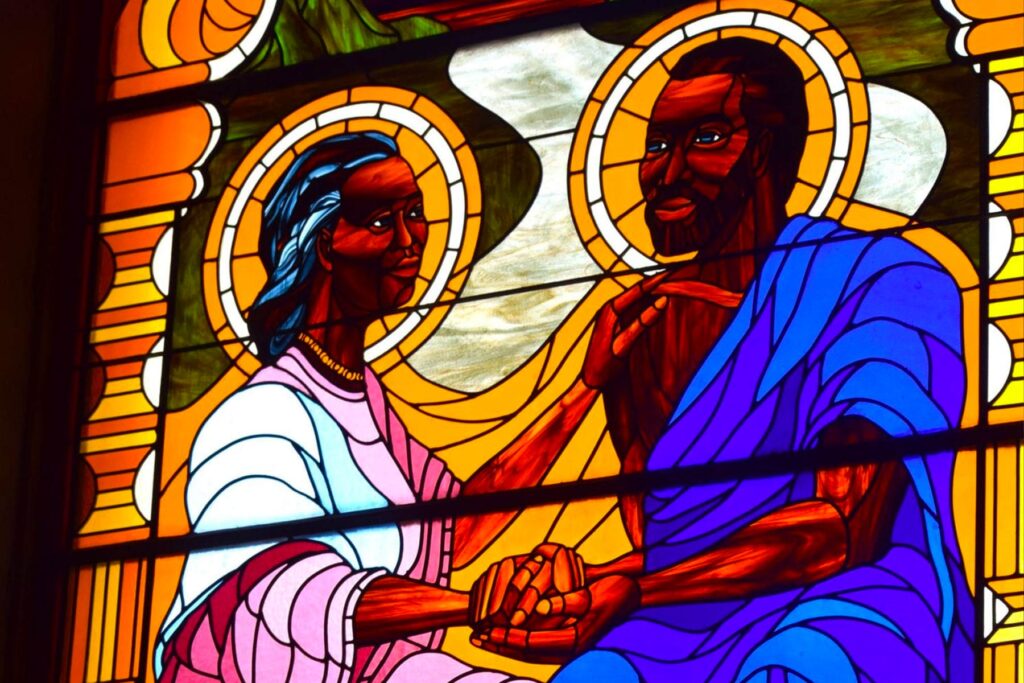
- Two distinct liturgical styles, 9:30 a.m. Gospel Liturgy Style and 11:30 a.m. Spirited Liturgy Style, shape parish identity.
- The Gospel Liturgy Style incorporates gospel choir robes, emotive songs, and a weekly Baptismal Rite replacing the Penitential Rite.
- Parish uses sifting: replacing hymns with Lead Me, Guide Me selections and expressive processions to reflect Black traditions.
- Msgr. Jones uses call and response homilies to connect scripture, parish history, and campaigns, motivating communal responsibility.
- Both Masses emphasize Jesus as Savior rather than Creator, reflecting Black Protestant influence and shaping a distinct Black Catholic culture.
(Image source: The Institute for Catholic Formation)
The following excerpt comes from the book Black and Catholic: Racism, Religion, and Identity (University of Notre Dame Press, 2025) by Tia Noelle Pratt. The book explores the experiences of Black Catholics and how the U.S. Catholic Church perpetuates systemic racism.
This excerpt comes from the book’s third chapter, “Finding a Place at the Table: Liturgy as Identity Work and an Act of Resistance.”
***
St. John Vianney sits in the Central Harlem section of Manhattan. The parish is well known throughout the archdiocese, most notably for Msgr. Jones, the charismatic pastor during the time of my data collection in 2005 and 2006. Because of the parish’s notoriety, it draws parishioners not only from within parish boundaries but also from outside of New York City, including northern New Jersey. During my visits to St. John Vianney, I observed clear distinctions between the styles of liturgy at the 9:30 a.m. and 11:30 a.m. Masses.
 The general tone of St. John Vianney’s 9:30 a.m. Mass foregoes the notion that exuberant expression is either incompatible with Catholicism or must be limited to the Black Church. The 9:30 a.m. Mass is a Gospel Liturgy Style, its tone set primarily by the music and the homily. The parish’s gospel choir provides the music. The members of the gospel choir wear robes that are typically found in Protestant congregations. They are floor length red and white robes, with large bell-style sleeves. The choir’s songs do not come from the Lead Me, Guide Me hymnal; instead, the selections invoke an expressiveness and level of emotion that is not readily identified with Catholicism. Choir members sway to the music, and the parishioners clap and join them in song. A number of parishioners stand during these selections. The use of choir robes commonly found in Protestant churches and gospel songs exemplify sifting: more traditional songs and choir attire are sifted out to make room to sift in elements that are more in line with worship seen in churches in the Black Protestant traditions. By using emotive music in the liturgy, parishioners sift out more traditional songs to make room for those that are more culturally relevant. This is a distinct means of parish culture production. Through music ministry, the choir engages the parish community and helps to create a specific parish identity.
Some of the rituals performed during the 9:30 a.m. Mass would be recognizable to Catholics accustomed to attending another style Mass. For example, the Baptismal Rite begins with a renewal of baptismal vows by those present and concludes with the officiating priest gently sprinkling holy water on the parishioners to remind those present of their baptism. To those familiar with the Roman Catholic Mass, a Baptismal Rite would not be viewed as foreign or in any way unusual. What makes it unusual at St. John Vianney is having it every Sunday. The parish replaces the Penitential Rite with a Baptismal Rite. During the Penitential Rite, parishioners communally acknowledge their sins and sinfulness in preparation for receiving the Body of Christ in the form of Holy Communion. Generally, the Penitential Rite is performed by having those present recite one of two commonly used prayers. On special occasions, such as Easter Sunday, the Penitential Rite is replaced by a Baptismal Rite. But at St. John Vianney, it is replaced weekly. The 9:30 a.m. Mass reimagines an unabashedly Catholic ritual. The parish makes this ritual its own, thus distinguishing St. John Vianney from other parishes.
Because this ritual lies within the structure of Mass, the parish community does not run the risk of incurring episcopal admonition by performing it every Sunday. The ritual would be easily recognizable to any Roman Catholic; however, its conventional use is sifted out to sift in a use that fits the parish’s needs. This Mass clearly borrows from the Black Church’s cultural playbook. The choir robes, gospel songs, and ritual adaptation are symbols of the African American religious experience that are used to incorporate Black culture into the Roman Catholic Mass. By doing so, the parish produces a specific Black Catholic cultural identity.
The celebration of the 9:30 a.m. Mass at St. John Vianney lasts almost two hours. The extra time, compared to the one hour more typical of Masses in the Traditionalist Liturgy Style, can be accounted for by a number of components. For example, in addition to the aforementioned Baptismal Rite, the homily can last anywhere from twenty to thirty minutes. The recitation of the Nicene Creed, also known as the Profession of Faith, is sung. This lengthens Mass considerably. Furthermore, parishioners recite the Hail Mary after the General Intercessions. While the Hail Mary is a well-known prayer to Roman Catholics, it is not usually recited during Mass. This is another distinctly Catholic practice that is reimagined by St. John Vianney’s parishioners as a means of distinguishing this Mass from a more traditional one.
Another component that can account for the length of the 9:30 a.m. Mass is the Offertory. During the Offertory, the gifts of bread and wine that will be used for Holy Communion are presented to the priest. The Offertory also includes parishioners making monetary offerings to support the parish. In most Catholic parishes in the United States, ushers collect the money donated by parishioners. However, at St. John Vianney, each person present walks up the center aisle to leave his or her envelope in a common basket.
None of these practices are contradictory to practices commonly found at other Roman Catholic Masses. While the recitation of the Hail Mary may give some staunch traditionalists pause, reciting it during Mass is not tantamount to a disavowal of Roman Catholic doctrine. In each of these instances, the parish is sifting out standard uses of practices to have room to sift in reimagined practices that both distinguish this Mass and produce unique cultural elements.
Another illustration of sifting and cultural production in the Gospel Liturgy Style occurs during the homily. During St. John Vianney’s 9:30 a.m. Mass, the Gospel reading and homily, whether given by Msgr. Jones or another priest, typically uses techniques that are closely identified with the Black Church. The priest proclaims the Gospel from the center aisle and remains there to offer the homily. Msgr. Jones uses the “call and response” technique that is generally associated with Black Protestant congregations.
During one of my visits to St. John Vianney’s 9:30 a.m. Mass, Msgr. Jones used the call and response technique effectively as a means of connecting with parishioners and connecting scripture readings to parishioners’ lived experience. He used his homily to ask parishioners “Who does God’s will?” After asking those in attendance if the tax collectors and prostitutes mentioned in the Gospel reading were doing God’s will, he heard a resounding “NO!” from parishioners. He connected this point to his parishioners’ lived experience by emphasizing that doing the will of God involves not blaming others for one’s own failings, including issues related to work, family life, and other personal relationships. Msgr. Jones then deftly managed to connect this message to the parish’s mandatory capital campaign held in conjunction with the Archdiocese of New York’s bicentennial. Msgr. Jones connected these two seemingly unrelated topics by articulating the parish’s needs—such as an elevator to accommodate disabled and elderly parishioners—then emphasizing parishioners’ duty to contribute to the campaign so that the parish’s needs could be met. The implication was that otherwise, members of the parish were not doing God’s will and would have no one else to blame for their failings.
Through his homilies, Msgr. Jones instills in parishioners an appreciation for Black history and Catholic history alike. This was especially evident during a Mass celebrating the feast of the parish’s patron. Msgr. Jones went to great lengths to provide those in attendance with an understanding of St. John Vianney’s life and how he used his ministry to serve God. The pastor described how St. John Vianney used his personal wealth to minister to the community and did not abandon those he served when a plague began to envelop the community. In doing this, Msgr. Jones carves space for his parishioners within larger Catholic history and makes the life of a sixteenth-century Italian saint resonate for twenty-first century African Americans in Harlem. Establishing a connection between the parishioners and the parish’s patron saint generates a concrete identity for members of the parish. Parishioners can see themselves in relation to a long-dead saint and, thus, can develop a broader sense of what it means to be a Roman Catholic.
These techniques associated with the homily demonstrate combining elements that identified Catholicism with elements firmly ensconced in the Black Church. All examples above show how elements from both the African American and U.S. Catholic traditions are sifted into liturgy to create a worship experience that meets the needs of parishioners and creates a uniquely Black Catholic culture.
The 11:30 a.m. Mass in the Spirited Liturgy Style contrasts with the 9:30 a.m. Gospel Liturgy Style in several ways. The most notable difference is in the music. The music at the later Mass is provided by the men’s chorus instead of the gospel choir, which consists entirely of women. During my visits, the 11:30 a.m. chorus had approximately eight members while the 9:30 a.m. choir had nearly twenty participants. The songs selected for the 11:30 a.m. liturgy came from the Lead Me, Guide Me hymnal and consisted of both hymns, such as “Let There Be Peace on Earth,” and more African American-oriented songs, such as “We’ve Come This Far By Faith.” The style of the men’s chorus is much more reserved than that of the gospel choir. They do not wear robes, sway with the music, or clap in the same way as the gospel choir. This could be because of the chorus’ smaller number; however, it is more likely a result of the muted tenor and flavor of the 11:30 a.m. liturgy.
The duration of the 11:30 a.m. Mass is noticeably shorter than the 9:30 a.m. liturgy. The service does not regularly replace the more traditional Penitential Rite with the longer Baptismal Rite. Music selections and homily length are also among the reasons that account for Mass lasting approximately thirty minutes less than the 9:30 a.m. Mass. There is some measure of sifting, as the music sifts out an abundance of traditional Catholic hymns to make room for more African American-oriented songs from the Lead Me, Guide Me hymnal. The muted tone of the 11:30 a.m. Spirited Mass is just as indicative of the production of a unique Black Catholic cultural identity as the Gospel Mass. Both styles reflect the depth and diversity of the community that produces them.
The only exception to the general tone of the 11:30 a.m. Mass that I observed was during an 11:30 a.m. Mass celebrating the feast of the parish’s patron saint. On this occasion, the 9:30 a.m. gospel choir stayed to lead the processional for the 11:30 a.m. Mass. The processional included multiple verses of a hymn that was not found in any hymnal present in the church. The parishioners stood while clapping and singing along with the gospel choir, who stood along the altar railing instead of at their usual place on the altar. The men’s chorus occupied that area since the 11:30 a.m. Mass is their usual venue. The processional turned toward the theatrical, as altar servers carrying crosses began dancing up the main aisle. The dance was in a style that is best described as a combination of hopping and marching in time to the music that is often found in the African American tradition. Initially, the altar servers made their way approximately half-way up the aisle then returned to the back of the church. The Eucharistic Ministers, then lectors, and finally the priests followed in a procession—a march in time to the music and less of a dance—to the altar. The entire procession lasted twenty minutes.
This display set a palpable tone for the occasion that celebrated the parish, its members, and its patron saint. Having attended Roman Catholic Masses regularly for my entire life, I had never seen the feast of a parish’s patron—or any other feast for that matter—celebrated with such fervor and gusto. It invoked the character of music and frenzy that W. E. B. Du Bois offered more than one hundred years ago when describing the Black worship experience.18 Of the music, Du Bois said, “The Music of Negro religion . . . still remains the most original and beautiful expression of human life and ongoing yet born on American soil.”19 In describing the Frenzy, Du Bois said, “It varied in expression from the silent rapt countenance or the low murmur and moan to the mad abandon of physical fervor.” The difference between a standard Sunday and this special occasion shows how expression can move along the continuum Du Bois described.
Unequivocally, the 11:30 a.m. Mass celebration included a sifting in of practices borrowed from the Black Church, such as the dancing and long processional to begin the liturgy, and a sifting out of a more straightforward and, frankly, bland opening to the liturgy. Once Mass began, there was no ambiguity regarding what type of service was taking place. During the homily, Msgr. Jones spoke at length about St. John Vianney’s personal narrative and how his life experiences influenced his actions. In doing this, Msgr. Jones called the parishioners to look to the parish’s patron for inspiration on how to live their lives, to help others, and not abandon those in need during difficult times.
At both the 9:30 a.m. and 11:30 a.m. Masses at St. John Vianney, the music and the homily emphasize Jesus as “Lord and Savior.” Parishioners are compelled to follow the high example set by Jesus’ life on earth and to ask for Jesus’ help in facing the problems and concerns of everyday life. There is much less emphasis placed on God as Creator and the Holy Spirit as Sanctifier. This emphasis on Jesus as Savior is more commonly found in the Black Protestant Church than in the Roman Catholic Church.20 There are certain characteristics of Jesus—his humanity, poverty, and earthly suffering—that could make this aspect (or person) of the Trinity more tangible and palatable to an African American audience. This worldview is an example of how liturgy can be adapted to serve the needs of a constituency by sifting out one commonly used image, God the Creator, to create room to sift in another, Jesus the Savior.
Tia Noelle Pratt is assistant vice president and director of mission engagement and strategic initiatives in the Office for Mission and Ministry and assistant professor of sociology at Villanova University.
***
Interested in more on this topic? Check out episode 62 of The Revealer podcast: “Black Catholics and Racism in the U.S. Catholic Church.”
Read the full article on the original source
