



Close Menu
Savannah HeraldSavannah Herald
    • Home
    • News
      • Local
      • State
      • National
      • World
      • HBCUs
    • Events
    • Directories
    • Weather
    • Traffic
    • Jobs
    • Sports
    • Politics
    • Lifestyle
      • Faith
      • Senior Living
      • Health
      • Travel
      • Beauty
      • Fashion
      • Food
      • Art & Literature
    • Business
      • Real Estate
      • Entertainment
      • Investing
      • Education
    • Guides
      • Summer Camp Guide
      • Juneteenth Guide
      • Black History Savannah
      • MLK Guide Savannah
    We're Social
    • Twitter
    • Facebook
    • YouTube

    Subscribe to Updates

    Get the latest creative news from FooBar about art, design and business.

    Trending
    • Jay-Z Smashes Yankee Stadium Record For Most Concert Tickets SoldIn His 2nd Night Of Residency
    • Savannah Steel coach to take leave of absence
    • My Search for a Psychiatric Bed in an Overburdened Health System
    • Arizona bans insider prediction market trading by employees
    • HBCU News – R&B legend Bobby Brown to perform at HBCU athletics fundraising gala
    • NABJ Convention in Atlanta: Chapter Leadership Updates
    • Mighty Sparrow, King of Calypso, Turns 91 – NY Carib News
    • Typhoon Bavi: China evacuates nearly two million people as powerful typhoon makes landfall
    Facebook X (Twitter) Instagram YouTube
    Login
    Savannah HeraldSavannah Herald
    Savannah HeraldSavannah Herald
    Home » My Search for a Psychiatric Bed in an Overburdened Health System
    Health

    My Search for a Psychiatric Bed in an Overburdened Health System

    Savannah HeraldBy Savannah HeraldJuly 12, 20268 Mins Read
    Facebook Twitter Pinterest LinkedIn WhatsApp Reddit Tumblr Email
    My Search for a Psychiatric Bed in an Overburdened Health System
    Share
    Facebook Twitter LinkedIn Pinterest Email

    Wellness That Matters: Black Health News & Community Care

    Key takeaways
    • Long-term decline in United States psychiatric beds created a national crisis, severely limiting inpatient mental health access.
    • Federal policy and funding barriers, notably the 16-bed Medicaid cap, constrain capacity; state waivers attempt to expand inpatient care.
    • Shortage forces emergency departments to board patients, shortens stays, raises readmissions, and meets community resistance rooted in stigma.

    If you or someone you know may be experiencing a mental health crisis, contact the 988 Suicide & Crisis Lifeline by dialing or texting “988.”

    Eight days before my 33rd birthday in April, a social worker at a crisis clinic near Denver determined I was an imminent danger to myself. She placed me on an involuntary 72-hour mental health hold.

    What came next wasn’t treatment, but a search for a bed. Clinic staffers called area hospitals with inpatient psychiatric units, asking if they had available beds. They didn’t. So, I was told I had to spend the night at the clinic, which is open 24/7. I settled into a recliner, trying to make myself comfortable as my mind drifted in a blank, disassociated haze. Sleep came in brief bursts.

    Since the 1950s, the United States has seen a dramatic decline in the number of psychiatric beds nationwide due in part to deinstitutionalization and the rise of antipsychotics. But that has created a critical shortage for those needing help. From 2011 to 2023, the number of hospitals with inpatient psychiatric units dropped significantly, according to a 2025 study. Another study from that year found that this country has 28.4 inpatient psychiatric beds per 100,000 people — not even half the 60-bed ratio researchers frequently refer to as the optimal level.

    The shortage has created what the American Psychiatric Association calls a crisis: emergency rooms overwhelmed with people suffering from severe mental health illnesses, inpatient stays prematurely shortened to speed up bed turnover, and acutely ill individuals left without critical care.

    (Oona Zenda/KFF Health News)

    “Where are these people going?” said Zoe Lindenfeld, an assistant health policy professor at Rutgers University, who co-authored those 2025 studies. “For people who don’t receive this care, they don’t just go away. How is it affecting them? Society? Their families?”

    Meanwhile, the White House shut down the part of the national suicide hotline catering to LGBTQ+ youth, President Donald Trump’s 2027 budget proposal calls for cuts to agencies engaged in mental health work, and Health and Human Services Secretary Robert F. Kennedy Jr. recently announced a plan to reduce the “overuse of psychiatric medications.”

    A Fractured System

    I was already intimately familiar with the country’s fractured mental healthcare system before I was involuntarily committed. What I had yet to experience myself, I saw through my wife: waitlists, outpatient programs stretched beyond capacity, and inpatient psychiatric care so scarce that access often depends on surviving a crisis severe enough to justify it.

    She died by suicide after we had separated.

    As the years passed, grief and anxiety pushed me from observer to patient.

    At the crisis clinic, I woke up the following morning disoriented and groggy. In the bathroom — its door deliberately unable to latch, swinging both ways so staffers could enter in case of an emergency — I stood at the sink and watched the faucet run, trying to piece together how I had ended up here.
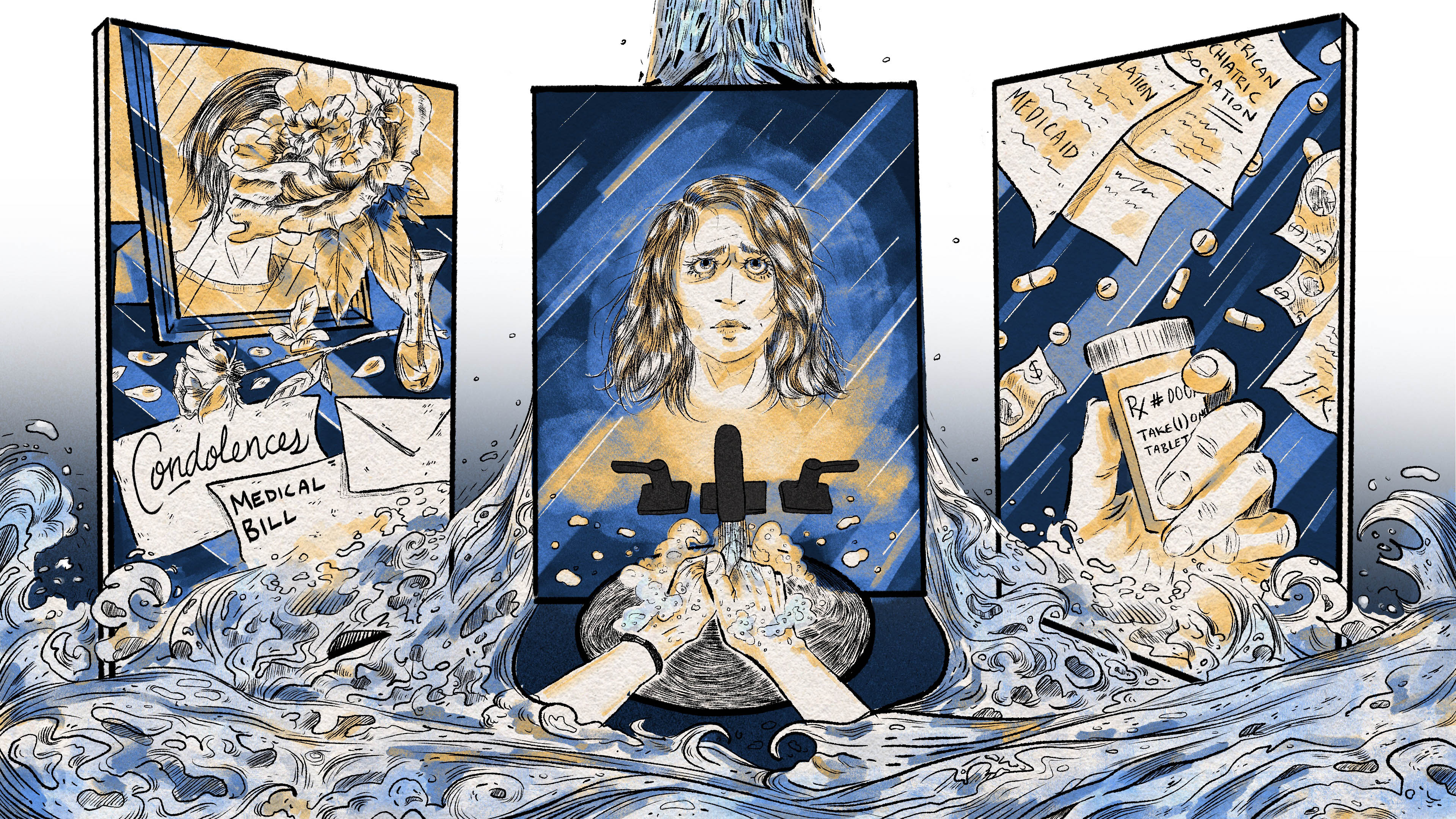
    A hand-drawn pen and ink illustration. Three panels are set up in a triptych style. 1 (left): We see a scene, through a bathroom mirror, from a memorial of the main character's wife. The wife's picture is obscured by a large flower. There's a condolence card and medical bill on the table in front of the picture frame. 2 (center): The main character's face is reflected in a bathroom mirror as she washes her hands in rushing water. 3 (right): Medical bills, legislation, and a hand holding a pill bottle are all visible in a collage. Around the three panels, water gushes down from above and floods the bottom half of the page.
    (Oona Zenda/KFF Health News)

    America’s history of treating mental illness is long and complicated.

    The 19th and 20th centuries saw the removal of people with severe mental disorders from jails and poorhouses — squalid facilities designed to house the poor — to state asylums that promised “moral treatment” (though they ultimately became overcrowded hospitals for the impoverished). From the 1860s to the 1930s, the number of psychiatric hospitals increased dramatically, according to the American Psychiatric Association, and by 1955, the number of psychiatric beds in the U.S. peaked at more than half a million.

    However, owing to the development of antipsychotics, the belief that psychiatric institutions were inhumane, and President John F. Kennedy’s 1963 Community Mental Health Act to free thousands of Americans from a life in institutions, many state hospitals shut down. An estimated 61,000 inpatient psychiatric beds for adults and kids are left in a country where more than 14 million experience severe mental illness each year.

    Two years after JFK’s legislation passed, a new policy prohibited federal Medicaid funds from covering inpatient psychiatric care in facilities with more than 16 beds. The goal was to encourage states to move patients out of large, often substandard psychiatric institutions into community-based care settings.

    Newsletter Icon

    Email Sign-Up

    Subscribe to KFF Health News’ free Morning Briefing.

    The consequences of these changes, however, have been far-ranging. People with severe mental illnesses are often forced to board in emergency departments as they wait for a bed to open. The length of stay in state psychiatric hospitals is shrinking while readmission rates rise, according to research by the Treatment Advocacy Center, a national organization focused on eliminating barriers to the treatment of severe mental illness. And some people with mental illness languish for months, or even years, in jail.

    From 1986 to 2014, as the behavioral health crisis intensified, mental health expenditures in the U.S. rose from $32 billion to $186 billion — though the proportion of that spending allocated to inpatient care fell from 42% to 27%.

    This period also recorded major policy shifts affecting inpatient hospitalization rates, notably the 1999 U.S. Supreme Court decision in Olmstead v. L.C. The ruling shifted care away from psychiatric facilities by mandating states provide home and community-based services to people with developmental and mental disabilities.

    “The road to hell is paved with good intentions,” said Leslie Carpenter, legislative advocacy manager at the Treatment Advocacy Center. “A lot of these bills, including the Community Mental Health Act, were really well intended and ended up with adverse consequences.”

    For me, that next day at the clinic passed both painfully slowly and in a blur. A staff member I hadn’t met before told me they were still reaching out to hospitals across the region. The search for a bed continued.
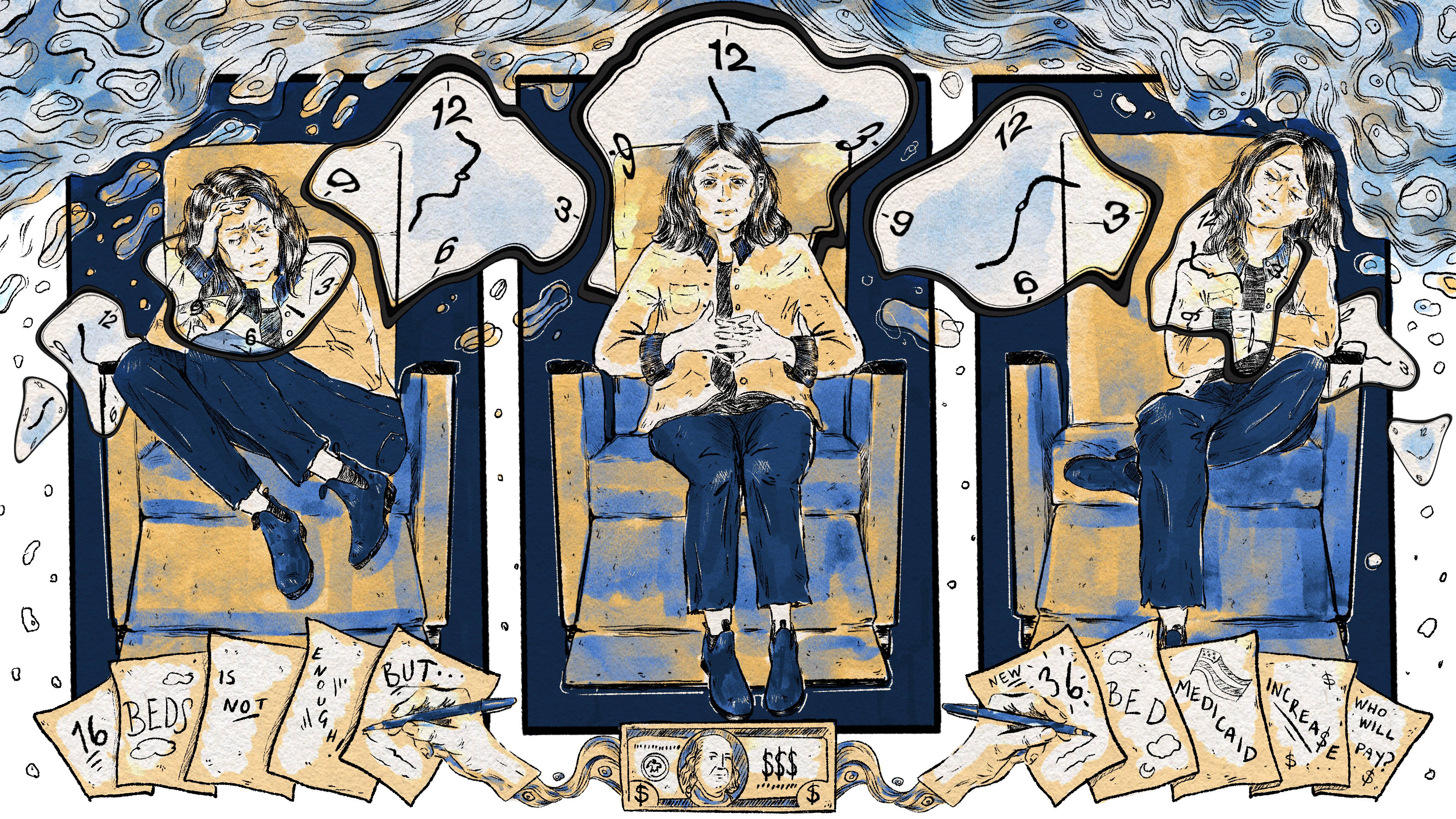
    A hand-drawn pen and ink illustration. Three panels are set up in a triptych style. In each, the main character is trying to figure out a comfortable way to sleep in the medical recliner. Dali-esque melting clocks float around her. Paper legislation frames the bottom of the page.
    (Oona Zenda/KFF Health News)

    ‘No One Wants To Pay for Any of This Care’

    Last year, members of Congress introduced two bills to change the 16-bed Medicaid funding cap at inpatient psychiatric facilities, the Repealing the Institution for Mental Diseases Exclusion Act and the Michelle Alyssa Go Act, which would increase the cap to 36 beds. Both have stalled in the House.

    According to the Congressional Budget Office, a federal agency that analyzes budgetary and economic issues, eliminating the 16-bed limit would increase Medicaid expenditures by $33.5 billion from 2024 to 2033.

    “No one wants to pay for any of this care that people need,” said Colorado state Sen. Judy Amabile, a Democrat who has witnessed limitations to Colorado’s mental healthcare system firsthand because her son has schizoaffective disorder.

    In lieu of federal action, states are stepping up to bridge the gaps.

    Colorado, 15 other states, and Washington, D.C., now operate under waivers allowing Medicaid to fund inpatient facilities with more than 16 beds for mental health treatment, according to KFF data. Seven additional states have waivers pending. One 2025 study found that these waivers may be tied to fewer hospitalizations, emergency department visits, and incarcerations among adults with serious mental illness.

    Yet even local efforts to improve mental healthcare face resistance. In California, Colorado, Iowa, Missouri, Nebraska, and New York, locals have pushed back against proposed psychiatric facilities for minors, claiming such facilities will worsen safety and lower property values. Behavioral health advocates have disputed these claims and argued they are rooted in stigma.

    That psychiatric facility in Colorado was ultimately greenlit. The state has nearly 20 inpatient beds per 100,000 people, ranking 24th nationwide, according to 2022 data across all 50 states plus Washington, D.C., collected by the Treatment Advocacy Center. Wyoming ranked first with 47.3 beds per 100,000 residents, although, as the least populous state, it has only 275 total inpatient beds compared with California’s 5,703. Minnesota ranked last, with only 4.3 inpatient beds per 100,000 residents.

    While increasing the number of inpatient psychiatric beds is vital, mental health advocates are also calling for more community-based supports, such as peer support specialists and clubhouses, where people with serious mental illnesses can learn life skills and find community.
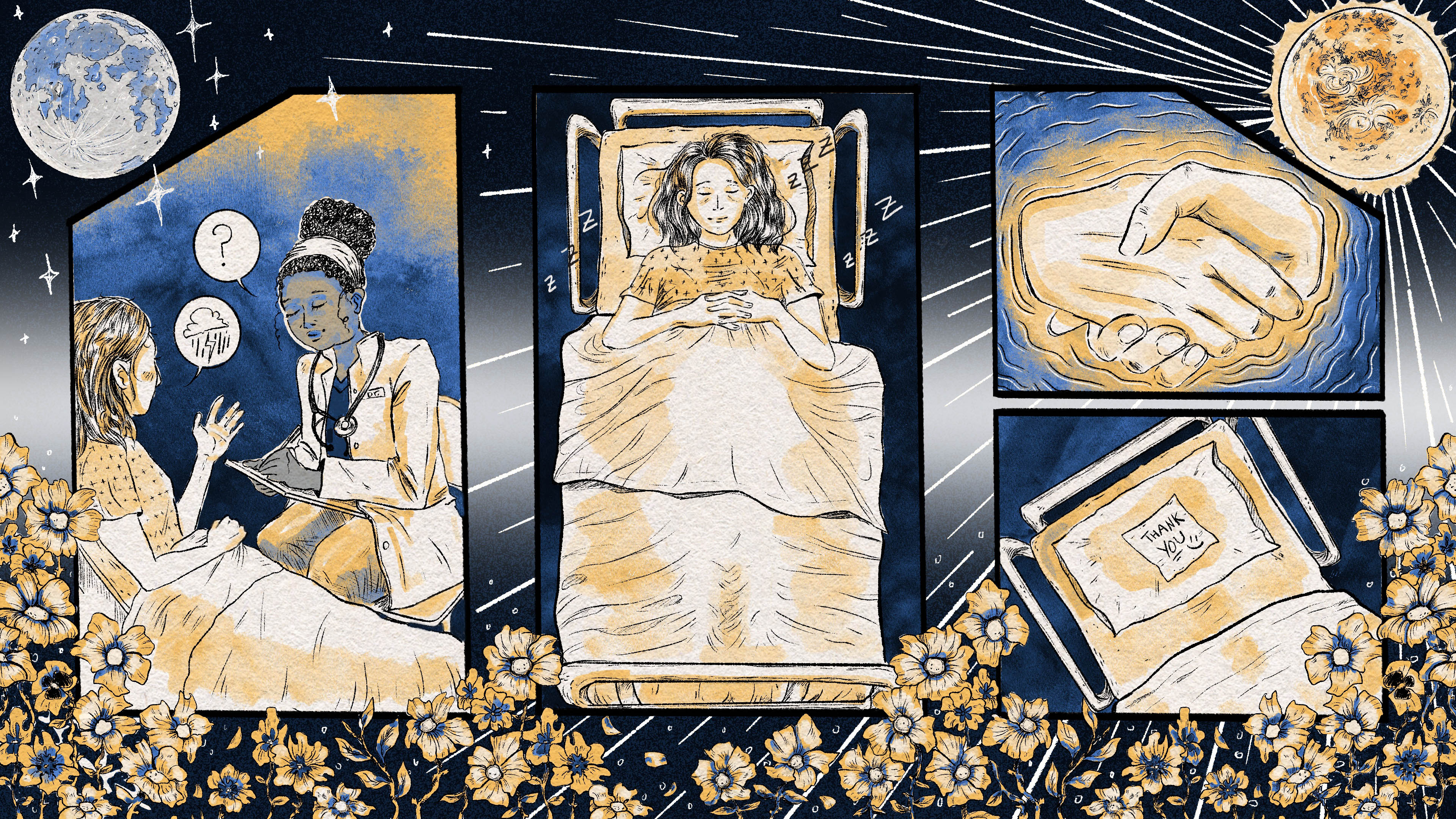
    A hand-drawn pen and ink illustration. Three panels are set up in a triptych style. 1 (left): The main character is lying in bed, discussing her mental health with a doctor who sits at her bedside. 2 (center): The main character is sleeping peacefully in a hospital bed. 3 (right), top panel: A warm handshake radiates good vibrations. Bottom panel: An empty hospital bed with a hand-written note that says "thank you" on its pillow. In the margins/borders of the page, a moon and sun radiate in the background, while new flowers bloom after the drenching storm of the previous images.
    (Oona Zenda/KFF Health News)

    When it came time for me to use our mental health safety net, I was among the fortunate ones: At noon the day after my hold began, a bed opened at a hospital in Denver — a rare stroke of luck in a system in which many people wait days or weeks for the care they need. An ambulance transferred me to the hospital at 3 p.m., marking 21 hours into my 72-hour hold.

    Two days later, on my last day at the psychiatric hospital, I stood outside the nurse’s station awaiting discharge papers.

    A man I had not seen before looked at me and asked, “Are you leaving?”

    “Yes,” I said. “Are you being admitted?”

    “Yeah,” he responded. “This is my third time being hospitalized in a year.”

    I shook his hand. “Good luck,” I said, and I walked out the door.

    Read the full article on the original site


    Related Posts

    • The Billionaire Kids Club and the Regulations that Regulate Them: Component 3 of a Collection
    • Jury finds city of LA not liable in death of 14-year-old girl hit by police officer’s stray bullet
    • HBR’s Best Practices for Supporting Employee Mental Health
    • Easy Ways To Stay Engaged
    • MLB trivia: Your in-5 daily game, Thursday edition
    • Mali court deals blow to Barrick Mining in dispute over gold project
    • Georgia Ports Workforce Housing Initiative helps local families – Savannah Herald
    • Environment-friendly Gumbo (Vegan Gumbo Z’Herbes)
    Black Health News Black Healthcare Access Black Mental Health Black Wellness Chronic Illness in Black Communities Community Health Updates Fitness and Nutrition News Georgia Health News Health and Healing Health and Wellness for Black Men Health Disparities Health Equity Healthcare Policy hospitals Legislation Local Health Headlines Mental Health in Black Communities Mental Wellness Midwest Bureau Mountain States Bureau multimedia Public Health in the South Savannah Health Resources Therapy for Black Women Wellness for Women of Color
    Share. Facebook Twitter Pinterest LinkedIn WhatsApp Reddit Tumblr Email
    Savannah Herald
    • Website

    Related Posts

    Health July 12, 2026

    The World Remembers Sen. Lindsey Graham

    Health July 12, 2026

    An Insider’s Guide to 6 of Vienna’s Splendid Public Pools

    Health July 11, 2026

    EPA promised a Make America Healthy Again agenda. It has yet to materialize, frustrating activists

    Health July 11, 2026

    A New Option for Long-Term Care Costs

    Health July 11, 2026

    Guidelines Help Spot Dermatomyositis Patients at High Risk for Cancer

    Health July 11, 2026

    They Harvest the Nation’s Food, but a New Rule May Strip Them of Health Insurance

    Comments are closed.

    Don't Miss
    Senior Living November 1, 2025By Savannah Herald06 Mins Read

    Court rejects federal government’s demand to unseal grand court product in Ghislaine Maxwell situation

    November 1, 2025

    Aging Well: Details & Insights for Elders and Caretakers By Jacob Rosen , Jacob Rosen…

    Meltwater ruptureds with Greenland ice in first-of-a-kind eruption

    July 30, 2025

    Ideal Wonderful Potato Recipes To Make All Year Lengthy

    February 12, 2026

    Wire service: FY 2026 Spending plan Strategy cuts and digestive tracts education and learning bucks and programs

    May 27, 2026

    Sports betting scammers see HBCU players as easy targets

    July 3, 2026
    Archives
    • July 2026
    • June 2026
    • May 2026
    • April 2026
    • March 2026
    • February 2026
    • January 2026
    • December 2025
    • November 2025
    • October 2025
    • September 2025
    • August 2025
    • July 2025
    • June 2025
    • May 2025
    • April 2025
    • March 2025
    • February 2025
    Categories
    • Art & Literature
    • Beauty
    • Black History
    • Business
    • Climate
    • Culture
    • Education
    • Employment
    • Entertainment
    • Faith
    • Fashion
    • Food
    • Gaming
    • Georgia Politics
    • HBCUs
    • Health
    • Health Inspections
    • Investing
    • Lifestyle
    • Local
    • Lowcountry News
    • National
    • National Opinion
    • News
    • Politics
    • Real Estate
    • Senior Living
    • Sports
    • State
    • Tech
    • Traffic
    • Transportation
    • Travel
    • World
    Savannah Herald Newsletter

    Subscribe to Updates

    A round up interesting pic’s, post and articles in the C-Port and around the world.

    About Us
    About Us

    The Savannah Herald is your trusted source for the pulse of Coastal Georgia and the Low County of South Carolina. We're committed to delivering timely news that resonates with the African American community.

    From local politics to business developments, we're here to keep you informed and engaged. Our mission is to amplify the voices and stories that matter, shining a light on our collective experiences and achievements.
    We cover:
    🏛️ Politics
    💼 Business
    🎭 Entertainment
    🏀 Sports
    🩺 Health
    💻 Technology
    Savannah Herald: Savannah's Black Voice 💪🏾

    Our Picks

    No, That AI-Generated Country Song Isn’t a No. 1 Hit

    November 20, 2025

    Elderly living should invite, sustain leaders from ultramodern histories

    June 30, 2026

    A review of Eject City by Jason Morphew – Compulsive Reader

    October 21, 2025

    What can cause low blood sugar?

    June 29, 2026

    Bahamas: 91-year-old woman alleges sexual assault by family member; Police investigate

    June 30, 2026
    Categories
    • Art & Literature
    • Beauty
    • Black History
    • Business
    • Climate
    • Culture
    • Education
    • Employment
    • Entertainment
    • Faith
    • Fashion
    • Food
    • Gaming
    • Georgia Politics
    • HBCUs
    • Health
    • Health Inspections
    • Investing
    • Lifestyle
    • Local
    • Lowcountry News
    • National
    • National Opinion
    • News
    • Politics
    • Real Estate
    • Senior Living
    • Sports
    • State
    • Tech
    • Traffic
    • Transportation
    • Travel
    • World
    Copyright © 2002-2026 Savannahherald.com All Rights Reserved. A Veteran-Owned Business

    Type above and press Enter to search. Press Esc to cancel.

    Manage Consent
    To provide the best experiences, we use technologies like cookies to store and/or access device information. Consenting to these technologies will allow us to process data such as browsing behavior or unique IDs on this site. Not consenting or withdrawing consent, may adversely affect certain features and functions.
    Functional Always active
    The technical storage or access is strictly necessary for the legitimate purpose of enabling the use of a specific service explicitly requested by the subscriber or user, or for the sole purpose of carrying out the transmission of a communication over an electronic communications network.
    Preferences
    The technical storage or access is necessary for the legitimate purpose of storing preferences that are not requested by the subscriber or user.
    Statistics
    The technical storage or access that is used exclusively for statistical purposes. The technical storage or access that is used exclusively for anonymous statistical purposes. Without a subpoena, voluntary compliance on the part of your Internet Service Provider, or additional records from a third party, information stored or retrieved for this purpose alone cannot usually be used to identify you.
    Marketing
    The technical storage or access is required to create user profiles to send advertising, or to track the user on a website or across several websites for similar marketing purposes.
    • Manage options
    • Manage services
    • Manage {vendor_count} vendors
    • Read more about these purposes
    View preferences
    • {title}
    • {title}
    • {title}
    Ad Blocker Enabled!
    Ad Blocker Enabled!
    Our website is made possible by displaying online advertisements to our visitors. Please support us by disabling your Ad Blocker.

    Sign In or Register

    Welcome Back!

    Login below or Register Now.

    Lost password?

    Register Now!

    Already registered? Login.

    A password will be e-mailed to you.