




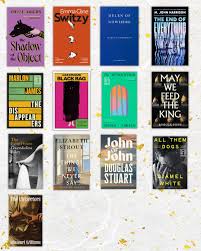
Black Arts & Culture Feature:
- Glad to see a Booker longlist with a 50/50 gender split, a welcome sign of nomination balance.
- Disappointingly there is only one Black author on the list, exposing persistent diversity issues.
- Notes that Caribbean authors remain largely ignored by the Booker, despite rich literary output.
- Blogger finds the longlist more accessible across genres and will focus on the five books that interest her most.
Well the verdict is in! We can stop speculating. The Booker Longlist 2026 has finally been announced. There were 2 books I was sure would make the list and they did, The Disappearers by Marlon James and John of John by Douglas Stuart.
I’m not familiar with a lot of the list but there are some interesting ones. It’s good to see that it’s 50 – 50 concerning gender, but damn disappointing that there is only 1 black author on the list. I’m hoping Marlon James wins again for a second time. Unfortunately, Caribbean authors have been largely ignored over the years as possible longlisters and eventual winners by The Booker. This being said let’s take a closer look at this list and try to figure out what I’m interested in reading because you know I won’t be reading all of the longlist nor the entire shortlist. I feel no obligation to do that. I’m only interested in the good ones.😉
 “Flora is visiting home in Mexico when the family dog leaps up and bites her hand. She winds up in hospital where she undergoes several surgeries under anaesthesia and meets Wilhelmina, an elderly German woman with pneumonia, who collects pre-cinema toys and instruments. The two of them embark on a series of dream-like conversations in the hospital corridors. Wilhelmina puts on a magic lantern show for Flora, leaving her spellbound.
When things take an unexpected turn, Flora finds herself entrusted with an important mission. She returns to London, where she resumes her job polishing silver at a jewellery shop, and strikes up a strange friendship with Wilhelmina’s son, Max. As Flora dips in and out of her imagination, she is increasingly aware it’s not only the magic lantern that projects, and her perception of reality is subtly altered.” (Goodreads description)
I don’t think this one is my cup of tea. It seems to have some magical realism and I don’t always do well with that in stores. It also feels like there isn’t very much going on in the story so I don’t think I’m going to read this one.
 A private plane cuts through the winter night, somewhere over Greenland. David, a retired executive, sits back in his leather seat, playing solitaire on his phone. Click. Click. Drag. Click. The notebook in his jacket pocket is filled with familiar phrases, urgent reminders to himself, but he struggles to recognize his own handwriting.
A mystery, among many mysteries. The world, once so knowable, has been rendered inscrutable.
This is what David Cody, his assistant, asleep in the seat next to him, will shepherd him along the voyage. A stopover in London. Dinner with his adult daughter. A meeting in France with an old friend, estranged for decades.
His final destination is Zurich.
David glides through hotel rooms and airports and foreign cities, running out the clock on his mortal life. His grasp on the present slips away, and the past rushes the Sunday roasts of childhood. The stiff clothes meant only for church. A summer at a school friend’s house. The losses and missteps that punctuate a life.
As David’s arrival in Zurich looms, an exquisitely rendered portrait of an unravelling mind emerges, both darkly humorous and profoundly moving. Hypnotic and startlingly original, Switzy probes the depths of human consciousness, revealing what a man is left with when the accomplishments and compromises that have defined him, and the illusions he’s relied on, vanish.
Well surprisingly this one intrigues me. It’s classified as contemporary on Goodreads and I don’t usually go for contemporary, but this one sounds like it could be an excellent character study. The ppprotagonist seems to be an older man and that’s interesting to read about older characters since that isn’t as common as it should be. I’m also curious about how the title links to the story. Switzy is an informal nickname derived from words related to Switzerland. It can also be a term to describe someone who is neutral for example relating to the expression “being Switzerland”. In British slang switzy can mean cheat or swindle. So yeah I would love to read this one.
Tony Ward has landed back in Lucan with his chest puffed up and a chip on his shoulder. After five years in the UK, staying out of trouble just like he’d been told to do, he’s returned home to his west Dublin estate ready to reinstate himself into the gangland scene.
But things are different now. Tony’s old mentor is dead and his best pal Kenny Boyle has gone on the straight and narrow. That won’t do, so when an opportunity to work directly for Darren ‘Flute’ Walsh, an enforcer of notorious crime boss Aengus Lavelle presents itself, it seems like a no brainer.
Flute Walsh is a far-cry from the meek, quiet boy Tony knew in school. Working as his left-hand man offers a level of security against repercussions for the crimes he’d gone on the run for as well as giving him a way into the life he wants but none of that stops the big-man Lavelle making it clear that any trouble from his past will be Tony’s alone to answer for.
Already burned by the empty promises of one dead mentor, Tony is keen to prove himself as his own man, but there is a pull to Flute Walsh, one he’s felt before. With the fragments of his past life still in the rearview and a whole new gang of headbangers to contend with, it is a pull too hard to resist. As Tony turns his back on the paper-thin structures that support him he looks for stability in his new, brutal surroundings. But where is there room for love in a world like this, where anything that’s buried is always unearthed and retribution is never far away?
`
This is another one that seems to have a lot going for it. Firstly it’s Irish and I feel I need to read more Irish novels. Despite it being contemporary, it’s about a queer gang member in Dublin. I’m so curious about this one. It does sound gritty so probably not for everyone. I’ll definitely be reading this one.
Out of money and with little to show for his art school education, John-Calum Macleod takes the ferry home to the Island of  Harris to find that not much has changed except for him.
In the windswept croft where he grew up, Cal resumes his old life, caught between the two poles of his childhood: his father John, a sheep farmer, weaver, and pillar of their local Presbyterian church, and his Glaswegian grandmother Ella, who has kept a faltering peace with her son-in-law for decades.
While Cal wonders if any lonely men might be found on the barren hillsides of home, John is dismayed by his son’s long hair and how he seems unwilling to be Saved. As the seasons pass, everything is poised to change as the threads holding together the fragile community become increasingly entangled.
Of course I’m reading this one! I have it in my TBR cart as I type this blog post. It’s been there for a while. I absolutely love Douglas Stuart’s writing of Shuggie Bain and I’m looking forward to reading this novel which follows a broke son who returns home changed. It’s a LGBTQ novel set in Scotland. Love reading books set in Scotland, especially if there’s an audiobook because of the accent.
 Taking place over the course of one day, Helen of Nowhere introduces an intimate cast: an unnamed man at the end of both his career and marriage, a young realtor showing him an idyllic house in the countryside, and Helen, the mystifying former owner whose spectral presence seems to imbue the house’s every grain of wood. Through stories of the remarkable woman, the man is presented with an alternate way of life. But, as evening fades into black, the specifics of how to live it become more than what he bargained for.
Philosophically adventurous, strange, and fascinating, Helen of Nowhere examines the structures that form our identity, staring the reader down to ask the haunting question: What is the cost of true happiness?
I think I’m going to pass on this one. I’m not at all interested in this storyline. Once I heard philosophical my brain switched off. It’s a short novel but from the description it feels very layered and complex. I’m not a fan of the cover.
In a famed but crumbling university city overrun by nature, where power is held in a fragile balance between academics and a contingent of rogue gardeners, the reclusive narrator of The Vivisectorsspends her days propping up the career of her needy and  fraudulent professor boss. Then a controversy ruptures her careful routine: Adam, a contrarian student and an obsession of the boss, comes into heated conflict with a young professor, with both men claiming discrimination. The crisis subsumes the university, though the narrator is unmoved—not even the attempted suicide of her estranged mother has been enough to dispel her lack of engagement with the world. But when her boss commands her to befriend Adam, the narrator finds herself both caught up in the events threatening to tear the city apart and increasingly drawn to the alluring student at the heart of it all.
Coursing with icy suspense and told with violent precision, The Vivisectors is a new kind of love story for an age of deteriorated communication. With the unsparing style and intellectual ambition that made her award-winning debut The Doloriad a celebrated provocation, Missouri Williams holds a mirror up to humanity’s most intimate contradictions and reflects them back through a novel of profound, spiky spiritual reckoning.
This novel is classified as fiction, dark academia, and horror. I know this isn’t my cup of tea, although there is something about the description that sounds interesting. This author’s writing has been compared to Ottessa Moshfegh. I was never tempted to read any Moshfegh books so I won’t be reading this one either.
She is a curator, who spends her time dressing the rooms of historic buildings to bring them to life. But in the lush private  quarters of a medieval palace, she finds herself so transfixed by the reign of an almost-forgotten King that the edges of her life begin to blur.
He is a reluctant ruler with no hunger for power, rushed to the throne after the untimely deaths of his older brothers. But it isn’t long before whispers begin to fly around the court. And with the growing belief that the King is not fit for the throne comes the idea that another might rule in his stead.
May We Feed the King dances between the lives of a historical subject who risks the future of his kingdom and a woman who turns to the past to hide from her present. Laced with desire and longing, it is a playful, stirring meditation on history and storytelling: on what makes a King ‘Great’, and a life meaningful.
This novel is classified as literary fiction with a heavy dose of historical fiction and fantasy. This one is definitely not my cup of the. I don’t like reading fantasy but I love watching it in films. So it’s a pass for me.
Laura Miller and Edmund Putnam have been friends for a long time. Theirs is a happy meeting of minds, with long evenings  spent huddled in an ancient pub by the Thames, where they share office gossip, reflect on their teenage passions, and lament the state of the world.
Recently, though, Putnam has been harder to reach: he has lost his father, and the magazine to which he has dedicated his life has been hijacked by an insufferable new editor, Simon ‘call me Shove’ Halfpenny.
Laura has her own problems: with a prickly mother and a tricky past, and in a beautiful and indifferent city, her day-to-day life is precarious. But as Putnam starts to sink into despondency, she must try to bring him back.
A novel of enduring friendships and small mercies, The Palm House offers us Gwendoline Riley’s trademark keen observation and wit, and leaves us – somehow – with a curious sense of possibility.
The Palm House sounds like a story about friendship and the workplace specifically based in England. This book could be a little gem or a book that completely leaves the reader wanting more. So when in doubt, I pass.
In Luke Kennard’s audacious new novel, a penniless and out-of-work actor picks up a job working for Dr. Blend, a university  professor who is conducting a psychological experiment. How will Dr. Blend’s students react to someone zipped into an oversized bag, sitting at the back of the lecture hall over a series of Fall lectures? The role, eagerly accepted, soon has unexpected consequences. A professor of post-humanism develops research questions of her own—in particular, can you love someone secreted away inside a black bag?—and the actor’s childhood friend forms a vision for monetizing this new situation . . .
A warped campus novel, an investigation into the crisis of masculinity, and an off-kilter love story, Black Bag is a firework of a blazingly funny and profoundly humane.
This book sounds like a social experiment. I wonder if someone actually tried doing this. Classified as literary fiction/book club/humor, you would think I’d want to try it but I’m really not tempted. So I’m going to pass.
Artie Dam is living a double life. He spends his days teaching history to eleventh graders, expanding their young minds,  correcting their casual cruelties, and lending a kind word to those who need it most. He goes to holiday parties with his wife of three decades, makes small talk with neighbors, and, on weekends, takes his sailboat out on the beautiful Massachusetts Bay. He is, by all appearances, present and alive. But inside, Artie is plagued by feelings of isolation. He looks out at a world gone mad—at himself and the people around him—and turns a question over and over in his mind: How is it that we know so little about one another, even those closest to us?
And then, one day, Artie learns that life has been keeping a secret from him, one that threatens to upend his entire world. Once he learns it, he is forced to chart a new course, to reconsider the relationships he holds most dear—and to make peace with the mysteries at the heart of our existence.
This book sounds so good and so relevant. I have to as yet read an Elizabeth Strout novel. This one is going to be my first. I have heard for so long how beautiful her stories are and I’m anxious to check this one out. I wouldn’t be surprised if it makes it to the shortlist. Elizabeth Strout has been nominated 3 times so far for the Booker: 2016 Longlisted for My Name is Lucy Barton, 2022 shortlisted for Oh William!, and 2026 Longlisted for The things We Never Say. Needless to say, I’ll definitely be reading this one.
In Salerno, Italy, Dilara spends her days caring for her aging father and her hypochondriac husband. Since leaving her native Istanbul, she’s been unable to find a job—adrift, she becomes increasingly fixated on domestic improvement, specifically on the  renovation of a second bathroom. When the work is completed, she enters and finds herself not in a bathroom but in a prison cell, and a Turkish one at that.
As she tries and fails to conceal the unfortunate discovery from her husband, she confronts the prison’s other inhabitants—the buffoonish guards who refuse to believe her conundrum; the other women who begin filling the cells beyond hers—and the strange things that drift through the smell of the Bosporus, her mother’s voice, calls to prayer . . .
Has she gone mad? Is she the victim of a terrible prank? Is it a portal, a dream, a simulation? As she burrows deeper into her cell, her life beyond it begins to fall apart—her husband disappears, her father’s grip on reality loosens, political dictatorship threatens to destroy everything worth keeping.
In his slender, disquieting first novel, Kenan Orhan tells a story of modern migration like no other. The Renovation is a tragic comedy of displacement, a story that remodels its own form to the dazzling inevitable end.
The Renovation is probably heavy on the magical realism since a renovation of a bathroom turns into a prison. It’s the Turkish author’s debut novel and sadly the description isn’t grabbing my attention. I’ll be curious to hear what others think about this storyline, but I’m going to pass.
Phillip Tennent makes his living at the tideline, collecting artefacts that wash up from the Channel. It’s been years since the crisis  changed everything, but its exact nature remains obscured. Government barely functions, the seas are full of new creatures, Europe has been mislaid. It feels like the end.
Now Phillip has fished out of the water an object he can’t keep. A creature that keeps changing. An artefact he must take inland, before it destroys everything he thinks he knows.
This book is classified as Literary fiction/Science Fiction/ Post Apocalyptic. Sounds great for me as a film but not as a book. It’s not my cup of tea. So I will pass.
In 1988, eight men in Kingston, Jamaica, begin rehearsals for a play. The men are strangers to one another and each has a  different reason for being involved. But they all share one inescapable All of them are gay―a “batty man” in Jamaican argot―and all of them must contend with the dangers that such a truth lays bare.
One night a mob savagely attacks them, killing one of the men. For the survivors, their recovery is as much emotional as it is As their bodies heal, each man grapples with the violence, the hatred and the rage that the attack made plain. Some try to ignore what the attack has unearthed, while others double down on retribution.
In The Disappearers, Marlon James has written a riveting and deeply human story of men forced to make compromises to survive what the society they live in demands. It is both a dramatic page-turner and an unflinching exploration of queer life in Jamaica during the 1980s and 1990s.
Marlon James’ latest novel which is being released on September 1st. I can’t wait! I’ve been waiting for it since I heard about it last year. It’s LGBTQ and set in Jamaica. I hear it’s gripping and a novel not to miss. So of course I’ll be reading this one.
Overall this list is very different from the previous longlists. It seems to be more accessible than usual. There is a balanced mix of genres. I’ll be interested to see how Booker lovers react to this list. So comment below and let me know what you’ll be reading from the longlist. I hope to get through the 5 books that interest me. So I’m heading off to hunt down the books and see what I can find on Kindle. Happy reading book lovers!
Related
Read more from the original source
